Affiliate disclosure: PetAdvisorPro may earn from qualifying purchases through links in this article.
Important: “Home alone” does not mean every interactive toy is safe to leave with an unsupervised dog. Establish safe use while you are present and follow each manufacturer’s current directions. Some picks below are best used before departure or only with supervision.
Quick Picks
| Product | Best For | Key Advantage | Buy | |
|---|---|---|---|---|
| Cheerble Wicked Ball AIR | motion-driven interactive play | Verified Amazon listing with a distinct enrichment format | View on Amazon | Jump to Review |
| PetSafe Automatic Ball Launcher | structured fetch practice | Verified Amazon listing with a distinct enrichment format | View on Amazon | Jump to Review |
| KONG Classic Large | a familiar stuffable rubber routine | Verified Amazon listing with a distinct enrichment format | View on Amazon | Jump to Review |
| Outward Hound Hide N’ Slide | supervised food-puzzle sessions | Verified Amazon listing with a distinct enrichment format | View on Amazon | Jump to Review |
| WEST PAW Toppl | food extraction and licking | Verified Amazon listing with a distinct enrichment format | View on Amazon | Jump to Review |
| KONG Wobbler | active kibble dispensing | Verified Amazon listing with a distinct enrichment format | View on Amazon | Jump to Review |
| PETSTA Dog Puzzle Toy | beginner problem solving | Verified Amazon listing with a distinct enrichment format | View on Amazon | Jump to Review |
How to Choose
Match the activity to your dog’s size, chewing style, food motivation, energy level, and history with toys. Introduce one product at a time, inspect it for damage, and avoid assuming a powered or complex toy is automatically better.
1. Cheerble Wicked Ball AIR
Best for motion-driven interactive play

Product Description
The Wicked Ball AIR is the most technology-focused option here. Its appeal is movement: a dog that ignores stationary enrichment may pay more attention to a ball that changes position and creates an active chase-and-investigate session. The verified Amazon listing identifies it as a Cheerble smart interactive dog toy made with an E-TPU material. For a dog that enjoys moving targets, that gives the activity a very different feel from a food puzzle. Introduce it while you are home, in a clear area, and watch whether your dog follows, paws, carries, or tries to crush the ball. The goal is controlled engagement, not maximum excitement. Several short observed sessions tell you far more about suitability than the product name alone. A dog that becomes over-aroused or tries to dismantle moving toys needs a different enrichment style.
The phrase “home alone” should never be treated as permission to leave a new powered toy unsupervised. First confirm the current Cheerble instructions, charging and use guidance, recommended dog size, and whether unattended use is permitted. Inspect the shell before and after play and remove the toy if it becomes damaged. Keep charging equipment away from the dog during use. Movement can also be unsettling for sound-sensitive or cautious dogs, so begin at the least intense suitable setting rather than assuming a smart dog wants the fastest action. I would choose this for a dog that has already shown safe interest in rolling toys and whose owner can establish that pattern under supervision. If the dog chews electronics, guards moving objects, or becomes frantic, a passive food toy is a more sensible choice.
What We Like
- Offers a defined enrichment activity.
- Can be introduced gradually under supervision.
- Helps owners learn the dog’s preferred play style.
- Provides variety within a broader daily routine.
What We Don’t Like
- “Interactive” does not automatically mean safe for unattended use.
- Individual chewing and frustration behavior can change suitability.
My Recommendation
Use this when motion-driven interactive play fits your dog, after supervised practice and a current check of the manufacturer’s safety guidance. Do not rely on any toy as treatment for separation distress.
2. PetSafe Automatic Ball Launcher
Best for structured fetch practice

Product Description
PetSafe’s Automatic Ball Launcher is a verified Amazon product that can add repetition to fetch practice, but it belongs in a carefully managed routine rather than being treated as a dog babysitter. The main attraction is predictable ball launching for dogs that already understand chasing and returning a ball. That can provide physical and mental engagement when the owner is present to manage the space and reinforce safe behavior. Before using an automatic launcher, teach the dog where to stand, how to approach the machine, and when to wait. Start with short sessions and an open area so the dog does not crowd the launch path. A dog that simply runs after a ball but refuses to return it may not get much independent value from the machine, while a dog with a strong retrieve pattern may understand the routine more quickly.
For this article’s “home alone” intent, the limitation is important: do not assume an automatic launcher is appropriate for unattended operation. Follow PetSafe’s current safety instructions, distance guidance, power requirements, and supervision recommendations. Check the balls for wear and use only compatible sizes so damaged or undersized balls do not create avoidable risk. Repetitive fetch can also be physically demanding; duration should suit the dog’s age, conditioning, health, footing, and recovery. Stop if the dog shows fatigue, obsessive behavior, limping, or unsafe positioning near the launcher. I would consider this primarily for supervised interactive sessions that help occupy a high-energy fetch enthusiast before periods alone, not as a default device to leave running after you go out. For true unsupervised enrichment, a product specifically approved for that use is a better fit.
What We Like
- Offers a defined enrichment activity.
- Can be introduced gradually under supervision.
- Helps owners learn the dog’s preferred play style.
- Provides variety within a broader daily routine.
What We Don’t Like
- “Interactive” does not automatically mean safe for unattended use.
- Individual chewing and frustration behavior can change suitability.
My Recommendation
Use this when structured fetch practice fits your dog, after supervised practice and a current check of the manufacturer’s safety guidance. Do not rely on any toy as treatment for separation distress.
3. KONG Classic Large
Best for a familiar stuffable rubber routine

Product Description
The KONG Classic Large is a verified Amazon listing and one of the simplest ways to turn food into a longer activity without motors or loose puzzle pieces. Its hollow rubber shape can be filled with dog-appropriate food, giving the dog a lick-and-extract task rather than handing over a bowl all at once. The value for a dog that spends time alone is familiarity: you can prepare the toy the same way during supervised practice and learn how the individual dog interacts with it. Start with an easy filling that the dog can remove without frustration, then make the task more involved only after safe use is established. Use part of the normal meal where practical so enrichment does not quietly add a large number of extra calories. The large version must still be matched to the dog rather than selected from the word “Large” alone.
Rubber toys are durable, but no toy should be described as indestructible. Check KONG’s current size chart and use directions, inspect the toy for cuts or missing material, and replace it when wear makes continued use questionable. Dogs with extreme chewing habits may require a different KONG material or another product, so do not generalize from one dog’s experience. Moist fillings also require prompt cleaning, and perishable food should not sit at room temperature for long periods. Before leaving any stuffed toy with a dog, observe repeated sessions and confirm that the manufacturer’s guidance and your dog’s behavior support that use. I like the KONG Classic for owners who want a low-tech, repeatable enrichment routine and can establish safe chewing habits first. It is not a treatment for separation anxiety; dogs showing distress when alone need an appropriate behavior plan and, when warranted, professional guidance.
What We Like
- Offers a defined enrichment activity.
- Can be introduced gradually under supervision.
- Helps owners learn the dog’s preferred play style.
- Provides variety within a broader daily routine.
What We Don’t Like
- “Interactive” does not automatically mean safe for unattended use.
- Individual chewing and frustration behavior can change suitability.
My Recommendation
Use this when a familiar stuffable rubber routine fits your dog, after supervised practice and a current check of the manufacturer’s safety guidance. Do not rely on any toy as treatment for separation distress.
4. Outward Hound Hide N’ Slide
Best for supervised food-puzzle sessions

Product Description
The Outward Hound Hide N’ Slide gives a dog a stationary problem-solving task based on finding food and manipulating parts of a puzzle board. The verified Amazon listing identifies this as a Nina Ottosson treat-puzzle enrichment toy. It can be useful for dogs that enjoy sniffing and working through a sequence rather than chasing a moving object. Begin with a few easy rewards and let the dog discover how movement exposes food. If the dog understands the pattern calmly, later sessions can become more challenging through reward placement rather than simply adding more food. This type of puzzle is particularly helpful for learning how a dog solves problems: a patient dog may investigate each section, while a frustrated dog may immediately try to bite or lift the board. That difference determines whether the toy is a good match.
This is one of the products where the article title requires extra caution. Outward Hound’s puzzle safety guidance emphasizes supervision and not allowing the dog to chew the game or pieces, so I would not present Hide N’ Slide as an unattended home-alone toy. Its role is better as structured enrichment before you leave or while you are available to supervise. Inspect the board for damage, follow current cleaning instructions, and store it when the food is gone. If your dog tries to destroy puzzle components, switch to a more appropriate format. I recommend it for owners who want to give an intelligent dog a short mental workout as part of a broader daily routine. It can help make mealtime more engaging, but it does not replace exercise, training, social interaction, or a behavior plan for dogs that become distressed when left alone.
What We Like
- Offers a defined enrichment activity.
- Can be introduced gradually under supervision.
- Helps owners learn the dog’s preferred play style.
- Provides variety within a broader daily routine.
What We Don’t Like
- “Interactive” does not automatically mean safe for unattended use.
- Individual chewing and frustration behavior can change suitability.
My Recommendation
Use this when supervised food-puzzle sessions fits your dog, after supervised practice and a current check of the manufacturer’s safety guidance. Do not rely on any toy as treatment for separation distress.
5. WEST PAW Toppl
Best for food extraction and licking
Product Description
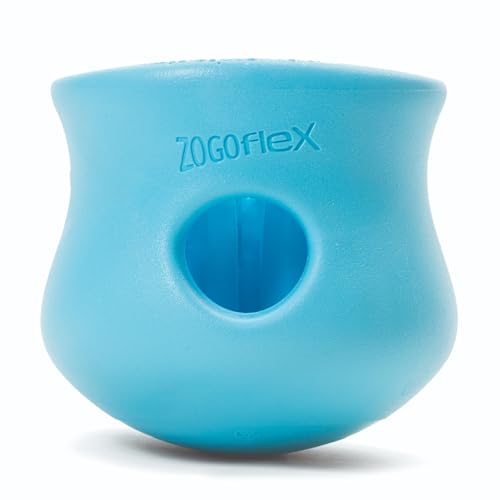
The verified WEST PAW Toppl listing describes an interactive treat-dispensing puzzle designed to hold kibble and treats. Compared with a board puzzle, the activity is simpler mechanically but can last because the dog has to lick, nose, and work food from the container. That makes it useful for dogs that become frustrated by sliders and lids but remain motivated by food extraction. Start with a filling the dog already eats comfortably and make the food easy to reach during the first sessions. Once the dog understands the object, you can vary preparation within WEST PAW’s current instructions. For dogs that settle well with licking, this style may encourage a calmer activity than a powered ball or launcher. It is also convenient for owners who want to portion part of a meal into enrichment rather than adding a separate collection of high-calorie treats.
Whether the Toppl is appropriate when a dog is alone depends on the individual dog and current manufacturer guidance. Observe repeated supervised use first, select the correct size, and inspect for damage every time. A dog that stops working on food and begins tearing or swallowing material should not be left with the toy. Moist and frozen fillings need good hygiene, so wash the product thoroughly and avoid leaving perishable food out for unsafe periods. I would choose the Toppl for a dog that enjoys licking and food extraction and for an owner who wants a reusable, low-tech activity. It is less suitable for a dog that needs fast movement to stay interested. As with every product in this roundup, do not use it as a substitute for addressing genuine separation distress; enrichment can occupy time, but anxiety-related behavior may require veterinary or qualified behavioral support.
What We Like
- Offers a defined enrichment activity.
- Can be introduced gradually under supervision.
- Helps owners learn the dog’s preferred play style.
- Provides variety within a broader daily routine.
What We Don’t Like
- “Interactive” does not automatically mean safe for unattended use.
- Individual chewing and frustration behavior can change suitability.
My Recommendation
Use this when food extraction and licking fits your dog, after supervised practice and a current check of the manufacturer’s safety guidance. Do not rely on any toy as treatment for separation distress.
6. KONG Wobbler
Best for active kibble dispensing

Product Description
The KONG Wobbler is a verified treat-dispensing toy for medium and large dogs that turns dry food into a push-and-release activity. The dog nudges the weighted toy, it moves, and food can come through the opening. That makes it more active than a stuffed rubber toy but less technologically complex than a powered ball. For a food-motivated dog, the cause-and-effect pattern can make part of breakfast or dinner last longer while encouraging movement and persistence. Introduce it in a clear indoor area where it cannot knock into fragile objects. Use a measured portion of compatible kibble and let the dog learn the relationship between pushing and food release. Some dogs understand it immediately; others need a few short demonstrations before the movement feels rewarding rather than confusing.
The Wobbler can be noisy on hard flooring, and movement may bother a cautious dog. It is also not a chew toy, so watch for dogs that try to pick it up and crush it instead of nudging it. Follow KONG’s current size and use guidance, inspect the product, and determine through supervised sessions whether your dog interacts safely. Do not assume that a toy described as interactive is automatically suitable for unattended use. I recommend the Wobbler for dogs that like both food and physical interaction and for owners who want to make dry-food feeding more engaging. For dogs that are sound-sensitive, destructive, or easily over-aroused, a stationary fillable toy may be more appropriate. Count the food used toward daily intake, and remember that enrichment can complement—but not replace—walks, training, social contact, and rest.
What We Like
- Offers a defined enrichment activity.
- Can be introduced gradually under supervision.
- Helps owners learn the dog’s preferred play style.
- Provides variety within a broader daily routine.
What We Don’t Like
- “Interactive” does not automatically mean safe for unattended use.
- Individual chewing and frustration behavior can change suitability.
My Recommendation
Use this when active kibble dispensing fits your dog, after supervised practice and a current check of the manufacturer’s safety guidance. Do not rely on any toy as treatment for separation distress.
7. PETSTA Dog Puzzle Toy
Best for beginner problem solving
Product Description
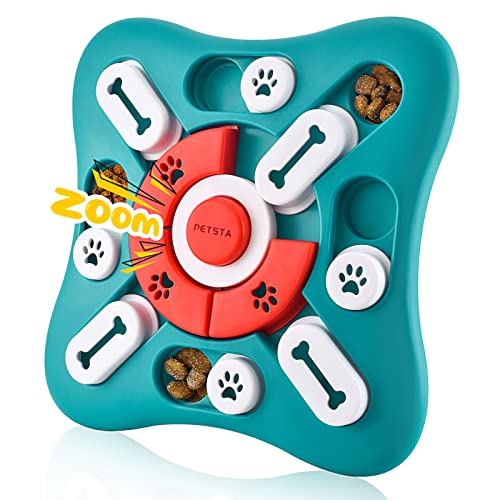
PETSTA’s verified treat-dispensing puzzle is a straightforward board-style option for owners who want to introduce problem solving without immediately choosing a complex multi-step game. Food hidden in the puzzle gives the dog a reason to sniff, paw, and experiment. Start with only a few rewards in easy positions and keep the first session short. That lets the dog learn that interacting with the board produces food rather than becoming frustrated by a completely loaded puzzle. A beginner-friendly activity can be valuable even for a very intelligent dog because puzzle experience and intelligence are not the same thing. Watching the first sessions also tells you whether the dog enjoys careful manipulation or simply wants to bite and carry the board. Use part of a normal meal when possible so repeated enrichment does not add unnecessary calories.
For a home-alone article, this product should be framed conservatively. Treat puzzle boards as supervised enrichment unless the current manufacturer explicitly permits unattended use and your own repeated observations show safe behavior. Remove the puzzle if the dog chews pieces, damages the board, or becomes frantic. Inspect it before every session and clean food-contact areas according to current directions. I recommend PETSTA mainly as a structured activity before departure or during times when you can observe the dog, not as a universal leave-behind toy. It can help add mental variety to the day, especially for dogs that are new to food puzzles, but it is not a solution for separation anxiety or destructive behavior caused by distress. If being alone triggers persistent barking, escape attempts, self-injury, or panic, seek appropriate veterinary or qualified behavior guidance rather than relying on a toy alone.
What We Like
- Offers a defined enrichment activity.
- Can be introduced gradually under supervision.
- Helps owners learn the dog’s preferred play style.
- Provides variety within a broader daily routine.
What We Don’t Like
- “Interactive” does not automatically mean safe for unattended use.
- Individual chewing and frustration behavior can change suitability.
My Recommendation
Use this when beginner problem solving fits your dog, after supervised practice and a current check of the manufacturer’s safety guidance. Do not rely on any toy as treatment for separation distress.
Frequently Asked Questions
Can interactive toys prevent separation anxiety?
No. Enrichment can occupy some dogs, but separation distress may require a veterinarian or qualified behavior professional.
Can I leave a new toy with my dog when I go out?
No. First observe repeated supervised sessions and follow the manufacturer’s current guidance.
Are automatic toys safer than food toys?
Not automatically. Powered devices and passive food toys have different risks and must be matched to the dog.
How many toys should I leave out?
Quality and known-safe use matter more than quantity. Rotate suitable enrichment instead of leaving every toy available.
What should I do if my dog destroys toys?
Remove damaged products and choose a more appropriate activity. Swallowed pieces can be dangerous.
Final Verdict
The most useful interactive toy is one your dog has already demonstrated it can use safely. For calm food work, the KONG Classic or Toppl may suit many routines; the Wobbler adds movement; puzzle boards provide supervised mental work; powered toys require especially careful setup and safety checks.