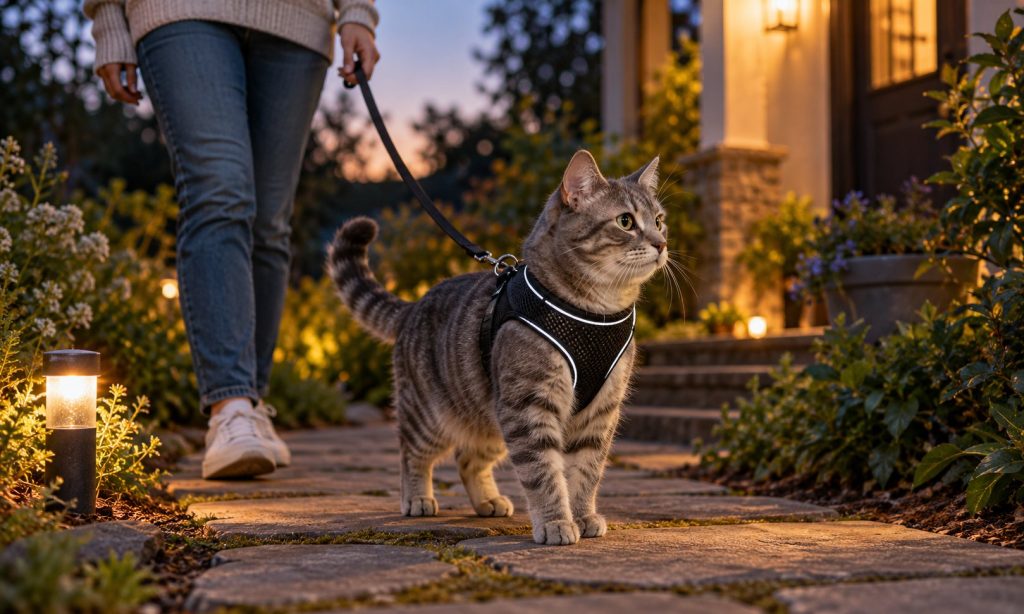
A reflective harness can make your cat easier to notice in low light, but visibility is only one part of safe outdoor walking. Fit, comfort, leash attachment, and patient training matter just as much. If you are learning how to choose the right reflective cat harness, start by measuring your cat and checking how the harness sits on its body. Then consider when and where you plan to walk. Reflective trim can catch light from a headlamp or vehicle, yet it does not make a cat impossible to miss. This guide explains what to inspect, how to introduce a harness, and when to replace worn gear. The goal is a calm, controlled experience that respects your cat’s limits. A best reflective cat harness for your household is one your cat can wear comfortably and you can fit consistently.
What a reflective cat harness can and cannot do
A reflective harness uses material that returns light toward its source. It may stand out when headlights, a flashlight, or another beam reaches it. It does not glow on its own, and it cannot guarantee that drivers or cyclists will see your cat. Treat reflectivity as an extra visibility aid, not a substitute for supervision, a leash, or a safe route.
Harnesses distribute leash pressure across a cat’s torso instead of relying on a neck collar. Designs vary. Some wrap around the chest and shoulders, while others use straps around the neck and rib cage. A reflective detail may appear as piping, a stitched strip, or a larger panel. Coverage and brightness differ, so inspect the actual placement rather than relying on a product label.
If you are comparing cat harness options for walking, keep the informational question separate from product claims. No harness is escape-proof in every situation. Cats can reverse, twist, crouch, or react suddenly. Proper sizing and training reduce risks, but they do not remove them.
How to choose the right reflective cat harness
How to choose the right reflective cat harness begins with the cat, not the color or pattern. Measure your cat carefully, assess the harness construction, and plan to check the fit each time you use it. Use the steps below to compare the features that affect comfort and control.
Measure your cat before selecting a size
Use a soft measuring tape and follow the harness maker’s size chart. Most charts ask for neck and chest girth. The chest measurement is often taken around the widest part of the rib cage, behind the front legs. Keep the tape snug without compressing fur or skin. Record the measurements in inches and compare them with the chart rather than choosing by weight alone.
If your cat falls between sizes, check whether the harness has enough adjustment range to fit both measurements. A practical part of how to choose the right reflective cat harness is measuring the widest point accurately, not guessing from weight. Do not assume that a smaller size is safer. A harness that is too tight can rub or restrict movement. A loose harness can shift or allow a cat to back out. Re-measure after weight changes, a growth spurt, or a thick seasonal coat.
Check fit, adjustment, and body coverage
When fitted, the harness should sit securely without digging into the armpits, pressing on the throat, or limiting normal movement. Check that straps do not twist and that the chest panel stays centered. Many caregivers use the “two-finger” check as a rough comfort cue, but it is not a universal sizing standard. Follow the manufacturer’s instructions and watch the cat’s response.
Adjustability helps accommodate a cat’s shape, but multiple straps can be confusing during first use. Look for clear adjustment points that remain in place after you set them. Fasteners should close fully and stay closed during gentle movement. If a harness requires force to fasten or leaves obvious pressure marks, remove it and reassess the size or design.
Evaluate reflective details realistically
Look for reflective material on more than one visible surface. Side strips may be easier to see from an approaching vehicle, while a strip across the back may show when light comes from behind. The details should be securely attached and visible when the harness is fitted correctly. A small logo-sized patch is not the same as broad reflective coverage.
Reflective fabric needs an external light source. How to choose the right reflective cat harness also means judging coverage in the lighting conditions your route is likely to have. Test it in a controlled, quiet area using a flashlight held at different angles. Do not test near moving traffic. Reflective material may work less effectively when dirty, wet, folded under a strap, or covered by fur. For night walks, choose a well-lit route and keep outings short. A reflective harness does not replace a light, supervision, or a leash.
Inspect the leash attachment and fasteners
Check where the leash connects. When deciding how to choose the right reflective cat harness, inspect the load-bearing seams and closure points before looking at decorative details. A sturdy attachment point should be sewn or secured into the harness structure, not attached to a loose decorative panel. Examine stitching around the ring and tug gently while the harness is off the cat. Avoid jerking or using a harness to lift your cat.
Review every buckle, hook-and-loop panel, and clasp before use. Buckles should click closed and release only when intended. Hook-and-loop material can collect fur and lint, which weakens the hold. Metal rings should not be bent, cracked, or sharply corroded. If any part slips, opens, or feels brittle, do not rely on it outdoors.
Choose breathable, comfortable materials
Soft, lightweight fabric may be more comfortable for a cat that is new to wearing gear. Mesh can allow airflow, while wider panels can spread pressure. However, thick coverage can feel warm, especially in humid weather. Consider your climate and your cat’s coat. Check for rough seams, stiff edges, loose threads, or areas likely to rub under the front legs.
Material preference is individual. Some cats tolerate a vest-like wrap, while others resist overhead openings or broad panels. Public owner discussions often describe fit and escape concerns, but those reports are personal experiences. Use them as reminders to test the fit at home, not as evidence that one style works for every cat.
Introduce the harness gradually
Choosing the right reflective cat harness is only the beginning. How to choose the right reflective cat harness also includes considering whether your cat can calmly accept it indoors. Let your cat investigate it indoors before fastening it. Place it near a familiar resting area and pair calm interest with a favorite reward. Keep sessions brief. If your cat hides, freezes, struggles, or shows mounting stress, pause and return to an easier step.
Once your cat is comfortable near the harness, let the cat sniff it while you offer a treat. Then drape it over the back for a moment without fastening. Gradually increase the time and close the fasteners only when the cat remains relaxed. Some cats need days or weeks. There is no deadline to reach an outdoor walk.
After the cat accepts the harness, attach a lightweight leash indoors. Follow the cat rather than pulling. Practice in a quiet room, then a secure enclosed space if available. Veterinary behavior guidance recommends that cats become comfortable indoors before going outside on leash. For fit and acclimation ideas, see this guide to fitting a harness for a large cat; its sizing discussion may also prompt useful questions for other body types.
Use the harness with a safety plan
Before leaving home, check the harness fit, leash connection, closures, and reflective surfaces. A sound plan for how to choose the right reflective cat harness includes matching the gear to a quiet route and close supervision. Choose a quiet area away from traffic, loose dogs, and sudden crowd noise. Keep the leash slack when possible and let your cat move at its own pace. Never tie the leash to a fixed object or leave a harnessed cat unattended.
A harness is not suitable for every cat or every outing. If your cat panics, tries repeatedly to back out, or cannot settle, return indoors. Do not drag or restrain the cat into continuing. A carrier, secure outdoor enclosure, or window enrichment may better fit that cat’s needs. Ask your veterinarian about outdoor exposure if your cat has health or mobility concerns.
Reflective details are most useful when light can reach them. Avoid assuming the cat is visible behind shrubs, parked cars, or other obstacles. In darkness, use a bright route and maintain close supervision. In hot weather, shorten the outing and watch for signs of overheating. Stop if your cat appears distressed or unwell.
How often should you use or replace a reflective cat harness?
There is no universal schedule for how often you should use a reflective cat harness. How to choose the right reflective cat harness includes thinking about cleaning, storage, and whether the material suits your climate. Use it only for outings your cat tolerates and only when you can supervise. A harness does not need to be worn around the house all day. For training, brief indoor sessions are usually more useful than long periods of forced wear.
Inspect the harness before every outing. Look for frayed stitching, stretched elastic, cracked buckles, peeling reflective strips, clogged hook-and-loop panels, and odor or residue that remains after cleaning. Replace it when a closure no longer holds, the fit cannot be adjusted securely, or reflective sections have worn away. Replace it sooner after chewing, a hard snag, or a sudden body-size change.
Follow the care label for washing and drying. Harsh chemicals, high heat, or rough scrubbing may damage reflective coatings or fabric. After cleaning, let the harness dry fully and check the seams and fasteners again. Store it away from direct sun and damp areas. Recheck the size after a kitten grows or an adult cat changes weight.
Common mistakes to avoid
A frequent mistake is treating “reflective” as a complete safety feature. Visibility depends on lighting, angle, distance, and whether anything blocks the material. Another is selecting a size by weight while ignoring body measurements. Cats with similar weights may have different chest shapes and coat thickness.
Do not take a cat outside the first time immediately after fastening a harness. Indoor acclimation helps reveal rubbing, movement problems, and escape attempts in a controlled place. Do not assume that a tight harness is automatically secure; excessive tightness can cause discomfort and may still fail to prevent a determined cat from slipping out.
Avoid relying on a single online anecdote or a label that says “escape-proof.” Owners describe varied results with harness fit, and an individual report cannot predict your cat’s response. Make a careful fit check, practice gradually, and stop if the cat is uncomfortable.
Frequently asked questions
These answers cover common questions about reflective cat harnesses, safe fit, and everyday use.
Does a reflective cat harness glow in the dark?
Usually, no. Reflective material returns light from a flashlight or headlight. It is not self-illuminating. Test it with a light source in a safe place and do not rely on it alone for visibility.
Can a cat slip out of a reflective harness?
Yes. Any harness can be escaped under some circumstances. Correct fit, secure closures, and gradual indoor training can reduce risk, but supervision remains essential.
How tight should a cat harness fit?
It should stay in place without pinching, rubbing, restricting breathing, or limiting normal movement. Follow the maker’s fitting guidance and check the harness after the cat moves. Refit if straps shift.
Can I leave a harness on my cat all day?
Most cats do not need to wear a walking harness continuously. Remove it after supervised training or an outing, unless a veterinarian has advised otherwise for a specific reason.
When should I replace a cat harness?
Replace it when stitching frays, closures fail, straps stretch, reflective sections peel, or the harness no longer fits securely. Inspect it before each use rather than relying only on age.
Final words
How to choose the right reflective cat harness comes down to fit, comfort, construction, and realistic expectations about visibility. Measure your cat, check the adjustment range, inspect the leash attachment, and test the reflective details with a light source. Then introduce the harness slowly indoors before considering an outdoor walk. The best reflective cat harness is one that fits your individual cat and supports calm, supervised use. Replace worn gear promptly, and remember that reflectivity is only one layer of a safety plan. If the harness causes fear or repeated escape attempts, stop and choose a safer form of enrichment. How to choose the right reflective cat harness also includes reviewing your cat’s comfort after each outing.