
Ever stood in a tack room and listened to two horse people argue about hooves? It’s more intense than a political debate. One side swears that metal shoes are the only way to keep a horse sound, while the other insists that going “barefoot” is the only natural path.
I’ve spent years around these four-legged money pits, and honestly, the Importance of horse shoes and the pros and cons of shoeing really comes down to your individual horse’s lifestyle. There isn’t a one-size-fits-all answer, much to the chagrin of internet “experts.” Let’s break down the metal and the muck to see what actually matters for your horse’s feet.
What are horseshoes?
Think of a horseshoe as a heavy-duty, custom-fit sneaker for a creature that weighs half a ton. At its simplest, a horseshoe is a metal plate—usually steel or aluminum—curved to match the shape of the hoof wall. Farriers nail or glue these onto the outer edge of the hoof to provide protection and support.
Modern technology brought us some fancy options too. You can now find shoes made of polyurethane, rubber, or even “boots” that you slip on only when riding. IMO, the classic steel shoe still reigns supreme for durability, but the “sneaker” tech is catching up quickly.
The hoof itself is made of keratin, just like your fingernails. Because the hoof wall doesn’t have nerves, the horse doesn’t feel a thing when the farrier drives those nails in. It’s basically a very loud, very expensive manicure.
Why do horses wear shoes?
Horses wear shoes primarily to prevent the hoof wall from wearing down faster than it can grow. In a domestic setting, we ask horses to carry riders, pull carts, and walk on abrasive surfaces like gravel or asphalt. Without protection, their “fingernails” would eventually wear down to the sensitive quick.
Shoes also provide much-needed traction. If you’re jumping a 1.20m course on wet grass or sliding around a reining pattern, you want some grip. Farriers can add “studs” or “caulks” to shoes, which act like cleats on a football boot to keep your horse upright.
Finally, shoes help with orthopedic issues. If a horse has a “club foot” or low heels, a talented farrier uses specific shoe shapes to realign the bone structure. It’s essentially physical therapy in metal form.
Do all horses need shoes?
The short answer? Absolutely not. Many horses live perfectly happy, sound lives without ever seeing a single nail. If your horse spends their days lounging in a soft pasture and only does light work on sandy soil, they likely have zero need for shoes.
Whether a horse needs shoes depends on their conformation, work level, and environment. A horse with “good feet” (thick walls and strong soles) often manages fine barefoot. However, a horse with “thoroughbred feet” (thin, crumbly walls) might need shoes just to keep their hooves from falling apart while standing still.
Have you checked your horse’s soles lately? If they seem thin or the horse winces on rocky ground, that’s a flashing neon sign that they need some protection.
How are horseshoes attached?
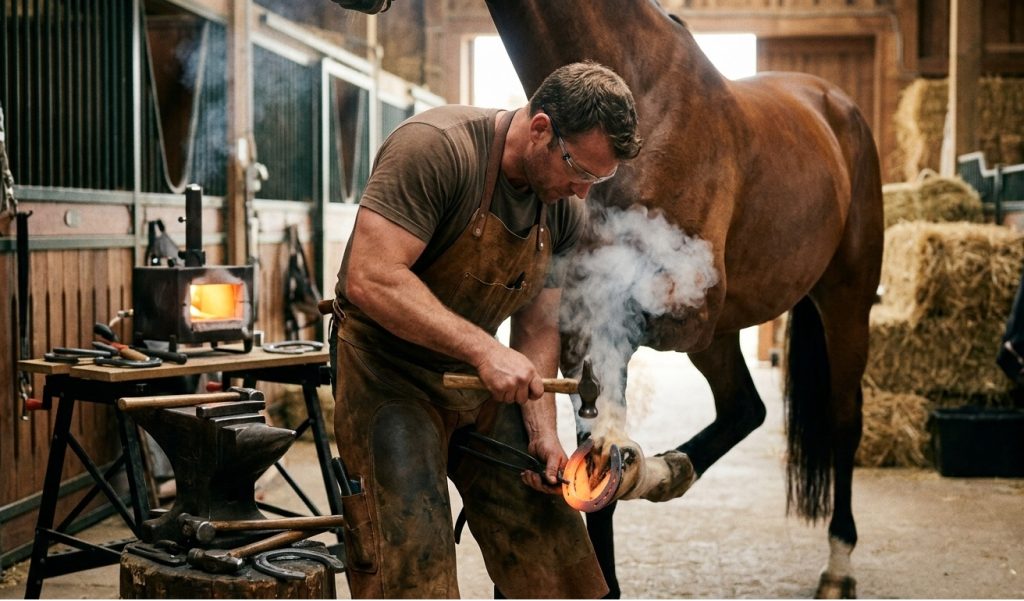
Most farriers use the traditional nailing method. They trim the hoof first, then shape the shoe—often using a forge and anvil—and nail it into the “white line” of the hoof. They then “clinch” the nails over on the outside so the shoe stays put.
Hot shoeing is my personal favorite to watch, mostly because of the dramatic puff of smoke. The farrier heats the shoe until it’s glowing orange and touches it to the hoof. This creates a perfectly flat surface for the shoe to sit on, ensuring a seamless fit.
If your horse has fragile hoof walls that can’t handle nails, glue-on shoes are a lifesaver. They are pricey and a bit of a pain to apply, but they keep the hoof intact. FYI, they also tend to fly off in deep mud, which is always a fun scavenger hunt for the owner.
Why don’t wild horses need shoes?
Wild horses are the poster children for the barefoot movement, but there’s a catch. They travel miles every single day over varied terrain, which naturally trims and hardens their hooves. Their feet become incredibly tough because they have to adapt to survive.
Domestic horses, on the other hand, often live in “wet” environments or stalls. Moisture softens the hoof, making it more prone to wear and damage. We also feed our horses high-sugar diets that can affect hoof quality, unlike the sparse, dry forage wild horses eat.
Also, nature is cruel. If a wild horse has “bad feet,” it doesn’t get a farrier; it gets eaten by a mountain lion. We prefer to keep our domestic buddies around, so we intervene with metal shoes when their genetics fail them.
Do racehorses need shoes?
Racehorses almost always wear shoes, specifically lightweight aluminum plates. Speed is the name of the game here, and aluminum provides protection without adding significant weight. At 40 mph, every ounce matters to a horse’s joints.
These shoes also have “toe grabs” to help the horse dig into the dirt track. Without them, the horse would lose power during the push-off phase of their gallop. Do they need them for everyday life? Probably not, but for the track, they are essential equipment.
The pros and cons of shoeing a horse
Deciding on the Importance of horse shoes and the pros and cons of shoeing requires a balanced look at both sides. It isn’t just about fashion; it’s about function.
Pro: Shoes allow horses to work on any surface without pain.
Pro: They correct gait imbalances and lameness issues.
Con: They are expensive and require maintenance every 4-6 weeks.
Con: A poorly fitted shoe can cause more damage than no shoe at all.
Ever lost a shoe in a muddy field five minutes before a show? That’s the ultimate “con” of the shoeing world.
Benefits of shoeing
The biggest benefit is versatility. With shoes, your horse is ready for a rocky trail ride, a paved parade route, or a jumping competition at a moment’s notice. You don’t have to worry about them “ouching” on a stray pebble.
Shoes also provide support for the internal structures of the foot. For horses with conditions like navicular disease or laminitis, specialized shoes can literally be the difference between a usable horse and one that is chronically lame.
Additionally, shoes protect against bruising. A stone bruise on a barefoot horse can sideline you for weeks. A metal shoe acts as a shield, taking the hit so the sensitive sole doesn’t have to.
Pros and cons of going barefoot
Going barefoot is a fantastic goal if your horse’s feet can handle it. It allows for the natural expansion and contraction of the hoof, which aids in blood circulation.
Pro: Better traction on certain surfaces like ice or slick pavement.
Pro: Reduced risk of “kick” injuries to other horses in the pasture.
Con: Limited to “soft” riding surfaces unless you use hoof boots.
Con: The transition period from shoes to barefoot can be long and frustrating.
Benefits of going barefoot
When a horse is barefoot, the hoof functions exactly as nature intended. The frog (that V-shaped pad on the bottom) makes direct contact with the ground, acting as a shock absorber. This reduces the impact on the horse’s upper joints and tendons.
You also save a significant amount of money. A “trim” is much cheaper than a full set of shoes. Over a year, those savings could practically buy you a new saddle—or at least a very nice pair of breeches.
Finally, barefoot horses tend to have fewer issues with “contracted heels”. Because the hoof isn’t locked into a rigid metal shape, it can spread and grow more robustly.
Cons of going barefoot
The main drawback is limited durability. If you want to go on a three-day camping trip in the mountains, a barefoot horse might finish the first day with very sore feet. You end up having to pack “emergency boots” anyway, which can be just as expensive as shoes.
Some horses simply have poor genetics. No amount of “natural” living will fix a horse born with paper-thin soles. Forcing a horse like that to go barefoot is just plain mean, regardless of what the “barefoot only” crowd says.
Ultimately, the Importance of horse shoes and the pros and cons of shoeing boils down to what makes your horse comfortable. If they’re happy barefoot, keep ’em naked! If they’re tender-footed, get them some “sneakers.” Your horse’s comfort should always outrank your philosophy.