
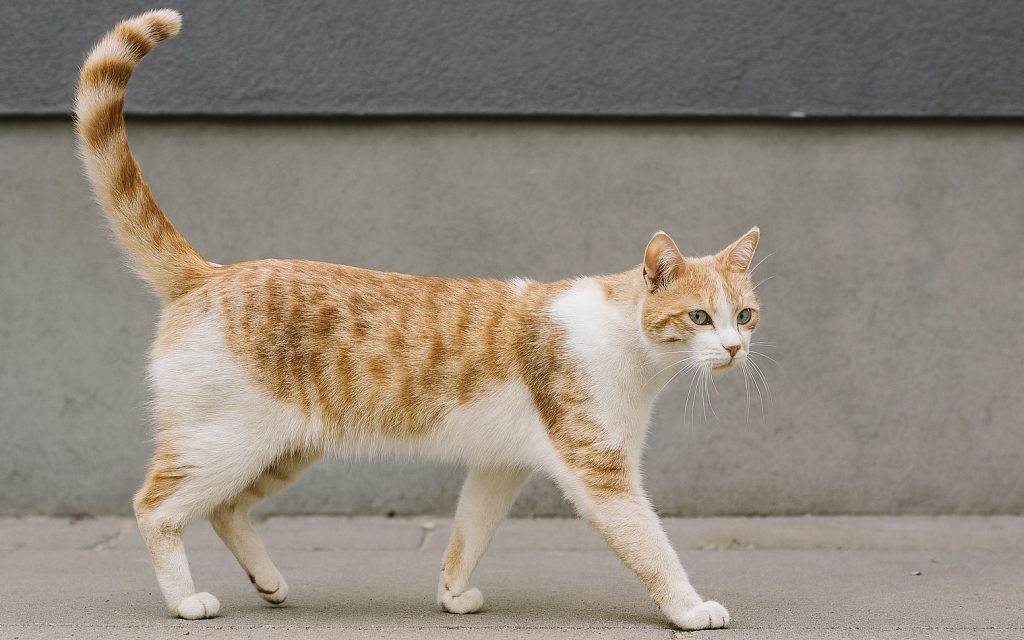
Ever caught your cat’s tail doing its own thing and thought, “Wait, are they even controlling that?” Same here. I’ve watched my cat, Luna, flick her tail like she’s swatting invisible flies, and I’ve wondered if she’s just being dramatic or if there’s some science behind it. Spoiler alert: there’s a whole lot of science.
So, let’s settle this once and for all—do cats control their tails? And while we’re at it, let’s unpack all the tail-related facts every cat owner should know. Buckle up, fellow feline fanatic. This is gonna be fun. 🙂
What Are Cat Tails Used For?
Before we talk about control, we need to appreciate the tail’s job description. It’s an incredibly versatile tool, and frankly, I think it deserves a raise. It’s not just there for looks, though it certainly adds to the pizzazz of a cat walking into a room. The tail essentially has three main functions, and they are all crucial to a cat’s daily life.
Sensing Their Environment
Cats use their tails as super-sensitive sensors. You might not realize it, but those tails pick up on subtle air movements and vibrations.
When a cat walks through tight spaces or prowls in low light, the tail helps it gauge surroundings—almost like a radar antenna. Pretty neat, right? It’s why they rarely bump into things, even at midnight zoomies o’clock.
Movement and Balance
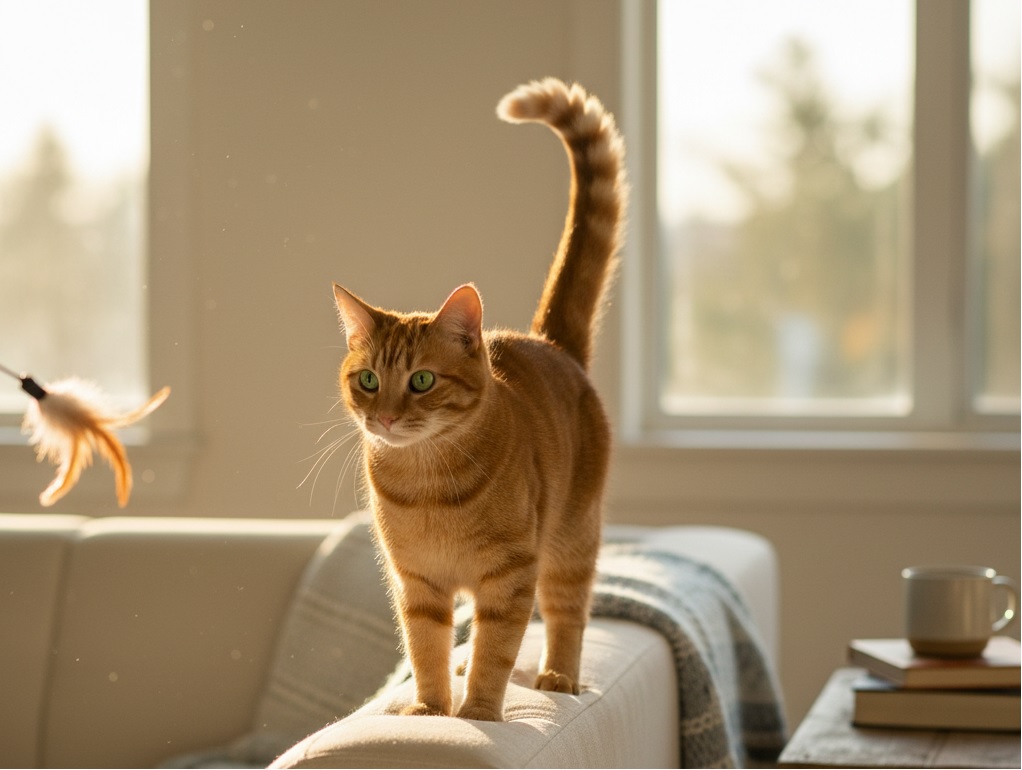
Ever seen your cat tightrope walk across the back of the couch like a gymnast on a beam? That’s the tail at work. It acts as a counterbalance, helping them make those sharp turns mid-jump or land gracefully (most of the time 😹).
Without that tail, cats would be way less agile. Sure, they’d still be impressive—but not “defy gravity” impressive.
Communication
This is where things get juicy. Cats express a ton through tail movements. A slow swish can mean curiosity. A puffed-up tail? Fear or anger. A high, quivering tail? Pure joy or excitement.
Your cat’s tail is basically a built-in mood meter—one that says a lot more than meows ever could.
Do Cats Control Their Tails?
Short answer? Yes, they do. However, it’s not always deliberate.
Cats can voluntarily move their tails to show their feelings or stay balanced. However, occasionally, such as during sleep or reflex reactions, their tails move uncontrollably.
How Do Cats Control Their Tails?
We’re going to get a little geeky here, but it’s really fascinating, so stay with me. In reality, how does all that amazing communication and balance take place? The seamless synchronization of anatomy and neurology is a marvel.
The Anatomy of Tail Control
In essence, a cat’s tail is an extension of its spine. It’s a complex structure made for optimal flexibility and control, not just cartilage and fluff.
Vertebrae
Depending on the breed, a cat’s tail can have anywhere from 19 to 23 vertebrae. That represents about 10% of their body’s total number of bones! The tail’s remarkable range of motion is attributed to the flexible, segmented chain of these tiny bones.
It makes sense that cats can flick, twist, and curve it like a ribbon.
Muscles and Nerves
Numerous tiny muscles and ligaments are connected to each tiny vertebra. The cat can make small, precise movements with these muscles, such as a tiny tip twitch.
The tail is home to a dense network of nerves that connects directly to the central nervous system. The cat uses this method to sense sensations in its tail and transmit the motor signals required to move it.
Brain Signals
The cerebellum and spinal cord, two parts of the cat’s brain, transmit electrical signals to the tail muscles, directing movement.
These cues cause your cat’s tail to waggle in anticipation when it spots a bird outside. Although it is instinctive, most of the time it is still controlled voluntarily. Like dance partners, the brain and tail are in perfect sync.
Reasons for Voluntary Tail Movements
Cats are communicating or performing a significant action when they purposefully move their tails. These are the primary causes of those intentional waves and tail flicks.
Balancing
Mittens is purposefully shifting her tail weight to keep her balance when she runs across the top of my bookcase—something I specifically asked her not to do.
She actively holds it out to compensate for slight variations in her center of gravity rather than merely letting it hang there. It’s a remarkable achievement of deliberate, willful control.
Communication
This is the most common voluntary use we notice. Cats actively use their tails to signal their moods. They decide how high, low, or rapidly to move it based on what they want to convey.
- Tail held straight up: A happy, confident greeting.
- Tail wrapped around another cat (or you): A voluntary sign of affection and bonding.
Excited Greeting
Ever notice your cat’s tail quivering like it’s vibrating when you walk in? That’s an excited greeting.
It’s their way of saying, “Oh, hey! You’re back!” Cats that trust and love their humans often do this. Consider it a kitty version of a happy dance.
Affection
When your cat wraps its tail around your leg, that’s affection—plain and simple. It’s the cat equivalent of holding hands.
That’s voluntary tail control at its sweetest. (And yes, we all secretly melt when it happens.)
Focus
When cats are hunting or playing, their tails often go still. That’s a sign of laser focus. The tiniest flick at the tip might happen as they zero in on their target. Think of it as their version of holding their breath before pouncing.
Agitation
A cat is expressing agitation or conflict when they begin to twitch or thump quickly and lowly. This quick motion is a voluntary warning sign that says, “Back off, I’m not happy with this situation.”
Reasons for Involuntary Tail Movements
Not every tail movement is a conscious choice. Sometimes the tail acts on its own, thanks to reflexes, dreams, or health issues.
Reflexes
Just like our knees jerk when tapped, cats have tail reflexes. If something touches or startles their tail, it may twitch without the cat deciding to move it. It’s a built-in protective reaction.
Dreaming
Have you ever seen your cat go completely unconscious and then notice a small, clumsy twitch in its tail? These tiny motions frequently occur during the dreaming phase of REM sleep.
Their brain is constantly working, sending erratic motor signals that are totally uncontrollable and result in tiny twitches and spasms.
Injury or Illness
Tail movements—or lack thereof—can occasionally be an indication of nerve damage or pain.
See a veterinarian right away if your cat stops using its tail, holds it limp, or reacts angrily when you touch it. Because nerves connect directly to the spinal cord, injuries to the tail can be quite serious.
Do Cats Control Their Tails While Sleeping?
Not really. When cats sleep, their brains partially shut down voluntary muscle control—just like ours. So, if the tail twitches, it’s usually from dreams or reflexes.
Think of it like sleep talking—but fuzzier and cuter. 😴
Do Cats Have Feelings in Their Tails?
Oh, absolutely. The tail is extremely sensitive due to its abundance of blood vessels and nerve endings.
That’s why cats don’t like it when people tug or grab their tails (and rightly so!). It can hurt, just like someone yanking your finger.
Always handle the tail gently—especially with kids around. It’s not a toy; it’s a super-sensitive limb that cats rely on daily.
Why Do Cats Wag Their Tails?
Cats wag their tails for a bunch of reasons, and it’s not always a good thing.
- Slow wag = curious or relaxed.
- Fast wag = annoyed or overstimulated.
- Whip-like wag = “I’m about to pounce or bolt.”
Different Cat Tail Movements and What They Mean
Let’s decode the tail language like pros.
Tail Movement | Meaning |
Straight up | Happy, confident |
Curled around you | Affectionate, friendly |
Twitching tip | Focused, hunting mode |
Swishing side to side | Annoyed, irritated |
Puffed up | Scared or defensive |
Low and still | Relaxed or sleepy |
Keep this handy next time you’re trying to figure out if your cat’s in cuddle mode or “don’t touch me” mode.
Frequently Asked Questions
Can cats control their tails?
Yes, cats have both voluntary and involuntary control over their tails. They use them consciously for balance and agility, and voluntarily as a key communication tool to express emotions. However, some movements, like small twitches when focused or during sleep, can be involuntary reflexes.
Do cats have full control over their tails?
Yes, cats have strong muscles and nerves at the base of their tails, allowing them to move their tails voluntarily. However, some tail twitches or flicks can be reflexive, especially when they’re stimulated or annoyed.
Why does my cat’s tail move when I’m petting them?
Tail movements during petting often signal emotion. A slow, gentle swish may mean your cat enjoys it, while a fast or sharp flick could mean they’re irritated or overstimulated.
Why do cats twitch their tails while sleeping?
Small tail twitches during sleep are usually normal. They can indicate that your cat is dreaming or simply reacting to sounds or sensations while in a light sleep stage.
What does it mean if a cat’s tail is puffed up?
A puffed-up tail is a sign of fear or aggression. Cats fluff up their tails to appear larger and more intimidating when they feel threatened or startled.
Is tail movement a reliable sign of a cat’s mood?
Yes — tail language is one of the clearest indicators of feline emotion. A raised tail shows confidence or friendliness, while a tucked tail often indicates fear or submission.
Final Words
So, do cats control their tails? Heck yes, they do. But like us waving our hands while talking, sometimes it’s intentional, sometimes it’s just habit or reflex.
Next time your cat flicks their tail at you, don’t take it personally. They might be annoyed, or they might just be dreaming of chasing squirrels. Either way, their tail’s doing its job—and doing it well.
Now go give your cat a little tail scratch (if they’re into that). And remember: tails tell tales. 😉



Pingback: Cat Tail Language: Secrets Behind Every Flick