Let’s face it, with their masked faces and snatchy hands, raccoons are adorable little bandits. However, if you’re a cat owner like me, you’ve undoubtedly wondered if raccoons attack cats. And if they do, how do we keep our feline friends safe from these sneaky night crawlers?
I completely understand the worry because I’ve had a couple late-night encounters with raccoons myself (one involving a stolen sandwich and a very perplexed tabby). Knowing how raccoons behave is essential to keeping your pet safe, whether your cat roams freely or relaxes on the porch. Let’s talk about cats, raccoons, and how to prevent fur-flying drama while you grab a snack (but don’t leave it outside).
Understanding Raccoon Behavior
We must first understand the raccoons themselves to comprehend their relationship with our cats. Raccoons are extremely versatile animals. They have learned to survive in almost any type of habitat, including busy cities and forests. They resemble the epitome of urban survivors.
Raccoon Habits and Habitat
Raccoons are mostly nocturnal scavengers. They like places with food sources (garbage, pet food, fruit trees), water, shelter (trees, attics, under decks). They adapt really well to urban, suburban, and semi-wild areas.
They aren’t usually out looking for trouble. They just want the easy meals, the safe spots to rest, and to raise their young quietly without being bothered. But sometimes they misstep (or get desperate), and that’s when things get messy.
Raccoon Aggression Triggers
Raccoons usually avoid conflict. But several triggers can push them into aggressive behavior:
- Protecting their young: A mother raccoon will become very protective around her den.
- Feeling threatened or cornered: If your cat surprises a raccoon (or vice versa), fight or flight kicks in.
- Fights over food or territory: When raccoons and cats or other animals vie for the same resources.
- Disease or injury: Sick raccoons (especially rabid ones) might behave unpredictably.
I once saw a raccoon hiss at my neighbor’s cat when the cat sniffed too close to the raccoon’s den. The cat backed off. That’s a good example: most of the time, avoidance wins.
Relationship between Cats and Raccoons
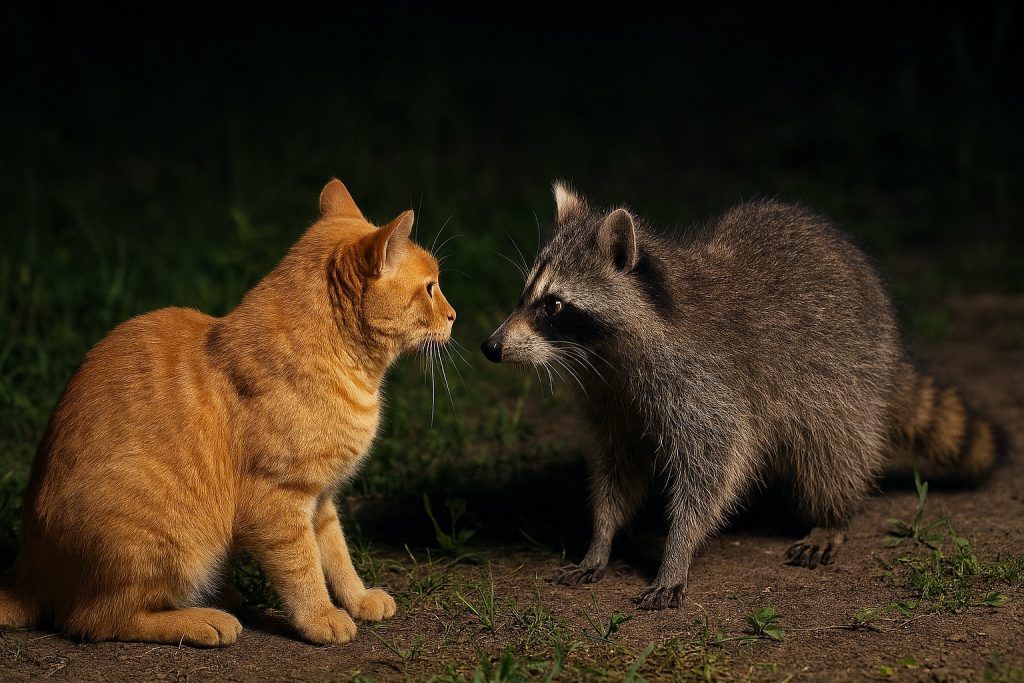
From what I’ve read and from talking to people, most cat-raccoon interactions are cautious. They usually glance, sniff, maybe hiss or growl, then go their separate ways. Raccoons and cats don’t often “hang out” together unless forced by circumstances (food, habitat overlap). Cats are more territorial; raccoons are more opportunistic. They both like darkness, though, so lots of overlap in when they’re active.
Are raccoons dangerous to cats?
Yes, raccoons can be dangerous to cats. While a direct attack isn’t the most common scenario, the potential for harm is very real. A raccoon is a wild animal with sharp claws and teeth. A quick swipe or bite could easily cause a serious injury to your cat. A single bite can lead to a nasty infection, and that’s not even considering the risk of disease.
Do Raccoons Attack Cats?
Let’s break this down because the internet loves drama, and we love facts.
Do Raccoons Eat Cats?
Nope. Cats are not preyed upon by raccoons. Instead of being predators, they are scavengers. However, a raccoon may view a cat as easy prey if it is already injured or very small. Sad, but accurate.
Do Raccoons Attack Cats at Night?
Nighttime is definitely more likely. Cat-raccoon encounters frequently occur after dusk because raccoons are nocturnal. If your cat roams outside at night, that increases the odds of crossing paths. Also, when visibility is low, surprise encounters happen (which can trigger attack mode from the raccoon).
Do Raccoons Attack Cats in the Winter?
Less likely. Raccoons slow down in colder months and focus on staying warm. But if food is scarce, they might get bold.
Do Raccoons Attack Cats in the House?
This is rare, but not impossible:
- If there’s a pet door, raccoons might slip in, especially at night.
- If raccoons find a way into attics, basements, garages, or crawlspaces, cats exploring those spaces may stir up a confrontation.
- Usually, the cat senses danger and avoids the raccoon. Cats are pretty good at retreats.
If you keep doors and entry points secure, you reduce this risk a lot.
Do Raccoons and Cats Compete for the Same Prey?
Sort of. Raccoons are opportunistic omnivores and will eat many of the same things a cat might, like mice, insects, and birds. However, their primary food sources are so different that they don’t typically compete in a way that leads to direct conflict. The real competition comes when they’re both eyeing the same bowl of cat food on your porch.
Do Raccoons and Cats Get Along?
Surprisingly, sometimes they do (or at least tolerate each other). In many real-life cases, cats and raccoons simply ignore each other once they realize there’s no threat or easy benefit from interaction. I’ve heard stories of outdoor cats and raccoons sharing space (yards, fences), sometimes even beds of leaves, without fighting — mostly because they avoid each other.
But “getting along” isn’t the norm. Most of the time, they co-exist with occasional flare-ups over food or territory. IMO, the fewer attractants you leave lying around, the more peace you’ll have.
Potential Dangers Raccoons Pose to Cats
Even if you minimize the risk of a full-blown attack, there are other dangers to consider. A raccoon encounter can still be a serious problem for your cat.
Physical Injuries
- The most noticeable are bites and scratches. Raccoons have powerful teeth and claws. They protect themselves when there is danger or fear. Cats may sustain puncture wounds, broken claws, or cut ears.
- Predation on small cats and kittens: as previously mentioned, smaller cats are more susceptible.
- Battles for food or territory: a raccoon may swipe, a cat may become alarmed.
These injuries may look minor but can lead to serious infection if untreated.
Disease Transmission
This is actually one of the bigger risks. Raccoons can carry a bunch of stuff your cat doesn’t want to mess with.
- Rabies: dangerous to cats (and humans). If a raccoon is rabid, it might attack or bite, transmitting rabies through saliva.
- Feline distemper (panleukopenia): Raccoons can carry viruses related to distemper which cats can catch. Baylisascaris (raccoon roundworm): Cats can become infected by coming into contact with raccoon feces or contaminated soil.
- Bartonella spp.: Shared between raccoons and feral cats in some studies. Can cause cat-scratch disease, etc.
Even without a full-on attack, disease risk is real if contact or contamination occurs.
Risk of Attack
You’re probably curious about the likelihood that your cat will be attacked by a raccoon. Below is a summary of the variables that may affect that risk.
Factors that Increase the Risk of an Attack:
- Food: Raccoons are openly invited when pet food or trash cans are left outside.
- Territorial Conflicts: Raccoons will protect their area, particularly if it has a den or food supply.
- Kits Present: A mother raccoon is fiercely defensive and will attack anything that she believes poses a risk to her young.
- Cat Personality: An aggressive or fight-prone cat is more likely to intensify an interaction.
Factors that Decrease the Risk of an Attack:
- The big one is that the cat is indoors. There is almost no chance of a raccoon attack for a cat kept indoors.
- No Food Left Outside: By removing food sources, you can eliminate the main cause of raccoon visits to your property.
- Cats and Raccoons Are Vaccinated: A vaccine can shield your cat from illnesses like rabies, but it won’t prevent an attack.
Impact of Season, Territory, and Food Availability
- Season: Raccoons may approach human homes due to winter scarcity, as was previously mentioned. Mothers will fiercely defend their dens during the breeding season in the spring. There is more food available in the summer and fall, but there is also more movement among raccoons.
- Territory: If your yard or home overlaps with established raccoon routes, encounters become more likely.
- Food availability: If natural food is plentiful (insects, fruit, rodents), raccoons might avoid human areas. When food in nature is scarce, raccoons venture into yards and homes.
Minimizing the Risk of an Attack
Here are practical steps (my own checklist I use) to reduce risk:
- Feed your cat indoors, especially at night.
- Bring in or secure trash, compost bins, and pet food bowls.
- Block off crawl spaces, seal pet doors at night.
- Remove brush piles, trim shrubs so no sneaky hiding places.
- Use motion-sensor lights around the yard.
Regular vet checkups, keep vaccinations up-to-date.
Raccoon-Cat Encounters: What to Expect
Let’s say the inevitable happens and your cat and a raccoon come face to face. What will it look like?
Aggression
If a raccoon feels threatened, it’ll stand its ground. Cats might puff up and hiss, but raccoons don’t scare easily.
Competition for Food
Food is often the instigator. Maybe you left food bowls or pet food outside. Raccoons sniff that out. Then maybe the cat comes to eat, the raccoon growls, cat hisses back. Ugly scenes sometimes, but usually neither wants a full fight.
Territorial Disputes
Cats mark their territory; raccoons follow trails. If raccoons repeatedly visit your yard, your cat might see that as an intrusion. Cats are territorial creatures. Sometimes they “defend” with posturing; sometimes with claws. If the raccoon doesn’t back off, things escalate.
How to keep raccoons away?
Keeping raccoons away from your property is the best way to keep your cat safe. It’s a game of outsmarting them.

Removing Attractants
You know what draws raccoons like magnets? Stuff lying around they can eat or hide in. Do this:
- Never leave cat food outside overnight. Bring it in after feeding time.
- Secure trash and compost bins with lids that lock or are heavy.
- Remove fallen fruit, pet snacks, and birdseed.
- Seal off any gaps under porches, decks, or sheds.
These little things make a huge difference (seriously, I saw a drop in raccoon visits just after securing trash cans).
Using Deterrents
A few deterrents I’ve tried or read about:
- Motion-Activated Sprinklers: These are a great way to startle raccoons without harming them.
- Predator Urine: You can buy this at most home improvement stores. The smell can deter raccoons.
- Secure Your Pet Door: If you have a cat flap, make sure it locks and is a small size so a raccoon can’t get in.
Do Raccoons Eat Cat Food?
Yes. They love it. Cat food tends to smell strong, has protein, often easy to grab. For a raccoon, cat food outside is like an invitation. If you’ve ever seen a raccoon pawing at an empty cat bowl, you know that smell lingers. 😏
How To Keep Raccoons Out Of Cat Food
- Feed your cat indoors.
- Use raccoon-proof feeders.
- Clean up leftovers immediately.
If you leave food out overnight, you’re basically inviting raccoons to a dinner party. And they never RSVP.
How Can Skedaddle Humane Wildlife Control Help With Raccoon Removal?
FYI, I’m not affiliated with Skedaddle but I’ve looked into what humane control folks do. If you have persistent raccoon problems, professionals like Skedaddle (or similar in your area):
- Assess how and where raccoons get in.
- Find attractants you might have missed.
- To safely move or keep raccoons out, use humane trapping techniques or deterrents.
- Provide sealing services to prevent access to crawl spaces, walls, and attics.
Professional assistance keeps wildlife and your cat safer. Better than attempting a dangerous do-it-yourself project that could backfire on everyone.
Do Raccoons Attack Humans?
In general, no. Almost invariably, raccoons will run away from people. They want to stay out of conflict and are cautious around us. But just like cats, they will attack if they are frightened, cornered, or ill. Avoid raccoons that exhibit odd behaviors, such as excessive aggression or stumbling. That might indicate rabies.
Do raccoons attack dogs?
Dogs are a different story. Bigger, sometimes more aggressive, sometimes more territorial. Raccoons often avoid big dogs, but small dogs or puppies are more vulnerable. Also similar disease risks apply. If a dog provokes a raccoon (or vice versa), fights can happen, so owners of small dogs should be especially cautious. Similar safety tips to cats apply.
Frequently Asked Questions
Can raccoons and cats live peacefully together?
Sometimes, but it’s risky. Better to keep them apart.
What should I do if a raccoon attacks my cat?
Get your cat to a vet ASAP. Then call animal control.
Are raccoons scared of cats?
Not really. They’ll avoid conflict but won’t back down if challenged.
Can raccoons climb fences to reach cats?
Yes. They’re like furry ninjas.
Should I trap a raccoon myself?
Nope. Leave that to the pros. It’s safer and more humane.
Final Words
So, do raccoons attack cats? Sometimes. But with a little planning and a lot of common sense, you can keep your furry friend safe and sound. Raccoons aren’t evil—they’re just hungry, curious, and occasionally rude.
Keep your cat’s food indoors, secure your trash, and don’t underestimate a raccoon’s determination. Trust me, I’ve seen one open a cooler like it was cracking a safe.
Got a raccoon story or a cat-raccoon showdown to share? Drop it in the comments—I’m all ears (and whiskers). 😼
Stay safe, stay smart, and give your cat an extra treat today. They deserve it.