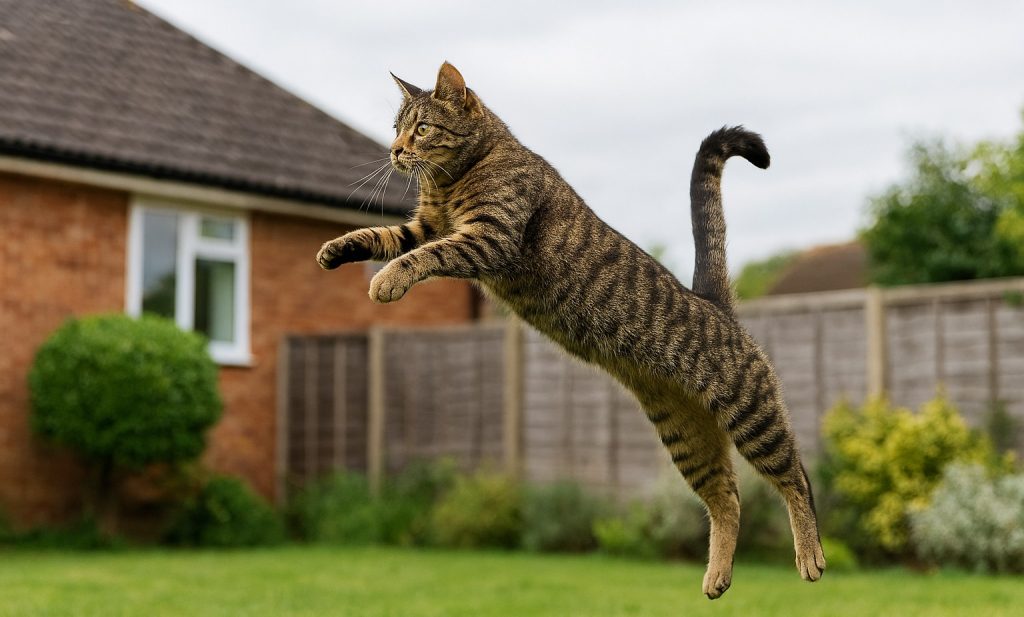
Ever watched your cat leap from the floor to the top of the fridge like it’s no big deal? Yeah, same here. I once saw my tabby, Luna, clear a five-foot fence like she was auditioning for the feline Olympics. That moment sent me down a rabbit hole (or should I say, a cat tree?) to answer the burning question: How high can cats jump?
Spoiler alert: it’s really high. But there’s more to it than just raw height. Cats are basically tiny parkour athletes wrapped in fur. So if you’ve ever wondered how your cat defies gravity—or if you’re trying to build a fence that actually works—this guide’s for you.
Let’s break down the science, the sass, and the sheer athleticism behind your cat’s vertical superpowers.
Characteristics of Cats
Cats have the physique of professional gymnasts. Their back legs function as springs, their spines are incredibly flexible, and their bodies are muscular but slender. Cats can leap like crazy without the need for warm-ups, running shoes, or protein shakes, unlike us awkward humans.
They can launch themselves thanks to their muscular hind legs; they can twist in midair like Cirque du Soleil contestants thanks to their flexible spines; and they have keen vision, which enables them to calculate distance like math nerds—without ever attending class.
Ever notice how they stare at a spot before jumping? That’s them running all the calculations you’d need a calculator for.
Why Do Cats Jump?
Why even bother with these bizarre antics, cats? Well, everything up high is automatically better in their minds.
- Survival instinct: Cats use their height to stay safe in the wild. Down there, predators? Relax up here.
- Curiosity: If there’s a shelf, they will climb it. FYI, this includes your kitchen counters.
- Territory: Cats love surveying their “kingdom” from above. Your bookshelf = their throne.
- Playfulness: Sometimes they just… feel like it. You know, zoomies plus gravity-defying leaps.
Ever caught your cat sitting on top of your wardrobe like a smug gargoyle? Yep, that’s the “because I can” vibe.
How Do Cats Jump So Well?
It’s not magic, even though it looks like it sometimes. Biology and physics work together harmoniously to give cats their ability to jump. They have a specific way of preparing and executing a truly remarkable jump. Every muscle, bone, and nerve fiber plays a crucial role.
Cats’ bodies allow them to leap high.
Cats have strong, spring-like muscles in their hind legs. They store energy when they crouch. They release it in a single, powerful motion when they leap.
Cats are naturally adept at climbing.
Cats use jumping as a survival strategy because they evolved to climb trees and rocky terrain. Even on small surfaces, they can land safely thanks to their balance and claws.
A cat’s overall health affects its ability to jump.
Older cats or those with joint issues might not jump as high. But a healthy, active cat? They’ll surprise you. Trust me—my senior cat still clears the couch like a champ.
Comparison of Cat Jump Heights
Let’s get nerdy for a sec. Here’s a quick breakdown of how different cats measure up:
Cat Type | Average Jump Height | Notes |
Housecat | 5–6 feet | Most common indoor jumper |
Athletic breeds | 6–8 feet | Think Bengals or Abyssinians |
Kittens | 1–3 feet | Still learning the ropes |
Senior cats | 2–4 feet | Depends on health |
FYI: These are averages. Some cats go way beyond. I’ve seen YouTube videos of cats clearing 8 feet like it’s a warm-up.
How High Can Cats Jump from The Ground?
This is the big question, right? On average, a healthy, adult domestic cat can jump six to eight times its own height. So, if your cat is about a foot tall, it can easily jump six to eight feet straight up from a standing position. That’s why your cat can reach the top of your fridge, your bookshelf, or even a tall fence without any problem.
My cat, Mittens, is about a foot tall and she’s managed to get on top of a seven-foot-tall wardrobe. It’s just insane!
Can a Cat Jump Over a 5 Foot Fence?
Absolutely. A 5-foot fence is basically a speed bump for most cats. If your goal is to keep your cat in—or other cats out—you’ll need to get creative.
Some folks install cat-proof fencing with inward-facing extensions. Others go full Fort Knox with motion sensors and netting. IMO, the best solution is a combo of height and deterrents.
A cat’s vertical jump height
We now know that a cat’s vertical leap is truly remarkable. Their flexible spine and strong back legs are the key. They contract every muscle in their crouch before exploding upward. It’s a gorgeously effective process that reduces energy waste and maximizes their power.
How High or Far Can Housecats Jump?
Housecats are able to leap:
- Vertically: Up to 6 feet from a standstill.
- Horizontally: Up to 10 feet in a single bound.
That’s Olympic-level stuff. And they don’t even stretch first. 🙄
How Can Cats Jump So High?
It all comes down to instinct and muscle coordination. Cats are adept at crouching, calculating, and launching. Their eyes measure distance like tiny engineers, and their tails aid in balance.
Ever noticed how your cat stares at a surface before jumping? That’s not hesitation—it’s math.

How Do Cats Always Land on Their Feet?
Cats have a “righting reflex.” Within milliseconds of falling, they twist their bodies midair to land paws-first. Do they always land gracefully? Nope. But they’ve got way better odds than us humans face-planting after tripping on a rug.
Okay, not always, but close. Cats use a trick called the “righting reflex.”
- They twist their bodies mid-air.
- They align their spine and head.
- They spread their legs to slow descent.
Even kittens develop this reflex by 6 weeks old. It’s basically built-in parkour
Factors That Affect Feline Jumping Ability
Although the majority of cats are excellent jumpers, certain factors may affect their skills. There is no one-size-fits-all solution.
- Age: Kittens may not be as strong as adult cats because their muscles and coordination are still developing. Conversely, older cats may experience pain or difficulty when jumping due to health conditions like arthritis.
- Weight: It will be much more difficult for an overweight cat to jump. Their power and agility are diminished as a result of the strain the additional weight places on their joints and muscles. Maintaining a healthy weight for your cat is important for more than just their ability to jump.
- Breed: Certain breeds are more athletic by nature than others. A stocky Persian cat may not be as good at jumping as a slender, muscular Siamese cat.
Breed impacts on jumping ability
Certain cat breeds are well known for their ability to jump.
- Abyssinians: Known for their love of climbing and jumping, these cats are exceptionally athletic.
- Siamese: These cats are strong jumpers and nimble climbers thanks to their slender, muscular bodies.
- Savannah cats: When standing, a Savannah cat can leap up to eight feet. Being a hybrid breed, these cats still have a lot of the amazing athleticism of wild servals.
Risks of high jumps
Cats are fantastic jumpers, but there are dangers. A bad landing can lead to injuries like sprains, fractures, or joint problems. Particularly on hard surfaces, falls from high places can be extremely dangerous. Providing them with secure landing areas is crucial.
How to Keep Your Cat from Jumping?
Let’s be real—you’ll never completely stop a cat from jumping. But you can discourage it:
- Use double-sided tape on surfaces.
- Place deterrents like citrus scents.
- Block access with furniture or barriers.
- Provide alternatives like cat trees.
Just don’t yell. Cats don’t respond well to drama. 😼
How to Encourage Cats to Jump Safely?
On the other hand, you might want to encourage your cat to jump and play more. It’s great for their health and mental stimulation.
- Install sturdy shelves or platforms.
- Use padded landings where possible.
- Keep surfaces clear of breakables.
- Reward safe behavior with treats.
My cat loves her wall-mounted steps. She climbs like a pro and hasn’t broken a single mug since. Win-win.
How High Does a Cat Fence Need to Be?
If you want to keep your cat in your yard, a standard six-foot fence probably won’t cut it. You need a cat-proof fence. This means the fence should be at least six feet tall and have an inward-facing overhang at the top. This makes it impossible for the cat to get a grip and climb over.
What Are Some of the Things to Consider About Cat Fencing?
Before you build, think about:
- Height: 8 feet or higher is best.
- Material: Smooth surfaces are harder to climb.
- Topper: Inward curves discourage escape.
- Visibility: They shouldn’t feel trapped, or they’ll try harder to get out.
IMO, a well-designed catio (cat patio) solves most problems. It’s safe, stylish, and gives your cat outdoor access without the drama.
Frequently Asked Questions
In comparison to humans, how high can cats jump?
Cats are five to six times taller than humans. People? If we’re lucky, maybe twice.
Are kittens able to jump as high as cats?
No, kittens are still developing their coordination, but as they get older, they become more agile.
Can cats who are overweight still jump high?
Physics usually says “nope,” but they can try.
Can cats survive long falls?
Sure, but not always in a safe way. Veterinarians caution against “high-rise syndrome” because of this.
What causes cats to wiggle before leaping?
It aids in energy channeling and stabilization for a flawless launch. It’s also very cute.
Final Words
What is the maximum height at which cats can leap? Regarding your furniture, the answer is likely higher than you would like and higher than you anticipate. Cats are natural-born jumpers with crazy athletic skills, and honestly, that’s part of what makes them so fascinating (and frustrating).
If you’re a cat parent, embrace their inner athlete—just make sure your home is safe for all their daredevil stunts. And hey, next time you see your cat perched like a king on top of the fridge, remember: that’s just them showing off their superpowers.