
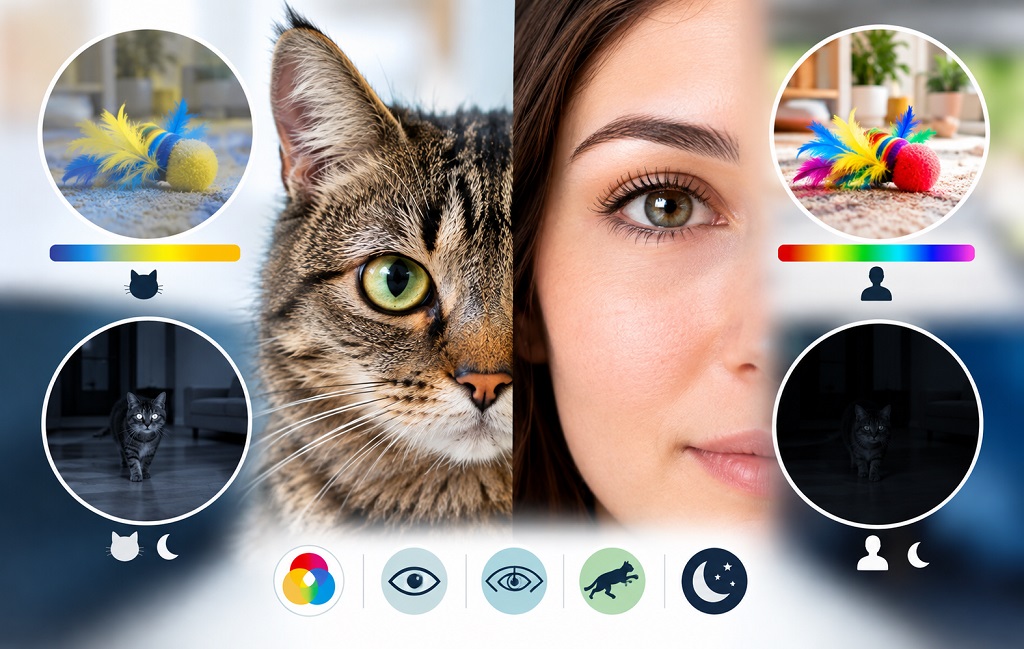
Have you ever watched your cat suddenly lock onto a tiny movement that you could barely notice and wondered what was happening inside those enormous eyes?
The answer is fascinating. How does cat vision compare with human vision? Cats and humans use the same basic visual system—cornea, lens, retina, optic nerve, and brain—but the way those systems are optimized is quite different.
Cats are particularly well adapted to seeing in dim light and detecting movement. Humans, on the other hand, generally have an advantage when it comes to color discrimination and certain aspects of detailed daytime vision. So, cat vision isn’t simply “better” or “worse.” It is specialized for a different lifestyle.
And no, your cat is not wandering around the house seeing everything in black and white. That old myth has been around for years, but feline color perception is more complicated than that.
Let’s take a closer look at how does cat vision compare with human vision, including color, night vision, visual sharpness, peripheral vision, and what these differences mean for your cat’s everyday life.
How Does Cat Vision Compare With Human Vision?
The simplest answer is that cats are visual specialists in different areas than humans.
Humans typically have excellent daylight vision and a much broader ability to distinguish colors. Cats have eyes that are particularly effective at gathering available light and detecting movement, which makes sense for an animal whose ancestors hunted during low-light periods.
Veterinary sources note that cats have many rod cells, which are particularly useful for detecting light and movement. Their pupils can also expand considerably, while the tapetum lucidum, a reflective layer behind the retina, helps increase the amount of available light used by the visual system.
So, how does cat vision compare with human vision in practical terms?
Think of it this way: your eyes are better at appreciating the colorful details of a sunny garden, while your cat’s eyes are better equipped for noticing something move across that garden when the light starts fading.
Cat Vision vs. Human Vision at a Glance
| Visual feature | Cats | Humans |
|---|---|---|
| Color perception | More limited | Much broader |
| Low-light vision | Excellent | More limited |
| Motion detection | Highly sensitive | Good, but generally less specialized |
| Rod cells | Numerous | Fewer relative to cats |
| Cone cells | Fewer | More numerous |
| Pupil | Vertical/elliptical, highly dilatable | Round |
| Tapetum lucidum | Present | Absent |
| Daylight detail | Can be less sharp than humans | Generally sharper |
| Peripheral vision | Broad | Generally narrower |
| Complete darkness | Cannot see | Cannot see |
This comparison explains why a cat can appear almost supernatural at dusk while simultaneously failing to notice something that seems obvious to you in bright daylight.
Cats have visual strengths; humans have different ones.
Do Cats See Color?
Yes, cats can see color, but their color perception is more limited than ours.
The retina contains two major types of photoreceptors: rods and cones. Rods are especially important for detecting light levels and movement, while cones contribute to color perception and visual detail. Humans have a greater number of cones than cats, giving humans a broader range of color discrimination.
Exactly how cats perceive every color is still not completely settled. Veterinary sources commonly describe feline color vision as more limited than human color vision, with cats likely seeing some colors more distinctly than others.
This means your cat probably doesn’t experience the world in the same vivid rainbow of colors that you do.
Imagine looking at a bright red toy. You might immediately recognize its intense red color. Your cat may see the object as a much less vivid shade and rely more heavily on its brightness, contrast, shape, and movement.
That’s an important point about cat vision: color isn’t the whole story.
A toy that looks spectacular to you may be visually uninteresting to your cat if it sits perfectly still. Move that same toy across the floor, however, and suddenly you may have your cat’s full attention.
Because apparently motion is more important than interior decorating. 🙂
Can Cats See Red?
So, can cats see red?
Not in the same way that humans with typical color vision do.
Cats have a more limited ability to distinguish colors than humans, and red is not likely to appear as the bright, highly saturated color that you see. Instead, red objects may appear less vivid and may be harder for a cat to distinguish from certain other muted shades.
This is one reason you shouldn’t assume that a red toy is automatically highly visible to your cat simply because it stands out to you.
Color is only one component of feline vision. Contrast, movement, lighting, shape, and distance can all influence how easily your cat notices an object.
The precise feline “Cat vision filter” is not something scientists can simply switch on and observe from inside a cat’s brain. Researchers infer visual abilities from anatomy and behavioral experiments, so some details remain uncertain.
How Good Is a Cat’s Night Vision?
This is where cats really have an advantage.
Cats are much better equipped than humans to see in low-light conditions. Merck Veterinary Manual notes that cats can see roughly six times better than people in dim light. Their large pupils, numerous rod cells, and tapetum lucidum all contribute to this ability.
The tapetum lucidum is a reflective layer located behind the retina. It reflects available light back through the retina, giving light-sensitive cells another opportunity to respond. It is also responsible for the familiar glowing or shining appearance of a cat’s eyes when light hits them at night.
This helps explain why cats are so comfortable moving around during dawn, dusk, and other low-light periods.
But there’s an important correction to the popular myth:
Cats cannot see in complete darkness.
They need at least some available light to see. Their eyes are simply much better at making use of limited light than human eyes are.
So if your cat confidently walks through a dim room while you’re reaching for the wall switch like a confused tourist, its eyes aren’t using magic. They’re simply extremely well adapted to low-light conditions.
Do Cats Have Better Eyesight Than Humans?
The answer depends on what you mean by “better.”
If we’re talking about low-light vision and motion detection, cats have important advantages.
If we’re talking about color discrimination and certain aspects of detailed daylight vision, humans generally have advantages.
VCA explains that cats have superior night vision compared with humans but may have less acute vision in daylight. Cats are also more nearsighted, meaning objects at certain distances may not appear as sharply defined to them as they do to humans.
Therefore, how does cat vision compare with human vision cannot be answered with a simple “cats see better.”
It is more accurate to say that cats see differently.
Their eyes are optimized for the needs of a predator that may hunt in relatively low light and needs to detect subtle movement.
Cat Vision and Visual Acuity
Visual acuity refers to how clearly an animal can distinguish fine details.
Humans generally have better visual acuity than cats under many normal daylight conditions. Cats can detect movement extremely well, but that doesn’t necessarily mean they can see every small detail more clearly than we can.
This difference becomes easier to understand with distance.
Imagine that you are looking across a room at a small object. You may be able to recognize its fine details more clearly than your cat can. Your cat, however, may notice a tiny movement associated with that object almost instantly.
In other words, your cat may be less interested in the label on the box and much more interested in the fact that something behind the box just moved.
That’s classic feline vision.
Peripheral Vision and Depth Perception
Another interesting part of how does cat vision compare with human vision is the field of view.
Cats’ eyes are positioned somewhat differently from ours, giving them a broad visual field. This can help them monitor their surroundings and notice movement from different directions.
However, vision is always about trade-offs.
A broad field of view does not automatically mean better depth perception. The overlap between the visual fields of both eyes is important for judging distance and depth.
For a hunting animal, the ability to notice movement and accurately judge the position of nearby prey is extremely useful.
That’s why a cat can suddenly focus on a small moving object and then calculate a jump with impressive precision.
Your cat may look like it’s casually sitting on the sofa. Its brain may actually be running a small air-traffic-control center.
Why Is Cat Vision Different From Human Vision?
The differences largely make sense when viewed through evolution.
Domestic cats retain many visual characteristics associated with their wild ancestors. Cats are predators, and their hunting behavior benefits from detecting movement, operating in lower light, and judging the position of moving objects.
Their large pupils allow more light to enter the eye. Their rod-rich retina supports sensitivity to low light and movement. Their tapetum lucidum helps make use of available light.
Humans evolved under very different visual demands.
We rely heavily on daylight vision, detailed visual information, and broad color discrimination. Humans also use vision for tasks such as reading, recognizing faces, identifying objects, and interpreting fine details.
So, when asking how does cat vision compare with human vision, the best answer is to consider what each species needs its eyes to accomplish.
What Does Cat Vision Mean for Cat Toys and Accessories?
Understanding feline vision can help when choosing toys and accessories.
For example, don’t select a toy only because its color looks attractive to you. Consider:
- Movement
- Contrast
- Size
- Shape
- Texture
- Lighting conditions
- How the toy interacts with your cat
A brightly colored toy that doesn’t move may receive less attention than a comparatively simple toy that moves unpredictably.
Blue or yellow objects may be easier for cats to distinguish than some other colors, although individual cats can respond differently. VCA recommends considering cats’ more limited color perception when choosing toys.
For indoor cats, interactive toys that encourage chasing, tracking, and pouncing can make good use of their natural visual abilities.
If you’re shopping for cat toys through Amazon or another retailer, look beyond marketing phrases such as “ultra-bright” or “high-visibility.” Ask a more practical question: Will this toy provide movement and contrast that my cat can actually use?
That’s a much better way to think about cat vision.
Cats Eyesight Problems: Signs Your Cat May Have Vision Trouble
Normal feline vision is one thing. A change in your cat’s eyesight is another.
Cats eyesight problems can develop for many reasons, including eye disease, injury, retinal disorders, glaucoma, cataracts, and other medical conditions. Cornell University College of Veterinary Medicine notes that feline vision problems can sometimes be associated with serious underlying diseases, and early evaluation may improve the chances of appropriate treatment.
Watch for changes such as:
- Bumping into furniture
- Difficulty navigating stairs
- Hesitation before jumping
- Difficulty finding the food or litter box
- Unusual disorientation
- Cloudiness in the eye
- Different-sized pupils
- Persistent squinting
- Excessive tearing
- Changes in the appearance of the iris
- Sudden behavioral changes associated with navigation
A cat that gradually loses vision may compensate surprisingly well, making the problem difficult for an owner to notice.
That is why regular observation matters.
When Should You Take Your Cat to a Veterinarian?
Any significant or sudden change in your cat’s vision deserves professional attention.
Contact your veterinarian promptly if you notice sudden blindness, severe squinting, obvious eye pain, significant cloudiness, unequal pupils, an eye injury, or sudden difficulty navigating familiar surroundings.
Cornell emphasizes that early recognition of feline vision problems can be important because some causes of vision loss may be treatable, while advanced damage may become irreversible.
Do not attempt to diagnose an eye condition at home based solely on internet information.
Your cat’s eyes may look perfectly normal while an underlying problem is developing—or a harmless-looking change may need attention. When in doubt, a veterinary examination is the sensible choice.
5 Frequently Asked Questions
1. How does cat vision compare with human vision?
Cats generally have better low-light vision and are highly sensitive to movement, while humans generally have broader color discrimination and sharper detailed vision in many daylight situations. How does cat vision compare with human vision? The key difference is specialization rather than overall superiority.
2. Can cats see red?
Cats do not perceive red the same way humans with typical color vision do. Red may appear less vivid to a cat and may be harder to distinguish from certain other muted colors. However, brightness, contrast, movement, and shape also influence what a cat notices.
3. Do cats see better than humans at night?
Yes, cats are substantially better adapted to low-light conditions than humans. Their rod-rich retinas, highly dilatable pupils, and tapetum lucidum contribute to this ability. However, cats still need some light and cannot see in complete darkness.
4. Do cats see in color or black and white?
Cats can see some colors, so the idea that they see only black and white is inaccurate. Their color discrimination is more limited than that of humans, and scientists continue to study the precise range of colors cats perceive.
5. How can I tell if my cat has vision problems?
Look for bumping into objects, difficulty navigating familiar areas, sudden hesitation, cloudy eyes, unequal pupils, squinting, excessive tearing, or unusual disorientation. Any sudden or significant change should be evaluated by a veterinarian.
Final Words
So, how does cat vision compare with human vision?
Cats and humans see the same physical world through remarkably different visual systems.
Humans generally have an advantage in color discrimination and detailed daylight vision. Cats have major advantages in low-light conditions and are exceptionally good at detecting movement. Their rod-rich retinas, large pupils, and tapetum lucidum make their eyes particularly well suited to the dim conditions in which cats naturally tend to be active.
Cats don’t see the world in simple black and white, and they don’t possess supernatural night vision either. Their eyesight is simply specialized for the life they lead.
For cat owners, understanding cat vision can make everyday choices—from selecting toys to recognizing potential eye problems—a little easier.
And perhaps the next time your cat stares intensely at something you cannot see, give it a moment. There may actually be something there.
Or your cat may simply be judging your life choices. IMO, both possibilities are equally feline.