
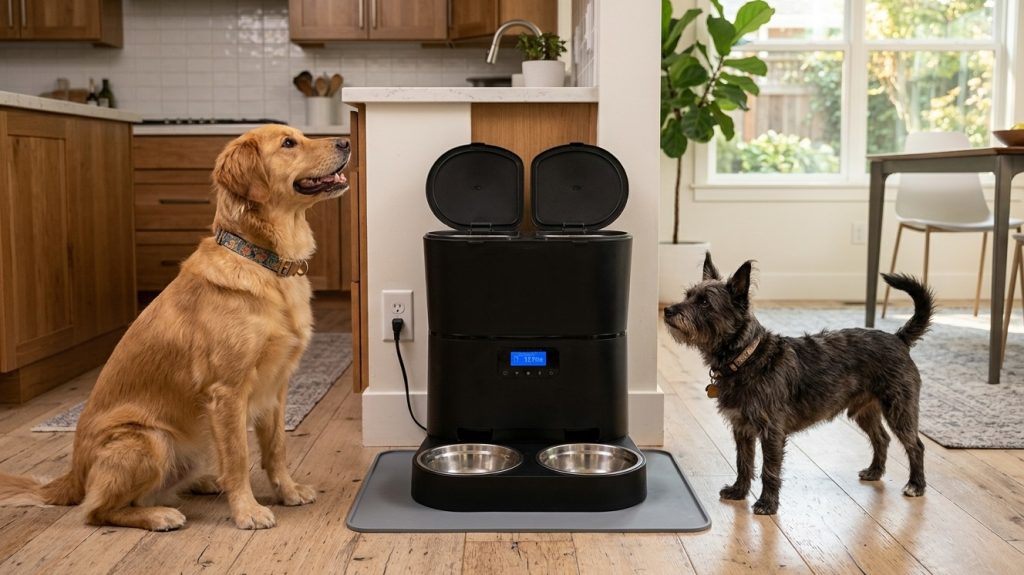
If your home sounds like a stampede of buffalo at 6:00 AM because two hungry pups realized it is breakfast time, you are not alone. Living with two dogs brings twice the affection, twice the tail wags, and twice the chaotic scramble when kibble hits the bowl.
Managing meals for a multi-dog household isn’t just about dumping dry food into dishes. One dog finishes in eight seconds flat and immediately eyes their sibling’s meal. The other takes two polite bites, gets distracted by a passing squirrel, and leaves the rest vulnerable to theft. Add different dietary needs or prescription kibble to the mix, and breakfast suddenly feels like orchestrating air traffic control.
This is why finding the best automatic dog feeder for two dogs becomes an absolute sanity-saver for busy pet parents. An automated setup brings consistency to your home, keeps schedules precise, and helps manage weight and behavioral tensions. However, picking a system that safely serves two distinct personalities requires looking closely at capacity, separation tech, and bowl mechanics.
                     +---------------------------------------+
                     |    TWO-DOG FEEDING CHALLENGES         |
                     |  - Resource Guarding                  |
                     |  - Speed Mismatches (Scorcher/Grazer) |
                     |  - Different Diets & Portion Sizes    |
                     +-------------------+-------------------+
                                         |
                                         v
                     +---------------------------------------+
                     |        SELECT FEEDER TYPE             |
                     +-------------------+-------------------+
                                         |
            +----------------------------+----------------------------+
            |                                                         |
            v                                                         v
+-----------------------+                                 +-----------------------+
|  DUAL-BOWL / HOPPER   |                                 |   MICROCHIP / RFID    |
| - Same Diet           |                                 | - Different Diets     |
| - Equal Eating Speeds |                                 | - Food Aggression     |
| - Similar Weights     |                                 | - Speed Mismatches    |
+-----------------------+                                 +-----------------------+
The Reality of Multi-Dog Mealtimes: Why One Size Doesn’t Fit All
Feeding a single dog is straightforward. Feeding two requires an understanding of pack dynamics, resource value, and biological speed differences.
In multi-pet homes, food is the highest-value currency. Even sweet, docile dogs can display subtle signs of resource guarding—a tense shoulder stance, hard eye contact, or eating so fast they swallow air—when forced to eat side by side.
When you automate this process, you remove yourself as the source of food chaos, which lowers overall anxiety. But if you choose the wrong style of dispenser, you might accidentally create a brand-new arena for mealtime drama. Understanding how to choose the right automatic dog feeder for two dogs? starts with assessing whether your dogs can peacefully share a single footprint or if they require total physical isolation during meals.
Key Types of Automatic Feeders for Two Dogs
Not all two-dog automatic systems operate the same way. The right style depends entirely on how your pups interact around food.
| Feeder Style | Best Suited For | Key Advantage | Main Limitation |
| Single-Hopper Dual Splitter | Dogs on the same diet with balanced temperaments | Cost-effective; feeds both simultaneously from one hopper | Equal portions only; requires proximity between bowls |
| Dual-Hopper Custom Dispenser | Dogs eating different kibbles or different portion sizes | Independent schedule & portion control per side | Larger footprint; higher initial cost |
| Microchip / RFID Selective Feeder | Resource guarders, prescription diets, slow vs. fast eaters | Complete access control; 100% stolen-food prevention | Requires two separate units; dogs must wear collar tags |
| Synced Dual Automatic Feeders | Large breed dogs needing heavy kibble capacity | Keeps dogs physically separated across the room | Requires extra floor space and two power outlets |
1. Single-Hopper Dual-Bowl Splitters
These units use one large central hopper holding dry kibble and a Y-shaped chute at the bottom to split meals evenly into two stainless steel bowls.
-
Pros: Highly convenient, compact design, and keeps both dogs on identical feeding schedules.
-
Cons: Assumes both dogs eat the exact same prescription or meal formula and require the exact same portion size. If one dog is a bully, they can easily push the passive dog away and eat both sides.
2. Dual-Hopper Independent Dispensers
These smart units feature two separate internal food chambers inside a single machine. Each chamber drops food into its own designated side bowl.
-
Pros: Allows you to dispense 1/2 cup of weight-management kibble to your older dog on the left while serving 1 cup of high-protein kibble to your energetic pup on the right.
-
Cons: The bowls are still stationed next to each other. While portioning is independent, physical access isn’t restricted if one dog finishes early and moves over.
3. Microchip and RFID Selective Access Feeders
Instead of relying on timers alone, these high-tech stations feature a locked lid that opens only when it detects your dog’s specific microchip or lightweight collar tag.
-
Pros: Completely eliminates stolen food and resource guarding. The slow eater can leave their bowl for hours without worrying about the household vacuum cleaner—err, golden retriever—stealing it.
-
Cons: These are single-dog stations. To cover two dogs, you must purchase two individual units and place them in separate spots.
What to Look for in Automatic Dog Feeder for Two Dogs
When narrowing down your options, evaluating build quality, capacity, and mechanical safety helps prevent clogged chutes and skipped meals.
1. Total Hopper Capacity (Cups & Pounds)
Two dogs consume food quickly. A small 2-liter feeder that works great for a cat will require refilling every 36 hours when feeding two medium-sized dogs. Look for a hopper holding at least 4 to 6 liters (around 16 to 25 cups) of dry kibble to ensure you aren’t refilling it constantly.
2. Kibble Size Compatibility & Anti-Jam Engineering
Kibble comes in all shapes—spheres, flat discs, cross shapes, and large chunks. Check the manufacturer’s maximum kibble size rating (usually expressed in inches or millimeters, such as 0.15 to 0.6 inches).
Look for internal features like flexible silicone impellers, dual-path agitators, and automatic reverse-rotation motors. If kibble jams while you are away at work, both dogs miss their meal, leading to frustration and potential behavioral issues.
3. Dual Power Supply (AC Adapter + Battery Backup)
Power outages happen. A dependable feeder must plug into a standard wall outlet while carrying a backup battery option (typically D-cell batteries or a rechargeable lithium pack). In the event of a power strip bump or storm, the internal memory retains your schedule and continues dispensing meals on time.
4. Hygienic, Durable Bowl Materials
Plastic bowls scratch easily under dog nails and teeth. Those microscopic scratches harbor bacteria, leading to unpleasant smells and dog chin acne. Prioritize feeders featuring removable 304 food-grade stainless steel or ceramic bowl inserts that lift out easily for dishwasher cleaning.
Matching Mechanics to Your Dogs’ Personalities
To figure out how to choose the right automatic dog feeder for two dogs?, take an honest look at how your dogs act when food is involved.
                   +---------------------------------------+
                   |       ASSESS YOUR DOGS' TYPES         |
                   +-------------------+-------------------+
                                       |
            +--------------------------+--------------------------+
            |                                                     |
            v                                                     v
+-----------------------+                             +-----------------------+
|    THE SYNCHRONIZED   |                             |     THE MISMATCHED    |
|        PAIR           |                             |        PAIR           |
| - Same speed          |                             | - Fast vs. Slow eater |
| - No aggression       |                             | - Special diets       |
| - Same diet           |                             | - Food guarding       |
+-----------+-----------+                             +-----------+-----------+
            |                                                     |
            v                                                     v
+-----------------------+                             +-----------------------+
|  SOLUTION: Dual-Bowl  |                             |   SOLUTION: Microchip |
|  Splitter Dispenser   |                             |   or Separated Units  |
+-----------------------+                             +-----------------------+
Scenario A: The Synchronized Pair
Both dogs are roughly the same weight, eat the same adult maintenance food, finish their bowls in two minutes, and sit politely next to each other.
-
The Match: A dual-bowl single or double-hopper feeder. Because neither dog guards food or leaves scraps behind, a single unit splitting meals equally serves them perfectly without taking up extra space.
Scenario B: The Fast Inhaler vs. The Slow Grazer
Dog A finishes their meal in 30 seconds. Dog B likes to sniff their kibble, eat three bites, take a nap, and come back an hour later.
-
The Match: Microchip-activated feeders or two separate timed feeders placed in different rooms. If you use a standard dual-bowl feeder here, Dog A will finish their portion and immediately eat Dog B’s meal every single time.
Scenario C: The Prescription Diet Need
One dog requires specialized kidney support or weight-loss kibble, while the other eats standard food.
-
The Match: Selective-access RFID feeders or dual-hopper feeders with distinct programming. You cannot use a basic splitter, as mixing formulas or allowing cross-contamination defeats the purpose of prescribed diets.
How Often Should You Use or Replace Automatic Dog Feeder for Two Dogs?
A common question pet parents ask is how often should you use or replace automatic dog feeder for two dogs to keep things running safely and hygienically.
Automatic feeders are designed for daily, continuous use. However, using a device daily means mechanical parts wear down over time, and oils from pet food build up inside the hopper.
Maintenance and Cleaning Schedules
-
Weekly: Wash the stainless steel bowls in warm, soapy water or run them through the dishwasher. Wipe down the dispenser chute with a damp cloth to clear kibble dust.
-
Monthly: Empty the hopper completely. Wash the removable hopper, lid, and dispensing rotor mechanism with mild dish soap. Let every part dry completely before adding fresh kibble—moisture trapped in a sealed hopper creates a breeding ground for mold and storage mites.
-
Every 3 to 6 Months: Replace desiccant bags/packs if your feeder model uses them inside the lid to maintain kibble crispness. Check backup battery levels and replace low batteries.
Lifespan and Replacement Signals
With proper maintenance, a high-quality automatic feeder typically lasts between 3 and 5 years under daily two-dog use. You should replace the feeder if you notice:
-
Frequent motor straining sounds or unresolvable internal gear slipping.
-
Cracking or warping of food-contact plastics that can trap bacteria.
-
Inaccurate dispensing weights (e.g., programming 1 cup but receiving 1/3 cup).
-
Corroded battery compartments or frayed cords.
Behavioral Tips for a Smooth Transition
Introducing automated mealtime gear to two dogs requires a brief adjustment period. Jumping straight to automated dispensing without preparation can startle skittish dogs or provoke mealtime confusion.
+-------------------------------------------------------------------+
|                  4-STEP BEHAVIORAL TRANSITION                     |
+-------------------------------------------------------------------+
| 1. SIGHT & SMELL  | Place unplugged feeder near current bowls.    |
| 2. MANUAL DISPENSE| Trigger manual feed while standing nearby.    |
| 3. SCHEDULED TEST | Let machine run while you observe reactions.  |
| 4. FULL AUTOMATION| Step back and let the machine handle meals.   |
+-------------------------------------------------------------------+
-
Introduce the Hardware Unplugged: Place the new feeder near their usual feeding area for 24–48 hours without turning it on. Let them sniff it while placing their regular bowls nearby so they associate the object with safety.
-
Run Manual Test Dispenses: Trigger a manual portion drop while standing next to them. Reward them with warm praise so the motor sound becomes an exciting cue rather than a scary noise.
-
Supervise the First Week: Never set up a new feeder and immediately leave for a weekend trip. IMO, watching their first dozen automated meals is crucial to ensure neither dog is stealing food or blocking access 🙂
-
Maintain Physical Separation if Needed: If you notice one dog tensing up or staring intently at the other during dispensing, move the bowls further apart or use a divider panel between the dishes.
When to Involve a Veterinarian or Board Certified Behaviorist
While automatic feeders resolve daily scheduling hurdles, they are tools, not complete behavioral fixes.
                                 +---------------------------------------+
                                 |        MEALTIME OBSERVATION           |
                                 +-------------------+-------------------+
                                                     |
                      +------------------------------+------------------------------+
                      |                                                             |
                      v                                                             v
+-------------------------------------------+                 +-------------------------------------------+
|          BEHAVIORAL WARNINGS              |                 |             HEALTH WARNINGS               |
| - Snarling, snapping, guarding            |                 | - Unexplained weight loss/gain            |
| - Complete meal refusal due to anxiety    |                 | - Vomiting from eating too fast           |
+---------------------+---------------------+                 +---------------------+---------------------+
                      |                                                             |
                      v                                                             v
+-------------------------------------------+                 +-------------------------------------------+
| CONSULT: Professional Veterinary          |                 | CONSULT: Primary Care Veterinarian        |
| Behaviorist / Certified Trainer           |                 | for Metabolic Checkup                     |
+-------------------------------------------+                 +-------------------------------------------+
If one of your dogs exhibits serious food aggression—such as snapping, growling, or lunging when food drops—automated splitters will not solve the underlying issue. In these cases, consult a professional veterinary behaviorist to design a safe behavior modification plan.
Similarly, if you notice unexplained weight loss, sudden changes in appetite, or frequent vomiting after meals, consult your veterinarian. An automatic feeder makes portion control easy, but sudden weight shifts warrant a medical checkup to rule out metabolic issues, dental pain, or underlying disease.
Frequently Asked Questions
Can two large dogs share a single automatic feeder?
It depends on the feeder’s capacity and motor strength. Most standard dual-bowl automatic units are designed for cats, small dogs, or medium breeds. Large dogs (over 60 lbs) consume significantly more volume per meal, which can empty a standard 4-liter hopper in just a few days and clog chutes designed for tiny kibble sizes. For two large dogs, using two separate heavy-duty feeders or a large-capacity unit is usually the most reliable route.
What happens if the Wi-Fi drops on a smart automatic feeder?
Quality smart feeders store meal schedules, portion sizes, and timer settings locally on internal memory chips. If your home Wi-Fi disconnects, the feeder will still dispense scheduled meals accurately on time. However, you will temporarily lose the ability to trigger manual feeds remotely or receive real-time push notifications on your phone until connection is restored.
How do I stop one dog from pushing the other away and eating both portions?
If your dogs are using a dual-bowl splitter and one dog finishes quickly to steal the rest, a basic splitter won’t prevent it. You can try installing a physical divider wall between the two bowls to block line-of-sight during meals. If that fails, upgrade to two microchip-activated RFID feeders that open only for the matching collar tag, keeping unauthorized noses out.
Can I feed wet food or canned food in a two-dog automatic feeder?
Most hopper-style automatic feeders are strictly designed for dry kibble, freeze-dried bites, or hard treats. Wet food spoils quickly at room temperature and will ruin internal gears. If you need to dispense wet food on a timer, look specifically for tray-style ice-pack-cooled feeders, though these generally serve single meals and require frequent resetting.
What kibble size works best in dual-bowl automatic feeders?
Uniform, round kibbles measuring between 0.2 inches and 0.5 inches (5 mm to 12 mm) work best in automated impellers. Exceptionally large, flat, or irregular freeze-dried shapes are more prone to bridging—where pieces wedge together above the chute and block the flow. FYI, keeping kibble dry and stored in a cool place prevents pieces from sticking together inside the hopper.
Final Words
Taking the headache out of multi-pet mealtimes comes down to matching the machine to your dogs’ real-world behavior. When you know what features to look for and how their personalities interact, setting up an automated routine keeps breakfast calm, predictable, and stress-free for everyone involved.
Invest in a system built with hygienic materials, jam-resistant mechanics, and dependable dual-power backups. By taking time to observe their habits and choosing the best automatic dog feeder for two dogs, you can enjoy peaceful mornings while knowing your furry family members are well-fed and cared for.









