
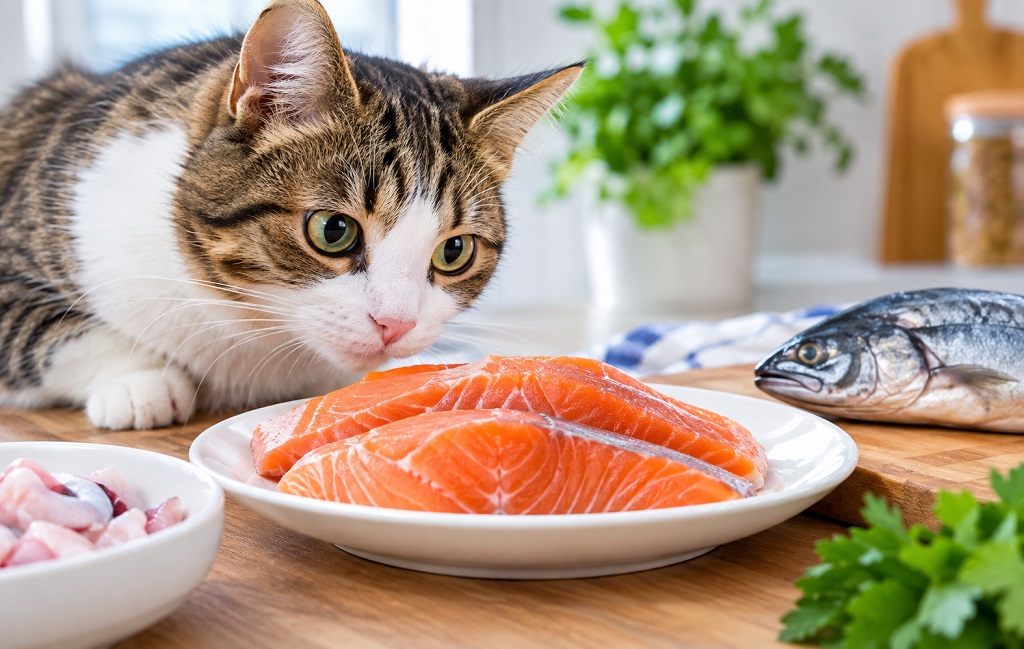
If your cat comes running the moment you open a package of fish, you are definitely not alone. Many cats seem to have a special relationship with anything that smells like seafood. But that naturally leads to an important question: Can cats eat raw fish?
The short answer is yes, cats can physically eat and digest raw fish, but raw fish is not recommended as a regular food for cats. Raw fish can expose cats to harmful bacteria and parasites, and some varieties contain thiaminase, an enzyme that breaks down vitamin B1. Fish bones can create another set of problems.
After 15 years of caring for different pets, I have learned one simple lesson about animal nutrition: just because a pet desperately wants something does not mean it belongs in the food bowl. Cats are remarkably persuasive little negotiators. 🙂
So, can cats eat raw fish safely? There is a difference between being capable of eating something and something being a sensible dietary choice. For most household cats in the United States, properly cooked, plain, boneless fish in moderation is a much safer option.
Can Cats Eat Raw Fish? The Short Answer
Can cats eat raw fish? Technically, yes—but I would not recommend feeding it intentionally or regularly.
Raw fish presents several concerns:
- Harmful bacteria such as Salmonella and Listeria
- Fish-associated parasites
- Thiaminase and the risk of vitamin B1 deficiency with repeated consumption
- Fish bones that may cause choking or gastrointestinal injury
- Nutritional imbalance if raw fish replaces complete and balanced cat food
The CDC specifically does not recommend feeding raw pet food or treats to cats and dogs because raw animal proteins can carry disease-causing germs. The FDA likewise considers raw pet food a significant food-safety concern.
That does not mean a tiny accidental bite of raw fish automatically constitutes an emergency. The risk depends on the amount eaten, the type of fish, how it was handled, and the cat’s health.
Why Do Cats Like Fish So Much?
Cats are obligate carnivores, so animal-based foods naturally appeal to them. Fish has a strong aroma and contains protein and fat that many cats find highly attractive.
However, the idea that cats are supposed to eat fish because cartoon cats have been eating fish for decades is not exactly a scientific nutritional guideline.
In fact, fish does not need to be a major component of a cat’s diet. A properly formulated commercial cat food can contain fish while still being nutritionally complete and balanced.
The important distinction is commercially formulated fish-containing cat food versus feeding raw fish from your kitchen.
The former can be formulated to meet a cat’s nutritional requirements. The latter can introduce food-safety and nutritional problems.
What Happens When Cats Eat Raw Fish?
The risks associated with raw fish are not identical for every species or every cat. Nevertheless, several important concerns deserve attention.
Bacteria and Foodborne Illness
Raw animal-source foods can contain harmful microorganisms.
The FDA and CDC warn about pathogens such as Salmonella and Listeria in raw pet foods. These organisms can make pets sick and can also create risks for people who handle contaminated food, bowls, surfaces, or animal waste.
This is one of the biggest reasons I would not make raw fish part of a cat’s routine diet.
There is also a household consideration. A cat does not need to look sick to make the situation inconvenient. Pathogens can potentially be spread through contaminated food, surfaces, feces, or saliva.
This matters particularly in homes with young children, older adults, pregnant people, or anyone with a weakened immune system.
The AVMA currently discourages feeding raw or undercooked animal-source proteins—including fish—to cats and dogs because of animal and human health risks.
Thiaminase and Vitamin B1 Deficiency
This is one of the more interesting—and frequently overlooked—reasons to avoid regularly feeding raw fish.
Some raw fish contain an enzyme called thiaminase. It can break down thiamine, also known as vitamin B1.
Cats require thiamine for normal energy metabolism and neurological function. Merck Veterinary Manual identifies raw fish diets containing thiaminase as one potential cause of thiamine deficiency in cats.
A cat that develops significant thiamine deficiency can show signs such as:
- Reduced appetite
- Weight loss
- Weakness
- Poor coordination
- Abnormal head or neck positioning
- Neurological abnormalities
- Seizures in severe cases
This does not mean your cat will become thiamine deficient because it stole one piece of raw fish from the kitchen counter.
The concern is much greater when raw fish makes up a substantial or repeated part of the diet.
Cooking is important because heat destroys thiaminase, which is one reason properly cooked fish does not carry this particular raw-fish risk.
Parasites From Raw Fish
Another concern is parasites.
Fish can carry parasitic organisms, and the risk varies according to fish species, geographic location, and preparation. Veterinary references document several fish-associated parasites that can infect cats after they consume raw or improperly prepared fish.
For example, the salmon poisoning fluke Nanophyetus salmincola occurs in the northwestern United States and can infect cats and other animals that consume infected raw or improperly prepared salmon and related fish.
So when researching parasites from raw meat cats can encounter, fish should not be overlooked simply because it looks fresh or smells perfectly fine.
Freezing is also not a universal guarantee of safety. Different parasites have different sensitivities to processing, and freezing does not eliminate every biological hazard associated with raw animal food.
Fish Bones and Choking Risks
Fish bones are another reason to think twice before giving a cat raw fish.
Some cat owners assume cats can safely crunch small bones because wild felines eat prey. Domestic cats, however, are not automatically protected from choking, mouth injuries, gastrointestinal injury, or obstruction.
This is why the answer to “Can cats eat raw fish bones?” should be straightforward:
I do not recommend intentionally feeding raw fish bones to cats.
Bones can become lodged in the mouth or throat, and swallowed bones can potentially cause gastrointestinal problems. Veterinary nutrition guidance also recognizes bones as a potential source of broken teeth, obstruction, and other complications in pets.
Raw Food Risks for Cats
The broader issue is that raw fish is part of the larger category of raw animal-source foods.
The CDC explains that raw pet food can contain harmful germs and that freezing, freeze-drying, or dehydration does not necessarily eliminate all of those germs.
That means “raw” should not automatically be interpreted as:
- More natural
- More nutritious
- More digestible
- Safer
- Better for every cat
The WSAVA Global Nutrition Committee also notes that there is no evidence that raw meat-based diets provide health benefits over properly balanced commercial or cooked diets, while bacterial contamination, parasites, nutritional imbalance, and bone-related risks remain concerns.
In my opinion, this is where pet owners sometimes get caught by the “natural must be better” argument. Fresh grass is natural too, but my cat is not exactly waiting for me to serve a salad.
The goal should be safe, nutritionally appropriate food, not simply food that looks closer to what an animal might encounter in the wild.
Can Cats Eat Raw Fish Bones?
Can cats eat raw fish bones? They may physically swallow them, but that does not make them a safe treat.
Raw fish bones can potentially cause:
- Choking
- Cuts or irritation in the mouth
- Throat injury
- Esophageal injury
- Gastrointestinal obstruction
- Digestive tract injury
Small bones can also be surprisingly difficult to detect once mixed into food.
For this reason, if you decide to give your cat fish, choose fully cooked, boneless fish instead of raw fish with bones.
Can Cats Eat Cooked Fish?
Yes, can cats eat cooked fish? In general, plain, thoroughly cooked, boneless fish can be offered to many healthy cats as an occasional treat.
Cooking has an important safety advantage because it reduces or eliminates many of the pathogens associated with raw animal protein and destroys thiaminase.
Good preparation matters, though.
If you give your cat cooked fish:
- Remove all bones.
- Cook it thoroughly.
- Keep it plain.
- Avoid onion and garlic.
- Avoid spicy sauces and heavy seasoning.
- Avoid excessive salt.
- Do not add butter, rich sauces, or other unnecessary ingredients.
- Give only a modest amount as a treat.
Fish should not replace your cat’s normal complete and balanced diet unless a veterinarian or veterinary nutritionist has specifically designed a diet for that purpose.
How to Prepare Fish Safely for Cats
A simple approach is usually the best one.
For example, a small amount of plain cooked salmon or another appropriate fish can be allowed to cool, carefully checked for bones, and offered as a treat.
Don’t turn your cat’s snack into a restaurant entrée.
Cats do not need lemon butter sauce, garlic seasoning, chili flakes, or a complicated recipe. In fact, some common human-food ingredients can be unsafe for cats.
Also remember that “cooked” does not automatically mean “healthy.” A heavily salted or seasoned fish dish prepared for humans is not equivalent to plain cooked fish prepared specifically as a small feline treat.
How Much Fish Can a Cat Eat?
There is no universal amount that is appropriate for every cat.
Age, weight, health status, activity level, existing diet, and individual nutritional needs all matter.
As a general principle, treats should remain a small part of a cat’s overall diet rather than becoming a substitute for nutritionally complete food.
This is particularly important with fish because cats can become very enthusiastic about foods they enjoy. Once a cat decides something is delicious, negotiating with the tiny dictator can become surprisingly difficult. :/
If your cat has kidney disease, gastrointestinal disease, food allergies, obesity, or another medical condition, ask your veterinarian before introducing additional foods.
What If My Cat Accidentally Ate Raw Fish?
Don’t panic.
If your cat stole a small bite of raw fish, the first step is usually to observe rather than immediately assume the worst.
Consider:
- What type of fish did your cat eat?
- Approximately how much was consumed?
- Was it raw, partially cooked, or previously frozen?
- Were bones swallowed?
- Was the fish seasoned?
- Does your cat have an existing medical condition?
- Is your cat showing any unusual symptoms?
A small accidental bite does not mean a serious illness is inevitable.
However, contact your veterinarian if your cat ate a substantial quantity, swallowed bones, consumed questionable or spoiled fish, or develops concerning symptoms.
Do not attempt to make your cat vomit unless a veterinary professional specifically instructs you to do so.
When Should You Call a Veterinarian?
Contact your veterinarian if your cat develops concerning symptoms after eating raw fish.
Potential warning signs include:
- Repeated vomiting
- Significant diarrhea
- Loss of appetite
- Severe lethargy
- Weakness
- Difficulty swallowing
- Excessive drooling
- Coughing or gagging
- Trouble breathing
- Abdominal pain
- Neurological abnormalities
- Seizures
- Difficulty walking
A swallowed fish bone deserves particular attention if your cat begins gagging, drooling excessively, repeatedly swallowing, pawing at the mouth, or showing signs of pain.
If you are uncertain, calling your veterinarian is preferable to relying on an internet article—including this one.
Safer Alternatives to Raw Fish
If your cat loves seafood, you do not necessarily have to remove fish from its life completely.
A safer approach is to choose a nutritionally complete cat food from a reputable manufacturer and, if appropriate, offer small amounts of plain cooked, boneless fish as an occasional treat.
Commercial cat foods containing fish are formulated differently from a bowl of raw fish from the refrigerator. The food’s overall nutritional composition matters much more than whether the ingredient sounds “natural.”
This is also why I would be cautious about designing a homemade raw diet based on internet recipes.
A cat’s nutritional requirements are more complicated than simply combining meat, fish, and supplements in a bowl.
5 Frequently Asked Questions
1. Can cats eat raw fish?
Cats can physically eat raw fish, but raw fish is not recommended as a regular part of a cat’s diet. It may expose cats to bacteria, parasites, thiaminase, and fish bones.
2. Can cats eat cooked fish?
Yes. Plain, thoroughly cooked, boneless fish can generally be given to a healthy cat in small amounts as an occasional treat. Avoid seasonings, sauces, onion, garlic, and excessive salt.
3. Can cats eat raw fish bones?
Can cats eat raw fish bones? They should not be intentionally fed raw fish bones. Bones may cause choking, injury, or gastrointestinal obstruction.
4. What happens if a cat eats raw fish?
A small accidental amount may cause no noticeable problem, but raw fish can carry bacteria or parasites and some fish contain thiaminase. Monitor your cat and contact your veterinarian if a large quantity was consumed, bones were swallowed, or symptoms develop.
5. Is fish-flavored cat food safe for cats?
Fish-flavored or fish-based commercial cat food can be appropriate when it is formulated as a complete and balanced diet for cats. This is different from feeding raw fish as a regular meal.
Final Words
So, can cats eat raw fish? Technically, they can—but that does not mean you should make it part of their routine diet.
The biggest concerns are foodborne bacteria, parasites, thiaminase-related vitamin B1 deficiency, and fish bones. The CDC does not recommend raw pet food for cats, and the AVMA discourages feeding raw or undercooked animal-source proteins because of potential risks to animals and people.
If your cat loves fish, there is a much simpler option: choose a nutritionally complete cat food and, when appropriate, offer a small amount of plain, thoroughly cooked, boneless fish as an occasional treat.
The key takeaway is not that fish is bad for cats. Raw fish simply carries risks that are unnecessary for most household cats.
And after years of caring for pets, IMO, unnecessary risk is a pretty poor ingredient for any cat’s dinner.









