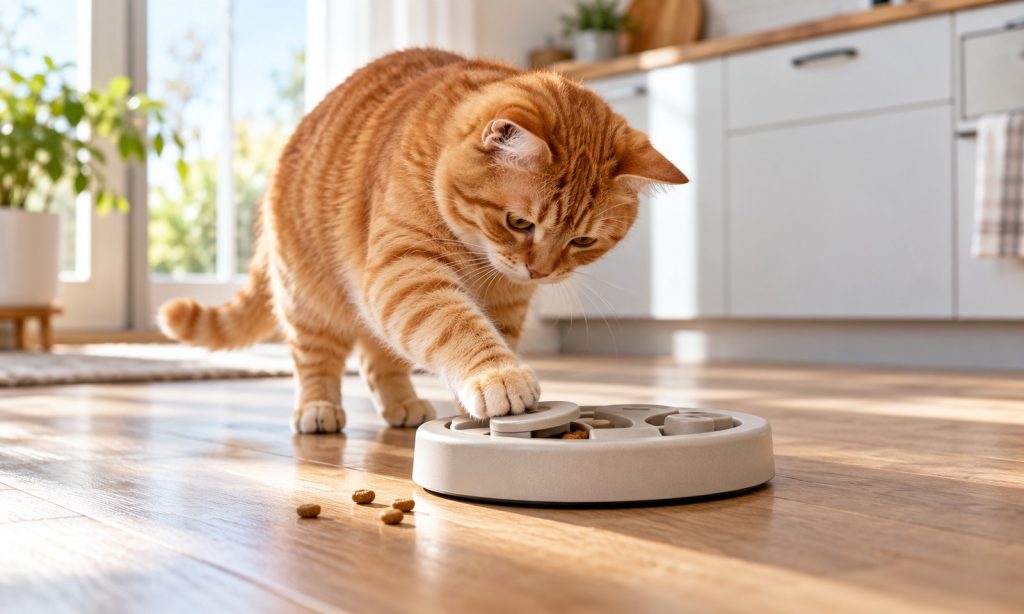
If your cat begs between meals, a puzzle feeder can make part of its daily ration an activity. Interactive feeders vary widely: some hide treats under sliders, while others release kibble as the cat bats or searches. Choose based on your cat’s confidence, mobility, and food type. Consider whether you can supervise and clean the feeder. A puzzle does not replace portion control, and adding treats on top of regular meals can increase daily calories. This guide compares seven feeder styles, with practical strengths and tradeoffs for cats that beg for food. Start with your veterinarian’s feeding guidance and use a measured portion of the cat’s usual food when possible.
Quick Picks
These picks cover several puzzle styles. “Best for” labels describe practical use cases, not a veterinary ranking.
| Product | Best For | Key Advantage | Buy | |
|---|---|---|---|---|
| Nina Ottosson Buggin’ Out Puzzle & Play | Best Sliding-Treat Puzzle | A multi-step sliding puzzle for cats that already show interest in moving pieces. | View on Amazon | Jump to Review |
| TRIXIE Tunnel Slow Feeder | Best Tunnel-Style Feeder | A tunnel layout that spreads food across several openings. | View on Amazon | Jump to Review |
| Doc & Phoebe’s Indoor Hunting Cat Feeder | Best Scattered-Meal Routine | Small mouse-shaped feeders designed to hide portions around the home. | View on Amazon | Jump to Review |
| Nina Ottosson Rainy Day Puzzle | Best Multi-Compartment Puzzle | A compact treat puzzle with several compartments to explore. | View on Amazon | Jump to Review |
| Nina Ottosson Kitty Cube | Best Rolling Food Puzzle | A cube-style activity that releases kibble as it moves. | View on Amazon | Jump to Review |
| ALL FOR PAWS Interactive Puzzle Feeder | Best Stationary Puzzle Board | A board-style feeder that encourages pawing and food discovery. | View on Amazon | Jump to Review |
| PetSafe SlimCat Interactive Feeder Ball | Best Simple Feeder Ball | A rolling ball that dispenses kibble through adjustable openings. | View on Amazon | Jump to Review |
Nina Ottosson Buggin’ Out Puzzle & Play

What We Like
- Level 2 board has 16 treat compartments
- Sliding cups create an adjustable challenge
- Holds up to 1/4 cup of food or treats
- No removable pieces; wipes clean
What We Don’t Like
- Level 2 may be demanding for a puzzle beginner
- Small capacity limits the portion per session
Cats can push the leaf-shaped sliders to uncover treats in the Nina Ottosson Buggin’ Out puzzle. The flat board keeps activity near the floor. Its openings let you set out a small measured portion. This adds enrichment for a cat that begs between meals. Keep the portion measured. The puzzle asks the cat to investigate and move parts, so it offers more interaction than a standard bowl. Start with a few visible treats and demonstrate how the sliders move. Keep the first session short, then make the task gradually harder as your cat learns the pattern. The movable parts make each session tactile, but an owner should check that all pieces remain intact. Offer the board in a quiet place, and put it away between sessions if your cat carries toys around.
The pieces are meant to move. A determined cat may solve them quickly or lose interest. Supervise early sessions and put the board away if your cat chews non-food parts. This is not an automatic feeder. Measure its treats from the cat’s daily allowance. The flat layout sits on a nonslip surface. Food can collect in the grooves, so it needs cleaning. It suits a curious cat that enjoys pawing at objects. A cat that becomes frustrated by puzzles may do better with a simpler feeder ball or a familiar bowl. Its compact board is easy to store between sessions.
My Recommendation
This puzzle suits a curious cat ready to move pieces, and its sliding cups offer an adjustable challenge. Use a measured part of the daily ration, supervise early sessions, and store the board if your cat chews toys. Pick a simpler feeder if frustration outweighs interest.
TRIXIE Tunnel Slow Feeder

What We Like
- Tunnel-style layout with several food openings
- Holds up to 2 cups of dry food
- Non-slip rubber pads help stabilize the feeder
- Simple format for treat-powered play
What We Don’t Like
- Listing specifies dry food
- Tunnel layout may be easy for experienced puzzle users
The TRIXIE Tunnel Slow Feeder places dry food or small treats along a track with multiple openings. A cat can reach through the gaps and move pieces around rather than gulping from a full bowl. Its low, elongated form gives the cat several access points, which can be useful when you want a simple activity that still feels different from a standard dish. Introduce only a small amount at first and show your cat where the food sits. For a cat that begs shortly after meals, you can reserve a measured portion of the regular ration for the feeder, keeping the overall daily amount consistent. Its open track also lets you see whether food remains after a session. Keep the feeder separate from other pets during use, and collect leftover pieces instead of letting them sit out all day.
This design is simpler than a puzzle with several movable components, so an experienced cat may finish quickly. It also works best with kibble or appropriately sized dry treats; wet food can make the track harder to clean. Check the product dimensions and feeding openings against your cat’s size and preferred food. The feeder does not set portions or prevent access to other pets’ meals, so supervise if food guarding is an issue. The track needs regular cleaning to remove crumbs and oils. Choose it when you want a straightforward, reusable feeder for dry food. Pick a more adjustable puzzle if your cat needs a longer challenge.
My Recommendation
Choose this tunnel feeder if you want a dry-food activity with more capacity than a small treat puzzle. Its non-slip pads help keep it in place. Start with a measured amount, and consider a more complex board if your cat solves the track too quickly.
Doc & Phoebe’s Indoor Hunting Cat Feeder

What We Like
- Set includes three feeder mice and a scoop
- Lets you hide portions around the home
- Search format encourages food-finding activity
- Locations can vary from meal to meal
What We Don’t Like
- Three units need filling and retrieval
- Hidden feeders must remain accessible to the cat
Doc & Phoebe’s Indoor Hunting Feeder uses small mouse-shaped containers that hold portions of dry food. Instead of serving the full meal in one place, you can hide the feeders in accessible spots and let your cat search them out. The routine offers scent-led activity and can turn part of mealtime into a home exploration task. Begin by placing the feeders in easy-to-find locations, then adjust their positions as your cat learns. Use the cat’s measured daily food rather than adding extra treats, especially when the goal is to manage persistent begging and maintain a consistent feeding plan. This approach can be introduced gradually by moving one feeder at a time to a slightly less obvious spot. Keep all hiding places reachable, and count every filled mouse when measuring the meal.
This setup requires more preparation than placing food in a bowl. You need to portion the meal, remember where each feeder is hidden, and collect the containers afterward. Some cats may bat, chew, or carry the mouse-shaped pieces, so supervise until you understand how your pet handles them. The product is designed around dry food; check current directions before trying other textures. It may not suit households where another animal can find the hidden food first or where the cat has limited mobility. Choose it if your cat enjoys searching and you can manage a repeatable routine. A stationary puzzle may be easier for cats that prefer a single feeding location.
My Recommendation
This set fits owners willing to portion and hide food in several spots. The three mice make search-based feeding possible, but they require setup and retrieval. Keep hiding places easy to reach, supervise the first sessions, and count the full meal before placing the feeders.
Nina Ottosson Rainy Day Puzzle

What We Like
- Level 3 puzzle has 19 treat spaces
- Sliding pegs and spinning covers add steps
- Easier and harder setup options are described
- Hand-wash instructions are provided
What We Don’t Like
- Level 3 may frustrate cats new to puzzles
- Hand-washing adds cleanup steps
The Nina Ottosson Rainy Day puzzle gives cats multiple compartments where you can place small treats or pieces of kibble. The cat works through the openings and movable covers to find the food, creating a focused mealtime activity on a stable surface. Multiple compartments let you spread a small measured portion across the board, which can make the eating process last longer than using a plain dish. Start with some food easy to see, then show your cat how to interact with the puzzle. It can be a good step for an indoor cat that is interested in pawing and sniffing but has not used a complex feeder before. Several spaces can make a small portion feel more varied without requiring the cat to chase a moving object. Let your cat finish at its own pace, and end the session if it starts biting the covers.
The extra covers create a few parts to clean and check after each session. Food residue can remain in small spaces, so follow the current care instructions and dry it fully before storage. A fast learner may clear the puzzle in little time, while a cat with low interest in objects may need a simpler introduction. This is a supervised enrichment toy rather than a portion-control appliance; measure food separately and account for every treat in the daily plan. Keep the puzzle on a steady floor or mat so it does not slide during use. Consider it for cats ready to explore several compartments. If your cat gets frustrated, reduce the difficulty or choose an open feeder.
My Recommendation
This advanced puzzle may suit a cat already comfortable with treat games. Its pegs and moving covers offer several steps, while the hand-wash directions are straightforward. Start with the easier setup and reduce the challenge if your cat seems frustrated.
Nina Ottosson Kitty Cube

What We Like
- Ten treat cups inside a rolling cube
- Holds up to 3/4 cup of food or treats
- Batting motion releases the food
- Easy-clean design is described in the listing
What We Don’t Like
- Rolling cube can travel under furniture
- Kibble size affects how smoothly food releases
The Nina Ottosson Kitty Cube is a rolling food puzzle that releases kibble as the cat bats it around. This gives active cats a chance to work for part of their meal with movement and paw play. The adjustable difficulty can help you begin with easier access and make the task more challenging when your cat understands the toy. Use a small measured amount of dry food, then observe how the cube moves on your floors. It may fit a cat that begs for food soon after finishing a bowl, while adding a short activity to the feeding routine. A short supervised trial can show whether your cat likes this kind of movement before you make it part of a meal routine. Clear the play area of breakable objects and retrieve the cube after use.
A rolling feeder can travel under furniture or make noise on hard flooring, so choose the play area carefully. The toy is not ideal for every cat, especially one that avoids moving objects or has trouble chasing them. It also requires supervision until you know whether your cat bats the cube or bites it. Confirm the current package directions for adjustment and cleaning. Kibble size affects how easily food comes out, so test a small amount first and avoid filling beyond a suitable portion. This product may engage a playful, mobile cat. A stationary puzzle or scattered feeder can be more practical for quieter cats or households where noise and rolling objects are a concern.
My Recommendation
The Kitty Cube suits a mobile cat that enjoys batting toys across the floor. Its ten treat cups and rolling action distinguish it from stationary boards. Try a small kibble portion in a clear area, and choose a flat puzzle if the cube rolls out of reach.
ALL FOR PAWS Interactive Puzzle Feeder

What We Like
- Difficulty can be adjusted as a cat learns
- Multi-module maze layout
- Non-slip feet help keep the board in place
- Detachable parts support cleaning
What We Don’t Like
- Detachable modules add parts to wash
- Adjustable difficulty takes setup before use
The ALL FOR PAWS Interactive Puzzle Feeder offers a stationary board for hiding small portions of food in different spaces. Your cat can sniff and use its paws to explore the compartments, making the meal more engaging than a smooth bowl. The format keeps the activity in one place, which may appeal to owners who do not want a rolling toy moving around the room. Set out a measured amount of dry food or treats according to the product directions. Leave some pieces easy to find at first, then let your cat work through the layout at a comfortable pace. The fixed layout also makes it easier to offer the same simple activity in a familiar spot. Keep the board away from water bowls, and inspect the surface for food residue after each use.
A stationary board still needs a nonslip location and regular cleaning, particularly if food crumbs settle in corners. The challenge level may be too easy for some cats and too demanding for others. Watch for signs that your cat is losing interest or becoming frustrated, and adapt the amount and placement of food. It does not dispense a controlled daily ration, so keep the cat’s total food plan in view. Verify the product’s current dimensions and material instructions before buying, especially if you need a dishwasher-safe design. It suits a cat that likes paw-based exploration. A food ball may better engage a cat that prefers to chase objects through the house.
My Recommendation
This board is a practical choice when you want a stationary puzzle with adjustable difficulty and removable modules. Set it on a stable surface, then match the challenge to your cat’s experience. Its parts need cleaning, so it suits households comfortable with that upkeep.
PetSafe SlimCat Interactive Feeder Ball

What We Like
- Adjustable openings fit different kibble sizes
- Rolling ball encourages batting and chasing
- Can serve treats or part of a meal
- Distributes meals into smaller portions
What We Don’t Like
- Ball can roll beneath furniture
- Only kibble that fits the openings will dispense
PetSafe SlimCat is a rolling feeder ball with openings that release dry food as the cat bats and rolls it. The opening size can be adjusted, allowing you to tune the flow for the kibble you use and your cat’s interest. This is a simple way to divide part of a measured meal into an active task, rather than leaving the whole portion in a bowl. Begin with the easiest setting and a small amount of food. Observe whether the ball moves smoothly on your floors and whether your cat understands that rolling it makes kibble fall out. Try the ball on both carpet and hard flooring if those surfaces are safe in your home. Remove it after the meal so kibble does not continue to dispense when your cat is no longer supervised.
The ball can roll beneath furniture, make sound on hard surfaces, and scatter pieces across the floor. It works only with dry food that fits through the openings, and the setting may require adjustment to avoid releasing food too quickly or too slowly. Because it is a rolling toy, supervise the first sessions and check it periodically for damage. It does not measure a daily ration by itself; portions still need to be counted as part of the cat’s food plan. Choose it for a cat that enjoys batting objects and can safely chase them. A flat puzzle board may be easier for a cat with reduced mobility or a household that needs a fixed feeding station.
My Recommendation
The SlimCat is a simple choice for a cat that likes to chase moving toys. Adjustable openings let you tune kibble release, but portions still need measuring. Try it on a safe surface and supervise before making it part of a regular feeding routine.
How to choose Best Interactive Feeder for Cats That Beg for Food
Choose a feeder that makes the existing meal more engaging while keeping the amount of food predictable. Consider your cat’s experience, mobility, preferred food, and the time you can spend preparing and cleaning the toy. Introduce one change at a time, watch your cat use it, and keep the feeder safe and accessible.
Start at your cat’s puzzle level
A beginner may do best with visible food and a simple track, feeder ball, or open compartment. A cat that already paws at toys may enjoy sliders or covered wells. Make the first session easy by placing food where it can be found quickly. If your cat walks away, paws frantically, or chews the toy, reduce the challenge or try another format. The goal is a calm, repeatable activity, not a test your cat must pass.
Match the feeder to food and portions
Check whether the design accepts dry kibble, treats, or other textures. Confirm that pieces fit through its openings. Use a measured part of the regular ration when the feeder is meant for meals. Count any added treats toward the daily amount. A puzzle does not decide how much your cat should eat, and it may release food unevenly. For portion planning, see our cat feeding guide. If your cat eats too quickly, compare these ideas with our slow feeder options for cats.
Consider supervision, cleaning, and your home
Movable toys can roll under furniture, while stationary boards may slide or collect crumbs in small spaces. Choose a safe spot and supervise initial use. Watch for chewing or other pets taking the food. Clean and dry the feeder as its current instructions direct. A design that is difficult to wash can quickly become inconvenient. Think about noise, storage, and how much setup fits your routine. For more context on feeder styles and daily use, read our guide to choosing a cat slow feeder. Select the simplest design your cat will use consistently, then reassess if mealtime behavior or appetite changes. Wash food-contact surfaces as directed and inspect moving parts for wear. Store small puzzle components where pets cannot chew them unsupervised. Take time to watch how your cat handles each session. A feeder that is easy to reset and clean is more likely to fit into everyday meals.
Frequently Asked Questions
Can an interactive feeder help with begging?
It can make part of a measured meal more engaging, but it does not address every cause of begging. Check feeding amounts and health concerns with your veterinarian.
Can I put my cat’s regular food in a puzzle feeder?
Many designs are intended for dry kibble or treats. Confirm the product directions and use a measured amount from the daily ration.
How should I introduce a puzzle feeder?
Begin with an easy setting and visible food. Supervise and increase difficulty only if your cat remains interested and comfortable.
Are puzzle feeders suitable for every cat?
No. A cat’s mobility, feeding needs, and preferences matter. Ask a veterinarian if your cat has a medical condition or a prescribed diet.
How often should I clean a cat feeder?
Follow the current care instructions and clean food-contact areas regularly. Remove residue and dry the feeder before storing it.
Final Verdict
The best interactive feeder for cats that beg for food is one your cat can use safely and that fits a measured feeding routine. Start with an easy design, supervise, and adjust based on your cat’s interest. Choose the feeder style that makes daily feeding workable for both of you.
Affiliate disclosure: This article contains Amazon affiliate links. If you purchase through them, PetAdvisorPro may earn a commission. As an Amazon Associate I earn from qualifying purchases.