
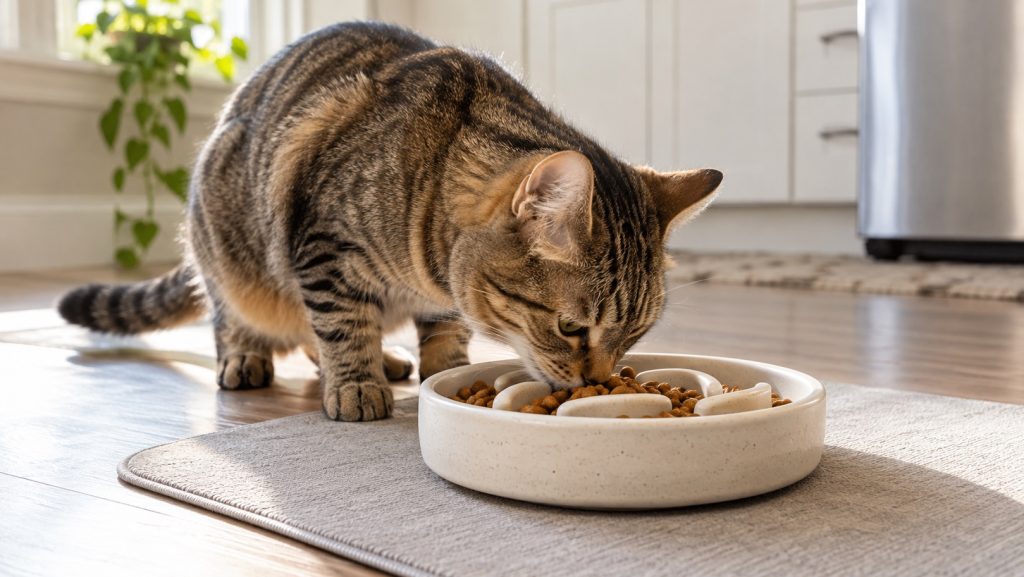
You set down breakfast, turn to rinse the spoon, and discover your cat has already finished. If meals regularly disappear that quickly, you may wonder whether a different bowl would make feeding more manageable. The best slow feeder bowl for cats is one your cat can use comfortably while still getting the food they need.
Choosing a slow feeder bowl for cats starts with access, not complexity. Look for reachable food spaces, a steady base, and a surface you can clean thoroughly. Then match the layout to your cat’s food, size, and abilities. Dinner does not need to become an entrance exam. A useful feeder adds manageable pauses without making every bite a struggle.
What Is a Slow Feeder Bowl for Cats?
A slow feeder has raised ridges, channels, or separate food compartments rather than one open basin. These features divide the meal into smaller accessible areas. Depending on the layout, your cat may eat around the ridges, lick food from shallow spaces, or retrieve pieces with a paw.
A slow feeder bowl for cats is one type of stationary feeding puzzle. Rolling dispensers and other food puzzles work differently, so their benefits and limitations should not automatically be assigned to every ridged dish.
Veterinary feeding guidance includes appropriate puzzle feeders among ways to offer small meals and opportunities to forage. That supports considering feeding enrichment, but it does not establish that every slow bowl delivers the same results. Feline feeding consensus statement.
Decide What You Want to Change
Before choosing a bowl, watch several ordinary meals. Does your cat rush through food, leave awkward pieces behind, push the dish across the floor, or check constantly for another pet? Each situation points to a different adjustment. If your cat eats comfortably at an unhurried pace, a complicated feeder may be unnecessary. If another cat steals meals, changing the bowl alone leaves the main problem unresolved.
Use a slow feeder bowl for cats as a feeding tool, rather than assuming it will correct every mealtime concern. Write down your goal: a more measured pace, a simple food activity, or easier portion distribution. This gives you something useful to evaluate after the change.
Slower eating is not proof that a digestive problem has been solved. Recurrent vomiting deserves veterinary attention rather than repeated experiments with feeding equipment. Cornell Feline Health Center: Vomiting.
What to Look for in a Slow Feeder Bowl for Cats
Shallow, Reachable Food Spaces
Inspect the interior, not just the outside dimensions. Can your cat reach food near the center and edges without pressing their face between tall barriers? Are the channels wide enough for the food you serve?
A broad dish can still have cramped grooves. Likewise, a bowl described as small may have a more accessible layout. There is no single groove depth or diameter that fits every cat, so judge usable space against your individual animal.
For a first slow feeder bowl for cats, prioritize easy access. A flat-faced cat, a cautious eater, and a confident paw-user may respond differently to the same design. Avoid treating a deep maze as an automatic improvement over shallow ridges.
Compatibility With Wet or Dry Food
For dry food, consider whether individual pieces fit between the ridges and remain retrievable. Very narrow channels may trap larger kibble. Piling food above the ridges can also defeat the intended layout.
For wet food, think about both serving and cleanup. Can you distribute the food across accessible sections without forcing it deep into corners? Could you remove every trace afterward?
If your cat eats both textures, assess each separately. A layout that works for kibble may be inconvenient for chunky wet food. FYI, a dish that holds food is not necessarily a dish that makes that food easy to reach.
Usable Capacity
Check how your normal measured serving sits inside the feeder. Total advertised capacity may include space above the obstacles, which tells you little about how the meal will function.
Measure the portion before placing it in the bowl. For example, if an established feeding plan calls for a measured amount of kibble at breakfast, distribute that amount rather than filling every compartment by eye.
Do not add food simply to make a large feeder look full. If your serving cannot be arranged sensibly, choose a different layout or discuss meal distribution with your veterinarian.
Materials and Surface Condition
Look for clear information confirming that the bowl is intended for food contact. Check the care instructions, including dishwasher compatibility and any temperature restrictions. Material names alone do not establish quality or suitability.
Inspect for rough edges, cracks, peeling surfaces, and poorly finished seams. With ceramic, check the glaze and chips. With flexible materials, consider whether your cat tries to bite or pull the feeder apart.
IMO, a simple, intact surface you can inspect and clean easily deserves more attention than decorative complexity. No material removes the need for regular washing and condition checks.
Stability on Your Actual Floor
Place the empty bowl where meals normally happen and check for rocking or sliding. Then observe it during supervised feeding. A dish that moves whenever your cat touches it adds an avoidable obstacle.
A nonslip base or washable mat may help, but inspect underneath too. Food and moisture can collect between the bowl and its supporting surface.
When evaluating a slow feeder bowl for cats, include the whole setup: bowl, floor, feeding location, and your cat’s approach. A stable dish in a crowded walkway may still be an inconvenient choice.
Cleaning Access
Before committing to a layout, imagine washing its tightest corner. Can a brush reach the bottom of every channel? Can removable parts be separated and reassembled easily?
A practical test is whether you can see and touch all food-contact surfaces during cleaning. If residue remains hidden beneath a fixed ridge or inside a seam, consider a simpler dish.
Convenience matters because the bowl becomes part of your daily routine. An elaborate pattern loses its appeal when breakfast leaves behind a miniature archaeological site.
Match the Feeder to Your Individual Cat
Think about ability as well as age. A senior cat may need an easy layout, but an older cat who enjoys pawing at food may respond differently from one with limited mobility. Kittens also need access appropriate to their size and feeding requirements.
For cats with dental pain, mobility difficulties, or an existing medical condition, ask your veterinarian whether changing the feeding setup is appropriate. Food access and adequate intake come first.
As practical selection advice, start with the least demanding arrangement that addresses your goal. A slow feeder bowl for cats should fit the animal using it today, rather than an imagined future puzzle-solving champion.
Observe posture as well as enthusiasm. Repeatedly twisting, reaching awkwardly, or abandoning otherwise familiar food is a reason to reassess the setup.
How to Introduce a Slow Feeder Without Frustration
Introduce the change gradually using familiar food. Begin with a small part of the usual meal in easily reached sections, while ensuring your cat can obtain the rest comfortably.
Let your cat investigate without repeatedly moving the dish toward their face. During early attempts, supervise and check whether food is actually being eaten rather than merely moved around.
If the challenge seems excessive, simplify it. You can use fewer accessible sections or return to the familiar dish while reconsidering the design. Do not withhold food to force acceptance.
A veterinary review of feline food puzzles recommends starting with easy access and adjusting difficulty to the cat’s skills. It also discusses initially offering a puzzle beside the familiar feeding container for cats who prefer that approach. Food puzzles for cats.
Your first priority is successful eating. Increase use only when your cat remains comfortable and consumes the intended amount.
Monitor Intake, Not Just Meal Length
A longer meal can reflect thoughtful engagement, but it can also reflect inaccessible food. Check what remains in the bowl and whether your cat returns to finish it.
For a few days, note the amount offered, leftovers, willingness to approach, and any changes in eating behavior. Use these observations to judge the feeder rather than aiming for a specific number of minutes.
There is no universal meal-duration target for every cat. Avoid making a healthy eater work harder merely to reach an arbitrary time.
If you are using a slow feeder bowl for cats alongside a weight-management plan, keep portions within that plan. Changing the dish is not permission to reduce food abruptly or assume weight loss will follow.
Make Separate Arrangements in Multi-Cat Homes
Watch who gets access to each meal. One cat may linger over a feeder while another finishes quickly and moves in. A slower dish can therefore make supervision more necessary during the transition.
Provide individual feeding spaces where you can check each cat’s intake. Different rooms or separated locations may be more practical than putting every bowl side by side.
Feline feeding guidance emphasizes feeding arrangements that account for competition and each cat’s needs. Choosing an appropriate location belongs in the plan alongside choosing the dish.
Keep dogs away from cat meals too. The feeder cannot help your cat eat comfortably if another animal is waiting to take over.
How Often Should You Use or Replace a Slow Feeder Bowl for Cats?
Set Frequency by Successful Use
There is no universal schedule requiring every cat to use a slow feeder at every meal. Begin with supervised use and evaluate comfort, access, and intake.
If it works well, you may incorporate it into the established routine. If it causes difficulty, use the familiar dish and reconsider. Cats whose food intake or meal timing needs close medical management should have feeding changes discussed with their veterinarian.
Keep the routine workable for your household. A feeder that requires more supervision than you can provide may be unsuitable for an unattended meal.
Wash After Each Use
The FDA advises washing pet food bowls and measuring utensils with soap and hot water after each use. Follow the bowl’s care instructions, rinse thoroughly, and allow cleaned components to dry. FDA pet-food handling guidance.
Pay attention to corners and removable bases. Promptly refrigerate or discard leftover canned or pouched food; do not leave wet residue in the feeder for the next meal. Follow the food’s storage directions.
Replace According to Condition
A slow feeder bowl for cats does not have a universal replacement date. Inspect it regularly and replace it if cracks, chips, loose pieces, sharp edges, or damaged surfaces make continued use unsuitable.
Persistent trapped residue or deterioration despite proper cleaning is another reason to retire it. Reassess fit as well: an intact bowl can still become inappropriate if your cat’s eating ability changes.
When to Contact Your Veterinarian
Contact your veterinarian for repeated vomiting, reduced appetite, unexplained weight loss, or apparent difficulty eating. Cornell advises prompt evaluation when vomiting is frequent or accompanied by signs such as lethargy, weakness, diarrhea, blood, or appetite changes.
Do not wait for hunger to persuade a cat to accept a new feeder. Cornell notes that sustained appetite loss can seriously affect an adult cat within as little as 24 hours, with very young kittens vulnerable sooner. Seek advice promptly when your cat stops eating.
Five Frequently Asked Questions
How to choose the right slow feeder bowl for cats?
Match accessible food spaces to your cat’s usual food and abilities. Then check stability, usable capacity, and cleaning access. Start with an easy layout and judge success by comfortable eating and adequate intake.
Can cats use slow feeders with wet food?
Some layouts can accommodate wet food, but check intended use. Choose accessible sections you can clean completely, and follow safe handling and storage instructions. Avoid packing food into spaces your cat cannot reach.
Will a slow feeder stop my cat from vomiting?
It is not a guaranteed solution. Vomiting has multiple possible causes. If it recurs or accompanies other concerning signs, contact your veterinarian instead of assuming that meal speed explains it.
What if my cat refuses the new bowl?
Restore reliable food access, then try a gentler introduction or simpler layout. Check for trapped food and awkward positioning. A continuing appetite change warrants veterinary advice, even if it began around the switch.
Are slow feeders necessary for every cat?
No. Choose feeding equipment around a specific need. A comfortable cat eating an appropriate amount may do well with a familiar dish, while enrichment can be offered in other suitable ways.
Final Words
The best slow feeder bowl for cats makes meals manageable: reachable food, a stable setup, and straightforward cleaning. Choose for your cat’s actual needs, introduce it gently, and keep checking intake.
Your cat’s response tells you whether the change belongs in the routine. A successful feeder supports comfortable eating; if it does not, adjust the arrangement and seek veterinary guidance when health concerns arise.









