
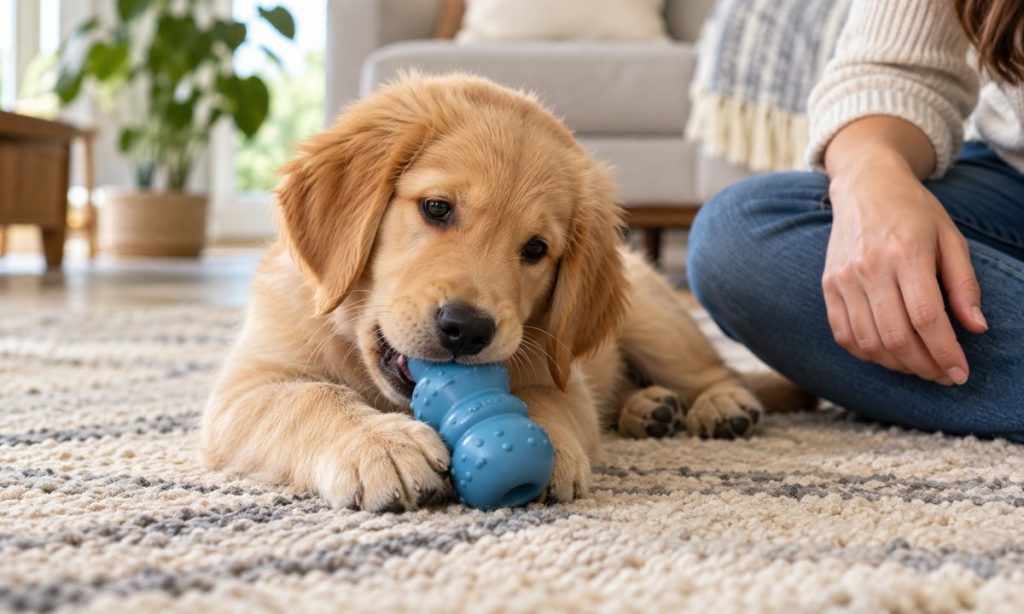
Puppies chew as they explore and grow, but not every chew toy is safe for every puppy. A suitable toy should match the puppy’s current size, chewing strength, and stage of development. It should be large enough to avoid swallowing, soft enough to reduce the risk of tooth damage, and sturdy enough not to shed pieces during supervised use. Check seams and parts often, and remove the toy if it cracks or becomes small enough to fit entirely in the puppy’s mouth. Teething discomfort can change how a puppy chews, so offer a safe outlet and redirect calmly when the puppy mouths hands or furniture. This guide explains what to check before choosing a chew toy for puppies teething. For additional selection context, see this guide to how to choose the right chew toy for puppies teething.
Start with your puppy’s age and size
A puppy grows quickly, so a toy that fit last month may now be too small. Follow the toy’s size guidance, then inspect the actual dimensions and shape. Avoid anything the puppy could swallow whole or lodge behind the teeth. A toy that is too large or awkward may also be difficult for a small puppy to hold and chew safely.
Age recommendations are useful, but they do not account for every puppy’s jaw, bite, or play style. Ask your veterinarian if your puppy has a retained baby tooth, oral pain, an unusual bite, or a recent dental procedure.
Choose a suitable texture and construction
Puppy chew toys should give slightly under pressure rather than feel like stone. Very hard objects can damage teeth. Avoid cooked bones, antlers, hard hooves, and other rigid items unless a veterinarian has specifically advised otherwise. A toy’s label does not guarantee it is safe for every chewing style.
Inspect the toy for small attachments, sharp edges, exposed filling, loose threads, and seams that could split. Avoid long cords or loops that could wrap around the mouth or neck. If the toy has a squeaker or removable part, use it only while supervising and stop if the puppy tries to extract it.
Match the toy to your puppy’s chewing style
Some puppies mouth gently, while others bite down hard or try to tear objects apart. Watch how your puppy handles a new toy instead of assuming the material is durable enough. If the puppy rips off chunks, remove it and choose a safer activity. A toy should be chewable without becoming a collection of swallowable pieces.
Supervise every new chew toy session. Stay close enough to intervene if the puppy chokes, breaks the toy, or guards it. Do not reach into a puppy’s mouth abruptly; if an object is lodged or the puppy is struggling to breathe, contact an emergency veterinarian.
Keep the toy clean and in good condition
Choose a toy that can be washed and dried as directed. Food residue can collect in grooves, so inspect crevices after each use. Replace a toy with cracks, torn sections, loose parts, or a size that no longer suits your puppy. Do not let the puppy chew unsupervised on a damaged toy.
If a toy is designed to be chilled, follow the maker’s instructions and ask your veterinarian before freezing it. Excessively hard or frozen objects may be uncomfortable for some puppies. Avoid adding foods that are unsafe for dogs or unfamiliar to your puppy.
Use chewing as a chance to teach
Keep appropriate toys within reach and calmly redirect your puppy when it chews furniture, clothing, or hands. Reward the puppy for choosing its toy. Avoid yelling or rough handling, which can increase excitement or fear. Short play and training breaks can provide other outlets for energy and attention.
A puppy’s chewing can continue after baby teeth are replaced. If chewing is excessive, destructive, or accompanied by drooling, bleeding, appetite changes, or apparent pain, ask a veterinarian to examine the mouth. You can also read the published guide to why dogs chew and safer ways to redirect it.
Rotate safe options and watch for warning signs
Offer a small set of appropriate toys and rotate them to keep the puppy interested. Do not give access to several new chews at once; a single supervised session makes it easier to see how the puppy handles each item. Keep children’s small toys, socks, and household objects out of reach so the puppy has clear, safe choices.
Mild red staining on a chew toy can occur as baby teeth loosen, but heavy bleeding, swelling, persistent drooling, refusal to eat, or obvious pain deserves veterinary advice. A veterinarian can check that baby teeth are shedding and adult teeth are coming in normally.
Inspect the toy between sessions
Check the whole toy before each use, including the inside of hollow designs and any flexible flaps. Look for tooth marks that have become cracks, missing pieces, stretched seams, and rough edges. If the toy is damaged, discard it so the puppy cannot swallow fragments later.
Use a toy only for its intended purpose. A chew toy is not automatically appropriate for tug, fetch, or unsupervised crate time. If your puppy guards a chew, separate pets and children during use and ask a trainer or veterinarian for help with safe handling.
Frequently Asked Questions
How do I know if a chew toy is too hard?
If it feels rigid and does not give under pressure, it may be too hard for chewing. Ask your veterinarian about safe options for your puppy’s teeth and chewing style.
Can I leave my puppy alone with a chew toy?
Supervise new toys and puppies that chew aggressively or tear objects apart. Remove any toy that breaks or sheds pieces.
Should I choose a toy that says “indestructible”?
Treat that wording cautiously. No toy is indestructible for every dog, and regular inspection and supervision still matter.
What if my puppy swallows part of a toy?
Call your veterinarian promptly for advice, especially if the puppy vomits, seems weak, has pain, or cannot pass stool. Do not try to induce vomiting unless a veterinarian directs you.
When should I ask about teething discomfort?
Ask your veterinarian if your puppy stops eating, has significant bleeding, persistent bad breath, visible oral injury, or teeth that appear crowded or retained.
Final Words
Choose a chew toy for puppies teething that fits your puppy now, has no easy-to-swallow parts, and gives some flexibility rather than feeling rock hard. Supervise use, inspect it often, and remove it when damaged. Redirect chewing calmly and ask your veterinarian about mouth pain or unusual dental changes. The related guide to how to choose the right chew toy for puppies teething offers further context.









