Planning the area before ordering helps prevent short rolls, awkward seams, and turf that blocks a gate or drain. To size artificial turf for dogs, measure the ground your dog will actually use, sketch obstacles and edges, then match the dimensions to the available roll width and the manufacturer’s layout directions. The total square footage is only the starting point: irregular corners, seams, trimming, drainage, and a safe route for people also affect the order. This guide shows a simple measurement method for rectangles and odd-shaped spaces, explains how to estimate extra material without overbuying, and flags site conditions that should be addressed before installation. For a permanent yard or dog run, verify the plan with a qualified installer before digging.
Decide what area the turf needs to cover
First identify the purpose: a small potty patch, a play zone, a kennel run, a balcony section, or a larger yard. Mark the boundaries with string, chalk, or landscape flags. Include the space the dog uses to turn, lie down, and move between entrances, but leave access to gates, drains, cleanouts, irrigation boxes, and other equipment. If the area is shared with people, mark a walking route and any furniture or shade structure that must remain outside the turf footprint.
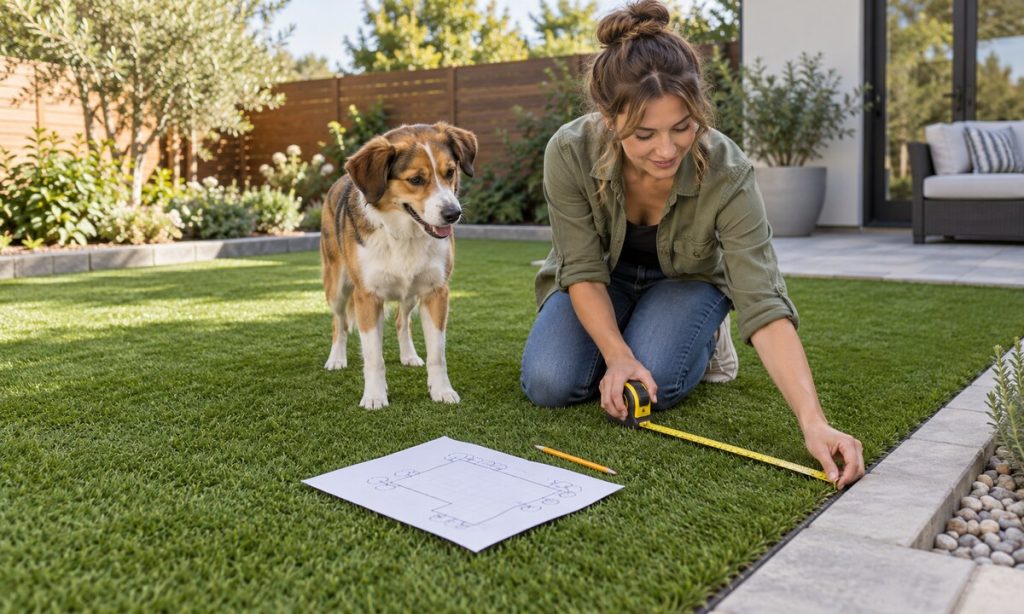
Walk the planned boundary and look for slopes, low spots, roots, tree trunks, edging, posts, steps, and changes in surface. Draw these on a quick overhead sketch. Measure from the inside edge where the turf will sit, not from a fence or wall that the finished turf will not touch. For a narrow strip between a house and fence, record the width at several points because the two edges may not be parallel.
Before measuring a large area, decide whether the whole yard needs synthetic turf. A compact dog-use zone with natural grass, paving, or gravel around it may be more practical than covering every available surface. Consider shade and water access too: artificial turf can become hot in direct sun, so dogs need a cool resting area and fresh water.
Measure a rectangular area
For a rectangle, measure the length and width in feet, then multiply them:
Area in square feet = length × width
For example, a run that is 18 feet long and 9 feet wide needs 162 square feet before allowance for cutting and layout. Measure each side twice and note whether your tape is reading feet and inches or decimal feet. Convert inches consistently: 6 inches is 0.5 feet; 3 inches is 0.25 feet. A one-foot mistake along a long edge adds or removes a surprising amount of material.
If the space is not square, do not assume that one width measurement applies throughout. Measure both ends and the middle. For a trapezoid with parallel sides, use the average of those two widths multiplied by the length. If the sides are curved or the boundary jogs around obstacles, break the sketch into smaller rectangles and triangles, calculate each piece, and add the areas. For a triangle, use half the base times the perpendicular height.
Handle curves, corners, and obstacles
For a circular patch, measure across the widest point to get the diameter, divide by two to find the radius, and use 3.14 × radius × radius for an approximate area. A curved border around a tree or a rounded patio usually needs more careful layout than the area calculation suggests because the cut edges create offcuts. Measure the narrowest and widest points, and draw the curve on the sketch.
Subtract large permanent obstacles only if the turf will be cut around them, such as a planter or post. Do not subtract a small obstacle if the installer will cut the turf in a way that leaves unusable scraps. Note which way doors, gates, and drains open so the finished surface will not obstruct them. A sketch with each measurement labeled is more useful to an installer than a single square-foot total.
Use a measuring wheel for a broad yard or a tape measure for a smaller patch. For an oddly shaped area, take photos from above if possible and mark the dimensions on a copy of the sketch. Keep the measurements, photos, roll width, and any seam plan together when requesting an estimate.
Plan the roll layout before adding extra
Artificial turf is sold in fixed roll widths or cut lengths, so the shape of the order matters as much as the area. Check the product’s available width and the direction of its pile or blades. If a space is 9 feet wide and the product comes in a 12-foot roll, a single piece may cover it with a trim strip. For a wide area, two or more pieces may be needed. Plan seams away from high-traffic paths, gate thresholds, and the place your dog repeatedly runs or turns when possible.
Measure each piece as it will be cut from the roll, then compare the layout with the installation directions for the exact turf you plan to use. Backing, pile direction, and seam methods differ across materials, so do not assume that a cut plan for one product applies to another.
After you have a layout, ask the supplier or installer how much extra material the cut plan needs. Curves, many corners, and multiple seams can create offcuts that a square-foot total does not show. There is no single extra percentage that fits every roll width and site shape. Confirm the allowance for the exact material before ordering; buying by area alone can leave you with the wrong dimensions.
Measure the site, not only the surface
The turf footprint is just one part of the project. Measure the base area, edging, drainage path, and any transition to concrete or natural grass. A dog area needs a stable base that drains; surface turf cannot correct standing water or poor grading by itself. Pet-turf systems can have different base requirements, so follow the instructions for the exact product and account for the local site conditions instead of copying another project’s measurements.
Call before digging if you are unsure where utility lines or irrigation run. On balconies, rooftops, and near foundations, confirm that the existing drain and waterproofing can handle rinse water; do not redirect runoff onto a neighbor’s property or into a prohibited drain. If soil holds puddles, the site slopes toward the house, or the project needs an integrated drain, get professional advice before ordering turf.
Record the final dimensions in both feet and inches, identify the roll width, and list the number and length of pieces. Include extra material only after confirming the plan. For installed projects, ask the installer to measure on site and explain what is included in their estimate: turf, base preparation, edging, drainage, seams, and offcut allowance.
Frequently Asked Questions
How do I calculate artificial turf square footage?
For a rectangle, multiply length by width in feet. Divide irregular spaces into rectangles and triangles, calculate each part, then add the results.
How much extra turf should I order?
It depends on roll width, seams, curves, and offcuts. Ask the seller or installer to apply the product’s layout instructions; irregular shapes usually need more allowance than a simple rectangle.
Should I subtract a tree or post from the measurement?
Show it on the sketch and ask how the piece will be cut around it. Small obstacles may create unusable scraps, so subtracting their area can underestimate the order.
How do I size a narrow dog run?
Measure the width at both ends and the middle, along with the length. If the sides taper, calculate the approximate area as a trapezoid and confirm the roll layout.
Can I install turf over a wet or uneven yard?
Measure the area, but address drainage and grade first. Persistent puddles, poor runoff, or a sloped foundation edge may require site work before turf is installed.
Final Words
Measure the usable boundary, sketch obstacles and drainage, calculate the area in smaller shapes, and match each dimension to the available roll width before ordering artificial turf for dogs. Include a product-specific allowance for seams and cuts, then verify the plan with the supplier or installer if the area is irregular or needs drainage work. A careful sketch and on-site check can prevent wasted material and help create a dog space that fits the yard.