Cats need more than a full food bowl when people leave for work. They benefit from places to explore, opportunities to hunt through play, and the freedom to rest undisturbed. What features matter most in a toys for cats home alone? Safety comes first, followed by a durable design, appropriate challenge, and a play style your individual cat actually enjoys. A toy that needs constant supervision is not suitable to leave out unattended, however exciting it looks during family playtime.
This guide explains how to assess independent play toys and set up a comfortable home environment. Our best toys for cats home alone article covers a related category, while the focus here is selecting and maintaining safe enrichment. Not every cat wants the same activity, and toys should supplement—not replace—daily human interaction and a predictable routine.
Put Unsupervised Safety Before Novelty
Inspect every toy for loose buttons, beads, batteries, feathers, bells, cords, and small removable pieces. A cat may chew or swallow material that looked sturdy during a quick inspection. Cornell's feline health guidance cautions about small parts and linear items such as string that could detach and be swallowed. For unsupervised periods, choose intact objects without dangling strings or accessible pieces that could cause choking or intestinal injury. If a toy is meant for interactive wand play, put it away when you leave.
Consider the cat's known habits. A cat that shreds fabric or gnaws plastic needs a different safety threshold from one that gently bats a ball. Check for sharp edges, splintering, cracked shells, and torn seams. Remove damaged toys immediately. An object may be appropriate for one cat but unsafe for another; no toy can be guaranteed risk-free. What features matter most in a toys for cats home alone includes realistic judgment about your cat's chewing strength and play behavior, not just the manufacturer's age label.
Offer Different Ways to Hunt and Explore
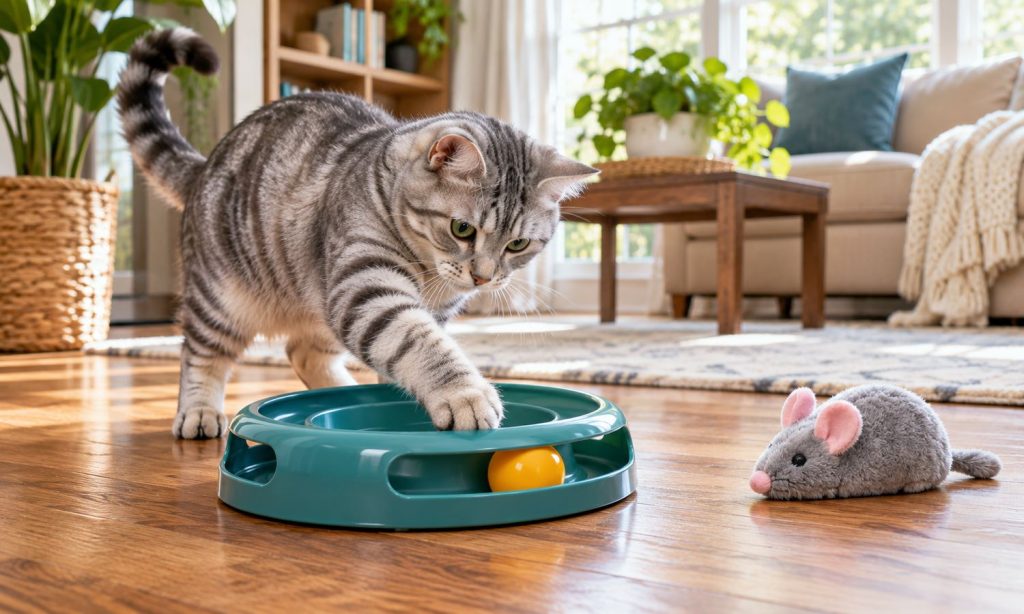
Cats often enjoy stalking, chasing, batting, scratching, hiding, and investigating food-related challenges. Independent enrichment can encourage some of these behaviors through sturdy balls, tracks, tunnels, and suitable food puzzles. Variety matters because a cat may prefer ground-level movement, climbing, or quiet problem solving. A senior cat with arthritis may not enjoy jumping after moving objects, while an energetic youngster may seek frequent motion. Match the activity to ability and personality.
Observe which movements your cat chooses during supervised play. Does it bat at a rolling object, investigate a treat puzzle, or retreat into a tunnel? Those preferences can inform the unattended setup. Our guide to treat-dispensing toys for cats discusses how challenge and feeding routines interact. Treat puzzles must fit the cat's prescribed diet and be easy to clean. Enrichment should make a cat's day more interesting without turning every activity into extra calories.
Look for Stable Construction and Easy Cleaning
Stable, one-piece construction is often useful for an unsupervised toy. Check that a track does not detach from its base, a ball cannot be removed and swallowed, and a tunnel has no hazardous wire ends. Look for surfaces that can be wiped down and fabric that can dry fully. Toys collect saliva, hair, litter dust, and food residue. Materials that are impossible to inspect or clean may become unsuitable long before they visibly break.
Keep size in mind. A toy should be too large to swallow or lodge in the mouth, yet light enough for the cat to move comfortably if movement is its purpose. Avoid improvised household objects with staples, elastic bands, twist ties, or sharp packaging. If a moving toy uses batteries, the compartment must remain securely closed, with no exposed wiring or overheating risk. What features matter most in a toys for cats home alone includes how confidently you can inspect and maintain the item week after week.
Match Challenge Level to the Individual Cat
A puzzle that requires too much effort can frustrate a cat, while one that immediately releases all rewards may offer little activity. Begin with easy supervised demonstrations and gradually increase difficulty only if the cat remains interested. For food-based enrichment, account for every calorie in the daily ration. Use an appropriate portion and ensure the cat can still access its normal meals and water. Never rely on a puzzle feeder as the only food source for a cat that struggles to use it.
Older cats and cats with mobility or sensory limitations may need larger, simpler pieces and lower placement. Shy cats may prefer hiding opportunities rather than noisy automatic movement. A multi-cat home introduces additional concerns: one cat may guard the toy or block access. Provide separate resources and safe retreat spaces. If tension rises, modify the arrangement. A toy is successful when it supports natural behavior and leaves the cat comfortable, not when it produces the most dramatic reaction.
Place Toys in a Safe, Comfortable Environment
Where you leave a toy matters as much as its construction. Keep play areas away from open windows, hot appliances, household chemicals, cords, and unstable furniture. Check that tunnels and tracks cannot block access to litter boxes, food, water, or resting areas. A secure window perch, scratching surface, and hiding spot may enrich a cat's day even when no toy is moving. A room should offer choices, not a crowded obstacle course.
Provide vertical space where it is appropriate for the cat's age and ability. Our guide to making vertical space accessible for older cats explains gentle access considerations. If your cat climbs, verify that furniture and shelves are stable and cannot tip. Keep windows and screens secure. What features matter most in a toys for cats home alone includes the surroundings in which the toy will be used. A safe play object cannot compensate for an unsafe room.
Rotate Toys and Keep Human Play in the Routine
Cats often renew their interest when familiar toys reappear after a break. Put out a few safe options and rotate them periodically, rather than covering every surface with objects. Observe behavior to determine whether the rotation helps. Some cats keep a favorite toy and ignore new ones; respect that preference. Check every item before returning it to the floor. A toy that has spent weeks under furniture may have collected grit or damage.
Schedule active play with a person before or after periods alone. A wand toy can support chase-and-capture behavior when properly supervised, but it should be stored safely afterward. Offer a calm finish and, when appropriate, a small portion of the cat's regular food. The Feline Veterinary Medical Association emphasizes meeting environmental and behavioral needs, including play. IMO, an owner who rotates three safe toys and plays daily may offer more value than a room packed with gadgets.
Recognize Boredom Without Overdiagnosing It
Excessive vocalization, destructive scratching, overgrooming, withdrawal, or changes in litter-box use can occur for many reasons. They are not definitive evidence that a cat needs more toys. Health problems, anxiety, pain, conflict, and environmental changes can cause similar signs. If behavior changes suddenly or becomes persistent, discuss it with a veterinarian. A new toy should not delay care for a potentially medical issue.
Watch for positive signals too: the cat voluntarily approaches toys, plays briefly, rests comfortably, eats normally, and can withdraw when desired. Some cats sleep through most of their owner's absence and become playful in the evening. That can be normal. Adjust activity to the individual rather than expecting constant play. If you are away for long periods, arrange appropriate social care and monitoring based on the cat's needs. Independent toys are one part of welfare, not a substitute for companionship.
Frequently Asked Questions
Choosing independent toys requires a different safety review from choosing something for supervised play. These short answers focus on the moments when nobody is available to retrieve a swallowed string or untangle a cat. Start with the individual cat's behavior, and inspect every item before leaving it out.
Even well-made toys age and break. Keep a simple rotation and discard items that develop loose parts, sharp surfaces, or exposed filling. Cats benefit from predictable spaces and play opportunities, but they do not need constant electronic entertainment.
Can I leave a feather wand out while I am away?
It is safer to store wand toys with strings, feathers, or dangling pieces after supervised play. Loose linear materials may be swallowed or create entanglement hazards.
Are automatic toys suitable for every cat?
No. Some cats find them stressful, and powered toys need secure compartments and safe mechanisms. Introduce them under supervision and follow the maker's unattended-use directions.
How many toys should I leave available?
There is no universal number. A few safe options with different play functions can be enough. Rotate based on interest, and keep essential food, water, litter, and rest areas unobstructed.
Can food puzzles replace a regular meal?
Only if they reliably deliver the appropriate portion and fit the feeding plan. For most cats, use them as enrichment within the normal diet rather than making access to food unnecessarily difficult.
What if my cat ignores every toy?
Try observing preferred activities, changing placement, and offering supervised interactive play. If interest changes suddenly with other symptoms, arrange veterinary assessment rather than assuming simple boredom.
Final Words
What features matter most in a toys for cats home alone? Start with robust, inspectable construction and freedom from loose parts or strings. Then match movement, texture, challenge, and placement to the cat's own preferences. Rotate safe objects and make sure the rest of the home offers comfortable choices, including places to climb, hide, and rest.
The best toys for cats home alone category overview can provide further context, but always assess suitability for unsupervised use. A toy should enrich ordinary life without adding avoidable risk. Daily human play and attention remain essential, no matter how clever the floor puzzle becomes.