Cat dander does not stay neatly on your cat. Allergens can travel through indoor air and settle on rugs, bedding, and upholstered furniture. That makes choosing the best cat allergy air purifier more complicated than picking the machine with the largest room-size claim. A useful purifier needs enough clean-air delivery for your actual space. It also needs filters you can replace, a tolerable fan noise, and a practical place to operate. A HEPA-style particle filter can capture airborne material while the machine runs. It cannot remove every allergen or promise relief from symptoms. In this guide, we compare seven identifiable models suited to different rooms and routines. We focus on features that affect everyday ownership, not inflated performance language. You’ll also learn how to read clean air delivery rate figures, evaluate carbon filters, and avoid ozone-producing devices. Use air filtration alongside cleaning and appropriate medical advice when allergies remain troublesome.
Quick Picks
| Product | Best For | Key Advantage | Buy | |
|---|---|---|---|---|
| MOOKA KJ190H Air Purifier | Flexible daily controls | Auto mode and washable pre-filter | View on Amazon | Jump to Review |
| Purivortex PX500 Air Purifier | Smaller rooms and simple operation | Three-stage filter and straightforward settings | View on Amazon | Jump to Review |
| Levoit Core 300-P Air Purifier | Bedrooms with clearer airflow data | Published AHAM particle CADR ratings | View on Amazon | Jump to Review |
| P358 Pet Air Purifier | Homes with noticeable floating fur | Dual U-shaped intake and pet pre-filter | View on Amazon | Jump to Review |
| Levoit Vital 200S-P Air Purifier | Larger family rooms | 250 CFM smoke CADR and pet-oriented intake | View on Amazon | Jump to Review |
| YARIKI P280 Pet Air Purifier | Washable pre-filter upkeep | Three filter stages and child lock | View on Amazon | Jump to Review |
| Meowant Pet Air Purifier | Multi-cat homes needing wide intake | Dual inlets and paired HEPA filters | View on Amazon | Jump to Review |
1. MOOKA KJ190H Air Purifier

What We Like
- Wide front and side air intakes
- Built-in PM2.5 display and auto mode
- Four selectable fan speeds
- Washable pre-filter for trapped fur
- Child lock and filter reminder
What We Don’t Like
- Room-size claim needs a CADR check
- Aroma pad is unsuitable for cat-safe fragrance use
The MOOKA KJ190H is designed for pet homes that want more control without constant adjustments. Its front opening and side intakes are intended to pull air from several directions. That layout can be useful in a room where light fur and dust circulate during normal activity. A washable pre-filter catches larger debris before it reaches the finer filter material. The maker also describes a three-stage system and an activated-carbon component. That combination addresses different types of airborne contamination, although carbon performance depends on how much material is provided. A PM2.5 display reports a measure of fine particles rather than cat-allergen concentration. Auto mode uses that sensor to adjust fan speed. This makes the KJ190H a practical candidate for a living area with changing activity levels. Its advertised coverage reaches a large area, but the listing does not establish a comparable independent smoke CADR. For sizing, request a dependable performance figure rather than assuming the maximum coverage number means rapid cleaning.
The practical details matter when you share a home with a curious cat. Four fan speeds let you choose between faster cleaning and a quieter setting. The manufacturer also lists sleep mode, timer settings, a child lock, and a filter reminder. The washable part is the pre-filter, not permission to wash the complete filtration cartridge. Follow the manual’s maintenance directions and replace nonwashable media as instructed. One caution deserves special attention: the unit is marketed with an aromatherapy pad. Avoid adding essential oils or strong fragrance products in a home with cats. The goal here is particle filtration, not scent masking. Position the purifier where neither furniture nor bedding blocks its intakes. Keep the power cord away from chewing and jumping routes. The KJ190H could fit a shared living space when you value automatic adjustment. However, its real suitability depends on verified airflow, replacement-filter availability, and how much noise you tolerate at useful fan speeds.
My Recommendation
Best for households that want a particle display, variable speeds, and an accessible pre-filter. Confirm independent airflow data before relying on the largest advertised coverage figure.
2. Purivortex PX500 Air Purifier

What We Like
- Pre-filter, HEPA and carbon stages
- Compact bedroom-oriented design
- Sleep, low, medium and high modes
- Multiple timer selections
- Optional night-light settings
What We Don’t Like
- Light controls may be unwanted near sleep
- Limited published comparable CADR information
The Purivortex PX500 is worth comparing when your primary goal is routine particle filtration in a bedroom. Its advertised three-stage setup combines a pre-filter, HEPA material, and an activated-carbon layer. These stages serve different purposes. The outer layer addresses larger debris. The fine-particle stage is intended for dust, pollen, and airborne pet allergens. The carbon stage may handle some everyday odors, but it cannot replace cleaning litter boxes or removing an odor source. The company describes operation across rooms of different sizes, including one air-cleaning pass across a much larger area. That marketing claim should not be confused with several air changes each hour in a continuously occupied room. For an allergy-focused purchase, the important question is how much filtered air reaches your actual space. Compare a trustworthy smoke CADR with the room’s square footage. A modest-sized room with a closed door often makes a clearer use case than an open-plan area.
The PX500 favors familiar controls rather than an elaborate monitoring system. The listing identifies four fan modes, timer selections, and several night-light choices. Those features help you fit filtration around sleeping, reading, and daily household routines. You can select a stronger setting when the room is empty, then reduce the fan when noise becomes distracting. Remember that reducing speed usually reduces the amount of air cleaned each minute. The maker describes a relatively tall replacement filter and provides warranty information, but the current replacement cartridge should still be checked for compatibility and cost. In a cat household, place the purifier beyond the animal’s preferred climbing routes. Leave space around the intake and outlet so the fan can work as intended. Also avoid treating its carbon layer as a solution for persistent urine odor. Deep cleaning and veterinary guidance may be needed when accidents recur. This is a practical, straightforward option for owners who value simple settings over app-based controls.
My Recommendation
Consider the PX500 for a bedroom where basic filter stages and accessible controls matter most. Prioritize current filter availability and room-appropriate airflow over the headline coverage claim.
3. Levoit Core 300-P Air Purifier

What We Like
- AHAM Verifide listing claims
- 143 CFM smoke CADR reported
- Display lights can be switched off
- Quiet-oriented sleep setting
- Dedicated compatible replacement filters
What We Don’t Like
- Less suited to very large open spaces
- Sleep speed moves less air than higher speeds
The Levoit Core 300-P stands out because its current product information supplies specific particle-performance figures. The maker lists a smoke CADR of 143 cubic feet per minute. It also reports 153 CFM for dust and 167 CFM for pollen. Those figures provide a much more useful starting point than a large one-pass square-footage claim. Under the common AHAM two-thirds guideline, a 143 CFM smoke rating corresponds to roughly a 214-square-foot room with a typical ceiling. That is an illustration, not a guarantee about your home’s real air movement. The product listing also identifies an AHAM Verifide designation. Check the current certification directory when independent confirmation matters to you. For cat-related allergens, a capable particle filter can reduce what remains airborne while the unit operates. It cannot remove dander already caught in cushions, rugs, or bedding. The Core 300-P therefore makes the most sense alongside routine cleaning and sufficient operating time.
Bedrooms have different requirements from busy living rooms. The Core 300-P includes a quiet sleep setting and an option to switch off its display lights. The manufacturer’s listing gives a 24 dB figure for sleep operation, which describes that setting rather than every fan level. It also lists timer choices and a reminder for filter maintenance. Its strong point is a relatively transparent starting point for matching airflow to room size. Even so, the low-noise mode will not deliver the same cleaning rate as its more powerful settings. If a cat sleeps near you, leave the outlet unblocked and keep the purifier away from water dishes or loose fabrics. Replacement-filter fit matters because the wrong cartridge can undermine a carefully chosen machine. Check the exact Core 300-P filter requirements rather than assuming another Levoit filter will work. Owners of open-plan rooms may need a larger unit or more than one appropriately sized purifier. For an enclosed bedroom, this model provides an especially easy comparison.
My Recommendation
A compelling bedroom candidate when you want documented smoke, dust, and pollen CADR figures. Choose a larger-capacity unit if your room is substantially bigger.
4. P358 Pet Air Purifier

What We Like
- Two-sided U-shaped air inlets
- Pet-focused pre-filter layout
- Activated-carbon stage for some odors
- Sleep mode with display-light control
- Pet lock and filter alert
What We Don’t Like
- High coverage statement lacks clear comparison basis
- Consumable filter costs require investigation
The P358 is marketed around a familiar problem in cat households: fine fur can collect around narrow intake openings. Its two-sided U-shaped openings aim to reduce that obstruction and bring air into the machine from more than one direction. A pet-oriented pre-filter forms the first collection surface. The fine-particle filter then handles smaller material, while the carbon component addresses some gaseous odors. This division of labor is useful to understand when comparing machines. A larger pre-filter can make upkeep more convenient, but it does not turn the purifier into a vacuum cleaner. Fur on sofas and carpeting still requires direct cleaning. The brand promotes the P358 for a very large area, yet that claim alone does not show cleaning speed in a specific room. Look for a dependable CADR before sizing it for a shared living area. A wide-intake design may be appealing, but airflow performance remains the foundation of allergen-oriented shopping.
The controls are another reason to evaluate the P358 rather than focusing only on its appearance. According to its listing, it has multiple fan speeds, a timer, and a sleep setting with reduced display lighting. The seller also describes a pet lock and a filter-replacement reminder. Those details can help prevent accidental control changes when a cat brushes against the unit. Sleep mode is promoted at a low noise level, but the airflow tradeoff still applies. Higher speeds move more air and are usually more noticeable. Inspect the replacement-media arrangement carefully because this model uses a particular filter design. The manufacturer’s savings claims are not a reliable substitute for comparing current cartridge costs. Keep the unit on a stable surface and provide clearance on both intake sides. A pre-filter that becomes heavily covered in fur needs cleaning according to the manual. For homes where loose fur builds up quickly, this design deserves attention alongside its ongoing maintenance demands.
My Recommendation
A reasonable shortlist choice for busy pet areas with floating hair. Verify the room’s required CADR and the exact replacement-filter system before purchasing.
5. Levoit Vital 200S-P Air Purifier

What We Like
- Manufacturer lists 250 CFM smoke CADR
- AHAM Verifide designation
- Additional U-shaped pet-hair intake
- Dust and pollen CADR figures supplied
- Designed for a larger occupied room
What We Don’t Like
- Larger body needs suitable floor space
- Smart features are unnecessary for some buyers
The Levoit Vital 200S-P offers a stronger airflow specification than several compact purifiers in this roundup. Its current product data lists a 250 CFM smoke CADR. Dust and pollen figures are 254 and 289 CFM respectively. This provides a concrete way to think about room size. Using AHAM’s basic two-thirds rule, a 250 CFM smoke CADR corresponds to roughly 375 square feet under typical ceiling assumptions. An open layout or taller ceiling can change that calculation. The listing also describes AHAM Verifide certification, which should be checked against the certification directory for the exact model. For a household with cats, an added U-shaped inlet is intended to accommodate some floating fur. That design feature is helpful only if the unit is placed with sufficient clearance. Particle filtration can reduce airborne dander, but it cannot stop cats from continually producing allergens or prevent allergens from settling on furniture.
The Vital 200S-P is especially relevant when a modest bedroom purifier cannot deliver enough clean air for a family gathering space. Its larger housing and intake layout require thoughtful placement. The machine should have an unobstructed path for air to enter and leave. Keep it away from curtains that could cover a vent or attract a curious cat. The product is positioned as a smart, allergy-oriented appliance, but that positioning does not guarantee improved medical symptoms. Daily usefulness depends on running it at an effective speed for sufficient hours. Check the current control features and instructions for the precise version before deciding whether automation adds meaningful value. Also account for the price and replacement frequency of compatible filters, not simply the purchase price. Carbon material may help certain odors, but litter hygiene and source cleaning remain essential. If you want one purifier to work in a defined larger room, verified airflow deserves more weight than an unusually broad manufacturer coverage estimate.
My Recommendation
The strongest larger-room option among these picks when sizing from the listed CADR. Confirm the current certification listing and allow generous intake clearance.
6. YARIKI P280 Pet Air Purifier

What We Like
- Removable washable pre-filter
- HEPA and carbon filter stages
- Child-lock control
- Sleep-oriented low-noise mode
- Replacement interval guidance supplied
What We Don’t Like
- Area claims should not replace a verified smoke CADR
- Fine filters still need periodic replacement
The YARIKI P280 is built around a straightforward mix of particle filtration and everyday maintenance. Its listed three-layer arrangement includes a washable pre-filter, a finer HEPA stage, and activated-carbon material. The initial layer is particularly relevant in homes with shedding cats because it collects larger loose material before that debris reaches the finer cartridge. Cleaning that pre-filter may help maintain airflow when used exactly as directed. However, owners should not assume the HEPA stage is washable. Fine filters usually require replacement on a manufacturer-defined schedule. The listing makes a broad room coverage claim and describes airflow performance using metric units. Because the published figure is not presented as a clearly comparable independent smoke CADR, avoid using the coverage claim alone to select a room size. Think instead about whether the purifier has enough capacity for your particular bedroom or family room. A stable flow of filtered air matters more than an impressive advertised maximum.
The P280 also includes features suited to homes where pets can bump or investigate appliances. Its listed child lock may reduce accidental button presses. The seller describes a quiet sleep setting and low-power operation, but owners should evaluate noise at the faster settings they expect to use. There is no benefit in buying a large purifier that must run constantly at an ineffective low speed. For upkeep, the manufacturer suggests replacing the fine filter periodically according to conditions and use. Always verify the correct replacement cartridge for this exact model. A carbon layer can be a useful secondary feature when mild household smells are present. It cannot substitute for removing spoiled litter, wet textiles, or an ongoing source of odor. Set the appliance on a level surface with room for airflow. Keep the cord secured and the filter cover properly closed. The P280 makes sense when washable preliminary filtration and uncomplicated controls are higher priorities than connected features.
My Recommendation
Consider this model when routine pre-filter cleaning suits your household. Check an independently comparable airflow figure before committing it to a large room.
7. Meowant Pet Air Purifier
What We Like
- Multiple U-shaped inlet openings
- Two HEPA filter components listed
- Washable electrostatic pre-filters
- PM2.5 readout and automatic adjustment
- Mechanical controls with pet-conscious design
What We Don’t Like
- Large advertised area requires CADR verification
- Dual-filter replacements may add cost
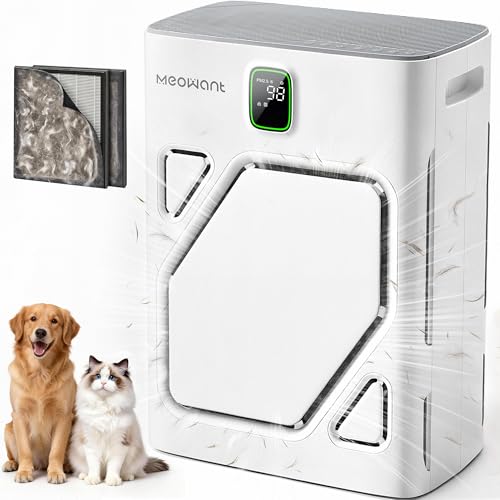
The Meowant pet air purifier uses a different arrangement from basic cylindrical bedroom designs. Its maker describes multiple U-shaped openings, air intake on both sides, and two fine-particle filters. That approach aims to collect floating hair while delivering filtered airflow across a wider intake area. It also uses electrostatic pre-filter sections that the manufacturer says can be cleaned. The difference between these washable parts and the two fine filters matters for cost planning. Buyers should confirm whether both fine filters need replacement together and how the correct cartridges are purchased. The listing also includes a carbon component for certain airborne odors. As with every purifier in this guide, carbon capacity is not equivalent to removing the source of litter or urine smells. A very large maximum coverage claim appears in the advertising. That does not establish how many complete air changes occur in your occupied room. Seek smoke CADR data if you need a defensible sizing comparison.
Convenience is a notable part of the Meowant design. The product lists a PM2.5 display, automatic fan adjustment, a timer, a child lock, and a sleep setting. Mechanical controls may be reassuring when a cat regularly walks close to an appliance. The maker also mentions a more resilient braided power cord, although a cord should never be treated as chewproof. Arrange cables away from a pet’s reach whenever possible. The manufacturer’s quiet-mode figure applies to a gentle setting; stronger filtration generally requires stronger airflow. The two-sided air intake should not be crowded against furniture. Give both sides clear space and inspect the pre-filter regularly if your cats shed heavily. Because this design involves more filter components, work out the expected annual replacement budget. Owners should also avoid adding fragrances simply to disguise odors. This unit is an interesting choice for multi-cat households that favor large intake openings and hands-off adjustments, provided airflow and maintenance costs suit the room.
My Recommendation
Worth comparing in multi-cat spaces where wide intakes and automatic controls are valued. Verify CADR and the price of both replacement filters first.
How to Choose an Air Purifier for Cat Allergies
Start with particle CADR, not coverage advertising
Clean air delivery rate, or CADR, describes how quickly a purifier delivers filtered air. For a standard eight-foot ceiling, a useful starting point is a smoke CADR of at least two-thirds of the room’s square footage. A 150-square-foot bedroom therefore calls for roughly 100 CFM or more. Check the intended fan setting when comparing figures. A claim that a unit covers 2,000 square feet may be based on only one complete air change per hour. That is not directly comparable with cleaning a bedroom several times per hour. Open doors and taller ceilings also affect what a single purifier can achieve.
Understand particle filters and carbon layers
Fine-particle filtration targets airborne particles, including some material carrying cat allergens. A pre-filter helps collect larger debris and protects the main cartridge. An activated-carbon stage may reduce some gases and odors, depending on the amount and type of carbon. Carbon does not replace appropriate particle CADR. Likewise, a machine cannot remove proteins already lodged in carpet or bedding. Treat odor claims cautiously, especially when litter-box maintenance is the real issue.
Check quiet-mode airflow, replacement filters and safety
Think about the fan speed you can tolerate for long periods. Quiet settings are convenient overnight, but they often clean less air. Compare the current price and availability of the correct replacement filters. Check whether only the pre-filter is washable. Keep air paths clear and secure power cords around cats. Avoid devices that intentionally emit ozone. Skip essential oils and strong fragrances in spaces shared with cats. For persistent human allergy symptoms, consult a qualified medical professional.
Final Verdict
For an enclosed bedroom, the Levoit Core 300-P offers useful published particle CADR figures. The Levoit Vital 200S-P is the stronger listed choice for a larger room. The MOOKA KJ190H and Meowant emphasize broader intakes and automatic adjustment. The P358 and YARIKI P280 favor pet-oriented pre-filter upkeep, while the Purivortex PX500 keeps controls relatively simple. No air purifier can eliminate cat allergens or guarantee symptom relief. Choose based on reliable room sizing, comfortable operating noise, and sustainable filter maintenance.
Frequently Asked Questions
Can an air purifier eliminate cat allergies?
No. Particle filtration may reduce airborne allergen material, but cats continue producing allergens. Allergens also remain on household surfaces. An air purifier is one part of exposure management, not a cure.
Is HEPA better than an odor-focused carbon filter?
They serve different purposes. Fine-particle filtration addresses airborne dust and allergen-bearing particles. Carbon targets some gases and smells. An allergy-focused purchase should prioritize enough particle airflow for the room.
Where should I put a purifier in a cat household?
Place it where air can enter and leave freely. Avoid tight corners, blocked inlets, unstable furniture, and water bowls. Keep cables secure and follow the manufacturer’s minimum-clearance instructions.
Should an air purifier run overnight?
Longer operation can filter more air. Overnight use may be helpful when the unit is safe and properly placed. Remember that the quietest setting usually delivers less filtered air per minute.
Will a purifier remove settled dander from my sofa?
No. A portable purifier filters air passing through the machine. It does not clean upholstery or carpets. Regular vacuuming, suitable laundering, and other source-control measures remain important.
For related reading
Explore vacuum options for cat hair and litter, cat litter choices for sensitive airways, and odor-oriented purifier considerations.
As an Amazon Associate, PetAdvisorPro earns from qualifying purchases.