
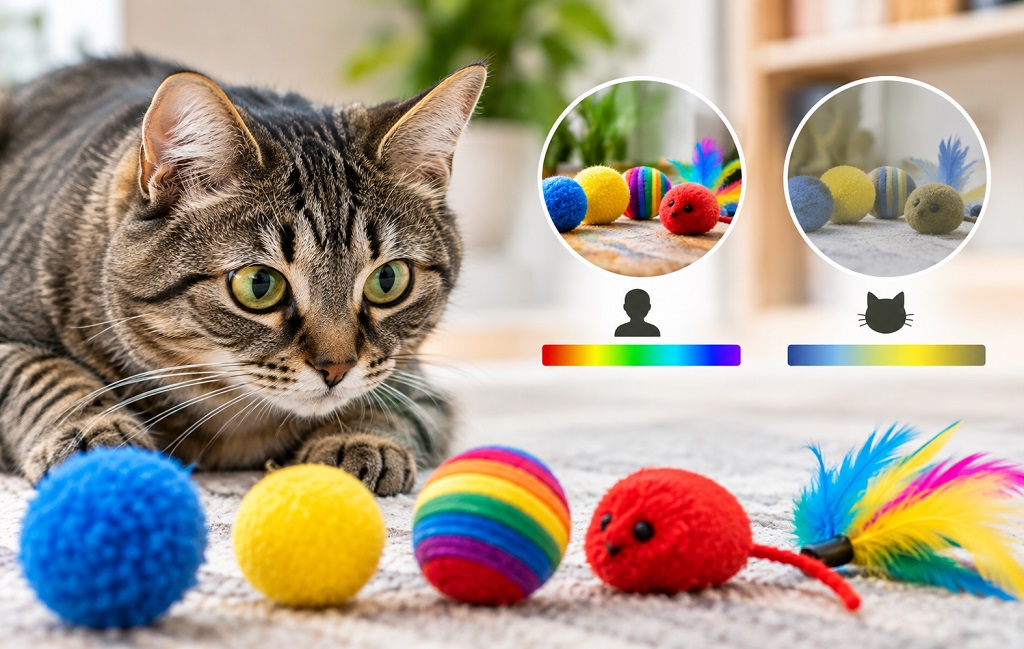
If you have ever watched your cat stare intensely at a colorful toy, bird, or moving object, you may have wondered what is actually happening inside those mysterious eyes. What colors can cats see, and does the world look as colorful to them as it does to us?
Cats do see color, so the idea that they experience the world entirely in black and white is a myth. However, their color vision is more limited than human color vision. Veterinary sources generally describe cats as having a narrower ability to distinguish colors, with blue and yellowish shades often considered easier for them to perceive than some other colors. Exactly how cats experience individual colors is still not completely settled.
Understanding what colors can cats see is more than an interesting piece of trivia. It can help you understand why your cat reacts to certain toys, why movement catches its attention so quickly, and why your feline companion seems perfectly comfortable navigating a dim room while you are reaching for the light switch.
What Colors Can Cats See?
The simplest answer is: cats can see some colors, but not the full range that humans can distinguish.
Humans have three types of cone cells that contribute to our broad color vision. Cats have fewer cone cells, which limits their ability to distinguish the many subtle shades humans can see. At the same time, cats have many rod cells, which are particularly useful for detecting light and movement.
So, what colors can cats see? Evidence suggests that cats can distinguish certain shades of blue and yellow, while their perception of reds, oranges, and some greens is considerably less distinct than ours. Some veterinary sources describe feline color vision as resembling a form of red-green color blindness in humans, while other sources emphasize that the exact range is still uncertain.
That uncertainty is important. It is tempting to create a neat chart saying, “Cats see this color but not that one.” Biology rarely cooperates with neat charts.
Can Cats See Color or Only Black and White?
Yes, cats can see color.
The black-and-white myth probably comes from the fact that cats have significantly less color discrimination than humans. Their visual system is optimized for a different job.
A human might appreciate the subtle difference between several shades of green, for example. A cat may not distinguish those shades with the same clarity. Instead, contrast, brightness, movement, and shape can play a much bigger role in what catches its attention.
This is one reason a cat may ignore a brightly colored stationary toy but immediately launch itself across the room when the same toy starts moving.
Classic cat behavior: apparently the toy was boring until it developed a survival strategy.
What Colors Can Cats See Clearly?
So, what colours can cats see clearly?
Blue and yellow are commonly identified as colors that cats can distinguish better than red or green. However, it is more accurate to think of feline vision as a limited color spectrum rather than saying cats see only two colors. Veterinary sources differ somewhat in how precisely they describe the colors cats perceive.
Cats may perceive:
- Blue: relatively noticeable to cats.
- Yellow: likely distinguishable to some degree.
- Gray: important in their visual environment.
- Red: likely much less vivid than it appears to humans.
- Green: may be difficult to distinguish from other shades.
- Orange: may not stand out the way it does to a human.
- Purple: perception may be different from the rich purple humans see.
The key point is that feline color perception isn’t necessarily about seeing a color as completely invisible. Instead, some colors may appear less saturated, less distinct, or more similar to other shades.
How Cats See Colors Compared With Humans
To understand how cats see colors, it helps to compare the basic structure of human and feline eyes.
Human Color Vision
Humans generally rely heavily on cone cells for detailed color perception. Our three main types of cones allow us to distinguish a broad range of colors and subtle variations.
That makes a rainbow look remarkably rich to us.
Feline Color Vision
Cats have fewer cone cells than humans but many more rod cells relative to their visual needs. Rods are highly useful for detecting light levels and movement, particularly in dim conditions.
As a result, what colors can cats see is only one part of the larger vision story. Their eyes are not designed simply to admire beautiful colors. They are highly adapted to detecting movement and functioning when light levels are relatively low.
For a predator that historically hunted around dawn and dusk, that makes considerable sense.
What Colors Can Cats See During the Day?
During daylight, cats can use their color vision normally, but their experience isn’t identical to ours.
If you are wondering what colors can cats see during the day, think about three factors: color, brightness, and contrast.
A cat may be able to distinguish a blue object against a suitable background more easily than a red object that blends into its surroundings. But color isn’t necessarily the only factor determining whether your cat notices something.
Movement can be extremely important.
Cats have visual adaptations that help them detect motion, and their eyes are particularly suited to hunting behavior. Their ability to notice a small moving object can be impressive even when that object isn’t especially colorful.
So if your cat ignores a new toy during the afternoon but suddenly becomes fascinated by a tiny moving speck on the floor, don’t blame your toy-shopping skills too quickly.
Why Cats See Better in Low Light
One of the most remarkable things about feline eyesight is its performance in low-light conditions.
Cats have many rod cells in their retinas. Rods are highly sensitive to light and help with detecting movement. Cats also have a specialized reflective layer called the tapetum lucidum behind the retina. This structure reflects light back through the retina, effectively giving available light another opportunity to be detected.
This helps explain the familiar glow you sometimes see in a cat’s eyes when light hits them at night.
However, cats cannot see in complete darkness. They still need some available light. Their eyes are simply much better adapted to low-light environments than ours. Merck Veterinary Manual notes that cats can see about six times better than humans in dim light.
That is why your cat can confidently walk through a room at night while you are standing there wondering where you left your phone.
Do Cats See Red, Green, Orange, or Purple?
If you’re specifically asking what colors can cats see, individual colors deserve a little explanation.
Red
Red is not thought to appear as vivid to cats as it does to humans. A bright red toy that looks highly noticeable to you may not have the same visual impact for your cat.
Green
Cats may have difficulty distinguishing certain green shades as clearly as humans do. Depending on the exact shade and surrounding background, green may appear less distinct.
Orange
Orange can also lose some of its visual distinction for a cat compared with human perception.
Purple
Purple is particularly interesting because human perception of purple depends on stimulation of different cone systems. Cats don’t experience color through exactly the same system as humans, so a purple object won’t necessarily look purple to your cat in the same rich way.
The safest conclusion is that cats experience a different and narrower color world, rather than a simple world of “visible” and “invisible” colors.
Does Color Matter When Choosing Cat Toys?
Understanding what colors can cats see clearly can be useful when shopping for toys, but don’t make color your only consideration.
Blue and yellow may be useful choices because cats are thought to distinguish these colors relatively well.
However, other characteristics can be just as important—or more important.
Consider:
- Movement
- Contrast against the floor or furniture
- Shape
- Texture
- Size
- Sound
- Safety
- The individual cat’s preferences
A feather wand may be more attractive because it moves unpredictably than because of its color.
Similarly, a toy that contrasts strongly with the floor may be easier for your cat to locate visually.
IMO, watching what your individual cat actually responds to is more useful than assuming every cat has identical preferences.
How Can You Tell If Your Cat Has Vision Problems?
Normal differences in color perception are not the same thing as vision impairment.
Cats can develop eye and vision problems, and some conditions can progress gradually without being immediately obvious. Cornell’s Feline Health Center recommends paying attention to changes in eye appearance and behavior.
Potential warning signs include:
- Bumping into furniture or other objects
- Difficulty navigating stairs
- Trouble locating familiar food or litter areas
- Unusual hesitation in unfamiliar surroundings
- Squinting
- Cloudiness in the eye
- Different-sized pupils
- Excessive tearing
- Changes in the appearance of the eye
- Sudden behavioral changes associated with vision
A healthy cat’s eyes should generally appear clear, and noticeable changes deserve attention.
When Should You Take Your Cat to a Vet?
If your cat suddenly seems unable to see properly, contact a veterinarian promptly.
Sudden or rapidly developing vision problems can have several possible causes, including conditions affecting the retina, eye pressure, inflammation, trauma, or other diseases. Cornell notes that early diagnosis can be important because some causes of vision loss may be treatable when addressed promptly.
Do not try to determine the cause based solely on how your cat behaves at home.
A cloudy eye, unequal pupils, obvious eye injury, sudden bumping into objects, or a sudden change in navigation ability is not simply a question of what colors can cats see. It may indicate a medical problem that deserves professional evaluation.
5 Frequently Asked Questions
1. What colors can cats see?
Cats can see color, but their color discrimination is more limited than humans’. Blue and yellowish shades are commonly considered easier for cats to distinguish, while some reds, greens, and oranges may be less distinct.
2. Can cats see red?
Cats can detect light in the red portion of the spectrum, but red is not believed to appear as vivid or distinct to them as it does to humans. Their color perception differs substantially from ours.
3. Can cats see blue and yellow?
Yes, veterinary sources commonly identify blue and yellow as colors cats can distinguish relatively well. However, feline color vision is more complex than saying cats see only blue and yellow.
4. Do cats see in the dark?
No. Cats cannot see in complete darkness. However, their eyes are highly adapted to low-light conditions, thanks in part to their abundance of rod cells and the tapetum lucidum.
5. What color toys are easiest for cats to see?
Blue and yellow may be easier for cats to distinguish than some other colors. However, contrast, movement, size, texture, and sound can also strongly influence whether a cat notices and enjoys a toy.
Final Words
So, what colors can cats see?
Cats do not live in a black-and-white world. Their eyes can detect colors, but their color vision is narrower than ours. Blue and yellow are commonly considered easier for cats to distinguish, while other colors may appear less vivid or harder to differentiate. The exact details of feline color perception are not completely settled, so it’s better to avoid overly simplistic claims.
More importantly, feline vision is about much more than color. Cats have an impressive ability to detect movement and function in low-light conditions. Their rod-rich retinas and tapetum lucidum are adaptations that make their visual world very different from ours.
Understanding what colors can cats see can help you choose toys and interact with your pet, but remember that every cat is an individual. If your cat suddenly struggles to navigate familiar spaces or you notice a physical change in its eyes, that’s a veterinary issue—not a quirky difference in color vision.