
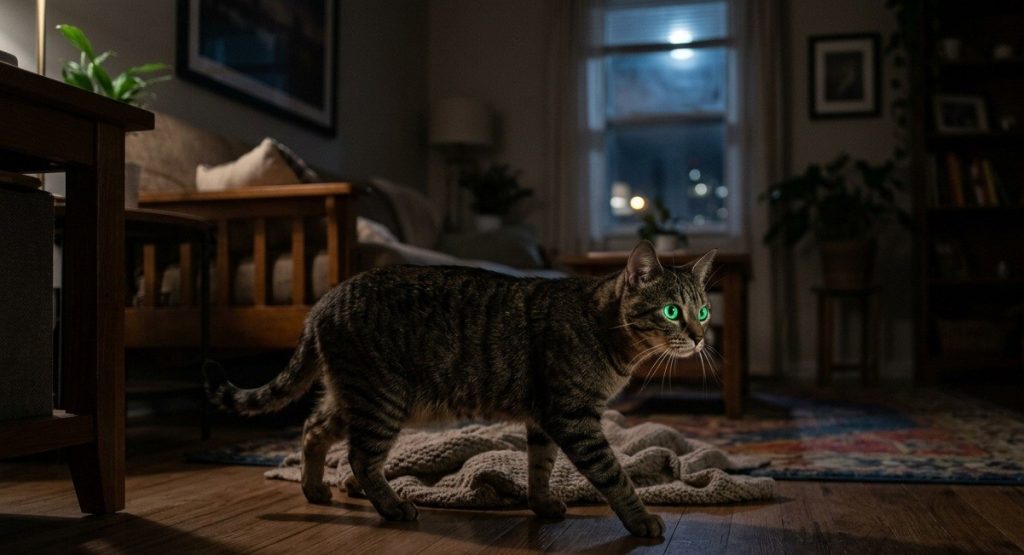
If you have ever stumbled over your sleeping feline in the middle of the hallway at 2:00 AM while they casually weave around furniture without missing a beat, you have probably asked yourself: can cats see in the dark?
As someone who has lived alongside cats, dogs, and various pocket pets for over 15 years, I have spent my fair share of late nights watching my domestic predators zoom around the living room in pitch-black conditions. It feels like they possess high-tech thermal goggles built right into their skulls. But the biological reality behind cats night vision is a mix of fascinating evolutionary optics, specialized anatomical features, and a few anatomical trade-offs that might surprise you.
In this guide, we will unpack how feline eyes actually process low light, whether they can navigate total darkness, how their color perception works (including whether can cats see blue, and how you can support your pet’s ocular health as they age.
The Biological Anatomy: How Feline Eyes Process Light
To answer whether can cats see in the dark, we have to look closely at the physical structure of the feline eye. Cats do not possess magical vision, but their eyes are precision-engineered by evolution to capture every available photon in low-light environments.
       LIGHT ENTERS EYE
              │
              ▼
   Large Curved Cornea & Pupil (Gathers maximum ambient light)
              │
              ▼
   Retina: Rod-Heavy photoreceptors (Ratio ~25:1 vs Human 20:1)
              │
              ▼
   Tapetum Lucidum (Reflective mirror layer bounces light back)
              │
              ▼
   Result: High Sensitivity to Motion & Low Light (~1/6th human threshold)
1. The Power of Rods vs. Cones
The retina at the back of the eye contains two primary types of photoreceptor cells: rods and cones.
-
Rods are responsible for detecting movement, sensing shapes, and operating in dim light.
-
Cones process color, details, and function best in bright daylight.
Cats have an overwhelming majority of rod receptors compared to humans. In fact, a cat’s rod-to-cone ratio is roughly 25 to 1, whereas human retinas sit at around 20 to 1. This abundance of rods allows feline eyes to detect minute movements and subtle shifts in illumination that human eyes completely miss.
2. Large Corneas and Vertical Slit Pupils
A cat’s eye features a proportionally massive cornea and an elliptical, vertical pupil. In bright light, the pupil narrows into a tiny vertical slit to protect sensitive retinal tissue. In low light, that same pupil can dilate up to 135 times its original area (humans only dilate about 15 times). This massive pupil opening acts like an ultra-wide aperture lens on a professional camera, flooding the retina with ambient light.
3. The Secret Mirror: Tapetum Lucidum
Have you ever taken a photo of your cat at night or caught their gaze with a flashlight, only to see eerie, glowing eyes staring back? That reflection is caused by the tapetum lucidum (Latin for “bright tapestry”).
Located directly behind the retina, this layer of reflective tissue acts like a tiny mirror. When light enters the eye and passes through the rods without hitting a receptor, the tapetum lucidum reflects that light back across the rods a second time. This secondary pass gives photoreceptors another chance to capture the image. This reflective structure gives cats night vision an efficiency boost that makes them exceptional crepuscular hunters.
Can Cats See in the Dark Entirely, or Do They Need Light?
A common myth among pet parents is that cats possess true infrared vision and can see in complete, 100% pitch-black environments.
The short answer is no. Cats cannot see in absolute darkness.
If you place a cat in a sealed room without windows, ambient streetlights, or electrical indicators, they are just as blind as we are. The tapetum lucidum and rod-dense retinas require some ambient photons—whether from the moon, stars, or a nightlight down the hallway—to construct a visual image.
| Visual Characteristic | Human Eyesight | Feline Eyesight |
| Minimum Light Requirement | High (Requires standard illumination) | Low (Needs ~1/6th of human light levels) |
| Field of View | ~180 Degrees | ~200 Degrees |
| Visual Acuity (Clarity) | 20/20 (Sharp details at distance) | 20/100 to 20/200 (Blurry beyond 20 feet) |
| Color Vision | Trichromatic (Red, Green, Blue) | Dichromatic / Limited (Primarily Blues & Yellows) |
| Motion Detection | Moderate | High (Extremely sensitive to rapid movements) |
While they cannot navigate absolute darkness, cats only require about one-sixth of the ambient light that humans need to map out their environment. Where you see pitch-black shadow while walking to the kitchen for a glass of water, your cat sees a clearly defined landscape of shapes, edges, and pathways.
Color Perception: Can Cats See Blue and Other Colors?
When pet owners research cats night vision, they often wonder if feline eyes sacrifice color perception to achieve superior low-light sensitivity. The answer is yes, but not entirely in the way people expect.
For years, popular culture claimed that cats live in a black-and-white world. Modern ophthalmic research shows that cats are dichromats. They possess two types of cone receptors that respond primarily to blue and green wavelengths.
So, can cats see blue? Yes, absolutely! In fact, blue is one of the clearest and most vivid colors in a cat’s visual spectrum.
Visible Wavelength Spectrum for Feline Eyes:
   [380nm - 450nm] ──► VIVID BLUE
   [450nm - 550nm] ──► MUTED GREEN / YELLOWISH-GREEN
   [550nm - 700nm] ──► GREY / WASHED OUT (Red & Pink appear neutral)
-
Blues and Yellow-Greens: Cats can easily differentiate between blue hues and yellow-green shades.
-
Reds and Pinks: Cats lack the specific cone receptors required to process red wavelengths. To a cat, a bright red cat toy or a pink scratch pad appears as a dull greenish-gray tone.
-
Saturation: Even for colors they can perceive, cats do not see the rich, highly saturated colors that humans do. Their visual field looks somewhat washed out, similar to looking through a pastel filter.
Understanding this biological quirk can help you choose toys that genuinely capture your cat’s visual interest. A bright blue feather wand will stand out against a hardwood floor far better than a crimson red mouse.
Evolutionary Trade-offs: Night Vision vs. Daytime Clarity
Nature rarely gives a species everything. To gain their remarkable nocturnal capabilities, cats traded off daytime clarity and depth perception at a distance.
1. Distance Nearsightedness
Humans with standard vision read 20/20. Cats, by comparison, range between 20/100 and 20/200. This means an object a human can see clearly from 100 feet away will appear blurry to a cat unless it moves within 20 feet. Because their eyes are built to capture wide-angle movement close up, far-off stationary objects simply blend into the background.
2. Slow Pupil Accommodation in Bright Light
Because their pupils must open wide to gather dim light, daytime sunlight requires heavy constriction. While a cat’s vertical slit pupil is efficient, sudden changes from dark rooms to bright sunlight can temporarily dazzle them.
3. Tactile Reinforcement: Whiskers and Hearing
When asking can cats see in the dark, we must remember that sight is only one part of their navigation system. When ambient light drops below usable levels, cats rely heavily on:
-
Vibrissae (Whiskers): Located on their muzzle, eyebrows, and front legs, these specialized tactile hairs sense tiny air currents and physical obstacles in the dark.
-
Auditory Precision: Cats can move their ears independently and detect ultra-high frequencies (up to 64,000 Hz), allowing them to pinpoint movement without needing visual confirmation.
Signs of Vision Problems in Cats
Even though feline eyes are durable, vision loss and eye diseases are relatively common, especially in senior pets. Knowing what is normal for cats night vision helps you spot early signs of ocular distress.
If you notice your cat displaying any of the following symptoms, their low-light navigation or overall sight may be compromised:
                  EARLY WARNING SIGNS OF VISUAL DISTRESS
                                    │
    ┌───────────────────────────────┼───────────────────────────────┐
    ▼                               ▼                               ▼
Physical Changes                Behavioral Shifts              Mobility Issues
• Cloudiness/Haziness           • Vocalizing at night          • Hesitation before jumping
• Asymmetric pupil size         • Startling when approached     • Bumping into furniture
• Redness or discharge          • Misjudging landings          • Sticking to wall edges
Key Symptoms to Monitor:
-
Bumping Into Furniture at Night: If a cat that used to navigate in dim light suddenly starts colliding with chair legs or doorways, their low-light vision may be failing.
-
Hesitation Before Jumping: Disorientation, lingering on elevated surfaces, or testing the ground repeatedly before taking a short jump indicates loss of depth perception.
-
Cloudiness or Discoloration: A milky appearance inside the eye or changes in pupil color can point to cataracts, nuclear sclerosis, or glaucoma.
-
Dilated Pupils in Bright Light: If your cat’s pupils remain wide open during the day, the retina may no longer be sensing incoming light correctly.
-
Excessive Squinting or Tearing: Persistent discharge, pawing at the face, or keeping one eye half-closed signals inflammation or corneal injury.
Common Causes of Vision Loss in Feline Patients
When feline vision deteriorates, several underlying medical conditions are frequently responsible.
1. Feline Hypertension (High Blood Pressure)
Hypertension is common in older cats, often secondary to chronic kidney disease or hyperthyroidism. High blood pressure can cause retinal detachment, leading to sudden, total blindness. The good news is that if caught early, treating the blood pressure can sometimes reattach the retina and restore vision.
2. Cataracts
While less common in cats than in dogs, cataracts cause the lens inside the eye to become opaque, blocking light from reaching the retina. They often develop secondary to chronic intraocular inflammation (uveitis) or severe trauma.
3. Glaucoma
Glaucoma occurs when fluid pressure inside the eye increases, damaging the optic nerve over time. It is a painful condition that causes eye enlargement, cloudiness, and progressive blindness if left untreated.
4. Progressive Retinal Atrophy (PRA)
PRA is a genetic condition that causes the photoreceptor cells (rods and cones) to degenerate over time. Because rods break down first, night blindness is usually the very first symptom owners notice.
When to Visit a Vet
Eye issues in cats can progress from mild discomfort to irreversible blindness in a matter of hours. You should schedule a veterinary exam immediately if you notice:
-
Sudden Onset Blindness: Your cat suddenly seems lost, disoriented, or refuses to leave a room.
-
Anisocoria: A condition where one pupil is dilated while the other is constricted.
-
Physical Trauma: Any visible scratch, puncture, or foreign object near or on the eye.
-
Severe Discharge: Thick yellow or green discharge pooling around the eyelids.
-
Apparent Eye Pain: Squinting, crying, or rubbing the face aggressively against furniture or carpets.
Your veterinarian will perform a thorough ophthalmic exam using a fluorescein stain to check for corneal ulcers, measure intraocular pressure (tonometry), and evaluate the retina using an ophthalmoscope.
Solutions, Prevention, and Environmental Options
While age-related eye changes cannot always be prevented, there are practical steps you can take to protect your cat’s eyes and support pets experiencing declining cats night vision.
                           CARE STRATEGY
                                 │
         ┌───────────────────────┴───────────────────────┐
         ▼                                               ▼
Environmental Supports                           Nutritional Care
• Strategic Nightlights                          • Taurine (Essential amino acid)
• Consistent Furniture Layouts                   • Antioxidants (Lutein, Vitamin A)
• Clear Walkways & Padded Steps                  • High-Quality Omega-3 Fatty Acids
1. Maintain Environmental Consistency
Cats with failing sight rely heavily on spatial memory and scent markers. Avoid rearranging your living room furniture if you have an elderly cat experiencing vision loss. Keep food bowls, water stations, and litter boxes in fixed locations.
2. Strategic Nightlight Placement
While healthy young cats do fine in minimal light, senior cats with clouding lenses appreciate extra assistance. Plug low-wattage LED nightlights into hallways, near stairs, and close to their litter box to boost ambient light levels.
3. Nutritional Support
A balanced diet rich in essential nutrients protects long-term ocular health:
-
Taurine: An essential amino acid that cats cannot synthesize on their own. Severe taurine deficiency leads directly to central retinal degeneration and total blindness. Ensure your pet eats a high-quality, commercially complete feline diet.
-
Omega-3 Fatty Acids: DHA and EPA support retinal function and reduce systemic inflammation.
-
Antioxidants: Vitamins A, C, and E help neutralize free radicals that contribute to nuclear sclerosis and cataract formation.
4. Safe Home Navigation
For pets with significant vision loss, wrap sharp furniture edges with soft bumpers, place non-slip rugs on slick hardwood floors to mark safe walking paths, and block open staircase landings with baby gates.
Frequently Asked Questions
FAQ 1: Can cats see in pitch-black rooms?
No, cats cannot see in total darkness. They require at least a small amount of ambient light—such as moonlight through a window or a faint nightlight—to navigate using their visual senses. In 100% dark environments, they rely on their whiskers, hearing, and scent.
FAQ 2: Why do my cat’s eyes glow green or yellow in photos?
That glow is caused by the tapetum lucidum, a reflective tissue layer sitting behind the retina. It reflects unabsorbed light back through the rod cells to enhance low-light vision. The color of the glow depends on the specific minerals and pigments in your cat’s eye, ranging from emerald green to bright yellow or gold.
FAQ 3: Can cats see blue and green clearly?
Yes! Can cats see blue is a common question among owners. Cats are dichromats, meaning they see blues and yellow-greens clearly. However, they struggle to perceive red and pink shades, which appear as neutral gray or muted greenish tones to them.
FAQ 4: Do cats get night blindness as they get older?
Yes. Senior cats can experience nuclear sclerosis (a hardening of the lens) or progressive retinal changes that diminish their ability to gather light. If your senior cat becomes hesitant to walk around at night, adding nightlights around the home can make a big difference.
FAQ 5: Are a cat’s whiskers more important than their eyes at night?
In very low light or complete darkness, whiskers become vital tactile sensors. Whiskers detect subtle changes in air currents around obstacles, allowing cats to map their surroundings without relying on sight alone.
Final Words
So, can cats see in the dark? While they do not have superhero-style thermal vision that works in absolute blackness, their anatomical adaptations—from massive pupils and rod-heavy retinas to the reflective tapetum lucidum—make cats night vision an evolutionary masterpiece.
Next time you see your feline companion gazing into a dark hallway at night, rest assured they aren’t seeing ghosts—they’re just taking in a rich, detailed world of shadows and subtle movement that our human eyes completely miss. Keep an eye on their ocular health as they age, ensure their diet is rich in essential nutrients like taurine, and throw in a few bright blue toys during playtime to keep their visual senses sharp.