Your cat finishes dinner before you have put the food container away, then heads toward another cat’s bowl. A slow feeder can make that familiar routine more manageable, but the right design depends on what you serve and how your cat likes to eat. A shallow bowl, a textured licking surface, and a paw-operated puzzle ask very different things of your pet.
The best slow feeder bowl for cats should keep food accessible while adding a manageable amount of effort. For many households, a straightforward ridged bowl is the easiest starting point. Wet-food eaters may prefer a licking mat, while curious kibble eaters may enjoy a food puzzle. This guide compares six researched options, explains their practical tradeoffs, and helps you choose without assuming that every cat needs the hardest challenge. These recommendations come from product documentation and available specifications, rather than hands-on testing or an analysis of Amazon customer reviews.
Affiliate disclosure: As an Amazon Associate I earn from qualifying purchases.
Quick Picks
| Product | Best For | Key Advantage | Buy | |
|---|---|---|---|---|
| Catstages Kitty Slow Feeder Bowl | A conventional slow-feeding bowl | Ridged surface; 3/4-cup capacity | View on Amazon | Jump to Review |
| LickiMat Casper | Adult cats eating spreadable wet food | Flat textured licking surface | View on Amazon | Jump to Review |
| Catit Senses 2.0 Digger | Cats that enjoy pawing out kibble | Removable cups in two formats | View on Amazon | Jump to Review |
| Catstages Kitty Lickin’ Layers | Cats ready for a moving food puzzle | Three spinning feeding layers | View on Amazon | Jump to Review |
| Catstages Buggin’ Out Puzzle & Play | Supervised foraging meals | Pegs and swiveling covers | View on Amazon | Jump to Review |
| Catstages Rainy Day Puzzle & Play | Cats familiar with food puzzles | Adjustable peg-and-cover challenge | View on Amazon | Jump to Review |
Catstages Kitty Slow Feeder Bowl

What We Like
- Familiar bowl format
- Wet or dry food
- Slip-resistant base
- Top-rack dishwasher cleaning
What We Don’t Like
- Ridges need thorough cleaning
- No microwave use
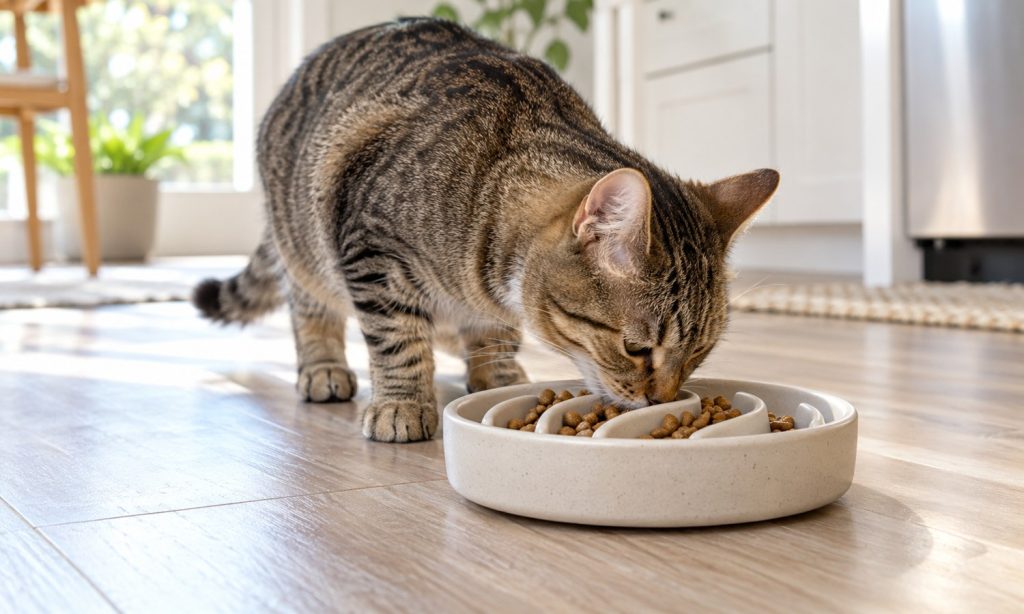
For a cat that already eats comfortably from a bowl, the Catstages Kitty Slow Feeder offers a relatively familiar starting point. Its internal ridges divide the feeding surface, giving food less room to collect in one easy mouthful. The verified green listing identifies a five-inch bowl with a three-quarter-cup capacity, and the manufacturer specifies use with wet or dry food. That flexibility matters if breakfast is kibble and dinner is a softer meal. You can introduce the dish with a small amount of familiar food instead of changing both the feeder and the diet at once. The slip-resistant base is another useful detail for hard floors, although placement still matters. Set it on a level surface and watch whether your cat can reach food comfortably. Capacity describes what fits inside the bowl; it does not tell you how much your cat should eat.
The main reason I would consider this design is its uncomplicated daily routine. There are no spinning layers to teach or tall cups to investigate, so it can suit owners who want feeding enrichment without turning every meal into a training session. The tradeoff is that ridges create extra surfaces where food can remain, especially with sticky pâté. Check the channels after washing rather than assuming a quick rinse removed everything. The manufacturer allows top-rack dishwasher cleaning and says not to microwave the bowl. Remove it if it becomes damaged, and do not let your cat treat it as a chew toy. If your cat repeatedly abandons food in the channels, begin with easier placement or return to a plain dish. A useful slow feeder should make a meal more engaging without becoming an obstacle to eating enough.
My Recommendation
I would start here if you want an actual bowl that works with your cat’s established meal routine. Choose a licking mat for easily spread wet food, or a paw puzzle if your cat enjoys retrieving individual pieces of kibble. Comfort and reliable eating matter more than maximum slowdown.
LickiMat Casper

What We Like
- Shallow feeding surface
- Spreadable-food format
- Several surface textures
- Freezer-friendly design
What We Don’t Like
- Hand washing required
- Unsuitable as a chew toy
Wet food changes the buying decision because a bowl maze is not the only way to offer a more deliberate meal. LickiMat Casper uses a flat, textured surface that encourages a cat to lick food from grooves. The manufacturer describes it as a feeder for mature cats and lists wet food, soaked kibble, and liquid cat foods among its uses. This makes it a different category from the Catstages bowl, rather than a direct replacement for every feeding situation. A thin layer of your cat’s normal wet food is a sensible introduction. You do not need to add unfamiliar spreads just because a product listing mentions them. Keep the amount within your cat’s planned daily food allowance, and observe whether licking is comfortable. For owners who already serve smooth or easily spread food, the format offers a practical alternative to putting the entire meal in a mound.
Casper’s deeper, narrower grooves also explain its principal limitation. They can ask more effort of the cat and more attention from the person cleaning it. The manufacturer specifies hand washing, so this pick will appeal less to someone who relies on a dishwasher after every meal. Rinse and clean the textured areas promptly, before remnants become difficult to remove. It is not a chew toy; supervise introduction and put it away if your cat starts biting pieces from it. I would also avoid making the first meal a difficult, deeply packed challenge. Leave some food easy to reach and increase the effort only if the cat remains interested. A plain shallow dish remains a perfectly reasonable alternative when your cat needs easier access. Casper makes the most sense when its licking format matches the food you serve and the way your cat comfortably eats, rather than when you simply want a feeder with more texture.
My Recommendation
Casper is my wet-food alternative for an adult cat that enjoys licking. I would pass if hand washing is inconvenient or the cat chews feeding mats. Its value comes from matching the meal texture, not from promises to treat anxiety or digestive problems.
Catit Senses 2.0 Digger

What We Like
- Five removable cups
- Two cup formats
- Broad supporting base
- Accessible introductory basin
What We Don’t Like
- Larger floor footprint
- Dry-food-focused design
A cat that fishes toys out of boxes may find a paw-operated feeder more interesting than a ridged dish. Catit Senses 2.0 Digger places dry food or treats inside five removable cups, asking the cat to retrieve pieces with a paw. The manufacturer provides two cup formats, allowing you to vary where food is placed instead of presenting the same challenge every time. Its front basin gives you somewhere to leave easy-to-reach pieces during introduction. That is a useful distinction: your cat can discover a reward before learning the more demanding part. This is a feeding puzzle, not a conventional bowl, and it should be chosen for that difference. If your cat likes picking up individual pieces of kibble, the design may suit that behavior. If the cat mainly eats smooth wet food, I would choose a different type of feeder.
The broad base and removable cups make the Digger a more substantial feeding station than a small dish. Catit lists an overall footprint of about 14.6 by 14.6 inches, so measure the intended spot before buying. It may fit comfortably in a dedicated feeding corner but feel oversized beside several ordinary bowls. The cups and base come apart for cleaning, and their rounded surfaces are useful when checking for food remnants. Introduce the easiest access first, then use additional cups only when your cat understands the task. I would judge success by willing participation and food intake rather than by how long a meal lasts. A cat with difficulty reaching or using its paws may be better served by a simpler surface. You can also offer just part of a measured meal in the Digger and keep the rest accessible elsewhere. That approach lets the puzzle provide variety without making every calorie depend on solving it.
My Recommendation
I would choose the Digger for an interested kibble eater with room for a larger feeding station. Begin with food in the basin and easiest cups. For a compact bowl or a wet-food meal, the other options are more practical.
Catstages Kitty Lickin’ Layers

What We Like
- Three rotating layers
- Wet or dry meals
- Adjustable food placement
- Layers separate for washing
What We Don’t Like
- More involved setup
- Supervised use required
Moving parts bring another kind of challenge to mealtime, and Kitty Lickin’ Layers is built around that idea. The feeder has three spinning layers with compartments for food or treats. The product’s designer describes it as a Level 2 puzzle, which makes it more involved than simply eating around ridges. You can start with food only on the top layer and then use the lower layers as your cat learns. That progression is the feature I find most useful for households that already enjoy feeding enrichment. It gives you a way to vary the task without immediately hiding the entire meal. The documented format accepts wet or dry food, although the consistency of your usual food will influence how easily it fills the compartments. Think of it as a supervised activity feeder rather than a dish you automatically leave out all day.
There is more preparation and cleanup here than with a plain bowl. Each layer needs checking for food remnants, and the manufacturer explains how to separate the layers for washing. Its instructions allow top-rack dishwasher cleaning on a low-heat setting. Follow the directions supplied with your particular unit, especially when reassembling the center connection. I would supervise the first sessions closely and remove the feeder if the cat starts chewing it or if any part becomes damaged. The challenge should be adjustable enough that your cat stays interested, rather than repeatedly failing to reach food. Some cats will happily investigate moving layers; others will prefer a stationary surface. You can use a small portion of the daily ration to find out which response you get. If the extra washing or supervised setup will make you avoid using it, the simpler bowl is the better purchase. Its strongest role is adding variety for a cat that already enjoys manipulating feeding puzzles.
My Recommendation
Choose Kitty Lickin’ Layers when your cat enjoys an interactive food task and you can supervise it. I would introduce the top layer first. For a first slow feeder or an easier daily cleanup routine, start with a stationary bowl.
Catstages Buggin’ Out Puzzle & Play

What We Like
- 16 hidden food compartments
- Adjustable food access
- Quarter-cup feeding capacity
- No removable play pieces
What We Don’t Like
- Requires active supervision
- More involved than a bowl
Pawing at food can be more engaging than eating around fixed ridges, and Buggin’ Out offers that different feeding task. This cat puzzle uses pegs and swiveling leaf covers to hide portions across 16 compartments. Outward Hound lists a capacity of up to one-quarter cup and describes adjustable difficulty. Those details make it a related slow-feeding option for a curious cat, rather than a conventional bowl. The benefit is the opportunity to uncover individual portions instead of reaching an entire meal immediately. How much this changes your cat’s eating pace will depend on the setup and the cat’s response. Unlike Catit Digger, which centers on retrieving food from cups, this design introduces covers that need movement. It is therefore worth considering when a simple open feeding surface no longer provides much interest.
Introduce the puzzle with food easy to reach and watch whether your cat can use the pegs and covers comfortably. Keeping the first session simple matters more than filling every compartment. The quarter-cup capacity is a container specification, not a recommended meal size; measure the food separately and offer additional portions in an accessible dish when needed. Outward Hound says the play pieces are not removable, but still requires close supervision and warns against chewing. Put the empty puzzle away, inspect it for damage, and follow its care instructions between meals. Compared with the Kitty Slow Feeder bowl, Buggin’ Out asks for more preparation and attention. That tradeoff makes sense for supervised enrichment, but less so when you need a straightforward dish for a cat that wants easy access. Choose it for a willing forager, and simplify feeding if the puzzle becomes frustrating.
My Recommendation
I would choose Buggin’ Out for a cat that enjoys moving covers to find food. Keep it as a supervised feeding activity. The straightforward Kitty bowl remains the easier choice when your main priority is adding a few obstacles without teaching a new task.
Catstages Rainy Day Puzzle & Play

What We Like
- Adjustable puzzle difficulty
- Quarter-cup food capacity
- Attached moving play pieces
- Manufacturer provides setup guidance
What We Don’t Like
- Advanced starting challenge
- Needs supervised sessions
For a cat already comfortable with easier food puzzles, Rainy Day adds another way to work for a measured portion. Nina Ottosson identifies it as a Level 3 puzzle, while Outward Hound describes pegs and movable raindrop covers that conceal food. The manufacturer lists a quarter-cup capacity and explains that you can adjust access as the cat learns. We treat it as an advanced bowl alternative, not the default choice for every fast eater. A cat that has never encountered moving covers may need a much simpler introduction than one that already enjoys Buggin’ Out. The useful distinction is the feeding task: your cat searches and manipulates parts rather than simply licking a textured surface. That makes Rainy Day more relevant to supervised dry-food enrichment than to choosing the easiest everyday serving dish.
Begin with the manufacturer’s easier setup, placing food where the cat can discover it without completing the hardest sequence. Progress only when the cat remains interested and can retrieve the food comfortably. Product pages differ in their compartment descriptions, so this recommendation does not depend on a particular advertised count. Focus instead on access, portion size, and your ability to supervise. Outward Hound states that the game has no removable play parts, yet still instructs owners to prevent chewing, check for damage, and store it after use. The moving areas also deserve careful inspection during cleaning. Compared with a shallow ridged bowl, this puzzle takes more owner involvement and may be an unnecessary complication for routine meals. A familiar bowl should remain available if the cat abandons the task. Rainy Day earns its place here as an optional next step for an interested puzzle user, rather than a promise of better feeding for every household.
My Recommendation
I would reserve Rainy Day for a cat that already enjoys simpler food puzzles. Start with easy access and supervise each session. For an uncomplicated first slow feeder, choose the ridged bowl or a food-appropriate licking surface instead.
How to Choose a Cat Slow Feeder
Match the feeder to the food before considering extra features. Ridged bowls can accommodate several meal textures; licking mats work best with food that spreads; cup puzzles favor individual dry pieces. A feeder that looks engaging in a photo can still be awkward for the food you actually buy. Your cat’s existing feeding habits are a better starting point than the number of compartments.
Keep the Challenge Manageable
Offer a small amount of familiar food with easy access during introduction. Watch for willing eating, rather than chasing a particular meal duration. If your cat becomes frustrated, walks away, or cannot comfortably reach food, simplify the task. Keep another accessible feeding option available while you learn whether the new dish suits the cat.
Portions, Cleaning, and Multi-Cat Households
Measure the meal independently of bowl capacity. Treats placed in a puzzle count toward the daily allowance, too. Wash feeding surfaces after use, inspect narrow channels, and follow the manufacturer’s cleaning instructions. In a multi-cat home, offer separate feeding spaces and observe whether one cat takes another’s food. A slow feeder does not resolve competition by itself.
When a Different Bowl Is the Better Choice
An ordinary dish may be more appropriate for a cat that needs very easy food access. Repeated vomiting, difficulty eating, or a change in appetite needs veterinary attention rather than a series of harder feeders. If comfortable access is your main concern, compare our cat bowls for wet food before choosing a puzzle. Feeding enrichment can add interest, but it should not make meals difficult to finish.
Frequently Asked Questions
Can cats use slow feeder bowls?
Yes, when the design suits the food and the cat can comfortably reach the meal. Introduce the feeder gradually and keep track of actual intake.
Which type works with wet cat food?
A ridged bowl documented for wet food or a suitable licking mat can work. Choose based on how easily your normal food spreads and how thoroughly you can clean the surface.
Will a slow feeder stop my cat from vomiting?
Do not assume that it will. Repeated vomiting has several possible causes and warrants veterinary guidance. A feeding accessory is not a diagnosis or treatment.
Can I put the whole meal in a puzzle?
Only after your cat understands the task and eats reliably from it. During introduction, use a small measured portion and keep the rest easy to access.
How often should I clean the feeder?
Clean it after use and follow its supplied care instructions. Wet-food residue in grooves and moving parts deserves particular attention.
Final Verdict
For a straightforward bowl, I would begin with the Catstages Kitty Slow Feeder. LickiMat Casper offers a different approach for adult wet-food eaters, while Catit Digger and Kitty Lickin’ Layers suit cats interested in a feeding task. Buggin’ Out adds moving-cover foraging, and Rainy Day offers a more advanced supervised puzzle. Choose the easiest design that adds interest while keeping meals comfortable and accessible. If your cat eats happily from an ordinary dish, there is no need to make feeding more complicated.