
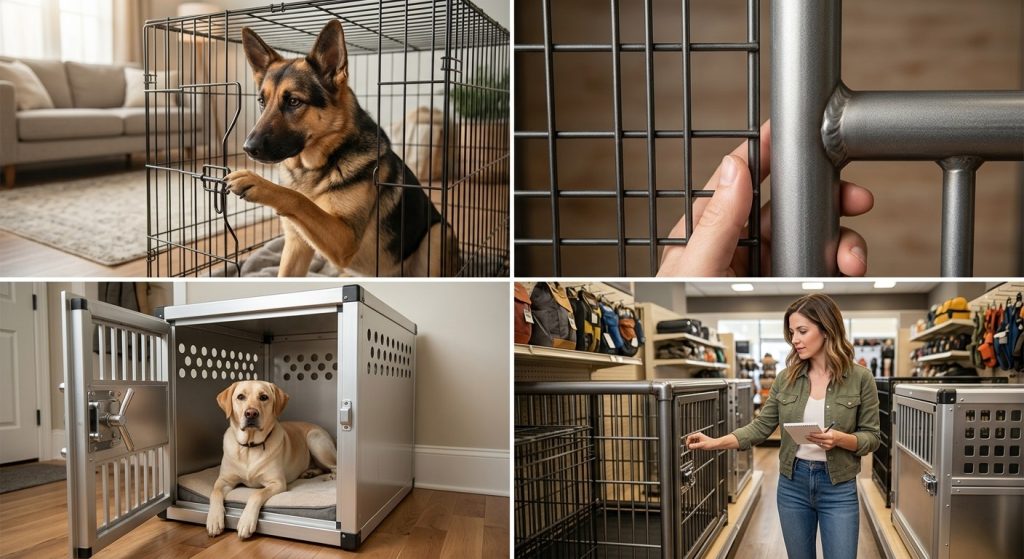
If your dog can nose open a latch, squeeze through a gap, or make a determined attempt at the door, choosing a crate can feel like a hardware challenge. But the best dog crate for escape artists is not simply the heaviest or most expensive option. It needs to suit your dog’s size, strength, and behavior—and it must be safe for that dog to use.
One question matters before you compare crate materials: Why is your dog trying to get out? Some dogs are persistent explorers. Others panic when confined or left alone. Those situations call for different responses. A more secure crate may help manage an ordinary escape route, but it cannot resolve anxiety. A dog that fights confinement can injure themselves trying to break free.
First, figure out why your dog is escaping
Watch what happens before and during confinement. Does your dog calmly investigate the latch, then wander out when you are nearby? Or do they pant, drool, bark persistently, claw at the door, chew bars, or seem frantic shortly after you leave?
Escape attempts that happen mainly when a dog is alone can be associated with separation-related distress. Repeated attempts to get out can cause broken teeth, scraped paws, damaged nails, and other injuries. If your dog shows these signs, a stronger crate may only make the confinement more dangerous. Pause closed-door crate use and talk with your veterinarian or a qualified behavior professional.
A camera can help you see what happens after you leave. Share the video with your veterinarian if you are concerned. A professional can help distinguish a learned escape trick from distress and advise whether a crate, gated room, exercise pen, pet sitter, or another setup is appropriate.
What to look for in a dog crate for escape artists
Match the crate to your dog’s size
Your dog should be able to stand naturally, turn around, and lie down in a comfortable position. A crate that is too small can restrict movement; one that is very large can give a determined dog more room to build momentum or reach different parts of the door. Measure your dog while standing and lying down, and check the crate’s interior dimensions rather than relying only on a weight range.
For a growing puppy, a divider can let you adjust the usable area over time. Recheck the fit as the puppy grows. For an adult dog with a long body or a large frame, check length and height carefully instead of choosing by breed name alone.
Inspect the frame, door, and latch
The best dog crate for escape artists should not have loose panels, sharp edges, or an easy-to-nudge latch. Examine how the door meets the frame. Look for gaps large enough for a paw, muzzle, or collar to catch, and check whether a dog could push the door inward or lift it out of alignment.
Crates vary in their materials and construction. Some have wire panels; others use solid walls or reinforced frames. Do not assume that a product description or “heavy-duty” label makes a crate safe for your individual dog. Inspect the actual design and consider how your dog tries to escape. If they bend bars, bite the frame, or work a latch, ask your veterinarian or a qualified trainer for help choosing a safer confinement plan.
Choose a door your dog cannot easily work
Check the latch with the crate empty. Open and close it several times. Does it engage fully? Does it stay in place if you gently press or pull on the door? Are there parts that can slide, twist, or lift?
Look at hinges, corners, and panel connections as well as the latch. A dog may find a weak point somewhere other than the obvious door lock. Avoid improvised modifications that could create sharp edges, pinch points, or openings that might trap a tooth or paw. The safest design is the one that keeps the dog from escaping without adding a new injury hazard.
Consider visibility, ventilation, and your dog’s response
Some dogs settle better when they can see their surroundings. Others rest more easily in a quieter, less visually busy area. Think about your dog’s reaction rather than assuming that one crate style suits every dog.
The best dog crate for escape artists still needs adequate ventilation and a stable place in the home. Keep it away from heaters, direct sun, and places where a passing person or pet could startle the dog. If your dog becomes more agitated when they can see activity, changing the crate’s location may help—but it should not be used to hide continuing panic.
Remove snag and chewing hazards
A collar can catch on crate parts, so remove it when your dog is inside. Check bedding, toys, and bowls for anything that could become a hazard if chewed or pulled through the bars. If your dog is chewing crate components or trying to force their head or paws through an opening, do not leave them alone to “get used to it.” That behavior deserves a safety review and professional guidance. The American Kennel Club also advises removing a dog’s collar in the crate.
Choose a crate based on your dog’s escape style
A dog that simply tests an unsecured door may need a different latch design. A dog that climbs, squeezes, or bends panels poses a more serious challenge. Consider whether the crate’s openings, frame, and door layout address the specific route your dog uses—and whether confinement remains calm and safe for them.
The best dog crate for escape artists is not necessarily the most enclosed one. Some dogs become more distressed when they cannot see out; others are bothered by household activity. Pay attention to whether your dog settles, rests, and accepts treats in the crate, or instead shows escalating stress.
Make crate training part of the plan
A secure design matters, but so does the dog’s experience of the crate. Introduce it gradually: leave the door open, let your dog explore voluntarily, and reward calm interest. Once they are comfortable entering, practice brief periods with the door closed while you remain nearby. Build duration slowly, and step back if your dog shows stress.
Cornell’s canine health center notes that positive reinforcement can help a dog learn to settle in a crate. It also advises against forcing a dog to stay confined when they are excessively barking, panting, drooling, pacing, or eliminating. A larger puppy-proofed area or a pet sitter may be more appropriate for some dogs.
An escape attempt should prompt two checks: Is the crate physically secure, and is the dog coping with confinement? Address both. The best dog crate for escape artists cannot substitute for gradual training, suitable supervision, exercise, bathroom breaks, or help with anxiety.
When a crate may not be the right choice
A crate may be inappropriate for a dog who persistently panics, tries to chew through the door, repeatedly injures themselves, or becomes more distressed when confined. University of California, Davis, notes that crating may do little to reduce anxiety and may make it worse for some dogs. A veterinarian can help you decide what to try next or refer you to an appropriate behavior professional.
Alternatives may include a thoroughly dog-proofed room, a suitable exercise pen, a qualified pet sitter, or daycare when appropriate. These options are not automatically safe for every dog either: your dog’s behavior and the space still need to be assessed. If a dog is in immediate danger of injury, contact a veterinarian promptly.
How often should you use or replace a dog crate for escape artists?
There is no single replacement interval that fits every crate. Inspect it before use and check it regularly for bent panels, loose connections, sharp edges, damaged hinges, a sticking latch, cracks, or corrosion. Replace the crate if damage makes it possible for your dog to escape or get hurt.
How often you use a crate depends on your dog’s needs, training, age, and ability to settle. A crate should not replace exercise, attention, bathroom breaks, or an appropriate plan for time alone. If your dog is growing, recheck the fit. If they have recently begun trying to escape, investigate what changed instead of simply increasing confinement time.
The best dog crate for escape artists is one that remains intact, fits correctly, and is used only when your dog can stay in it safely. A crate that looks fine from across the room may still have a latch or opening that needs attention.
Five frequently asked questions
What is the best dog crate for escape artists?
There is no single best crate for every dog. Look for a well-fitted, intact design with a door and latch your dog cannot easily work, while considering ventilation, gaps, and your dog’s behavior. If your dog panics when confined, ask a veterinarian about alternatives before trying a stronger crate.
Can a dog escape from a heavy-duty crate?
Any crate can fail or be used in a way that creates risk. Inspect the construction, door, latch, and condition, and monitor your dog’s response. Do not treat “heavy-duty” as a guarantee of safety.
Should I use a crate if my dog has separation anxiety?
Not without professional guidance. Some dogs with separation anxiety or confinement distress may hurt themselves trying to escape. Cornell and ASPCA guidance recommends considering other setups when a dog shows clear distress in a crate.
How do I know if the crate is too small?
Your dog should be able to stand, turn around, and lie down comfortably. Measure your dog and the crate’s interior, then recheck the fit as your dog grows or changes.
When should I replace my dog’s crate?
Replace it when cracks, bent panels, broken hinges, sharp edges, loose joints, or a faulty latch compromise safety. There is no universal age at which every crate must be replaced; condition and fit are more useful guides.
Final Thoughts
When you are looking for the best dog crate for escape artists, start by identifying how and why your dog escapes. Check fit, construction, door security, gaps, and wear. Then consider the dog’s emotional response: a crate that is difficult to escape may still be the wrong choice for a dog who panics inside it.
Choose a crate that is appropriate for your dog, introduce it gradually, and inspect it regularly. If escape attempts are frantic or lead to injury, stop using the crate while you get veterinary or behavior-professional advice. A safe plan should protect your dog’s body and account for how they feel when confined.









