
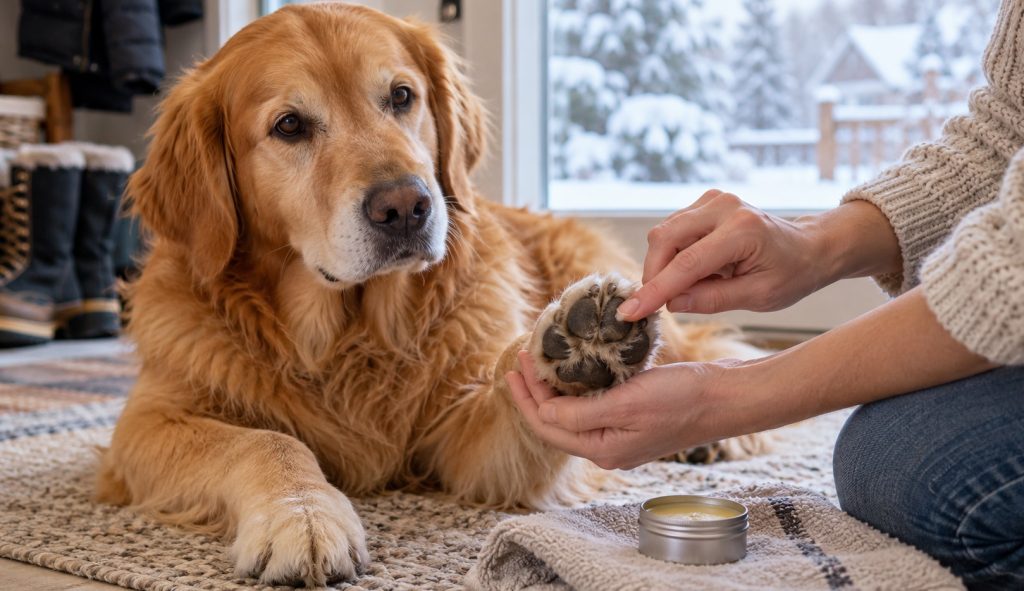
Your dog reaches the sidewalk, takes a few steps, and lifts a paw. Is it packed snow, salt between the toes, or a sore pad? Before reaching for a tin of balm, bring your dog somewhere comfortable and check. Winter paw care starts with understanding the problem.
Choosing the best paw balm for dogs in winter means looking beyond appealing packaging. You need clear ingredients, appropriate directions, and a formula that fits your dog’s needs. You also need realistic expectations: a topical barrier cannot make every winter surface safe.
This guide explains how to choose the right paw balm for dogs in winter, use it sensibly, and recognize when your dog needs veterinary attention instead.
What Does Winter Paw Balm Actually Do?
Paw balm is a topical preparation used to condition paw pads or provide a protective surface layer. Products vary: some emphasize moisturizing, while others are intended as barriers before outdoor activity. Read the stated purpose instead of assuming every balm does both equally well. The ASPCA recommends veterinary-approved paw protectants before winter outings to help guard against salt and chemical exposure. It also notes that booties provide more coverage, including protection between the toes. [1]
Think of paw balm for dogs in winter as one part of a care routine. It does not neutralize de-icing chemicals, replace cleaning, or give you permission to extend a walk in unsafe weather.
Check Your Dog’s Paws Before Choosing Anything
Look at each pad and gently check between the toes. Compare both front feet and both back feet. Note whether your dog walks normally, accepts handling, or keeps returning to one particular spot with their tongue. Write down what you see rather than deciding that every rough patch is winter dryness. Useful observations include when discomfort began, which feet are affected, and whether it happens after a particular walking route.
If you are choosing paw balm for dogs in winter because of recurring soreness, bring those notes and the proposed ingredient list to your veterinarian. Repeatedly switching formulas can delay understanding what is wrong. For comfortable paws with no visible injury, the selection process can focus on routine care. For painful, bleeding, or persistently irritated feet, start with professional advice.
What to Look for in Paw Balm for Dogs in Winter
Clear Intended Use and Complete Ingredients
Choose something explicitly labeled for canine paws, with a complete ingredient list and readable directions. Check whether it is intended for intact pads, when to apply it, and whether there are age restrictions or warnings. Avoid choosing by a single highlighted ingredient. A front label might emphasize a familiar oil while saying little about the rest of the formula. Your dog encounters the entire preparation, so evaluate the whole label.
My preference is straightforward information over ambitious promises. If you cannot establish what is in the container or how it should be used, move on.
A Formula Your Veterinarian Can Evaluate
Words such as “natural,” “organic,” and “gentle” do not answer whether a preparation suits your individual dog. This matters especially when your dog has a history of skin reactions or already uses prescription topical medication. The ASPCA warns that concentrated essential oils can harm pets through ingestion or skin exposure. Do not add essential oils to a finished balm or assume a homemade aromatic mixture is harmless. [2]
For paw balm for dogs in winter, I would favor an uncomplicated, fragrance-free option when there is no clear reason to choose added fragrance. That is a practical selection preference, not a guarantee against reactions.
Instructions That Address Licking
Dogs investigate their feet with their mouths. Read any licking precautions and keep the container out of reach, even when its label suggests incidental licking is expected. A vague “lick-safe” claim is not an instruction to let your dog eat the balm. If the label leaves you uncertain, ask your veterinarian about the complete formula before use.
Consider your household routine, too. Can you supervise application? Will your dog immediately lick every pad? A preparation that is difficult to use as directed may be a poor fit, regardless of its other features.
Texture and Application That Fit Your Dog
You should be able to spread the recommended amount gently, without a prolonged wrestling match. A dog who dislikes foot handling may find several short practice sessions easier than having all four feet held at once. Packaging is a practical choice. A stick can simplify application, while a jar allows you to transfer a small amount with a clean finger or applicator. Neither format proves that the contents work better.
When comparing paw balm for dogs in winter, prioritize manageable application over packaging that merely looks convenient. Your dog did not volunteer for a ten-minute spa appointment.
Honest Limits and Useful Label Details
Look for storage instructions, an expiration date or stated shelf life, and a way to contact the manufacturer. These details help you use and replace the product responsibly. Be cautious about promises to heal every crack, stop all licking, or provide complete protection from winter conditions. A general grooming balm should not be treated as a diagnosis or an all-purpose treatment.
Before deciding, ask: “Can I explain what this is for, how I will use it, and when I should stop?” If the answer is unclear, keep evaluating.
Match Paw Care to Your Winter Routine
Your dog’s daily route matters more than a snowy picture on the label. Think about the surfaces you actually encounter and the opportunities you have to avoid them.
| Your usual situation | Practical priority |
|---|---|
| Short neighborhood outings | Simple application and consistent paw checks |
| Heavily treated sidewalks | Avoiding visible de-icer and considering properly fitted booties |
| Snow collecting around the feet | Checking between toes and removing accumulated snow |
| Comfortable but mildly dry-looking pads | Asking whether routine conditioning is appropriate |
| Repeated soreness or limping | Veterinary assessment before changing products |
Choosing paw balm for dogs in winter should also account for travel. A dog spending the season in a mild climate may suddenly encounter salted sidewalks during a holiday visit. Pack your care supplies before the trip and reassess the walking route when you arrive.
How to Apply Paw Balm Without Making a Mess
Set up on a washable mat with the label, a towel, and your chosen applicator nearby. Read the directions before asking your dog to settle.
- Inspect the feet. Stop if handling reveals pain or an injury.
- Clean away debris. Do not cover visible dirt or sidewalk residue with another layer.
- Dry gently. Include the spaces between the toes.
- Apply the directed amount. Cover only the areas specified on the label.
- Supervise afterward. Follow licking precautions and check that your dog moves comfortably.
Start with a calm, brief session. Praise cooperative handling and pause if your dog becomes distressed. Do not force a painful foot into your hand to finish the job. When introducing paw balm for dogs in winter, watch for new discomfort or increased licking. Stop using it and contact your veterinarian if irritation appears.
IMO, keeping the towel and supplies together is more useful than creating an elaborate routine nobody can maintain on a busy morning.
How Often Should You Use or Replace Paw Balm for Dogs in Winter?
Let the Directions Set the Schedule
There is no single application schedule that applies to every formula and every dog. Follow the label and your veterinarian’s advice instead of automatically applying it several times a day. A preparation intended for use before walks may have different instructions from one intended for routine conditioning. Washing, outdoor activity, and the dog’s response also influence how you evaluate the routine.
Avoid repeatedly adding more because you cannot see a thick coating. Visible buildup is not a reliable measure of protection. If you are unsure whether to reapply, consult the directions or ask the manufacturer and veterinarian.
Replace According to Condition and Shelf Life
Check the expiration date and any instructions about how long the product remains usable after opening. Writing the opening date on the container makes that easier. Store it as directed, close it securely, and use clean hands or an applicator. Do not leave an open jar beside wet boots or within reach of a curious dog.
Replace it if it becomes contaminated or develops an unexplained change in smell, color, or texture. Do not assume last winter’s half-used container is still suitable simply because some remains.
Balm, Booties, and Cleaning: Give Each a Role
Protective balm is not a substitute for avoiding obvious hazards. Where possible, choose a route with less visible salt and skip piles of de-icing material. The ASPCA explains that dogs can ingest ice-melt residues while licking their feet or eating treated snow. Even products described as pet-friendly can cause stomach upset. Prevent access to treated snow and clean the feet after exposure. [3]
Booties offer another way to limit contact, provided they fit and your dog tolerates them. Introduce them gradually indoors and check the feet after removal. After outings, the American Animal Hospital Association recommends removing salt, ice, and debris with a warm, damp cloth as part of winter paw care. [4]
When using paw balm for dogs in winter, keep this order in mind: assess the route, protect appropriately, and clean afterward. One step does not cancel the others.
When to Visit a Veterinarian
Arrange veterinary advice for persistent licking, recurring soreness, visible wounds, swelling, discharge, or an unusual odor. Seek prompt care for significant pain, bleeding that does not stop, or difficulty bearing weight. Bring the balm container or a photograph of its ingredients. Explain what was applied, how often, and whether signs appeared before or after starting it. Photos from earlier in the week may help describe changes.
Suspected cold injury needs urgent attention. AAHA advises bringing a pet indoors and seeking veterinary care when frostbite is suspected; do not rub or massage the affected area. Weakness or confusion after cold exposure also warrants urgent help. [4]
If your dog swallows de-icer, contact your veterinarian or an animal poison service promptly. Do not wait for a balm to solve an ingestion problem. [3]
Five Frequently Asked Questions
1. Does Every Dog Need Paw Balm During Winter?
No universal routine suits every dog. Consider your dog’s pad condition, walking surfaces, and veterinary advice. A dog with comfortable feet may primarily need regular inspection and cleaning. Avoid adding a topical preparation merely because the calendar says winter.
2. Can I Use My Own Hand Cream on My Dog’s Paws?
Do not substitute your hand cream without checking with your veterinarian. A product intended for people may have ingredients or directions unsuitable for a dog that licks its feet. Share the full ingredient list instead of relying on the words “sensitive skin.”
3. Is Paw Wax Better Than Paw Balm?
The names alone do not establish which is appropriate. Compare intended use, ingredients, warnings, and application instructions. Choose based on the specific task and your dog’s needs, rather than assuming that one naming convention represents a stronger or safer preparation.
4. Can Balm Make Long Winter Walks Safe?
No. Paw balm for dogs in winter does not establish a safe outdoor duration. Cold exposure affects more than the pads. Adjust plans to conditions and your dog, and move exercise indoors when necessary. AAHA recommends limiting outdoor exposure during extreme cold. [4]
5. What If My Dog Licks Immediately After Application?
Supervise, follow the label’s precautions, and avoid encouraging licking. If it happens repeatedly, ask your veterinarian whether the formula or routine should change. Contact a veterinary professional if your dog eats a substantial amount or becomes unwell, keeping the container available for identification.
Final Words
The best paw balm for dogs in winter is one that fits an appropriate care plan: understandable ingredients, clear directions, manageable application, and realistic limits. Check your dog’s feet before deciding what they need, and judge the routine by comfort rather than marketing promises.
Start with one practical step today: inspect all four paws and read your current product’s label. Combine sensible protection with cleaning and suitable walking conditions. If pain, licking, or injury persists, ask your veterinarian before adding another layer.









