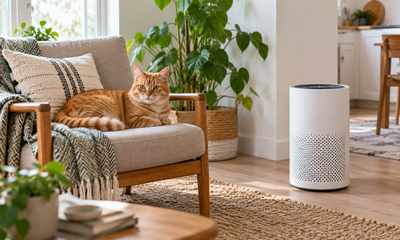
A cat allergy air purifier can be one part of an indoor allergen plan, but it cannot remove every allergen from the home or guarantee symptom relief. People looking for the Best Cat Allergy Air Purifier should understand what a device can and cannot filter before choosing one. Cat allergens can come from skin flakes, saliva, and other materials, and some settle on furniture, clothing, and bedding rather than remaining airborne. If you are asking what to look for in cat allergy air purifier, start with the room where symptoms are strongest, then compare particle filtration, room coverage, noise, airflow, and filter costs. A unit that is too small for the space or blocked by furniture may not circulate enough air. This guide explains how to choose and place a purifier, what its limits are, and how to maintain it. The phrase Best Cat Allergy Air Purifier should not suggest that one appliance can diagnose or treat an allergy. For persistent or breathing-related symptoms, consult an allergist or other healthcare professional.
What an air purifier can do for cat allergens
To understand what to look for in cat allergy air purifier, consider what a portable unit can filter. A portable air cleaner draws room air through one or more filters and returns filtered air to the room. A HEPA filter is designed to capture airborne particles, which can include some allergen-bearing particles. A purifier does not clean allergens that have already settled on bedding, curtains, upholstered furniture, floors, or clothing.
The American Academy of Allergy, Asthma & Immunology notes that pet allergens can come from dander, skin flakes, saliva, and urine, and that allergens can linger in the air and on surfaces. Air filtration may help reduce airborne particles, but it works best alongside source control and regular cleaning. It is not a cure for cat allergy.
What to look for in cat allergy air purifier
The first step in what to look for in cat allergy air purifier is choosing a unit that matches the room where you plan to run it. Compare the filter type, clean-air delivery, noise, placement, and ongoing filter replacement before considering extra features.
Check the particle filter
When comparing what to look for in cat allergy air purifier, check the particle filter specification. A HEPA filter is a pleated mechanical filter designed to capture fine particles. Check that the purifier’s documentation clearly describes the filter and the unit’s performance. The term “HEPA-type” may not mean the same performance as a filter that meets a recognized HEPA standard. Review the specifications rather than relying on broad claims such as “allergen removal.”
Air cleaning depends on the whole machine, not only the filter media. Air needs to pass through the filter without bypassing it, and the unit needs enough airflow for the room. Sealed construction and a clear filter replacement plan are practical features to check.
Match room coverage and clean-air delivery
Another part of what to look for in cat allergy air purifier is whether its clean-air delivery rate (CADR) matches the room. Compare the purifier’s clean-air delivery rate (CADR) or other room-sizing guidance with the size of the room where you will use it. The U.S. Environmental Protection Agency recommends selecting a portable air cleaner with a particle CADR large enough for the room. A higher CADR generally means more particle-filtered air per unit of time, but performance can fall at lower fan settings.
If the room has an open doorway or connects to other spaces, the stated coverage may not reflect the full area you want to treat. In a small apartment, decide whether the bedroom or living room is the priority. One portable unit is usually intended for a room or area, not an entire multi-room home.
Consider noise and run time
A purifier can filter more air when it runs longer and at a higher fan speed, but noise may make those settings inconvenient. When deciding what to look for in cat allergy air purifier, consider noise at the speed you expect to use. Check noise information at the speed you expect to use, not only the quietest mode. If a unit is too loud to run while sleeping, its actual use may be limited even if its highest-speed rating looks strong.
Some people with cat allergies report modest relief from running an air cleaner, while others continue to have symptoms. These are personal experiences and do not predict a medical result. They reinforce why room coverage, run time, and other allergen controls matter.
Review filters, cost, and availability
Ongoing care matters when choosing what to look for in cat allergy air purifier. Check the cost and replacement interval for the main particle filter and any prefilter or carbon layer. A washable prefilter can capture larger particles such as lint and fur, but it does not replace the main fine-particle filter. Some filters need replacement more often in dusty rooms or with frequent use.
Carbon or other gas-adsorbing filters may help with certain odors, but CADR is a particle rating, not an odor-removal rating. EPA notes that gas-filter performance does not have a widely used rating system comparable to particle CADR. Do not treat a carbon layer as a substitute for removing the odor source or cleaning surfaces.
How to choose the right cat allergy air purifier
How to choose the right cat allergy air purifier begins with a clear room and use plan. Rather than relying on a product label alone, work through the following steps:
- Identify the room where the allergic person spends the most time or sleeps.
- Measure the room and compare it with the purifier’s coverage and particle CADR.
- Check that the unit uses a clearly described particle filter, such as a true HEPA filter.
- Review noise at the fan setting you can use consistently.
- Confirm replacement filters are available and fit the unit.
- Place the purifier with open space around its intake and outlet.
How to choose the right cat allergy air purifier also means recognizing its limits. A purifier may reduce airborne particle exposure, but it cannot prevent all contact with cat allergens. Keep the unit running as directed, clean surfaces and bedding, and discuss persistent symptoms with a healthcare professional. If asthma symptoms or breathing difficulty occur, seek appropriate medical care rather than relying on air filtration.
Placement in a small home
Placement is part of what to look for in cat allergy air purifier. Place the unit in the room you want to clean, with its intake and outlet unobstructed. Follow the manual’s clearance guidance. Avoid pushing it behind a sofa, into a closet, or directly against curtains. A clear path lets air circulate through the unit.
If the bedroom is the main concern, run the purifier there rather than placing it in a hallway and expecting it to clean every closed room. Keep it away from water, litter dust, and areas where a cat could knock it over. Place cords where they cannot be chewed or tripped over.
In a multi-room apartment, you may need to prioritize one room or consider more than one unit. Base that decision on the coverage guidance, your budget, and how much time you spend in each room. Do not assume that a single portable cleaner can serve an entire home because the apartment is small.
How often should you use or replace cat allergy air purifier
To use what to look for in cat allergy air purifier in practice, run the purifier according to its manual and your room-use needs. Longer operation and higher fan speeds generally filter more air, although noise and electricity use may affect how consistently you run it. Keep the prefilter clean as directed and replace the main filter at the interval specified by the manufacturer or when the unit indicates it needs service.
Do not wash a filter unless the instructions say it is washable. A filter that is clogged, wet, damaged, or installed incorrectly may not perform as intended. Write down the replacement date or use the unit’s filter indicator, but confirm the manual’s recommended interval.
Other steps that may reduce exposure
Combine filtration with cleaning and practical boundaries. Wash bedding regularly, vacuum with a suitable filtration system, and damp-dust surfaces so settled particles are not simply moved into the air. Keep the cat out of the allergic person’s bedroom if that is part of the clinician’s exposure-reduction plan.
The AAAAI lists HEPA air cleaners among possible exposure-reduction measures, while its practice parameter notes that reducing airborne allergen levels does not always produce clear clinical benefits. An allergist can help determine whether symptoms are due to cat allergy and advise on a management plan. Do not make major decisions about a pet or medication based on a purifier alone.
Frequently Asked Questions
1. Does a HEPA air purifier remove cat allergens?
A HEPA purifier can capture some airborne particles that carry allergens, but it does not remove allergens already settled on surfaces or eliminate all exposure.
2. What size purifier do I need for a bedroom?
Measure the room and compare it with the unit’s CADR or room-coverage guidance. Consider whether doors remain open to adjoining areas.
3. Can an air purifier cure cat allergies?
No. Filtration may be one part of exposure reduction, but it cannot diagnose or cure an allergy. Ask an allergist or healthcare professional about ongoing symptoms.
4. Should I run the purifier all day?
Use it according to the manual and your needs. Longer operation can filter more air, but fan speed, room size, noise, and maintenance affect actual use.
5. How often should I replace the purifier filter?
Follow the unit’s manual or filter indicator. Replace filters when directed, and do not wash a filter unless the instructions say it is washable.
Final Words
What to look for in cat allergy air purifier includes a suitable particle filter, enough clean-air delivery for the room, manageable noise, and filters you can maintain. How to choose the right cat allergy air purifier also means understanding its limits: a portable cleaner can reduce some airborne particles, but it cannot remove every allergen or replace medical advice. Use it alongside cleaning and the exposure plan recommended by a healthcare professional. The phrase Best Cat Allergy Air Purifier is a starting point for comparing features, not a promise of symptom relief.
Reference
These public-health and allergy sources informed the filtration and cat-allergen guidance in this article.