
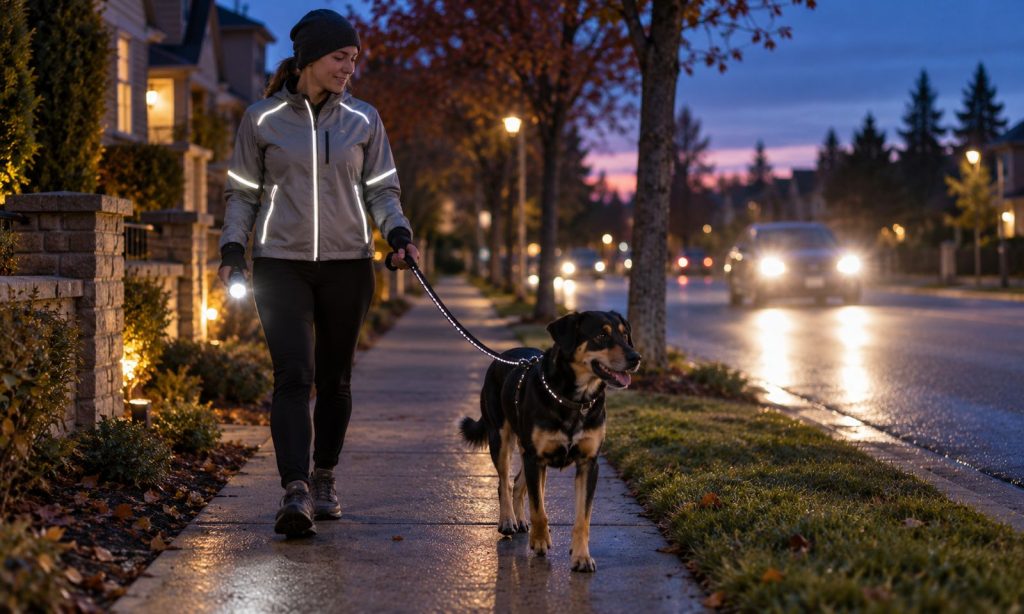
Even a familiar neighborhood can feel different after sunset. Drivers may have less time to notice a dog and handler. Reflective material can be hard to see until light reaches it. A leash is only one part of a safer setup. The right choice can help others locate your dog during a walk. This guide explains how to choose the right reflective dog leash for night walking. It covers reflective coverage, leash length, handle comfort, hardware, care, and routes. Your route and dog shape the choice. It also explains the limits of reflective gear and why your own visibility matters. If you are comparing a reflective dog leash for night walking, use these checks to judge whether its design fits your dog and routine.
What reflective material does and does not do
Learning how to choose the right reflective dog leash for night walking starts by understanding this basic limit. Reflective material returns some light toward its source. It can stand out when headlights or a flashlight illuminate it, but it does not glow by itself. That distinction matters on a dark path or in a poorly lit driveway. A vehicle may also approach from an angle that does not light the leash.
Some products combine reflective stitching or panels with a small LED light. These are different features. Reflective trim depends on an external light source, while an LED is powered and emits light. Neither guarantees that a driver will see your dog in time. Keep your dog on a secure leash, choose routes with good lighting, and stay attentive around traffic.
A useful night-walking setup often makes both the dog and handler visible. A reflective vest can add a larger visual area on your dog; our guide to reflective dog vests for night walks explains coverage and fit. Wear visible clothing yourself and carry a light that lets you see the path.
Inspect how much of the leash reflects
When deciding how to choose the right reflective dog leash for night walking, look at the full leash rather than relying on a product name. Reflective details may appear as narrow threads, repeated strips, or broader panels. More coverage can make the leash easier to notice from different angles, but placement and lighting still affect what others can see.
Check whether reflective sections continue along most of the leash or stop near the handle. The leash moves as you walk, so visibility from several directions can be useful. Reflective material on both sides may be easier to notice than a strip placed only on one face. Confirm the description or inspect the item under a light instead of assuming all trim performs alike.
Think about your dog’s coat and body shape too. A dark leash and dark dog may blend together, especially under weak street lighting. A contrasting leash can help you see where the line is, while reflective stitching may help it catch light. These features support visibility; they do not replace an illuminated accessory when the route is very dark.
Choose a practical leash length
An important part of how to choose the right reflective dog leash for night walking is choosing a length you can manage. A shorter standard leash can help you keep your dog close near roads, driveways, or crowded sidewalks. A longer leash may allow more sniffing on a quiet, open path, but it can create extra slack that is harder to manage in low light. Decide where you walk most and choose a length that gives control without dragging on the ground.
Avoid letting the leash cross a bike lane, roadway, or another pedestrian’s path. In darkness, you may not see a low line or a person approaching until they are close. Keep the leash gathered when passing others, and use a consistent side for walking where possible.
Retractable leashes can extend far from the handler and may be harder to control around traffic or people. A standard fixed-length leash is often simpler for low-light walks. If you already use a retractable model, follow its instructions and use it only where you can maintain safe distance and control.
Check the handle and how it feels in your hand
Another consideration in how to choose the right reflective dog leash for night walking is how securely you can hold it. A comfortable handle matters when you are walking in gloves, rain, or cold weather. Look for a loop that fits your hand without cutting into your fingers. A padded grip can feel comfortable, but it should not be so bulky that you cannot close your hand securely.
Some leashes have a second traffic handle closer to the clip. This can help you shorten the distance quickly when approaching a crossing or another dog. Check that you can reach it without dropping the main loop or tangling your fingers. Extra handles add bulk, so consider whether you will actually use them.
If you have limited hand strength, arthritis, or balance concerns, practice gripping the leash before using it outside. Do not wrap the leash around your wrist. A sudden pull can injure you or make it harder to release the line safely.
Evaluate the clip and leash material
For how to choose the right reflective dog leash for night walking, check the hardware as carefully as the trim. The clip should close securely and attach to your dog’s harness or collar without sticking. Inspect the spring gate and swivel for smooth movement. A clip that is too heavy may pull on a small dog’s harness, while one that is too small may not suit a larger dog. Match hardware to your dog’s size and strength.
Nylon webbing is common and often dries faster than thick padded fabric, though construction varies. Rope-style leashes can feel comfortable in the hand, while coated materials may wipe clean easily. Whatever the material, look for strong stitching and edges that will not fray quickly. Avoid a leash with cracks, loose threads, or a clip that opens unexpectedly.
Some reflective threads can wear with repeated washing or abrasion. Follow care directions and check the leash periodically under a bright light. A product’s reflective appearance when new does not mean it will remain effective after damage or heavy use.
Match the leash to your dog and walking habits
How to choose the right reflective dog leash for night walking also depends on your dog’s size and behavior. A dog that pulls hard needs equipment that you can hold securely and use with a well-fitted harness or collar appropriate for that dog. A leash does not teach loose-leash walking by itself. If pulling creates a safety concern, get guidance from a qualified trainer or veterinarian rather than relying on a reflective feature to solve control problems.
For a small dog, a lightweight clip may be easier to carry. For a strong dog, hardware and stitching need to withstand force. Consider whether the leash has enough width for your hand and enough substance for the dog’s size without being cumbersome.
If your dog has a habit of lunging or darting, prioritize control and training over extra leash length. A reflective dog leash for night walking can help make the line more visible, but it cannot prevent a sudden pull or stop a dog from entering traffic.
Think about your route and the rest of your gear
When considering how to choose the right reflective dog leash for night walking, also plan where you will use it. Choose a route with sidewalks, streetlights, and fewer vehicle crossings when possible. Walk against traffic on roads without sidewalks so you can see oncoming vehicles, and keep your dog away from the roadway. Cross at visible crossings and pause before stepping off the curb.
Carry a flashlight or wear a headlamp so you can notice cracks, debris, and approaching people. Use reflective or bright clothing on yourself. A leash can be visible while the person holding it remains difficult to see, so do not treat dog gear as a complete safety plan.
Keep identification current and make sure your dog is wearing properly fitted walking equipment. A weatherproof collar can complement the setup in rain; our guide to choosing a waterproof dog collar explains material and fit checks. If your dog is nervous around traffic, start with short walks in familiar, well-lit places. Choose a time with less activity while they adjust to the routine.
Test the leash before relying on it
One step in how to choose the right reflective dog leash for night walking is testing it before you rely on it. Before your first night walk, inspect the stitching and clip in daylight. Attach the leash to the equipment your dog normally wears and walk around a quiet, enclosed area. Confirm that the clip stays fastened and the handle feels secure during turns and gentle changes in direction.
To check reflectivity, shine a flashlight toward the material from several angles. This is a basic visibility check, not a measure of how far away a driver can see it. Repeat the check after cleaning or visible wear. If the reflective area has peeled, cracked, or become difficult to see, replace the leash.
Use the first outing to learn how the leash behaves in your neighborhood. Notice whether the reflective surface catches streetlights or headlights, whether the clip catches on fur, and whether the length gives you enough control. A few minutes of preparation can reveal problems before a busy walk.
Care and replacement
Clean the leash according to its care label. Let it dry fully before storing it, especially if it has padded sections or a metal clip. Dirt and grit can wear webbing and reflective trim. Keep the leash away from sharp edges that could cut or weaken it.
Inspect the whole length before each walk. Look for torn stitching, fraying, cuts, loose reflective sections, corrosion, and a clip that no longer springs closed. Replace damaged equipment instead of knotting or taping it as a repair. If a leash fails during a walk, move to a safe area before making a plan to get home.
Combine reflective and active visibility
Reflective trim and lights serve different purposes, so consider the lighting on your regular route. A well-lit neighborhood may give headlights and streetlights more chances to hit reflective surfaces. An unlit trail offers fewer of those moments. A small light on the leash or harness can help others notice your dog even when direct headlights are absent, but batteries can run down. Check power before leaving and carry a backup light if you will be out for a while.
The leash itself is a narrow line. A reflective vest or harness can create a larger visible shape, especially when the dog turns or moves. Make sure any added gear fits without rubbing the skin or restricting movement. Avoid stacking so many accessories that the leash catches on them or the dog becomes uncomfortable. The aim is a clear, simple setup you can inspect quickly.
These choices do not make night walking risk-free. Reflective material is most useful when a light reaches it, while active lights depend on power and correct placement. Keep to routes where you can see traffic and footing, and skip the walk if weather or visibility becomes unsafe.
Frequently Asked Questions
Does a reflective leash glow in the dark?
Usually, no. Reflective material returns light from headlights or a flashlight. It does not emit light on its own unless the leash also has a powered light feature.
Is reflective trim enough for a dark road?
No single feature guarantees visibility. Use a well-lit route, carry a light, make yourself visible, and keep your dog under close control near traffic.
What leash length is safest at night?
Choose a length that lets you keep your dog close near roads and other people. A fixed-length leash is often easier to manage than a long or retractable line in low light.
Can I use a reflective leash with a harness?
Yes, if the leash clip fits the harness ring and both items are in good condition. Use a harness that fits securely and does not restrict normal movement.
How often should I replace a reflective dog leash?
Replace it when the webbing, stitching, clip, or reflective sections are damaged. Check it regularly because wear depends on use, cleaning, and storage.
Final Words
The best choice depends on your route, your dog’s size and behavior, and how much control you need in low light. In short, how to choose the right reflective dog leash for night walking comes down to control, visibility, and dependable construction. Check reflective coverage, leash length, handle comfort, clip security, and stitching. Pair the leash with visibility gear for you and your dog, plus a light that helps you see the path. When reviewing night-walking reflective leash options, remember that reflective trim needs light to work. The right setup supports a safer routine, but attentive handling and a sensible route remain essential.









