
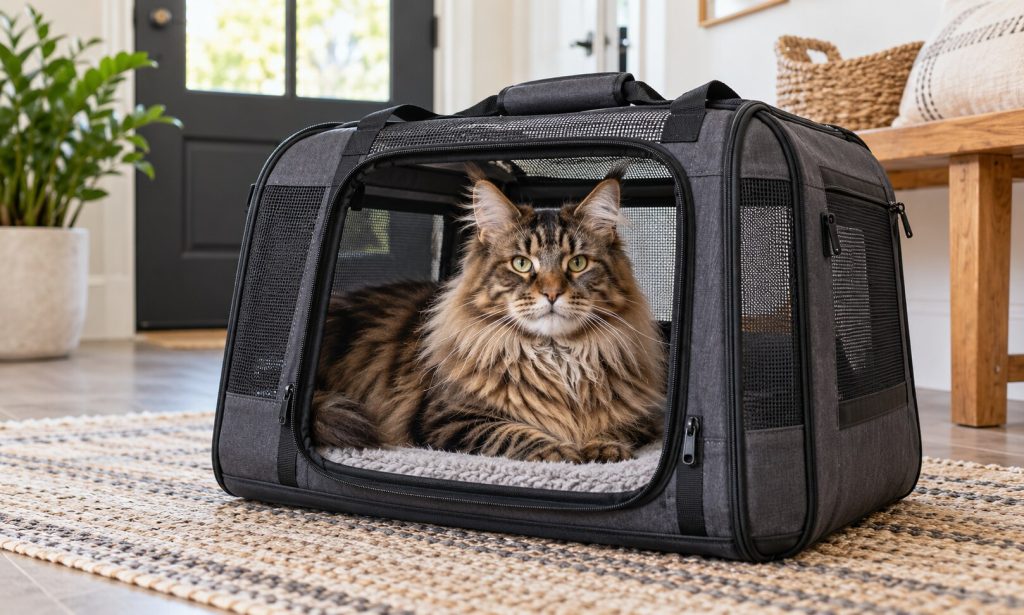
A soft carrier can be easier to store and carry than a rigid one, but large cats need enough usable room and a stable base. A carrier that sags, collapses, or strains its zipper can become uncomfortable and difficult to handle. Before choosing a soft cat carrier for large cats, measure your cat and compare the interior space, weight rating, frame, ventilation, door placement, and handle or strap support. This guide focuses on practical fit and construction so you can decide whether a soft-sided design suits your cat and your trip. If the carrier will be used in a car, secure transport matters as much as portability. Try lifting the carrier a few inches to see whether the base stays level and the cat remains supported.
Measure the cat and the usable interior
Measure your cat from nose to tail base and from floor to the top of the head while standing naturally. Compare those measurements with the carrier’s interior, not only its exterior. Confirm the cat can sit, turn, and lie down without the roof pressing on the body. Check both the stated weight limit and whether the base supports the cat without sagging.
Inspect structure and carrying points
Soft sides should retain their shape under normal handling. Look for a reinforced base, strong stitching, reliable zippers, and a closure that cannot be nudged open. Test handles and shoulder straps with an appropriate load before relying on them. Ventilation panels should remain open when the carrier is set down. Make sure the carrier does not collapse around the cat when carried.
For a broader look at sizing across carrier styles, see the guide to carriers for large cats.
Choose entry and cleaning features
Top and side openings can help with different cats. A wide opening may be useful for a large cat that resists being guided through a small door. Removable or washable bedding, wipe-clean fabric, and a leak-resistant base can simplify cleanup. Avoid loose straps that can snag and decorative parts that could be chewed or swallowed.
If the bag will ride in a vehicle, our guide to a cat carrier for car travel covers restraint and travel-specific considerations.
For general travel routines, see our guide to preparing a cat for travel. If a large cat cannot sit or turn comfortably, choose a different size or construction rather than forcing a tight fit.
When a soft carrier may not be the right fit
A soft-sided design may be convenient to fold and carry, but it may not suit a cat that pushes hard against mesh, chews fabric, or needs extra structural support. If the carrier bends around the cat, the usable interior becomes smaller. Check whether the base stays level when lifted and whether the walls keep their shape when the cat shifts position.
Consider how you will carry the weight over stairs, through a parking lot, or to a veterinary clinic. A shoulder strap can free your hands, but it must attach securely and keep the carrier balanced. If the cat’s weight makes the seams strain or the carrier swing, a more supportive design may be safer and more comfortable.
Check how a soft carrier supports a larger cat
For a larger cat, the floor panel and seams deserve as much attention as the listed weight capacity. Press gently on the base and check whether it stays level when supported by the handles. A sagging floor may cause the cat to slide or place weight on a zipper. Inspect the stitching where handles meet the carrier, the frame or support rods, and the connection points for shoulder straps. Confirm the maker’s stated capacity and use the carrier only as directed.
Measure the cat in a relaxed position and compare those measurements with the usable interior, not the outside dimensions. The cat should be able to turn and lie naturally; the bag should not become so wide that it is difficult to carry securely. Consider how the carrier opens, how easily you can reach the cat, and whether the mesh stays clear when the bag is held by its handles. A wide opening can simplify loading, but it must close reliably.
Try the carrier empty first, then place familiar bedding inside and invite the cat to explore. Lift it briefly from every intended carrying point while the cat is safely supported, and inspect for shifting or strain. Practice a short carry around the home. If the cat’s weight causes the floor to bow, seams to pull, or the carrier to swing, choose a more supportive design. The best soft carrier is one that remains stable and comfortable when actually carried.
Frequently Asked Questions
How much room should a large cat carrier have?
Your cat should be able to sit, stand, turn, and lie in a natural position. Follow airline rules if applicable.
Are soft carriers safe for car travel?
Use a carrier only as directed by its maker. A soft carrier is not automatically crash-tested; secure it according to veterinary and vehicle guidance.
What weight should I use when checking the limit?
Include the cat and anything carried inside, and follow the manufacturer’s stated limit.
Is a shoulder strap important?
It can help with carrying, but check stitching, balance, and secure attachment. Support the base if the carrier shifts.
When should I choose a hard carrier?
Consider one if a soft carrier collapses, strains under the cat’s weight, or is difficult to secure and clean.
Final Words
Choose a soft carrier by interior space, stable support, secure closures, ventilation, and practical cleaning. Test the fit and carry system before travel. If the carrier sags or compresses around your cat, select a more supportive option.









