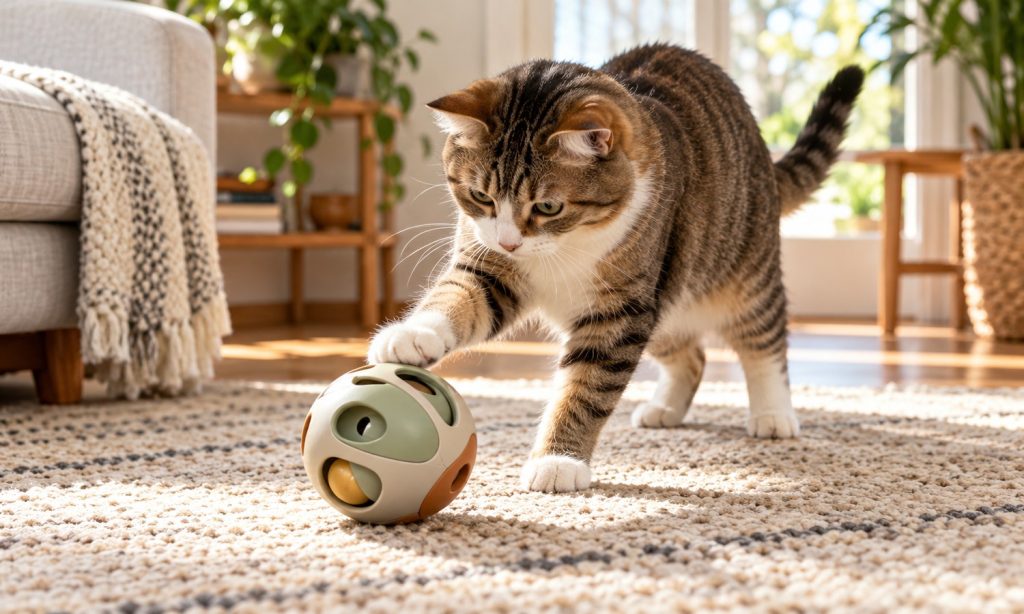
How to choose the right automatic cat toy for cats home alone begins with matching the design to your cat’s preferences, routine, and environment. The word “automatic” can mean a timed motion toy, a rolling device, or a feeder that releases food; those designs have different supervision needs. Start by considering how your cat plays, whether it chews or swallows toy parts, and how long the device will run. Then inspect stability, moving pieces, power source, noise, and cleaning requirements. No toy can replace daily interaction or guarantee that a cat stays entertained while alone. This guide explains how to evaluate automated toys, introduce one while you are present, and decide what is safe to leave accessible. Careful testing lets you choose a practical option that fits your cat and household routine.
Understand the job of an automatic toy
Indoor cats need opportunities to play, stalk, chase, and forage. An automatic toy may add movement or food activity when you cannot actively direct a game. It does not replace human interaction, environmental variety, or the cat’s other needs for rest, climbing, scratching, and safe resources.
Decide when you expect the toy to be used. A battery-operated device that runs for a few minutes on a timer is different from a toy that moves continuously. A treat dispenser creates a food activity rather than a chase game. A simple ball that a cat bats independently may be safer to leave out than a wand with an exposed cord.
Be realistic about the cat’s behavior. A cat that plays gently may use a motion toy safely, while a chewer or toy destroyer may need supervision. “For independent play” does not automatically mean suitable for every cat to use alone.
Match the movement to your cat
Some cats enjoy unpredictable movement that resembles prey. Others are wary of buzzing motors, flashing lights, or sudden starts. Observe your cat during supervised play and choose a motion style that attracts interest without causing fear. A quiet rolling movement may work better than a fast, noisy device for a cautious cat.
Check that the toy’s path fits the room. A device should not repeatedly crash into glass, fall down stairs, become wedged under heavy furniture, or knock objects from shelves. Clear the play area before testing it. If it moves across a rug, check whether it can become stuck in fibers or cords.
Adjustable speeds, short cycles, or a manual off switch can help you tailor activity. Begin with a brief session while you are home. Watch whether your cat chases appropriately, bites the device, paws at seams, or becomes frustrated. Stop if the cat appears distressed or the device behaves unpredictably.
Inspect construction and moving parts
Look for a sturdy outer case, secure seams, and components that cannot be easily pulled off or swallowed. Avoid loose strings, ribbons, thin elastic, feathers, small bells, and exposed wires for unsupervised access. These parts may be tempting to chew or can become tangled. Put wand toys and dangling attachments away when play ends.
Check moving parts for gaps that could pinch a paw, trap fur, or catch a claw. A ball or rolling toy should be large enough that it cannot be swallowed. Batteries should be enclosed behind a secure compartment, and the toy should not show cracks that expose wiring or battery contacts. Keep the device away if the cat can pry it open.
Use the toy as directed and inspect it before each period of independent use. Remove it if it becomes damaged, overheats, smells unusual, or makes a new grinding sound. Do not leave a questionable device running simply because it still turns on.
Evaluate timers, power, and noise
Some automatic toys operate on batteries; others plug into an outlet or recharge. A cord can be a chewing or entanglement hazard, so keep it inaccessible and do not place the toy where a cat can pull it down. Confirm that the battery compartment closes securely. Follow charging instructions and unplug the device during inspection or cleaning.
Timer settings can limit how long a toy runs, but they are not a safety guarantee. Test the timer while you are present and confirm that the device stops as intended. If a toy restarts unexpectedly or cannot be switched off easily, do not leave it accessible while you are away.
Noise matters too. A motor that seems quiet to a person may still startle a cat in a small apartment. Introduce sounds gradually and let the cat retreat. A toy that causes hiding or avoidance is not providing useful enrichment, even if it is technically functioning.
Test it before leaving your cat alone
Introduce the toy while you are home. Start with the device off so the cat can inspect it, then activate it briefly at a distance. Observe the cat’s response and check whether it chews, claws at the case, or tries to reach internal parts. Repeat short trials before considering any unsupervised use.
Test it in the same room where you plan to leave it. Look for stairs, cords, curtains, breakables, other pets, and tight spaces where the device could get stuck. Do not place it near water bowls that could spill or food that needs to remain undisturbed. If the toy can be moved, make sure it cannot block an exit or become trapped behind furniture.
Begin with brief absences and a simple safe setup. If you will be gone for a long period, provide ordinary essentials and a safe environment rather than relying on one device. If the cat has a history of chewing or ingesting objects, choose supervised enrichment and consult your veterinarian about unusual chewing.
Keep food-based toys balanced and clean
If the toy dispenses treats or kibble, count that food as part of the cat’s daily allowance. Use an appropriate portion and avoid leaving more food than the cat should eat. Make sure the cat can access water and regular meals as usual. Food toys should add an activity, not disrupt the feeding routine.
Clean food compartments according to the toy’s instructions. Crumbs, oils, and moisture can collect in small spaces. Dry the parts fully before refilling them. Do not use a food dispenser if the mechanism jams, the portions vary unexpectedly, or the cat can chew open the container.
A puzzle or food ball may be a good choice for a cat who likes to forage. Start with an easy setting and check that the cat can retrieve food without becoming frustrated. If the cat cannot solve the toy, simplify it or use another activity.
Provide variety beyond one device
Rotate safe solo toys so they stay interesting, and keep supervised toys stored when not in use. Offer other forms of enrichment such as climbing spaces, windows to observe, scratching areas, hiding places, and food puzzles. Multiple activity types support a fuller indoor environment than a single automatic toy.
Plan a play session with your cat before or after you leave when possible. Interactive play can be tailored to the cat’s movements, and the cat can catch the toy. Keep that session separate from unattended toy use so the cat still receives direct attention.
Frequently Asked Questions
Can an automatic cat toy be left on all day?
Do not assume it is safe for continuous use. Follow the instructions, test its timer, and consider the cat’s behavior and room setup. Short cycles are generally easier to monitor.
Are automatic toys safe for cats home alone?
Some may be appropriate after supervised testing, but safety depends on construction and the individual cat. Avoid exposed cords, loose parts, and devices the cat can chew open.
Should I leave a laser toy running while I am away?
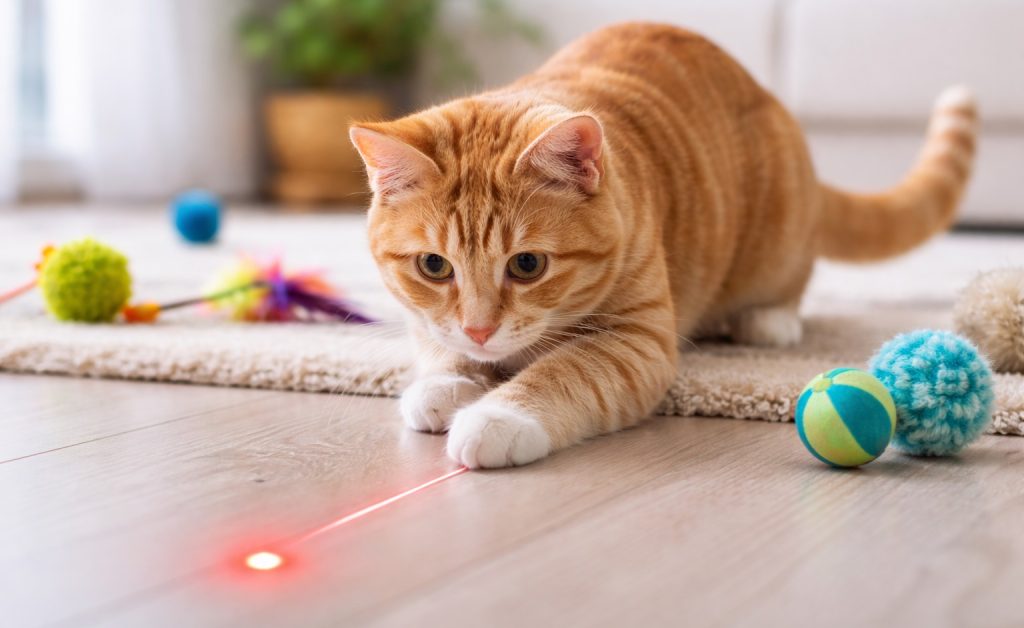
No. Laser toys require supervision so you can control the beam and end play in a satisfying way. Store them safely after use.
How do I know if my cat likes an automatic toy?
Observe whether the cat approaches, follows, bats, or returns to the device voluntarily. Hiding, repeated avoidance, or frantic biting suggests the toy may not be a good fit.
Can an automatic toy replace playtime with me?
No. It can add activity, but it does not replace social interaction or supervised play. Keep a regular routine that includes time with your cat.
Final Words
The right automatic cat toy for cats home alone matches your cat’s behavior and has secure construction, controlled movement, and a reliable way to stop. Introduce it while present, inspect it regularly, and only leave it accessible if your cat uses it safely. Keep cords, strings, and damaged devices out of reach. Pair independent activities with normal care and direct play. A tested toy can enrich a cat’s routine, but it should never be the sole plan for a long absence.