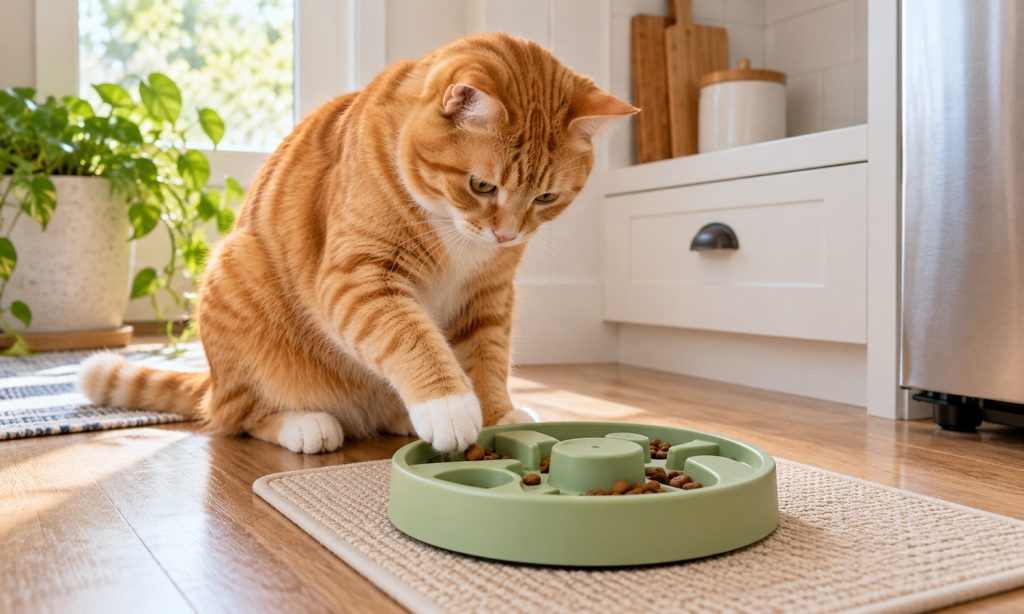
How to choose the right puzzle feeder for cats begins with matching the design to your cat’s preferences, routine, and environment. The right feeder should be challenging enough to engage your cat but simple enough to use without frustration. It must also be stable, easy to clean, and suitable for the food you plan to offer. Start by considering how your cat eats now, whether it paws or noses at objects, and how much time you can spend introducing a new setup. A puzzle feeder is an enrichment option, not a reason to withhold meals or change a cat’s diet without guidance. This guide explains how to choose a suitable difficulty, fit the feeder into a feeding routine, keep it sanitary, and tell when a different design may work better.
What a puzzle feeder does
A puzzle feeder holds food that a cat must move, reach, roll, or uncover. It can add activity and mental engagement to feeding and encourage foraging behavior. Some designs are simple trays with shallow wells; others require pushing pieces or rolling a ball. The word “puzzle” covers a wide range of effort, so choose based on your cat rather than the most complicated design.
Decide what you want the feeder to do. A slow feeder may spread kibble across a maze to slow quick eating. A food puzzle may make the cat reach or paw for pieces. A scatter-style design can encourage searching. These purposes overlap, but they are not identical. A feeder should fit the cat’s ability and the type of food, not just look mentally stimulating.
Use a puzzle as one part of a complete feeding plan. Cats should still receive appropriate meals and access to fresh water. If your cat has a prescribed diet, swallowing difficulty, or a medical condition that affects feeding, ask your veterinarian before changing how food is delivered.
Start with your cat’s current skills
Observe whether your cat already uses its paws to move objects, noses food around a dish, or loses interest when food is not immediately accessible. A cat that has never used a feeder usually benefits from a simple design with visible food and easy access. A cat that solves basic puzzles quickly may enjoy a design with more steps or adjustable openings.
Do not confuse refusal with laziness. The feeder may be too difficult, unstable, noisy, unfamiliar, or uncomfortable to use. Offer a small amount of the cat’s normal food in an easy configuration and stay nearby. If the cat is hesitant, return to a regular bowl for the meal and try again later with a simpler setup.
Age and mobility matter. A senior cat or a cat with limited paw movement may prefer shallow compartments or a broad, low feeder. A very small opening or high-sided tray could be frustrating. Adjust the puzzle to the individual cat’s reach and coordination.
Choose an appropriate difficulty
Look for a feeder that allows food to be found with modest effort at first. Some designs let you begin with treats placed on top or in open wells, then gradually make access harder. This staged approach helps the cat learn the mechanism. Increase difficulty only when the cat can retrieve food successfully and continues to engage.
A puzzle that is too easy may not hold a practiced cat’s interest, but an overly complex one can cause frustration or discourage eating. Watch whether the cat remains engaged, pauses calmly, and obtains some food. If it bats the feeder away, walks off, or cannot access any food, simplify the setup or try another style.
Adjustability is useful because cats can learn. However, a complex feeder is not automatically better. The aim is manageable exploration, not a test the cat must pass. Keep a familiar bowl available during the transition, especially if the cat is not reliably eating from the puzzle.
Check size, stability, and materials
Choose a feeder with a broad, stable base that does not slide or tip during pawing. Put it on a nonslip mat and test it with the food before serving a meal. A feeder that skitters across a hard floor can make the task more difficult for the wrong reason. Check that compartments are large enough for the food pieces and accessible to the cat’s paws or nose.
Inspect the material for smooth edges, cracks, loose pieces, and small parts that could be swallowed. Avoid designs with narrow gaps that can trap a claw or pinch a paw. If the cat tends to chew hard objects, use a durable feeder and supervise early sessions. Remove it if the cat breaks or gnaws off pieces.
Consider your cat’s size and posture. A feeder should sit at a comfortable height and allow the cat to approach from more than one side if needed. A design that makes a cat twist awkwardly or press its face into a narrow opening may be a poor fit. Stability and access are more important than an elaborate appearance.
Match the feeder to the food
Some puzzles work only with dry kibble; others can hold small treats or wet food. Check how food is released and whether the opening is large enough. Wet food can be harder to remove and may dry onto surfaces, so choose a feeder with washable parts if you plan to use it. Do not leave perishable food sitting out beyond safe handling guidance.
Measure the amount placed in the puzzle. Treats and kibble used for enrichment still count toward the cat’s daily food intake. If you use part of a meal in a puzzle, serve the remainder in the cat’s usual way. Avoid adding extra treats simply to keep the puzzle filled.
If several cats share a home, feed them separately if one cat might steal from another or block access. Provide each cat with a calm feeding location and watch for competition. Puzzle feeding should not create a reason for cats to guard food or crowd one another.
Introduce it gradually
Set the puzzle on a familiar feeding surface and begin with a simple layout. Place a few pieces of the cat’s normal food in open sections or directly on top. Let the cat investigate without moving its paws for it. You can demonstrate by gently moving a compartment, but do not force the cat’s face toward the feeder.
At first, use only a portion of a meal or a few pieces of food while the regular bowl remains available. This prevents a new challenge from interfering with the cat’s normal intake. Once the cat understands the puzzle, gradually increase the amount or difficulty. Keep the routine predictable and positive.
Watch the cat’s behavior. If it becomes frustrated or stops eating, return to an easier setting. If it engages comfortably, you can make one small change at a time. Do not make the cat go hungry to “make” it use the feeder. A puzzle should invite activity, not replace access to food.
Clean and maintain the feeder
Food residue can collect in corners, sliding parts, and small compartments. Wash the feeder as often as needed for the food used and follow its care directions. Dry it fully before refilling. If parts cannot be cleaned adequately, use another design. A clean feeder is especially important when using moist or oily food.
Inspect it for cracks, worn edges, and loose parts during cleaning. Replace it if the cat can chew through it or if components no longer fit securely. Keep the feeding area dry and remove uneaten food according to safe storage practices.
Frequently Asked Questions
Are puzzle feeders good for cats?
They can add activity and foraging opportunities when matched to the cat’s ability. They should not interfere with regular meals or access to water.
How do I teach my cat to use a puzzle feeder?
Begin with an easy setup and visible food. Let the cat explore voluntarily, and keep the usual feeding option available until the cat reliably understands the puzzle.
Can a puzzle feeder slow down eating?
Some designs spread food out or require movement, which may slow a fast eater. Monitor that the cat can still access enough food and does not become frustrated.
Can I use wet food in a puzzle feeder?
Only if the feeder is designed for it and can be cleaned thoroughly. Remove leftovers promptly and wash the feeder as directed.
What if my cat refuses to use a puzzle feeder?
Try a simpler design, make food easier to reach, or use another enrichment activity. Do not withhold meals to force the cat to solve a puzzle.
Final Words
The right puzzle feeder for cats matches your cat’s skills, food, mobility, and feeding routine. Begin with an easy challenge, keep the feeder stable and clean, and increase difficulty only when your cat is succeeding. Count puzzle food as part of the daily ration and maintain normal meals and water access. If the feeder makes eating stressful or difficult, choose a simpler option. Enrichment should make mealtimes more engaging while keeping feeding comfortable and reliable.