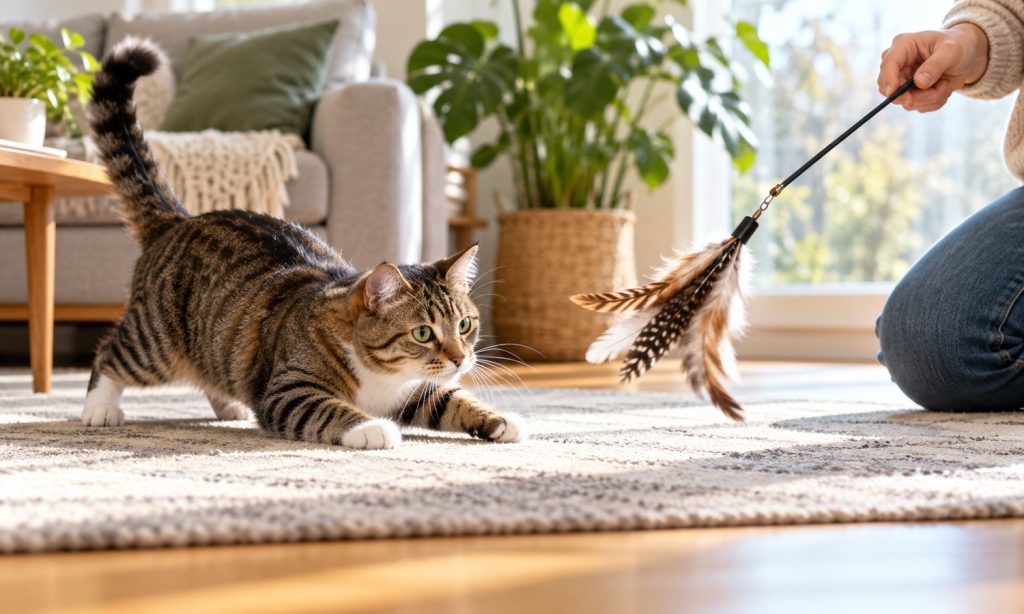
How to choose the right interactive cat toy for indoor cats begins with matching the design to your cat’s preferences, routine, and environment. The best fit is not necessarily the toy with the most moving parts. It is one your cat can engage with safely and repeatedly. Start by noticing whether your cat chases fluttering objects, bats rolling toys, stalks around corners, or works for food. Then check the toy’s movement, size, materials, difficulty, and supervision needs. Indoor cats benefit from opportunities to express natural hunting and play behaviors, but a toy left out between sessions must be appropriate for unsupervised use. This guide explains how to choose an interactive toy, adapt play to a cat’s style, and inspect it so play stays engaging and safe in your home.
Decide what kind of interaction you want
Interactive toys can involve a person, another cat, or a cat-operated activity. A wand toy lets you control movement and create a prey-like path. Toss toys invite chasing and carrying. Food puzzles add foraging and problem-solving. Motion toys may move on their own, but they are not a substitute for every cat’s social play needs.
Think about when you want the activity to happen. A wand toy is useful for a short, supervised session when you are available. A puzzle can occupy a cat while you prepare dinner. A rolling toy may be suitable for solo play if its parts remain secure and the cat does not chew them. Your own availability is part of the selection, not an afterthought.
Indoor cats need enrichment that supports natural behaviors, including simulated hunting and foraging. Toys can help, alongside perches, hiding spaces, scratching surfaces, and predictable interaction. A single toy cannot meet every need, so choose one that fills a gap in your cat’s routine.
Match movement to your cat’s play style
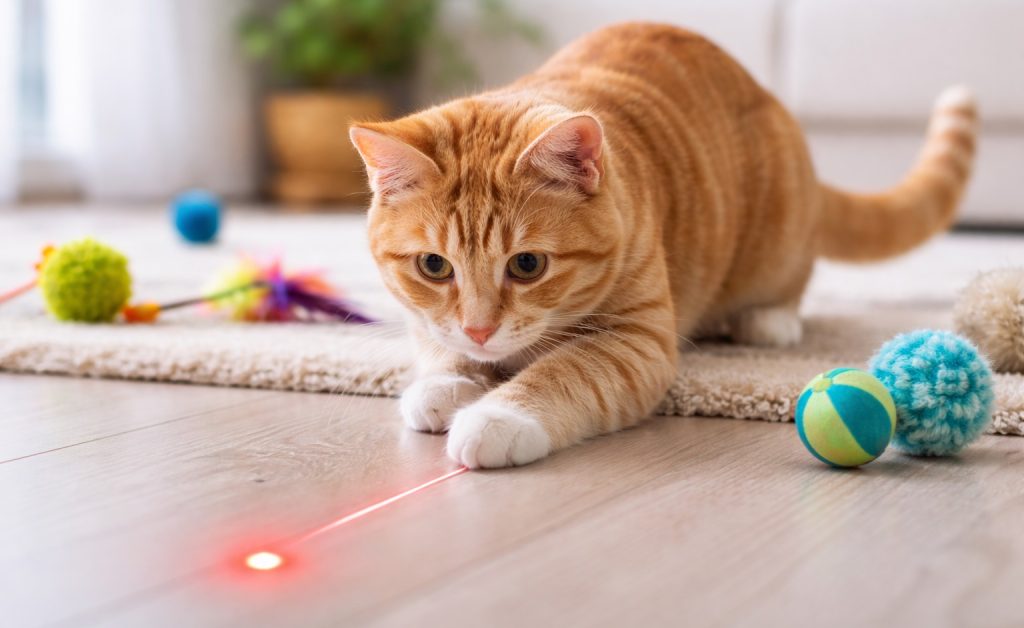
Observe how your cat approaches a moving object. Some cats stalk slowly, then sprint; some prefer a quick flutter or a toy that disappears behind furniture. Others like batting a ball across the floor. Move a wand toy like prey by letting it pause, dart, and retreat rather than waving it continuously in the cat’s face.
For a ground hunter, a toy that skitters along the floor may be more inviting than one lifted overhead. A cat that likes jumping may enjoy brief upward movement, but avoid encouraging risky leaps from slippery surfaces. Keep enough open floor space for turns and landings, and use movement that suits the cat’s age and mobility.
Some cats are cautious around noisy or fast-moving objects. Begin with slow movement and allow the cat to watch from a comfortable distance. If it hides or walks away, stop and try another style later. The goal is voluntary engagement, not maximum excitement.
Choose a safe size and construction
For a cat-operated toy, inspect seams, attachment points, and small parts. Avoid loose strings, long cords, feathers that detach easily, sharp edges, and pieces a cat could chew off or swallow. A toy should be large enough that it cannot be gulped, yet manageable for the cat to bat or carry. Check it before each session and remove damaged toys.
Wand toys and string-like attachments require supervision. Put them away after play so a cat cannot become tangled or chew the cord when alone. Soft toys should not have loose eyes, bells, or other parts that can come free. If your cat is a vigorous chewer, select a sturdy object designed for cats and inspect it more often.
Use toys intended for cats and follow any age or use directions. Household items can have staples, loops, toxic coatings, or parts that break unpredictably. If your cat swallows a piece or seems unwell after play, contact a veterinarian promptly and share what the toy contained.
Consider cleanup, storage, and space
In an apartment or smaller home, consider how much floor space the toy needs. A wand session can happen in a clear hallway or living room; a track toy or tunnel may need a permanent spot. Avoid play near breakable objects, open flames, cords, or furniture where the cat could get trapped.
Choose toys that are easy to inspect and clean. Washable fabric toys should dry fully before returning to use. Wipe hard surfaces according to their care instructions. Food puzzles need frequent cleaning to remove crumbs and residue. Store interactive toys in a designated place so you can quickly check for damage and keep supervised items out of reach between sessions.
Rotating a few toys can help restore novelty without buying a large collection. Put some away and bring them back later, while keeping safe solo-play options available. If a cat loses interest, the movement or timing may be the issue rather than the toy itself.
Make play satisfying and predictable
Let the cat stalk and catch the toy during a session. A toy that remains just out of reach can be frustrating. Allow pauses and small wins, then end the activity calmly. If using food as part of play, account for it within the cat’s daily food allowance rather than adding unlimited treats.
Short sessions can fit into daily routines more easily than one long session. Notice when your cat is most alert and plan play around that time. If the cat prefers rest, do not force interaction. Offer another opportunity later or leave an appropriate self-play option available.
Use a toy instead of hands or feet. Direct hand play can teach a cat to bite or claw people during excitement. Keep fingers away from the toy’s moving path and let the object absorb the pounce. If another cat is present, observe their interaction and avoid a toy that triggers competition or conflict.
Know when automated toys need monitoring
Some electronic toys move, light up, or rotate without a person controlling them. Check that the device is stable, has secure moving parts, and cannot trap paws or snag fur. Follow the manufacturer’s supervision guidance, especially during first use. A cat that chews or attacks components may need supervised sessions only.
Turn off and store powered toys when they are not intended for continuous play. Keep batteries inaccessible and replace damaged casings. Do not assume that “automatic” means safe to leave running while nobody is home. The toy should match both the cat’s behavior and the conditions in the room.
Troubleshoot a cat that ignores toys
Try changing the movement, not just the toy. A slow drag behind a chair may interest a cat that ignores fast waving. A rolling object may suit a cat that avoids jumping. Keep early sessions brief, then stop while the cat is still engaged. Offer play at a different time of day if the cat is usually sleepy.
Consider whether an environment factor is interfering. Another pet, loud noise, or lack of a clear retreat can make play feel unsafe. Give the cat a quiet space and a route to disengage. If interest in play drops suddenly along with changes in appetite, movement, grooming, or social behavior, consult a veterinarian to rule out health concerns.
Frequently Asked Questions
How often should I play interactively with an indoor cat?
Offer regular opportunities that fit the cat’s age, energy, and interest. Several short sessions may work better than one long session. Let behavior guide the pace.
Are wand toys safe to leave out?
Put wand toys and dangling cords away after supervised play. A cat can become tangled or chew the string when unattended.
What if my indoor cat ignores interactive toys?
Try a different movement, texture, or time of day. Let the cat watch and approach voluntarily, and keep sessions short and low pressure.
Can I use food as part of interactive play?
Yes. Food puzzles or tossed kibble can add foraging activity. Count treats or kibble as part of the cat’s daily food allowance.
How can I tell if a cat toy is worn out?
Remove it if seams split, strings loosen, small parts detach, or the toy exposes sharp edges. Inspect toys before each session.
Final Words
The right interactive cat toy for indoor cats matches your cat’s movement preferences, your available time, and the level of supervision the toy needs. Choose secure construction, create room for safe play, and let the cat stalk and catch at its own pace. Put away cords and damaged parts, and offer variety across the week. A thoughtful mix of active play and safe solo enrichment gives an indoor cat more ways to explore natural behaviors at home.