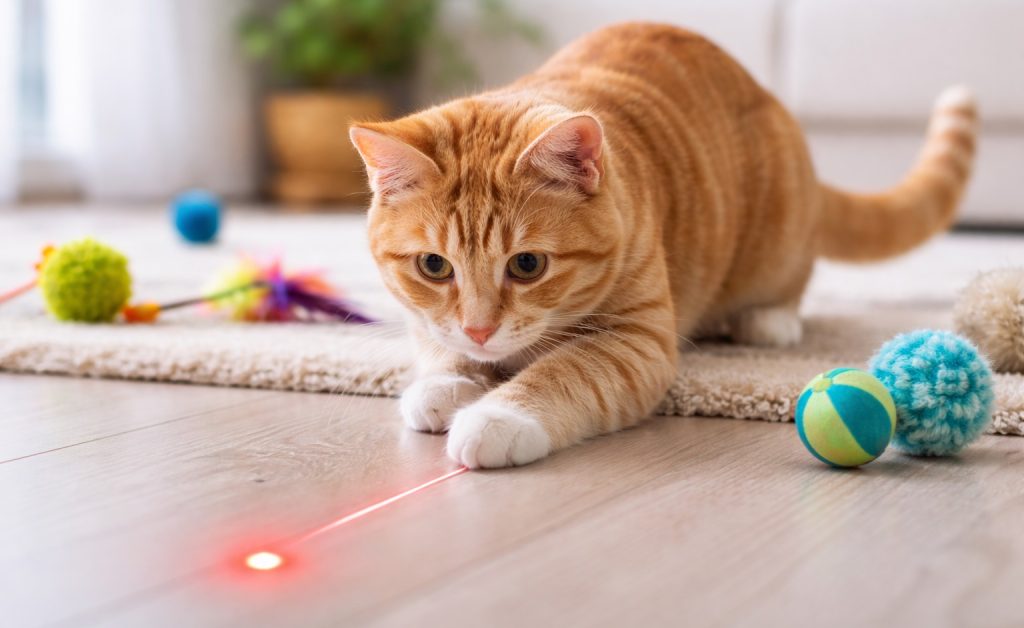
How to choose the right laser toy for indoor cats begins with matching the design to your cat’s preferences, routine, and environment. The right option is easy to control, produces a visible point without directing light toward the cat’s eyes, and lets you end play with a tangible catch or reward. Cats may chase a moving dot intensely, yet they cannot physically capture light. A session that ends abruptly can leave some cats frustrated. Before choosing a laser toy, consider beam control, safe handling, the room layout, and whether your cat enjoys this kind of play. This guide explains how to evaluate a laser toy, use it responsibly, and pair it with other activities so indoor play feels engaging and complete.
Decide whether your cat enjoys laser play
Some cats eagerly follow a moving light; others watch briefly and lose interest. Observe your cat’s body language. A relaxed, focused cat may stalk, follow, and pounce. If the cat hides, freezes, becomes agitated, or continues searching after the session, stop and try a different activity. Do not use a laser simply because it appears exciting to people.
Laser play is one option among many. Wand toys, toss toys, food puzzles, and physical toy mice give cats something they can touch and catch. A variety helps meet different preferences and gives the cat a clear ending to play. Keep sessions short enough to maintain interest and allow breaks.
If your cat has a history of fixation on reflections or lights, a laser may not be a good fit. Choose a tangible toy instead. The goal is safe, voluntary play that supports the cat’s natural interest in movement.
Look for simple, controlled operation
Choose a device you can switch off quickly and aim precisely. A basic control that requires deliberate pressure is easier to manage than a device that activates unpredictably. Read the operating instructions and check that the battery compartment is secure. Avoid damaged casings, loose buttons, or devices with unclear beam information.
Do not use an automatic laser that operates without supervision. You need to control where the dot goes, avoid hazards, and finish the game with a physical toy or reward. A timer does not replace active oversight. Store the device safely after play, especially if children are in the home.
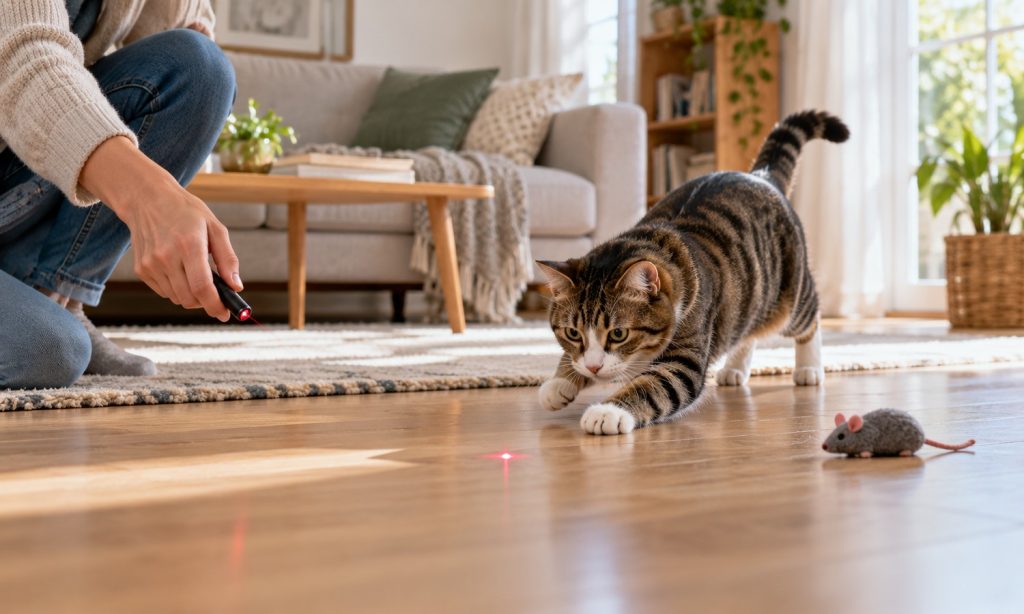
Keep the beam on the floor or another safe surface. Never point it at a person or animal, including the cat’s face or eyes. Avoid mirrors, polished metal, glass, and other reflective surfaces that can redirect the light. Do not shine the beam outdoors where it could reach traffic, aircraft, or neighboring windows.
Check the room before you start
Clear the play area of breakable items, cords, hot surfaces, and clutter that could trip the cat. Use a room with a nonslip floor and enough open space to run, turn, and stop. Avoid directing the dot up furniture, onto shelves, or near stairs where a cat may leap without a safe landing.
Move the light along low, predictable paths. Let it travel behind a box or around a corner so the cat can stalk. Avoid making the cat leap from high places or skid across a slick floor. If the cat seems winded or stops engaging, pause. Keep the beam away from sensitive areas and from other pets who are not part of the game.
Be aware of household members and visitors. A laser can be difficult to see in bright light, which may lead someone to look toward the emitter. Keep control of the device and do not allow children to aim it unsupervised. Follow the manufacturer’s directions and applicable safety labeling.
Make the chase feel like a complete game
During play, let the dot behave like prey: move, pause, dart away, and sometimes disappear. Avoid endless erratic motion that never gives the cat a chance to succeed. The cat should have room to stalk and pounce, with rest pauses as needed.
Plan the ending before you begin. Move the dot to a physical toy mouse, a favorite toy, or a small food reward placed on the floor. Let the cat catch or investigate that object, then turn the laser off. This gives the cat something tangible at the end of the sequence. Count any treat as part of the cat’s daily food allowance.
Some cats may still show frustration, even with a clear ending. Watch the response after the session. If the cat keeps searching, fixates on light spots, or becomes unsettled, discontinue laser play and use a toy the cat can catch throughout the game. Each cat responds differently.
Control session length and frequency
Short, regular play sessions are easier to fit into a routine and let you adjust to the cat’s energy. There is no single duration that suits every cat. Stop when your cat loses interest or shows signs of fatigue. Avoid pushing a cat to run hard, especially if it is older, overweight, or has mobility limitations.
Keep play positive and predictable. Start in a calm space, use movements your cat can follow, and end with the tangible reward. You can alternate laser sessions with wand play or food puzzles. That variation keeps the cat from depending on one kind of activity.
If the cat becomes overstimulated, pauses, or walks away, respect that choice. Do not corner the cat or move the light directly at its body to get a reaction. A good session ends with the cat calm, not frustrated or frightened.
Choose an alternative when needed
A wand toy lets you control a physical object that the cat can catch. A soft toy mouse can be tossed across the floor, while a food puzzle offers slower foraging activity. Select toys with secure construction and remove dangling cords after supervised play. A mix of activities can support stalking, chasing, catching, and problem-solving without relying on a light beam.
If a laser consistently causes fixation or agitation, stop using it. Provide a quiet area and a different play option. If your cat shows a sudden change in play interest, movement, or behavior, discuss it with your veterinarian; the issue may not be the toy itself.
Frequently Asked Questions
Can I shine a laser pointer at my cat?
Keep the beam on the floor or another safe surface. Never direct it at the cat’s eyes or face, or at another person or animal.
How should I end laser play?
Guide the dot to a physical toy or a small food reward, let the cat catch or investigate it, then switch the laser off.
Are automatic laser toys safe for cats?
Use laser play only while you can supervise and control the beam. Do not leave an automatic laser running when nobody is watching.
Why does my cat keep searching after laser play?
The cat may not have had a tangible catch at the end. Try finishing with a toy or treat, or discontinue laser play if the searching continues.
What if my cat does not chase a laser?
Do not force interest. Try a wand toy, a tossed toy, or a food puzzle that matches how your cat prefers to play.
Final Words
The right laser toy for indoor cats is controllable, used only with supervision, and part of a game that ends with a real catch or reward. Keep the beam away from eyes and reflective surfaces, clear the play area, and avoid unsafe jumps. Watch your cat’s response and stop if the light causes frustration or fixation. A laser can be one brief activity in a broader routine of interactive play and enrichment.