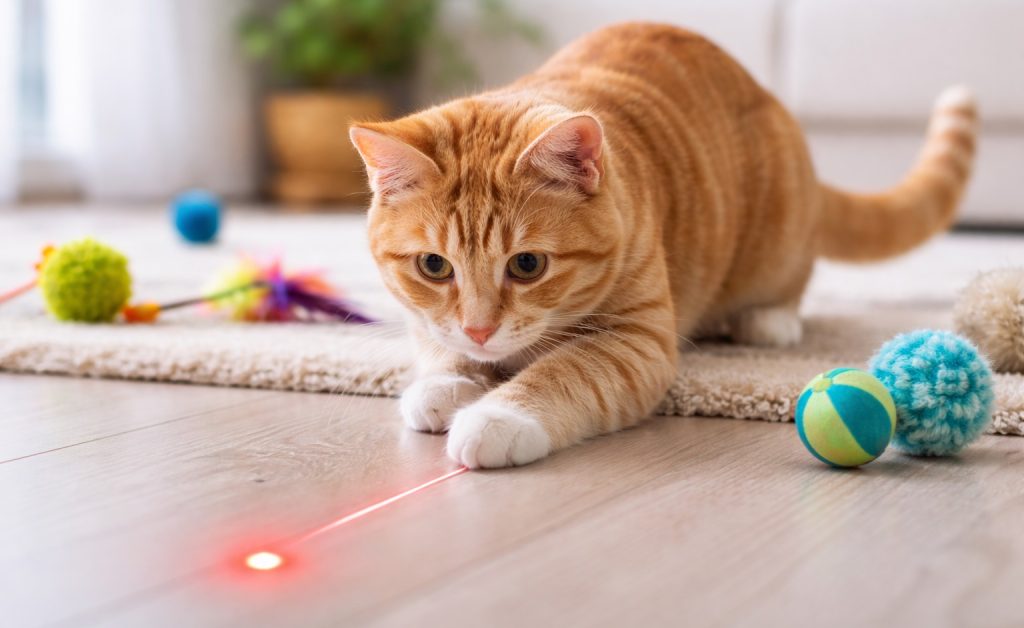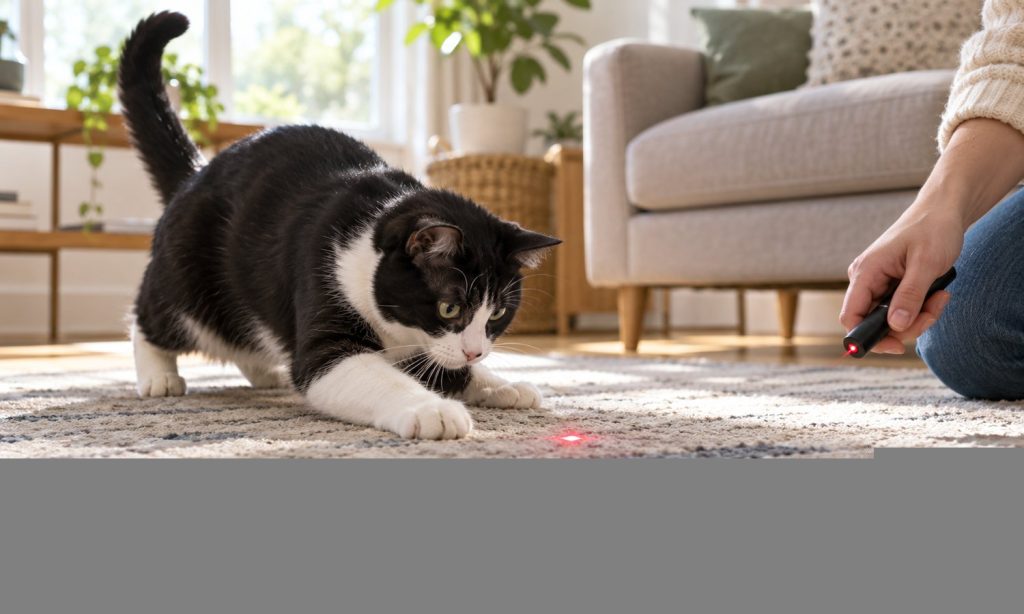
A laser toy can give an indoor cat a fast-moving target, but it works best as one part of a supervised play routine. Some cats enjoy a person-guided pointer; others respond to a motion-activated unit or a hybrid toy with feathers and track balls. We compared seven verified options and focused on how each one moves, how it is powered, and how much control you have over play. Keep the light away from eyes, choose a clear floor area, and end the chase with something your cat can catch. If your cat prefers tactile toys, our guide to catnip toys for adult cats covers other ways to encourage play.
Quick Picks
| Product | Best For | Key Advantage | Buy | |
|---|---|---|---|---|
| YVE LIFE Motion-Activated Automatic Laser Toy | Automatic random movement | Three speeds and adjustable laser angle | View on Amazon | Jump to Review |
| TBTeek Rechargeable Pattern Laser Pointer | Hands-on play | Five red patterns in a pocket-size pointer | View on Amazon | Jump to Review |
| TBTeek Motion-Activated Automatic Laser Toy | Multiple movement settings | Four speeds and five pattern choices | View on Amazon | Jump to Review |
| Saolife Suction-Mount Random-Trajectory Laser Toy | Flexible mounting | Suction cup base with adjustable angles | View on Amazon | Jump to Review |
| ORSDA 2-in-1 Laser and Feather Toy | Laser plus physical play | Alternates moving light with pop-out feathers | View on Amazon | Jump to Review |
| MOHAYA 4-in-1 Interactive Cat Toy with Laser | Varied activity in one unit | Laser, butterfly, feather, and track-ball play | View on Amazon | Jump to Review |
| JANHER Rechargeable Pattern Laser Pointer | Portable interactive sessions | Five patterns in a small rechargeable pointer | View on Amazon | Jump to Review |
How to choose a laser toy for indoor cats
A laser can prompt a quick chase, but the cat’s safety and response matter more than how many modes the device offers. Choose a format you can use responsibly in your home.
Choose handheld or automatic control
A handheld pointer lets you control the dot directly, slow the movement, and stop when your cat is ready for a break. An automatic toy moves on a programmed or motion-triggered cycle, but its sensor range, run time, and rest period vary. It still needs a safe placement and should be supervised until you know how your cat responds. Hybrid toys combine a laser with a physical feature such as feathers or track balls; that can give you an object to bat after light chasing. A cat that startles at sudden motion may prefer a person-guided pointer at a low speed. For more ideas on play formats, see our interactive cat enrichment options.
Check modes, sensors, and power
Look at how long the device runs, whether it sleeps between automatic sessions, and whether it needs a charger or replaceable batteries. A motion sensor can conserve power, but its operation depends on placement, light, and a cat entering its range. Adjustable speed and angle can help tailor a session, but extra modes also mean more controls to learn. Read the manual before use and place the device on a stable surface where the light stays on an open floor or a safely reachable wall. For handheld units, check the charging instructions and store the pointer where children and pets cannot access it.
Keep the game safe and satisfying
Never aim a laser at a person or animal’s eyes, and avoid reflective surfaces that could redirect the beam. Keep the chase away from stairs, sharp corners, glass, and unstable furniture. Use short sessions and watch your cat’s body language; stop if the cat becomes distressed, fixated, or disengaged. Since a light dot cannot be caught, finish with a physical toy or a measured treat so the cat has a reachable reward. Do not leave an automatic laser running with an unsupervised cat until you have observed safe use and confirmed the toy cannot be knocked into a hazard. For cats that chew or grab moving parts, choose a simple wand or ball and supervise closely. The guide to durable toys for large cats also explains how to inspect physical toys.
The Best Laser Toys for Indoor Cats
1. YVE LIFE Motion-Activated Automatic Laser Toy

What We Like
- Motion sensor starts a 15-minute play cycle
- Three speed settings are listed
- Laser head angle can be adjusted
- Rechargeable 1,200 mAh battery
- Random moving dot with dual motors
What We Don’t Like
- Motion sensor rests for two hours between triggers
- Placement and sunlight can affect sensor response
The YVE LIFE automatic laser toy is designed to start when its motion sensor detects activity and run for a 15-minute cycle. The listing says the sensor then rests for two hours before it can trigger again, so this is a brief automatic activity rather than an always-on device. Three speed modes—fast, slow, and mixed—let you choose a movement style, and the head angle can be adjusted to direct the dot onto a floor or wall. The dual-motor system is described as moving the light in a random trajectory. Place it on a stable surface within the stated sensor range and avoid corners, as the product guidance recommends. It is intended for indoor use.
The product includes a USB-rechargeable 1,200 mAh battery; the listing gives an approximate 2.5-hour charging time and advises using a standard 5V/1A charger rather than fast charging. It can also support plug-in operation according to the product details. These specifics make placement and charging part of the setup, and the sensor should not be obstructed by direct sunlight. Laser play needs active supervision: keep the light away from eyes, stairs, breakables, and surfaces the cat cannot safely reach. Many cats benefit from short play bursts, so stop if your cat becomes frustrated or loses interest and follow the chase with a physical toy or treat. Do not leave the laser unattended as a substitute for interaction.
My Recommendation
Consider this model if you want an automatic laser with adjustable angle and three speed choices. Its motion-triggered 15-minute cycle offers a short burst of activity, and the rechargeable battery can reduce disposable-battery upkeep. The two-hour sensor rest means it will not respond to every movement throughout the day. Position it securely, supervise laser play, and keep the dot in a safe area. If you prefer to control every movement and finish play with a tangible catch, a handheld pointer may suit your routine better.
2. TBTeek Rechargeable Pattern Laser Pointer

What We Like
- Five red pattern options are listed
- USB charging with about 20-minute charge time
- Portable 4.25-inch body with clip
- Stainless steel casing listed
- Three lighting modes for different uses
What We Don’t Like
- Requires a person to operate throughout play
- Instructions say not to point at eyes
The TBTeek pointer is a handheld option for people who want to control each movement instead of leaving an automatic unit running. Its product listing describes five red patterns, including dots, a mouse, stars, butterflies, and a smile, plus three lighting modes. The compact body is listed at about 4.25 inches long and includes a metal clip and anti-loss cord, making it easy to store between sessions. USB charging takes about 20 minutes according to the listing, which also cautions against fast chargers. Because you move the light, you can keep the chase at floor level, slow it down for a cautious cat, and pause when the cat needs a break.
This pointer requires active participation and supervision; the cat cannot operate it alone. The listing says it is a Class I laser product with output below 0.4 mW and explicitly warns not to point it at human or pet eyes. Keep the beam and dot away from faces and reflective surfaces, and choose an uncluttered floor area rather than stairs or high furniture. Laser play can be hard to conclude because the dot cannot be caught, so finish with a physical toy or a small measured treat to give the cat a reachable reward. The listing describes a stainless steel housing and rechargeable battery, but the pointer is not a chew toy. Store it out of reach when play ends and follow its adult-use warning.
My Recommendation
This is a practical pick if you enjoy guiding interactive play and want a pocket-size, rechargeable pointer with several pattern choices. You can adjust the pace moment by moment and stop whenever your cat has had enough. It is not an automatic toy and should never be used without supervision. Keep play low and away from eyes, then end with a tangible toy or reward. If you need hands-free enrichment while away, choose a cat-safe physical activity toy instead.
3. TBTeek Motion-Activated Automatic Laser Toy

What We Like
- Four speed modes listed
- Five red pattern selections
- Motion activation starts a ten-minute cycle
- Adjustable light angle
- USB-C rechargeable battery
What We Don’t Like
- Two-hour sleep period limits repeated automatic cycles
- Power adapter is not included
This TBTeek model combines automatic motion activation with several light patterns and speeds. Its listing names five patterns—such as a dot, mouse, star, butterfly, and smile—and four speed modes, from slow to mixed. It runs for ten minutes when activated, then enters a two-hour sleep period; the product information says a manual button press can restart it during that interval. The angle can be adjusted so the light moves across a floor or wall. A motion-activated unit may interest cats who respond to brief bursts, but the scheduled rest means it is not a continuous home-alone companion. Set it on a stable surface at the recommended height and confirm the dot travels across a safe area.
The toy charges through USB-C, with the product details giving about 2.5 hours for a full charge and approximately five days of use; actual battery life depends on operation. A power adapter is not included, and the listing says the device cannot run while charging. Check its charging indicator and follow the supplied directions. As with any laser toy, supervise sessions and never aim at a person or animal’s eyes. Keep movement away from stairs, glass, and unstable objects. Short sessions are easier to monitor; when play ends, offer a physical toy or measured treat. If the cat begins staring anxiously at the device or searching after it turns off, discontinue laser play and use an object the cat can catch.
My Recommendation
Pick this version if you want automatic activation with more speed and pattern choices than a basic pointer. The ten-minute session can provide a short play burst, and the adjustable head helps target a safe play surface. Its two-hour rest and lack of included power adapter are practical limits. Supervise the first sessions and watch how your cat responds after the dot stops. For cats who become fixated or frustrated, a wand toy or rolling ball gives a visible object to catch.
4. Saolife Suction-Mount Random-Trajectory Laser Toy

What We Like
- Suction cup base supports glass mounting
- Three speeds include slow, fast, and mixed
- Adjustable head and rotatable base
- Motion rests after ten minutes
- Rechargeable 1,100 mAh battery listed
What We Don’t Like
- Suction cup needs a clean, suitable surface
- Two-hour standby cycle is not continuous play
The Saolife laser toy is notable for its mounting choices. The product listing describes a suction cup base for glass as well as tabletop or bookshelf placement, with a multi-angle adjustable head and rotatable bottom. It offers slow, fast, and mixed speed modes and is designed to move the dot in a random path. The listing recommends cleaning and lightly moistening the suction cup before attaching it; check that the surface is appropriate and the toy is firmly secured before a session. A flexible mount may help direct play across an open floor, but it should not be aimed toward a ledge or area where a cat might leap unsafely.
The product details list an 1,100 mAh rechargeable battery and an automatic ten-minute operating period followed by a two-hour rest cycle. Its ultra-quiet design is a listing claim, not a guarantee that every cat will find it calming. Keep the laser away from eyes and supervise play, particularly when the device is mounted above floor level. Do not leave it operating if you cannot confirm that the surface is secure and the dot remains in a safe zone. Some cats lose interest or become frustrated when a light cannot be caught. If you notice that response, turn it off and switch to a physical toy that the cat can grasp. Recharge and clean the mounting surface as directed. Check fit before mounting.
My Recommendation
This model is worth considering if you want to mount a laser on suitable glass or place it on a shelf or table, then adjust its direction. Three speeds and a short automatic cycle provide some variety. Its suction cup needs a secure, clean surface, and its two-hour rest prevents continuous play. Use it only where the dot stays safely on an open surface and supervise your cat’s response. A handheld toy gives you finer control if your room layout is difficult.
5. ORSDA 2-in-1 Laser and Feather Toy

What We Like
- Laser and feather activities in one toy
- Feathers emerge from eight holes
- Three speed modes for laser movement
- Touch and voice activation are listed
- USB-C rechargeable with night mode
What We Don’t Like
- Laser and feather modes cannot run at the same time
- Pop-out feather parts need inspection
The ORSDA combines an automatic laser with a physical feather activity that appears through eight openings. The listing describes three laser speeds and says the laser and whack-a-mole feather features operate alternately rather than simultaneously. That combination offers a way to move from chasing light to batting at something tangible, which can be helpful for cats that need a catchable target at the end of play. Touch and voice activation are listed, alongside an automatic ten-minute run every three hours and a night mode. Place it on a stable surface and read the manual so you understand how its modes and sensor work before allowing a cat to approach.
The product information describes an ABS body and claims Class I laser certification; keep the beam away from eyes regardless, and supervise all sessions. A rechargeable Type-C battery is listed, with an approximate two-hour charge and standby of three to four days. Feather components and holes add parts to inspect for looseness, damage, or snagging. Remove the toy if the cat chews on an attachment or if a piece comes loose. The physical mode may be a better fit than laser-only play for a cat that becomes frustrated by an unreachable dot. Do not leave the unit with a cat unattended simply because it has an automatic mode; monitor the cat’s response and store it safely after play. Keep the base clean.
My Recommendation
Consider the ORSDA if your cat is interested in both moving light and batting at a physical feather. Its two activity types give you an option to switch away from the laser, and touch activation may invite a brief interaction. The modes cannot run together, and attachments need inspection. Supervise the session, follow the manual, and remove the toy if your cat chews or pulls at the feathers. A simple wand toy may be easier to control for a cat who needs close interaction.
6. MOHAYA 4-in-1 Interactive Cat Toy with Laser

What We Like
- Four play features in one rechargeable unit
- Butterfly and feather components add physical targets
- Track balls offer non-laser activity
- USB rechargeable with two-hour charge listed
- Several movement patterns are described
What We Don’t Like
- Multiple moving parts need monitoring
- Large feature set may be too busy for cautious cats
The MOHAYA is a multi-activity toy with a built-in laser, fluttering butterfly, moving feather, and track balls. Its product listing says feathers emerge from six openings and describes automatic, unpredictable movement intended to encourage chasing, pouncing, and batting. The four features can provide alternatives when a cat loses interest in one type of motion. It may suit a curious indoor cat that likes switching between a light and physical objects, while a sensitive cat may prefer one simple toy at a time. Place the unit on a stable surface with room for movement, and introduce the features gradually so you can tell which activities your cat enjoys.
The product details describe a rechargeable battery with an approximate two-hour charge time and say there are no exposed cords during play. They do not establish durability, so inspect the butterfly, feather, track balls, and housing before each use. Supervise any laser activity and never direct it at eyes. Do not leave a cat alone with an automatic unit until you have observed safe use over several sessions; remove the toy if the cat chews or pulls on small parts. The laser should not be the only enrichment available. Rotate in toys the cat can physically catch, and keep play brief if the cat appears overstimulated. Follow the supplied charging and cleaning instructions. Start with one feature and put it away after play.
My Recommendation
This is a flexible choice if your cat likes varied motion and you want laser, feather, butterfly, and track-ball activity in one rechargeable unit. The physical features can offer a catchable alternative to chasing light. There are several moving parts to inspect, and the feature mix may overwhelm a cautious cat. Introduce one mode at a time, supervise use, and keep a simpler toy available if your cat prefers a quieter game.
7. JANHER Rechargeable Pattern Laser Pointer

What We Like
- Five patterns are listed for interactive play
- USB rechargeable with rapid charge claim
- Stainless steel housing listed
- Compact 4.52-inch length
- Metal clasp helps with carrying
What We Don’t Like
- Requires continuous human supervision
- Multiple-use light modes can confuse simple operation
The JANHER pointer is a small handheld device for interactive chase play rather than an automatic toy. The product listing describes five patterns and three functional light modes, with red intended for pet play and white as a general flashlight. Its stainless steel housing measures about 4.52 inches long, and a metal clasp makes it portable. USB charging is listed, with the product page claiming a brief charge can provide extended play; treat that as manufacturer-provided information and follow the included directions. Because the person controls the pointer, you can direct the dot along the floor, slow down, or pause as your cat responds. This direct control makes the toy a better fit for supervised play sessions than for unattended enrichment.
The listing is broad and mentions several animal types, so focus on the stated cat-play use and read the product instructions before turning on any mode. Keep any laser away from eyes and reflective surfaces, and never allow children to operate it; the page specifies adult use and says to keep it out of children’s reach. A laser dot cannot be physically caught, so finish the chase with a tangible toy or a measured treat. Use brief sessions and stop if your cat shows frustration or disengages. The pointer is not a chew toy, and its compact size makes safe storage important. Check the charging port and casing for damage, and do not use a device that heats, cracks, or otherwise changes during charging.
My Recommendation
Choose the JANHER if you want a portable pointer for short, supervised play and prefer to guide the movement yourself. Its multiple patterns and rechargeable design make it easy to carry between rooms. It requires your attention throughout the game, and the instructions call for adult use and safe storage. Keep the dot away from eyes and finish with a toy the cat can catch. For automatic play bursts, consider a motion-activated unit instead.
Frequently Asked Questions
Are laser toys safe for cats?
Use them carefully: never point the beam at eyes, keep the chase area clear, and supervise play. Follow the product instructions and stop if your cat appears distressed.
How long should a cat play with a laser?
Keep sessions brief and observe your cat rather than following an arbitrary timer. Stop when the cat loses interest or shows signs of frustration, and offer a physical toy or measured treat at the end.
Can I leave an automatic laser toy on while I am away?
First supervise several sessions and confirm that the device stays stable and the light remains in a safe area. Automatic operation does not remove the need to assess the toy and your cat’s response.
Why does my cat keep looking for the dot after play?
Some cats may continue searching after a light chase. End with an object the cat can catch and switch to another activity if the behavior seems persistent or upsetting.
Should I choose an automatic or handheld laser?
A handheld pointer gives you direct control and requires your attention. An automatic model offers a programmed movement cycle but needs careful placement and supervision. Choose according to your cat’s response and your ability to monitor play.
Final Verdict
The best laser toy for indoor cats is one you can use safely and that suits your cat’s response. The YVE LIFE and TBTeek automatic units offer movement settings and scheduled cycles, while the TBTeek and JANHER handheld pointers let you guide each chase. Saolife adds flexible mounting, and ORSDA and MOHAYA pair light with physical play features. Keep sessions short, protect eyes, maintain a clear play area, and finish with a toy or reward the cat can catch. If your cat fixates on the dot or seems frustrated, stop laser play and choose a tangible toy.
Affiliate disclosure: This article contains Amazon affiliate links. If you purchase through them, PetAdvisorPro may earn a commission. As an Amazon Associate I earn from qualifying purchases.