
Choosing the best dry cat food for urinary tract health means separating everyday nutritional support from veterinary treatment. Some mainstream kibbles advertise urinary mineral or pH support. Therapeutic formulas target specific diagnoses and usually require veterinary direction. They are not interchangeable. This guide compares seven authenticated Amazon-listed dry formulas by their stated nutritional purpose, practical feeding fit, and limitations. It does not rank diets as cures for urinary tract infections, bladder inflammation, or stones. Because dry food contributes limited water compared with wet food, hydration and the cat’s full feeding routine remain important. Watch for straining, little urine, pain, or blood during urination. Contact a veterinarian promptly. Suspected blockage is an emergency. For a healthy cat, these options can support an informed discussion about food. Do not self-diagnose a medical problem.
Also compare our wet urinary cat food guide, canned urinary food comparisons, veterinarian discussion checklist, and diet monitoring guidance.
Quick Picks
These seven formulas serve different needs. Distinguish general urinary-support kibble from veterinary-exclusive diets before comparing their stated benefits.
| Product | Best For | Key Advantage | Buy | |
|---|---|---|---|---|
| Purina ONE +Plus Urinary Tract Health | Everyday urinary-support kibble | Low magnesium and urinary pH focus | View on Amazon | Jump to Review |
| Purina Pro Plan Urinary Tract Health Chicken & Rice | Protein-focused adult formula | Chicken recipe with mineral approach | View on Amazon | Jump to Review |
| Hill’s Science Diet Urinary & Hairball Control | Urinary plus hairball concerns | Urinary minerals and added fiber | View on Amazon | Jump to Review |
| Royal Canin Urinary Care Adult Dry Food | Nonprescription urinary care | Balanced mineral-targeted adult diet | View on Amazon | Jump to Review |
| Blue Buffalo True Solutions Urinary Care | Chicken-first adult choice | Urinary mineral support positioning | View on Amazon | Jump to Review |
| Royal Canin Veterinary Diet Urinary SO | Vet-directed urinary stone management | Therapeutic veterinary diet category | View on Amazon | Jump to Review |
| Royal Canin Urinary SO Moderate Calorie | Urinary care with calorie control | Therapeutic formula for weight-prone cats | View on Amazon | Jump to Review |
1. Purina ONE +Plus Urinary Tract Health

What We Like
- Low magnesium formulation
- Urinary pH support positioning
- Chicken-based dry recipe
- Nonprescription feeding option
What We Don’t Like
- Not a therapeutic prescription diet
- Kibble provides limited moisture
Purina ONE +Plus is a widely recognizable dry-food option formulated specifically for adult-cat urinary tract support. Its product information describes real chicken, reduced dietary magnesium, and an approach to urinary pH. That separates it from ordinary all-purpose kibble. A urinary-health label does not prove treatment for every cause of urinary symptoms. It cannot replace a diagnostic appointment. Urinary labels identify a nutritional goal, not a diagnosis. A cat may have inflammation, infection, stones, or another cause that requires separate investigation.
This formula may suit a healthy adult cat needing nonprescription maintenance food. Ask the veterinarian whether it is appropriate. Introduce a new food gradually, follow the feeding chart as a starting point, and adjust portions to body condition. A cat with stones, recurrent blockages, or another diagnosis needs an individualized plan. A retail comparison cannot replace that guidance. Use a digital scale or measuring scoop consistently so changing kibble does not accidentally change calorie intake. Recheck weight and feeding response over time.
Dry kibble has a practical storage and portioning advantage, but it contains less moisture than wet food. Fresh drinking water should remain available, and a veterinarian may recommend additional moisture through other means. Do not combine a urinary-acidifying diet with supplements or alternative formulas without professional advice. For cats needing a therapeutic prescription food, this general retail formula may not be sufficient. The right purchase fits the cat’s overall health and an appropriate dietary recommendation. Ignore the loudest health-sounding slogan.
My Recommendation
Purina ONE +Plus is a reasonable retail comparison when an adult cat needs veterinarian-approved urinary-support nutrition. Its low-magnesium and urine-pH positioning distinguishes it from ordinary kibble. It does not replace a therapeutic stone-management diet. Keep fresh water available and confirm the formula before changing an established feeding plan.
2. Purina Pro Plan Urinary Tract Health Chicken & Rice

What We Like
- Targeted adult urinary formula
- Chicken and rice positioning
- Linoleic-acid skin support
- Lower-magnesium nutritional design
What We Don’t Like
- No individualized stone treatment
- Moisture intake still important
Purina Pro Plan Urinary Tract Health uses a chicken-and-rice dry recipe and a urinary-focused mineral profile. The manufacturer lists lower magnesium intake and urine pH support as intended features. It also lists linoleic acid for skin and coat maintenance. It is an appealing comparison for people who want a standard dry-food format while paying attention to urinary nutrition. Those claims should not be confused with treatment for a blocked urethra. Whole-diet context matters: moisture, calories, current medical history, and other foods can all affect how the feeding plan works in practice.
For a healthy adult cat, examine the full ingredient and nutrient labels rather than relying on the front-of-bag phrase alone. A measured feeding routine helps prevent unplanned weight gain, which can complicate feline health management. When switching from another complete diet, use a gradual transition and observe appetite and stool. Keep any separate veterinary diet or medication instructions in the discussion before making a purchase. A steady transition lowers the chance of confusing ordinary digestive adjustment with poor food tolerance. Ask about transition timing if the cat is medically fragile.
This kibble does not provide the moisture of canned food. It may not suit every cat’s documented urinary diagnosis. Chicken-based diets also will not suit a cat that requires a different protein or a specific elimination plan. Compare it with Purina ONE based on food tolerance and your veterinarian’s dietary goals. Neither bag is automatically medically stronger. Never delay veterinary care while comparing products when your cat repeatedly strains, cries during urination, or passes only tiny amounts of urine.
My Recommendation
Consider Purina Pro Plan’s chicken-and-rice urinary formula if your adult cat tolerates those ingredients and needs general urinary-support kibble. Its mineral strategy is more relevant than the branding alone. Cats with diagnosed stones or recurring obstruction need a veterinarian’s specific diet advice, not a self-directed food swap.
3. Hill’s Science Diet Urinary & Hairball Control

What We Like
- Urinary mineral profile
- Fiber for hairball management
- Adult complete-diet positioning
- Two routine needs in one recipe
What We Don’t Like
- Not a substitute for diagnosis
- Hairball benefit may be irrelevant
Hill’s Science Diet Adult Urinary & Hairball Control addresses two household concerns in a single dry-food line. Product information highlights a urinary mineral profile and natural fiber intended to help manage hairballs. That makes it relevant when a cat’s owner is considering more than one routine nutritional priority. It is still an everyday wellness formula rather than an automatic substitute for a therapeutic diet prescribed after urinary testing. List the actual concerns before selecting a combined-health formula. Ask which problems nutrition can reasonably influence.
A combined-purpose product is most useful when the cat actually has both concerns and can tolerate the ingredients. Fiber may influence stool consistency and overall digestive comfort, so monitor changes during a gradual transition. Confirm the life stage on the bag and measure intake based on the cat’s current weight and condition. If vomiting or constipation is persistent, do not attribute everything to hairballs without veterinary evaluation. Keep a record of normal meal portions, water sources, and any vomiting or litter-box changes. Concrete observations make nutrition follow-up more useful.
The clear tradeoff is that one formula cannot serve every urinary disorder, hairball problem, or dietary restriction. For a diagnosed mineral stone, follow the veterinarian’s nutritional guidance. A multifunction label alone is not enough. Because this is kibble, water availability remains a separate priority. Compare the manufacturer’s intended uses, not impressive-sounding claims or advertising awards. Routine dietary support is not interchangeable with a clinician-selected plan for stones, urethral obstruction, or other diagnosed urinary disease.
My Recommendation
Hill’s Science Diet Urinary & Hairball Control makes the most sense when both routine urinary nutrition and hairball management are relevant. Its fiber content offers a practical distinction, but it is not a therapeutic stone diet. Check tolerance during a gradual transition and investigate persistent vomiting rather than assuming hairballs explain it.
4. Royal Canin Urinary Care Adult Dry Food

What We Like
- Adult urinary-care formulation
- Mineral-balance positioning
- Dedicated daily care option
- Clear dry-food feeding format
What We Don’t Like
- Name resembles veterinary formulas
- Dry diet alone adds little water
Royal Canin Urinary Care is an adult dry formula positioned around supporting healthy urinary mineral concentrations. The product listing describes a precisely balanced nutritional approach rather than a single-ingredient supplement. It can be considered by owners whose veterinarians recommend a general urinary-support diet. The similarly named Royal Canin Urinary SO veterinary diets are different products with different intended clinical roles; that distinction matters. A retail urinary care label often means something different from a veterinary therapeutic label. Check the exact version instead of relying on a broad keyword.
When comparing daily diets, verify the exact product name, package size, and feeding instructions. A cat eating normally and maintaining stable body condition may have different needs from one with recurrent crystals or stones. Use the veterinarian’s advice to decide whether a nonprescription care food is appropriate. Consider how to increase total water intake and whether a complementary wet diet is advised for the individual animal. Never assume a dry food solves low water intake. Offer clean water in accessible locations and discuss moisture-rich feeding when appropriate.
One drawback is the easy-to-miss naming overlap between retail urinary care and veterinary-exclusive urinary treatment formulas. Do not substitute one for the other based on a similar bag color or a short online title. Its dry format also demands attention to hydration. If a cat has dysuria, frequent tiny urine spots, or blood in the box, treat those signs as a prompt for a medical evaluation. A change in urination is a clinical sign, not a reason to keep switching brands. Seek professional assessment when symptoms appear or return.
My Recommendation
Royal Canin Urinary Care can suit an otherwise healthy adult cat when a veterinarian supports a retail urinary-care formula. Its balanced mineral approach is intended for maintenance, not diagnosis-specific treatment. Double-check the bag name: this product is different from Royal Canin’s veterinary-exclusive Urinary SO diets.
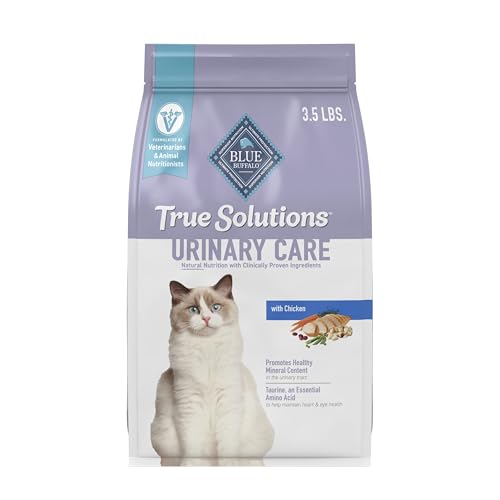
5. Blue Buffalo True Solutions Urinary Care
What We Like
- Chicken listed prominently
- Urinary nutrient focus
- Formulated with nutrition input
- Adult dry-food convenience
What We Don’t Like
- Not stone-specific therapy
- Avoid unsupported prevention claims
Blue Buffalo True Solutions Urinary Care offers a chicken-first adult kibble with a stated focus on urinary tract nutrition. The manufacturer describes its formula as developed with veterinary and nutrition input and emphasizes mineral content. That is useful positioning for owners comparing clearly labeled urinary-support recipes. That claim does not prove prevention of infections or dissolution of every stone. It cannot replace indicated prescription food. A veterinarian can evaluate whether a maintenance diet is relevant and whether other conditions change the desired nutrient profile.
The relevant questions are practical: Is this complete food suitable for the cat’s life stage, does the veterinarian agree with its nutritional goals, and will the cat eat a gradual transition? Check portions, observe appetite, and keep drinking water easily accessible. Product positioning around natural ingredients is not itself a reliable clinical ranking. Look instead for the actual urinary nutrient strategy and the cat’s response. Look beyond a single front-label claim. The full diet, feeding quantity, hydration habits, and individual response belong in the same comparison.
This bag may be appealing if a chicken-forward formula fits existing feeding habits, but it is not a one-size-fits-all choice. Cats with food intolerances, renal disease, or a documented mineral problem may require a very different plan. Compare it with other nonprescription urinary diets on label details and professional advice. Persistent urinary signs deserve prompt care regardless of what the package promises. If your cat has a previous obstruction, do not treat a nonprescription bag as a replacement for an established therapeutic feeding plan.
My Recommendation
Blue Buffalo True Solutions Urinary Care is an option for owners comparing chicken-first adult urinary-support kibble. Its mineral-focused formulation is the relevant feature, rather than any general natural-ingredient claim. Discuss its suitability with your veterinarian, especially if the cat has crystals, stones, kidney disease, or a history of obstruction.
6. Royal Canin Veterinary Diet Urinary SO

What We Like
- Veterinary-specific urinary diet
- Intended for diagnosis-led feeding
- Distinct from retail maintenance food
- Supports a monitored feeding plan
What We Don’t Like
- Requires veterinary direction
- Not for indiscriminate substitution
Royal Canin Veterinary Diet Urinary SO belongs in a different decision category from ordinary retail urinary-care dry foods. It is a veterinary-exclusive formulation intended for cats whose urinary problem warrants a clinically directed nutritional plan. Its product identity matters because a similar retail Urinary Care bag is not equivalent. Treat this as an option to discuss after diagnosis, not as a casual upgrade for every healthy cat. Prescription-style urinary management may require consistent feeding without extra treats or foods that alter the targeted nutrient balance.
Veterinarians may choose a therapeutic urinary diet according to the type of crystals or stones, previous episodes, urine findings, and the cat’s broader medical history. Owners should follow the exact selected formula and feeding instructions rather than mixing it freely with ordinary food. Ask whether treats, other diets, and water strategies are compatible with the plan. Continued monitoring can be important even when clinical signs seem to improve. Ask which measurements will be checked at follow-up and what clinical change would trigger a diet reassessment. Do not guess from litter appearance alone.
The limitation is not simply its price or availability. It is that therapeutic mineral and urinary goals may be wrong for a cat without a matching diagnosis. Do not infer that any urinary diet dissolves every stone type or addresses bacterial infection. A cat straining without urine needs emergency treatment, not a food change. If the veterinarian has prescribed a specific formulation, confirm the exact package and life-stage suitability before ordering. Even a suitable prescription diet does not treat an acute blockage. Prompt veterinary intervention remains necessary for severe or obstructive urinary signs.
My Recommendation
Royal Canin Veterinary Diet Urinary SO is for a veterinarian-directed urinary plan, not a routine upgrade from retail kibble. The exact product and feeding consistency matter when managing a diagnosed condition. Confirm the prescribed version and discuss treats or mixed feeding before making changes. Acute inability to urinate is still an emergency.
7. Royal Canin Urinary SO Moderate Calorie

What We Like
- Modified calorie profile
- Urinary-specific veterinary formula
- Useful for weight-management discussions
- Clear distinction from standard SO
What We Don’t Like
- Must match a veterinary plan
- Not a general adult maintenance pick
Royal Canin Urinary SO Moderate Calorie is a veterinary-exclusive dry diet for cats that need urinary management while being prone to excess weight. The manufacturer distinguishes it from the standard Urinary SO formula through a modified calorie profile. That difference can be important when a veterinarian is balancing urinary history and body condition. It should not be selected solely because moderate-calorie wording sounds universally healthier. Body weight is one part of the medical picture, not a reason to independently choose a therapeutic diet for an otherwise healthy animal.
Weight management changes the practical feeding discussion. A cat’s target daily calories, activity, measured portions, and progress are more useful than free-feeding a therapeutic kibble. Ask the veterinarian how the urine results and the weight plan will be monitored together. Sudden severe restriction is unsafe for cats, so use an individualized target rather than sharply reducing the food bowl without professional support. Track portions and body condition under a veterinary plan, and make any calorie changes gradually rather than imposing a sudden drastic food cut.
This is not an appropriate self-treatment for unexplained urinary symptoms, and the moderate-calorie version is not interchangeable with every other therapeutic formula. A veterinarian may have reasons to choose standard Urinary SO, a wet prescription food, or something else entirely. Compare the exact product and intended clinical use before purchasing. If your cat cannot urinate, seek emergency medical attention regardless of feeding history. A tailored therapeutic choice is valuable only when it matches documented needs. Incorrect substitutions can undermine a carefully designed nutritional strategy.
My Recommendation
Royal Canin Urinary SO Moderate Calorie deserves consideration when a veterinarian is managing both urinary disease and excess-weight risk. Its calorie profile differs from standard SO, so the two should not be substituted casually. Follow prescribed portions and monitoring. Avoid sudden severe calorie restriction in cats.
How to choose best dry cat food for urinary tract health
Start by deciding whether your cat needs routine maintenance nutrition or a veterinarian-directed therapeutic diet. Compare the exact formula, mineral goals, life stage, and hydration plan instead of choosing only by brand name. Medical history and urine testing can change which food is appropriate.
Understand retail care versus therapeutic diets
A retail food marketed for urinary health generally aims to support normal urinary mineral balance or urine pH. That does not prove it will treat a diagnosed infection, dissolve a specific stone, or prevent every future episode. Veterinary urinary diets may be formulated around more specific nutritional goals and should be selected for the cat’s actual diagnosis. Even two bags with similar names can have different clinical uses. Ask whether your cat needs a general adult maintenance diet or a therapeutic prescription formula, then check the exact product name and feeding instructions. Do not substitute one category for another without approval.
Review urine findings, hydration, and the full diet
Urinary discomfort has several causes, including inflammation, stones, infection, and obstruction. A veterinarian may recommend testing before deciding whether diet changes are appropriate. What matters is not simply the lowest magnesium figure on a marketing label: stone type, urine results, medical history, current medications, weight, and food tolerance may all change the target. Clean, fresh drinking water should always be available. Wet food or other hydration strategies may be useful for some cats, as directed by a clinician. Treat kibble as part of the complete feeding plan instead of the only lever for urinary health.
Compare portions, transitions, and medical follow-up
Choose an age-appropriate complete diet and measure portions so a well-intended switch does not cause unplanned weight gain. Introduce ordinary diet changes gradually unless the veterinary team directs otherwise. For a cat using a prescribed urinary food, ask whether mixing with treats or other recipes could undermine its purpose. Monitor appetite, body condition, water availability, and litter-box behavior. Veterinary follow-up may include urine testing, imaging, or other checks depending on the condition. Frequent attempts to urinate, vocalization, blood, or little to no urine output require immediate attention. A blocked cat cannot be treated by simply serving a new bag of kibble.
Frequently Asked Questions
Urinary problems have different causes. The following answers clarify the limitations of diet claims and the warning signs requiring urgent care.
Can ordinary urinary-care kibble dissolve bladder stones?
Do not assume so. Stone types have different treatments, and dissolution may require a specific veterinary diet or another intervention after diagnosis.
Is dry cat food enough for hydration?
Dry food provides relatively little water compared with wet food. Keep fresh water available and ask about moisture-rich feeding if urinary concerns are present.
Is Royal Canin Urinary Care the same as Urinary SO?
No. The retail care and veterinary-exclusive SO lines have different intended uses. Confirm the exact product with the veterinarian.
Should a healthy cat eat prescription urinary food?
Not without a veterinary recommendation. Therapeutic diets are designed around particular medical goals and may not suit an otherwise healthy cat.
When is difficulty urinating an emergency?
Straining repeatedly with little or no urine can indicate urethral obstruction. Seek emergency veterinary treatment immediately.
Final Verdict
For veterinarian-approved nonprescription urinary support, Purina ONE, Purina Pro Plan, Hill’s Science Diet, Royal Canin Urinary Care, and Blue Buffalo each offer a distinct retail approach. Cats with a diagnosed urinary condition may instead need a carefully selected veterinary formula such as Royal Canin Urinary SO or Moderate Calorie. Never select the therapeutic category solely from marketing labels. Hydration, appropriate calorie intake, accurate diagnosis, and follow-up are more important than declaring any dry food a universal winner.
Featured photograph source: Pexels.com, photo 30001420; used under the Pexels License.
As an Amazon Associate, PetAdvisorPro earns from qualifying purchases. This article contains Amazon affiliate links; qualifying purchases may earn us a commission at no additional cost to you. These comparisons use verified product listing information and practical nutritional considerations, not claims of personal testing or a substitute for veterinary care.









