
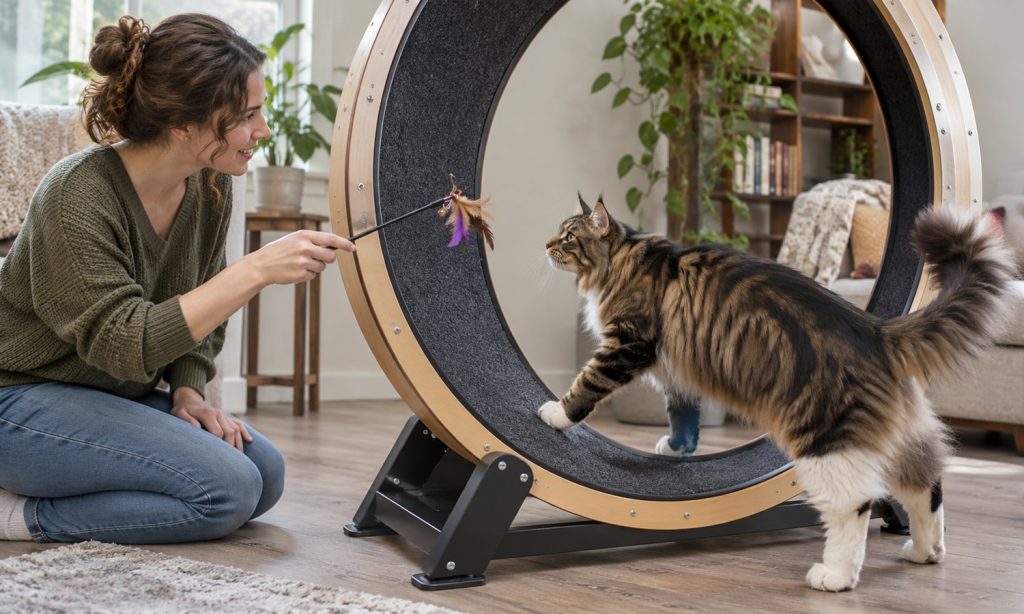
A cat wheel can sit unused, wobble, squeak, or move too quickly when setup and adjustment problems get in the way. Cats also differ in how they respond to new equipment. Troubleshooting works best when you separate mechanical issues from a cat’s comfort and never try to solve hesitation by forcing a session.
This guide covers common setup and adjustment problems with cat wheels, practical checks for stability and noise, and a gentle plan for helping a cat become familiar with the equipment. If you are considering a cat wheel for large cats, confirm its fit and weight capacity before focusing on training. Work through one issue at a time so a mechanical problem is not mistaken for a behavior or training concern.
The wheel wobbles or shifts on the floor
A wheel that rocks or slides may be assembled unevenly, placed on an irregular surface, or missing a tightened fastener. Stop using it and check the base, support feet, and hardware against the maker’s instructions. Do not wedge random objects under the frame to make it appear level.
Move the wheel to a firm, level floor and use only the mat or stabilizer recommended by its manufacturer. Test the wheel by turning it slowly while empty. If the frame continues to shift or a part appears bent, discontinue use and contact the maker for approved repair guidance.
The wheel makes a squeak, scrape, or grinding sound
Noise can come from debris, a loose component, a wheel rubbing its frame, or a bearing that needs attention. Remove the cat from the area and inspect the moving parts. Follow the product’s cleaning and maintenance steps; do not apply oil or lubricant unless the instructions specify a suitable type and location.
A new or worsening sound is a reason to pause, not to encourage the cat to run through it. The noise can startle a cat and may indicate that the wheel is not moving freely. If cleaning and approved adjustments do not solve it, stop using the wheel until the manufacturer advises what to do.
The wheel turns too fast or stops abruptly
A cat that has not learned the wheel’s movement may lose balance if it accelerates suddenly. Check that the wheel rotates smoothly at a slow pace and that any speed control or brake is adjusted as described in the manual. Never push the wheel while the cat is on it to demonstrate how it works.
Begin with the wheel stationary, then move it gently by hand while the cat is away. Later, use a toy to invite a few steps at a walking pace. If the wheel resists, catches, or spins unevenly, treat it as a mechanical issue rather than a training challenge.
The cat ignores or avoids the wheel
Avoidance is common when an object is unfamiliar, unstable, noisy, or placed in a busy part of the home. Leave the wheel stationary in a calm area and let the cat inspect it without pressure. Keep the path open so the cat can leave or approach on its own terms.
Reward calm investigation and stop before the cat becomes worried. Never lift or lure a reluctant cat onto the wheel, and do not withhold food to make it participate. If the cat remains uninterested, offer other forms of play; a wheel is optional enrichment.
Use gradual familiarization
Break introduction into small steps: seeing the wheel, sniffing it, standing near it, touching the surface, and stepping on while it is still. Some cats may take days or weeks, and others may never choose to use it. The cat sets the pace.
Use a favorite wand toy or a small reward to create a positive association, but keep sessions brief. Avoid loud cheering, sudden movement, or multiple people crowding around. A relaxed cat that walks away freely is more likely to investigate again later.
The cat slips, jumps off, or runs with poor posture
Slipping may mean the running surface is dirty, worn, or too slick, or the wheel is not a good size for the cat. Stop the session and inspect the tread and fit. Do not add improvised tape or a loose cover that could bunch up or catch claws.
Observe the cat walking on the stationary wheel. If the back arches, paws reach awkwardly, or shoulders strike the sides, the wheel may not fit the cat’s body. Check weight and size guidance, and ask a veterinarian if movement looks painful or unsteady.
The wheel is in the wrong location
A wheel near a doorway, stairs, glass, or a noisy appliance can make both cat and caregiver uneasy. Move it to a spacious area with clear space around it and a predictable route away. Keep cords, breakable items, and other pets out of the immediate zone.
A quiet location should still be part of the cat’s familiar living area. Hiding the wheel in a rarely visited room may reduce exposure but can also make the equipment less inviting. Choose a place where the cat can observe normal household activity without being crowded.
When to stop and ask for help
Stop using the wheel for limping, stumbling, fear, panting, open-mouth breathing, unusual fatigue, or any apparent pain. Cats with heart, breathing, joint, neurologic, or other medical conditions should have exercise plans reviewed by a veterinarian. Do not use wheel time to test stamina.
For a persistent mechanical fault, consult the manufacturer or a qualified repair service. For a cat that suddenly stops using the wheel after previously enjoying it, consider pain or illness and contact your veterinarian. Resolve safety concerns before restarting practice.
Keep simple notes while troubleshooting
Record when the noise or wobble occurs, which adjustments you tried, and whether your cat’s response changes. This helps you avoid repeating ineffective changes and gives the manufacturer useful details if you need support.
Change one factor at a time, such as the room location or the assembly check. That makes it easier to tell whether the improvement came from a stable floor, less noise, or a slower introduction.
Frequently Asked Questions
Most wheel difficulties come from setup, fit, noise, or an introduction that moved too quickly. These answers can help narrow down the cause.
Pause whenever the wheel or cat seems unsafe. Continue only when the equipment works smoothly and the cat chooses to approach.
Why does my cat wheel wobble?
It may be unevenly assembled or placed on an irregular floor. Stop use and check the base and fasteners using the manual.
How can I make a cat less afraid of the wheel?
Leave it still in a calm place and reward voluntary investigation. Keep sessions short and never force the cat onto it.
Can I lubricate a squeaky cat wheel?
Only if the manufacturer’s instructions specify an appropriate lubricant and application point. Otherwise, ask the manufacturer before adding anything.
Should I use treats to keep my cat running?
Use a small reward to encourage interest, not to make a cat continue when it wants to stop. Let the cat leave freely.
What if the wheel does not suit my cat?
Stop using it and offer other play or enrichment. Ask a veterinarian if the cat’s movement or exercise tolerance seems unusual.
Final Words
Common setup and adjustment problems with cat wheels include wobble, noise, uneven movement, poor fit, and a cat that is not ready to approach. Check the equipment and its location first, then introduce it in small voluntary steps.
If the wheel remains unstable or the cat shows discomfort, stop and get appropriate advice before trying again. A cat wheel for large cats still needs a suitable fit, stable setup, and a cat that chooses to participate.









