
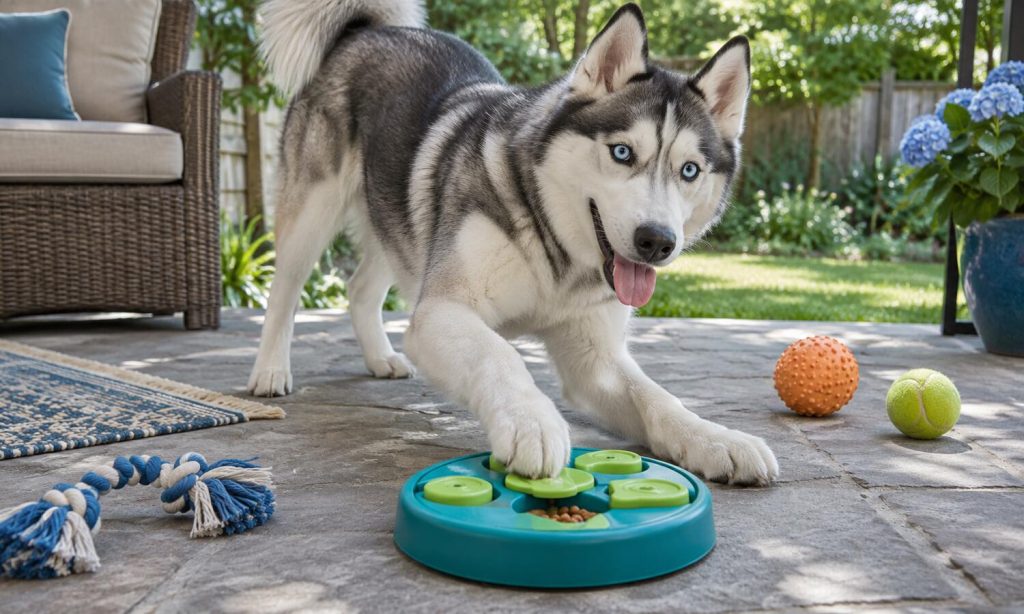
Huskies are often energetic, inventive dogs, which is why choosing a toy solely for a ‘smart breed’ can backfire. The best dog toys for huskies should suit your dog’s actual interests and safely channel curiosity. This comparison concentrates on seven food-puzzle and enrichment toys, from beginner rolling dispensers to complex boards with moving compartments. These are useful for slower feeding and structured problem-solving, but they are not substitutes for walks, training, play with people or other daily activity. We compare challenge levels, food capacity, cleaning demands, loose parts and risks for strong chewers. A beginner may need an easy success before moving to a difficult puzzle. Use the Quick Picks to shortlist a level, then check individual designs and supervise the first sessions.
For more practical background, see our guide to choosing interactive toys safely.
Quick Picks
These 7 options cover different uses within Husky enrichment. The quick comparison is a starting point; detailed limits appear below.
| Product | Best For | Key Advantage | Buy | |
|---|---|---|---|---|
| Outward Hound Wobble Bowl | beginner wobble-style slow-feeding bowl | Beginner wobble feeding design | View on Amazon | Jump to Review |
| West Paw Zogoflex Toppl | food-stuffable rubber Toppl with an open cup design | Stuffable rubber open cup | View on Amazon | Jump to Review |
| Outward Hound Treat Tumble | beginner rolling treat-dispensing puzzle ball | Rolling ball for basic puzzles | View on Amazon | Jump to Review |
| Outward Hound Dog Brick | intermediate brick with multiple hidden compartments | Multi-compartment intermediate board | View on Amazon | Jump to Review |
| Outward Hound MultiPuzzle | expert multi-step puzzle with many compartments | Advanced multi-step treat puzzle | View on Amazon | Jump to Review |
| Outward Hound Lickin’ Layers | layered licking and food-engagement puzzle | Layered licking slow feeder | View on Amazon | Jump to Review |
| Outward Hound Dog Tornado | spinning intermediate puzzle with hidden treats | Rotating treat compartments | View on Amazon | Jump to Review |
Our Picks: Best Dog Toys For Huskies
Each pick below has a different intended use. Compare its stated features and drawbacks with your own Husky enrichment needs.
1. Outward Hound Wobble Bowl

- Beginner-level food puzzle
- Wobbling food-release action
- Interior feeding maze
- Slow-feeder function
- Food residue needs thorough cleaning
Outward Hound Wobble Bowl deserves a closer look when you need beginner wobble-style slow-feeding bowl. The Wobble Bowl is a beginner-level puzzle. A wobbling action releases kibble through an interior maze. For a Husky, puzzles can occupy part of a busy day. They cannot replace exercise, social time or safe exploration. Your dog’s behavior and care needs should determine whether the listed features matter.
The bowl also works as a slow feeder. Clean food-contact grooves after use and dry them before storage. Sticky fillings require more scrubbing than dry kibble. Compare this with food-stuffable rubber Toppl with an open cup design. The two options address different preferences or setup requirements. Inspect the current label, package quantity and directions before buying. Start with a few easy-to-find pieces of the daily food allowance. Reward calm exploration and end the session before frustration rises. For a very enthusiastic problem-solver, raise difficulty in stages. An expert puzzle used too early can produce frustration rather than useful enrichment.
A practical limitation: food residue needs thorough cleaning. Remember to subtract puzzle rewards from the daily ration. Repeated treat sessions can add meaningful calories. The best fit should solve one identifiable problem in your routine while remaining safe for the animal. Food-based enrichment works best when the dog can succeed without breaking parts. Choose the challenge level based on experience, not reputation for intelligence. Everyday maintenance and safe handling are part of the actual cost of ownership.
My Recommendation
Consider this option if you prefer beginner wobble-style slow-feeding bowl. The Wobble Bowl is a beginner-level puzzle. A limitation to weigh: food residue needs thorough cleaning. Check the current directions and compare practical fit, safety and serving requirements before ordering for your animal.
2. West Paw Zogoflex Toppl
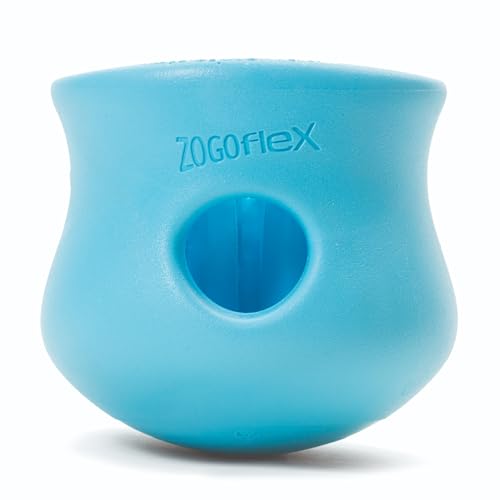
- Rubber treat-dispensing cup
- Accepts wet or dry food
- Freezable food fillings
- Simple open-top design
- Rubber cup differs from a locked-compartment puzzle
West Paw Zogoflex Toppl deserves a closer look when you need food-stuffable rubber Toppl with an open cup design. The Toppl accepts kibble, wet food or frozen fillings. Its open cup design is simple to refill. Challenge should increase gradually. A clever dog may still need a beginner demonstration before understanding a new puzzle mechanism. Your dog’s behavior and care needs should determine whether the listed features matter.
The rubber toy can extend mealtime activity. Start with a few easy-to-find pieces of the daily food allowance. Reward calm exploration and end the session before frustration rises. Compare this with beginner rolling treat-dispensing puzzle ball. The two options address different preferences or setup requirements. Inspect the current label, package quantity and directions before buying. Supervise moving lids and removable components. Dogs that chew the plastic rather than search for food need a different style of enrichment. Remember to subtract puzzle rewards from the daily ration. Repeated treat sessions can add meaningful calories.
A practical limitation: rubber cup differs from a locked-compartment puzzle. Consider flooring and space. Rolling dispensers behave differently on tile, rugs and narrow hallways. Choose for the specific function shown on the label, not because a similar product helped another household. For a Husky, puzzles can occupy part of a busy day. They cannot replace exercise, social time or safe exploration. A careful match will matter more than a broad claim of universal suitability.
My Recommendation
Consider this option if you prefer food-stuffable rubber Toppl with an open cup design. The Toppl accepts kibble, wet food or frozen fillings. A limitation to weigh: rubber cup differs from a locked-compartment puzzle. Check the current directions and compare practical fit, safety and serving requirements before ordering for your animal.
3. Outward Hound Treat Tumble

- Beginner rolling puzzle ball
- Treats released by rolling
- Approximately 4.8-inch diameter
- Active food-seeking play
- Rolling toys need enough floor space
Outward Hound Treat Tumble deserves a closer look when you need beginner rolling treat-dispensing puzzle ball. The Level 1 Treat Tumble releases food as it rolls. The puzzle ball measures about 4.8 inches. Food-based enrichment works best when the dog can succeed without breaking parts. Choose the challenge level based on experience, not reputation for intelligence. Your dog’s behavior and care needs should determine whether the listed features matter.
The movement encourages active food seeking. Supervise moving lids and removable components. Dogs that chew the plastic rather than search for food need a different style of enrichment. Compare this with intermediate brick with multiple hidden compartments. The two options address different preferences or setup requirements. Inspect the current label, package quantity and directions before buying. Clean food-contact grooves after use and dry them before storage. Sticky fillings require more scrubbing than dry kibble. Consider flooring and space. Rolling dispensers behave differently on tile, rugs and narrow hallways.
A practical limitation: rolling toys need enough floor space. For a very enthusiastic problem-solver, raise difficulty in stages. An expert puzzle used too early can produce frustration rather than useful enrichment. Look at what you will do every day: measuring, cleaning, supervision and the time required all influence value. Challenge should increase gradually. A clever dog may still need a beginner demonstration before understanding a new puzzle mechanism. The final decision should reflect the animal’s behavior and the realities of daily use.
My Recommendation
Consider this option if you prefer beginner rolling treat-dispensing puzzle ball. The Level 1 Treat Tumble releases food as it rolls. A limitation to weigh: rolling toys need enough floor space. Check the current directions and compare practical fit, safety and serving requirements before ordering for your animal.
4. Outward Hound Dog Brick

- Level 2 intermediate puzzle
- 20 hidden treat spaces
- Sliding and moving pieces
- Flat tray design
- Movable parts require supervised play
Outward Hound Dog Brick deserves a closer look when you need intermediate brick with multiple hidden compartments. The Level 2 Dog Brick hides treats under moving pieces. The listing identifies 20 hidden treat spaces. For a Husky, puzzles can occupy part of a busy day. They cannot replace exercise, social time or safe exploration. Your dog’s behavior and care needs should determine whether the listed features matter.
The flat tray format works for supervised tabletop-style setup. Clean food-contact grooves after use and dry them before storage. Sticky fillings require more scrubbing than dry kibble. Compare this with expert multi-step puzzle with many compartments. The two options address different preferences or setup requirements. Inspect the current label, package quantity and directions before buying. Start with a few easy-to-find pieces of the daily food allowance. Reward calm exploration and end the session before frustration rises. For a very enthusiastic problem-solver, raise difficulty in stages. An expert puzzle used too early can produce frustration rather than useful enrichment.
A practical limitation: movable parts require supervised play. Remember to subtract puzzle rewards from the daily ration. Repeated treat sessions can add meaningful calories. Make a purchase decision based on the documented design and practical fit, not a promise of instant results. Food-based enrichment works best when the dog can succeed without breaking parts. Choose the challenge level based on experience, not reputation for intelligence.
My Recommendation
Consider this option if you prefer intermediate brick with multiple hidden compartments. The Level 2 Dog Brick hides treats under moving pieces. A limitation to weigh: movable parts require supervised play. Check the current directions and compare practical fit, safety and serving requirements before ordering for your animal.
5. Outward Hound MultiPuzzle

- Level 4 expert difficulty
- 28 hidden compartments
- Multiple linked puzzle steps
- Large 15-inch board
- Expert difficulty can frustrate beginners
Outward Hound MultiPuzzle deserves a closer look when you need expert multi-step puzzle with many compartments. The Level 4 MultiPuzzle has several linked tasks. It advertises 28 hidden treat compartments. Challenge should increase gradually. A clever dog may still need a beginner demonstration before understanding a new puzzle mechanism. Your dog’s behavior and care needs should determine whether the listed features matter.
The large 15-inch board is aimed at experienced puzzle solvers. Start with a few easy-to-find pieces of the daily food allowance. Reward calm exploration and end the session before frustration rises. Compare this with layered licking and food-engagement puzzle. The two options address different preferences or setup requirements. Inspect the current label, package quantity and directions before buying. Supervise moving lids and removable components. Dogs that chew the plastic rather than search for food need a different style of enrichment. Remember to subtract puzzle rewards from the daily ration. Repeated treat sessions can add meaningful calories.
A practical limitation: expert difficulty can frustrate beginners. Consider flooring and space. Rolling dispensers behave differently on tile, rugs and narrow hallways. Keep a record of how your dog responds, and stop using a product that causes discomfort or concern. For a Husky, puzzles can occupy part of a busy day. They cannot replace exercise, social time or safe exploration. A careful match will matter more than a broad claim of universal suitability.
My Recommendation
Consider this option if you prefer expert multi-step puzzle with many compartments. The Level 4 MultiPuzzle has several linked tasks. A limitation to weigh: expert difficulty can frustrate beginners. Check the current directions and compare practical fit, safety and serving requirements before ordering for your animal.
6. Outward Hound Lickin’ Layers

- Three rotating licking layers
- Slow-feeding function
- Holds up to two cups
- Works with different food textures
- Licking and layered use may be messy
Outward Hound Lickin’ Layers deserves a closer look when you need layered licking and food-engagement puzzle. The Lickin’ Layers has three rotating food surfaces. It combines licking, slow feeding and a food puzzle. Food-based enrichment works best when the dog can succeed without breaking parts. Choose the challenge level based on experience, not reputation for intelligence. Your dog’s behavior and care needs should determine whether the listed features matter.
The listed capacity is up to two cups of food. Supervise moving lids and removable components. Dogs that chew the plastic rather than search for food need a different style of enrichment. Compare this with spinning intermediate puzzle with hidden treats. The two options address different preferences or setup requirements. Inspect the current label, package quantity and directions before buying. Clean food-contact grooves after use and dry them before storage. Sticky fillings require more scrubbing than dry kibble. Consider flooring and space. Rolling dispensers behave differently on tile, rugs and narrow hallways.
A practical limitation: licking and layered use may be messy. For a very enthusiastic problem-solver, raise difficulty in stages. An expert puzzle used too early can produce frustration rather than useful enrichment. The best fit should solve one identifiable problem in your routine while remaining safe for the animal. Challenge should increase gradually. A clever dog may still need a beginner demonstration before understanding a new puzzle mechanism. Try the shallow layer first and verify that your husky licks rather than chews moving pieces.
My Recommendation
Consider this option if you prefer layered licking and food-engagement puzzle. The Lickin’ Layers has three rotating food surfaces. A limitation to weigh: licking and layered use may be messy. Check the current directions and compare practical fit, safety and serving requirements before ordering for your animal.
7. Outward Hound Dog Tornado

- Level 2 spinning puzzle
- 12 treat compartments
- Rotating tier design
- Compact board footprint
- Spinners may wear with rough handling
Outward Hound Dog Tornado deserves a closer look when you need spinning intermediate puzzle with hidden treats. The Level 2 Dog Tornado uses rotating layers. Its design includes 12 treat compartments. For a Husky, puzzles can occupy part of a busy day. They cannot replace exercise, social time or safe exploration. Your dog’s behavior and care needs should determine whether the listed features matter.
It occupies less floor area than some larger boards. Clean food-contact grooves after use and dry them before storage. Sticky fillings require more scrubbing than dry kibble. Compare this with beginner wobble-style slow-feeding bowl. The two options address different preferences or setup requirements. Inspect the current label, package quantity and directions before buying. Start with a few easy-to-find pieces of the daily food allowance. Reward calm exploration and end the session before frustration rises. For a very enthusiastic problem-solver, raise difficulty in stages. An expert puzzle used too early can produce frustration rather than useful enrichment.
A practical limitation: spinners may wear with rough handling. Remember to subtract puzzle rewards from the daily ration. Repeated treat sessions can add meaningful calories. Choose for the specific function shown on the label, not because a similar product helped another household. Food-based enrichment works best when the dog can succeed without breaking parts. Choose the challenge level based on experience, not reputation for intelligence. Everyday maintenance and safe handling are part of the actual cost of ownership.
My Recommendation
Consider this option if you prefer spinning intermediate puzzle with hidden treats. The Level 2 Dog Tornado uses rotating layers. A limitation to weigh: spinners may wear with rough handling. Check the current directions and compare practical fit, safety and serving requirements before ordering for your animal.
For a related practical routine, see our guide to toys for busy dogs.
How to choose best dog toys for huskies
The best match for Husky enrichment depends on purpose, clear directions, and practical limits. Compare verified product features, then use the checks below to avoid misleading claims and prevent a poor fit.
Pick the right puzzle difficulty
Start by defining the exact buying task. Huskies can be athletic and curious, but a food puzzle is not a substitute for exercise or companionship. Start with an achievable challenge, supervise the first sessions, and prevent frustration or chewing of loose parts. The first check is what the package actually says, not the most dramatic benefit claimed in an advertisement. Start with your Husky’s puzzle experience, food motivation and tendency to chew plastic. A beginner level can be more productive than a frustrating expert board. Then narrow your options to products whose intended use lines up with that list. If the product category touches medical care, ask your veterinarian before making a change. A careful choice is usually a specific choice: it matches a real routine instead of solving an imaginary problem. Keep notes about fit and usability so you can compare two candidates honestly.
Check size, loose parts, and chew behavior
Look beyond the front label to the details you can verify. Check whether compartments detach, trays slide or food sticks in deep grooves. Cleaning access and a stable size matter for repeat use. Check whether the named listing has variations and whether the exact option you select has the same features. Calculate the treat portion from the daily calorie allowance. Count kibble used in puzzles as food, not free entertainment. Think about cleaning, storing, handling, and monitoring over a month, not only a single day. When specifications are missing, do not guess. Contact the maker or select a product with better documentation. The goal is to understand what is really being purchased and whether its conditions of use are realistic.
Use treats carefully within daily calories
A sound buying decision includes a plan for first use and follow-up. Huskies can be athletic and curious, but a food puzzle is not a substitute for exercise or companionship. Start with an achievable challenge, supervise the first sessions, and prevent frustration or chewing of loose parts. If the animal reacts poorly or the product is inconvenient, stop and reassess rather than pushing through. Keep the original package and instructions. Supervise every new mechanism and build difficulty gradually. Stop if the dog bites components instead of solving the task; rotate puzzles with walks and training. Treat promotional outcomes as uncertain. The best value is a suitable option that you can use correctly and maintain without creating new safety problems. Practical follow-through matters more than a flashy feature list.
For related reading
Useful related guides include large-dog toy options, durable toys for chewers.
Frequently Asked Questions
These answers address common decisions about Husky enrichment.
Are puzzle toys enough exercise for a Husky?
No. They add mental enrichment but do not replace daily movement, training, and social interaction.
Which puzzle level should a beginner Husky use?
Begin with an easy rolling or wobbling toy. Increase difficulty after your dog learns the task.
Can a Husky chew a plastic puzzle unsupervised?
No. Many board puzzles have movable parts. Follow the maker’s supervision instructions.
Do treat puzzles add calories?
Yes, when filled with treats. Consider using part of the normal daily food allowance.
How do I clean dog food puzzles?
Follow each maker’s directions. Remove food residue and dry parts fully before reuse.
Final Verdict
Start with the puzzle level your Husky can solve calmly. The Wobble Bowl and Treat Tumble introduce food-seeking games; the Toppl suits stuffing and freezing; the Dog Brick and MultiPuzzle add more complex challenges. Harder is not always better. Watch for chewing of movable parts, clean food grooves thoroughly and count rewards within the daily ration. These options complement walks, training and social play; they should not be the dog’s only toys or enrichment.
Affiliate disclosure: This article contains Amazon affiliate links. If you purchase through them, PetAdvisorPro may earn a commission. As an Amazon Associate I earn from qualifying purchases.









