
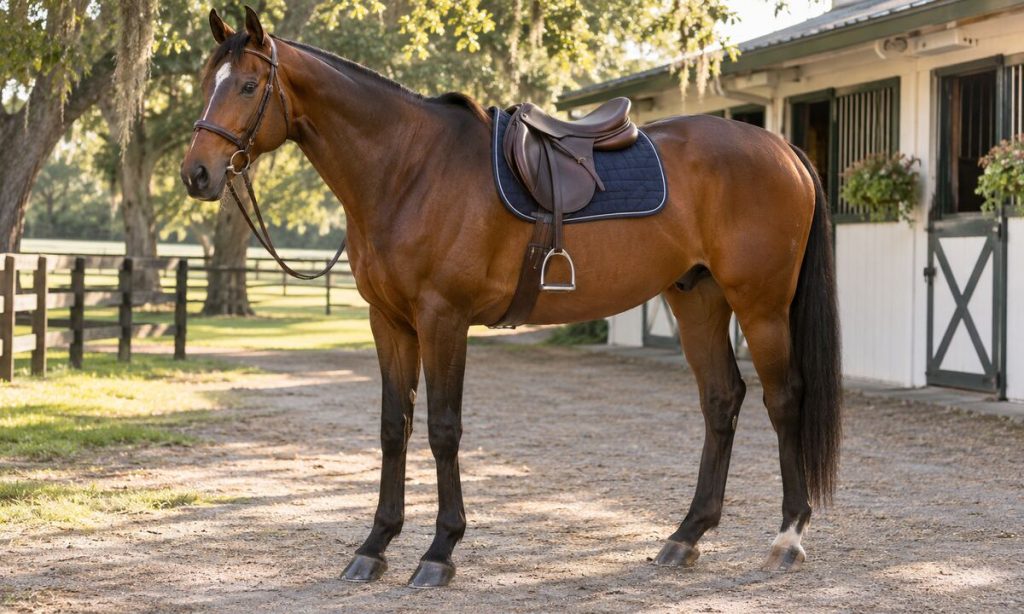
Prominent withers can make saddle shopping frustrating. A saddle may look clear of the top of the withers while still pinching behind the shoulder, bridging over the back, or slipping out of balance. The best saddle for high withered horse comfort must provide sufficient clearance and even supporting contact throughout movement. No particular brand or adjustable gullet can guarantee that result.
We compared seven distinct English, endurance, and Western saddle models that offer fitting features worth discussing with a professional. Several use adjustable gullet systems; others have specific tree or panel designs that require careful measurement. These are potential fitting candidates, not models verified to fit every high-withered horse. Have a qualified saddle fitter assess the horse, rider, intended pad, and saddle during a mounted trial before purchase.
Quick Picks
The best comparison begins with a professional template or fitting session. Use these seven designs to discuss possible tree, panel, and discipline differences.
| Product | Best For | Key Advantage | Buy | |
|---|---|---|---|---|
| Tough1 Equitare Eventing Saddle with Adjustable Gullet | English eventing-style fit trial | Adjustable gullet with wool flocking | View on Amazon | Jump to Review |
| Tough1 Equitare Dressage Saddle with Adjustable Gullet | Dressage-oriented fitting trial | Deep seat and adjustable front | View on Amazon | Jump to Review |
| Henri de Rivel Millennium Covered Close Contact Saddle | Close-contact English riding | IGP gullet system listing | View on Amazon | Jump to Review |
| Circle Y High Horse Highbank Western Saddle | Western riding comparison | Traditional Western saddle profile | View on Amazon | Jump to Review |
| Wintec 500 HART All Purpose Saddle | All-purpose synthetic trial | HART-equipped Wintec model | View on Amazon | Jump to Review |
| Wintec 2000 All Purpose Saddle with HART | Upgraded schooling saddle trial | Adjustable gullet listing | View on Amazon | Jump to Review |
| Wintec Pro HART Endurance Saddle | Long-distance riding comparison | Endurance-focused seat and layout | View on Amazon | Jump to Review |
Tough1 Equitare Eventing Saddle with Adjustable Gullet

- Adjustable gullet feature
- Wool-flocked panel listing
- Cushioned deep seat
- Large knee blocks
- Leather construction
- Requires compatible adjustment
- Seventeen-inch seat may not fit all
The Tough1 Equitare Eventing Saddle is an English saddle with an adjustable gullet, wool flocking, a plastic tree, and prominent knee blocks. These features make it worth discussing with a fitter when a high-withered horse needs a particular front opening and panel contact. The eventing-style layout also suits riders who prefer a secure leg position across varied flatwork. However, a deeper seat and adjustable plate do not establish whether its tree shape matches a horse’s shoulders or how the panel bears weight behind the withers.
The selected listing gives a seventeen-inch seat, so rider fit is a separate consideration. Ask the manufacturer which gullet plates are compatible and how the adjustment must be installed. A fitter should evaluate front and rear balance, channel width, tree-point pressure, and panel contact while the rider is seated. Wool-flocked panels may permit professional adjustment in some circumstances, but confirm what can be changed in this specific model. Never adjust a plate by guesswork or ride extensively in a saddle that tips or rocks.
Leather surfaces require cleaning and conditioning according to the maker’s instructions, and the panels should be checked for changes over time. This saddle is a candidate for someone who rides English disciplines and wants a structured fitting conversation about an adjustable front. It is not a universal high-wither solution because the shape elsewhere along the tree remains critical. Obtain a return or trial arrangement that allows a qualified professional to assess it safely before regular riding.
My Recommendation
I would shortlist the Equitare Eventing if a fitter believes its tree and panel geometry could work for your horse. The adjustable gullet and wool-flocked listing are useful fitting features, but no substitute for pressure and balance checks. Confirm rider seat size and the specific compatible plates before ordering.
Tough1 Equitare Dressage Saddle with Adjustable Gullet

- Dressage-specific layout
- Adjustable gullet
- Wool-flocked listing
- Large knee blocks
- Leather upper
- Small listed seat size
- Tree shape still fixed elsewhere
The Tough1 Equitare Dressage model shares an adjustable-gullet concept with the eventing saddle but uses a dressage-oriented riding layout. A deeper seat, large knee blocks, and long-leg positioning may suit a rider working on balanced flatwork. The selected listing shows a fifteen-inch seat, considerably smaller than many adult dressage saddles, so verify the size carefully rather than assuming it will fit. For a horse with prominent withers, the useful feature is the opportunity for a fitter to evaluate its front opening within the maker’s approved system.
The saddle still needs appropriate contact through its full panel length. Changing the gullet opening cannot make a long or differently curved tree match a horse’s back automatically. Arrange a fitting that includes walking, trotting, and the intended dressage exercises with the rider aboard. Watch whether the saddle migrates toward the shoulders or leaves uneven pressure. Confirm the correct gullet components and any wool-flocking adjustment procedure through an authorized service provider. Do not improvise with inserts or unusually thick pads.
This model is most relevant when the rider actually needs a dressage seat and the saddle’s dimensions can suit both partners. Its leather covering means normal conditioning and hardware inspection remain important. The name alone says nothing about high-wither compatibility, and the small seat dimension may rule it out immediately for many riders. Compare it with the Equitare Eventing on rider position, then let an experienced fitter determine whether either has a suitable tree for the horse.
My Recommendation
Consider the Equitare Dressage only if your rider fits the advertised fifteen-inch seat and a professional recommends trying its tree. The adjustable front could aid fine-tuning within limits. I would not select it merely because your horse has high withers; confirm panel pressure and dressage balance while moving.
Henri de Rivel Millennium Covered Close Contact Saddle

- IGP gullet reference
- Close-contact profile
- High-density foam panels
- Grippy covered leather
- Deep seat design
- Foam panel adjustment limits
- Exact gullet setup needs checking
The Henri de Rivel Millennium Covered Close Contact Saddle is marketed as a grippy leather English option with high-density foam panels and an IGP gullet reference. A close-contact design may appeal to riders who want a more direct leg position, but the panel profile and tree must fit the horse beneath it. The advertised gullet system is useful to investigate with a fitter, particularly if adjustment components are available. Do not assume that a replaceable front plate will change the complete saddle shape.
Foam panels distribute weight differently from wool flocking and generally offer a different scope for adjustment. An experienced fitter should examine their contact pattern against the horse’s back and check front clearance with the rider on board. Confirm whether the specific model and size support a changeable plate or other official fitting components. The selected listing indicates a regular-width variant and a sixteen-and-a-half-inch seat, both of which may or may not suit your horse and rider. Test balance carefully before riding over poles or fences.
Covered leather requires normal care, while foam panels and stitching should be inspected for damage or compression over time. This saddle provides an alternative English construction to the two Equitare models above. It is best viewed as a close-contact candidate when that riding style is appropriate and the horse’s shape matches the panels. A high-wither label is not present in the product specifications, so fitting expertise is essential. Return eligibility and authorized parts availability deserve attention before purchase.
My Recommendation
I would compare the Millennium if your fitter recommends a close-contact style with an IGP-related front system. Check the exact regular-width specification and foam-panel contact before riding. It is not my default recommendation for all high-withered horses; suitability depends on tree geometry, rider balance, and a hands-on trial.
Circle Y High Horse Highbank Western Saddle

- Western riding format
- High Horse model line
- Listed sixteen-inch seat
- Wide variant available
- Distinct from English models
- Wide tree may not fit
- Sparse product specifications
The Circle Y High Horse Highbank offers a Western alternative to the English saddles in this guide. The selected listing indicates a sixteen-inch seat and a wide black variant, but provides limited information about its precise tree geometry. That is a key limitation for someone shopping for a high-withered horse. A wide tree is not inherently better for high withers; the shoulder angle, bar flare, gullet shape, and contact length determine whether it fits without pinching or rocking.
Before considering this model, obtain official bar and gullet specifications from Circle Y or an authorized seller. Ask an experienced Western saddle fitter to assess the horse’s weight-bearing area and shoulder movement with the actual saddle and pad. Do not use a thick pad to compensate for bars that are too wide or too narrow. Western saddles spread weight through bars rather than English-style panels, so compare these structures on their own terms. The rider must also fit the seat and rigging position comfortably.
Leather, rigging hardware, fenders, and stirrup attachments should be inspected regularly. The High Horse line could be appealing to a Western trail rider, but the sparse Amazon product details make a professional and potentially in-person fitting especially important. It is included to show that high-withered horses are not limited to English tack, not as proof that this particular wide model is suited to prominent withers. A properly fitted alternative may have a completely different width label.
My Recommendation
Consider High Horse Highbank only if you ride Western and can arrange a measured fitting with verified tree specifications. I would not choose the wide version simply because the withers are tall. Check bar angle, shoulder freedom, back length, and seated balance, and request trial terms before purchase.
Wintec 500 HART All Purpose Saddle

- All-purpose riding style
- Synthetic easy-care exterior
- HART design designation
- Seventeen-inch seat variant
- Everyday schooling potential
- Adjustment range must be verified
- No guaranteed high-wither fit
The Wintec 500 HART All Purpose is an English saddle designed for everyday schooling across more than one riding activity. The selected listing identifies a seventeen-inch seat and the HART system, which makes it a logical product to ask a saddle fitter about when comparing modern adjustable constructions. However, HART refers to a group of technologies, and the exact model’s gullet components, panel configuration, and adjustment possibilities must be verified with the manufacturer. The branding itself is not proof of adequate high-wither clearance.
Synthetic materials often make routine exterior cleaning convenient, an advantage for frequent lessons and damp weather. Fit still depends on tree shape, panel balance, and the intended rider’s position. Arrange a controlled trial with the approved gullet configuration and appropriate pad. Check that the front does not collapse toward the withers under weight and that the rear does not lift or bridge. Do not select the widest adjustment simply to create visible space above prominent withers; the full contact pattern matters.
The all-purpose cut may suit riders mixing flatwork and low-level jumping or trail exercise, but it is not ideal for every discipline. Confirm whether the exact size and color in the Amazon listing are available and inspect the saddle upon arrival. Synthetic tack still needs checks for worn stitching, loose fittings, and panel problems. For a high-withered horse, this is a sensible fitting candidate because of its modern modular positioning, provided a qualified fitter determines that this specific tree truly matches.
My Recommendation
I like Wintec 500 HART as a practical all-purpose saddle to discuss with a fitter, especially for riders who want simpler exterior care. Confirm exactly which adjustment parts this model accepts. A trial with the actual rider is more meaningful than any advertised technology badge or gullet-width guess.
Wintec 2000 All Purpose Saddle with HART

- Adjustable gullet stated
- All-purpose layout
- HART designation
- Synthetic construction
- Seventeen-and-a-half-inch listing
- Fit differs by model
- Check exact color and size
The Wintec 2000 All Purpose with HART is a second synthetic English option, with the selected listing specifically noting an adjustable gullet and a seventeen-and-a-half-inch seat. It provides a useful comparison for a rider who prefers the all-purpose format but needs a different model and seating feel from the Wintec 500. An adjustable opening may help a fitter refine the front width, yet pressure on a high-withered horse also depends on the underlying tree angle, panel distribution, and complete balance.
A saddle fitter should identify the precise compatible adjustment system and examine the horse in motion after each approved change. The seat must position the rider neutrally without forcing weight toward the pommel or cantle. Check the saddle’s length relative to the horse’s back and whether the girth line pulls it into the shoulder. If the saddle looks high at the front when empty but compresses toward the withers with a rider, the static appearance was misleading. Always evaluate ridden clearance and contact.
Synthetic construction can simplify cleaning, but panels, billets, and stirrup attachments still require careful inspection. The choice between the 500 and 2000 should not be based solely on a higher model number. Compare the exact seat shape, available panel configuration, and how a qualified professional judges the horse-and-rider fit. This model belongs on the shortlist when its actual geometry is promising, but it should be rejected promptly if front adjustment cannot resolve deeper tree incompatibility.
My Recommendation
Wintec 2000 HART is a worthwhile comparison for an all-purpose rider who fits its larger listed seat. I recommend verifying the specific adjustable gullet and arranging a mounted fitting session. Choose between Wintec models by pressure distribution and rider balance, not price tier or the word adjustable alone.
Wintec Pro HART Endurance Saddle

- Endurance riding orientation
- HART model designation
- Synthetic exterior
- Sixteen-and-a-half-inch seat
- Distinct riding position
- Specialized seat may not suit
- Horse fit still needs testing
The Wintec Pro HART Endurance Saddle is designed around endurance-style riding rather than conventional all-purpose schooling. The selected listing indicates a sixteen-and-a-half-inch seat in brown and a HART designation. For owners of high-withered horses who spend long hours on trails, an endurance layout may be worth evaluating with a fitter. However, the riding discipline and model name do not guarantee the horse has the correct tree and panel contact. Long sessions make small pressure problems particularly important.
Compare the rider’s intended forward position, stirrup adjustment, and how the saddle balances when the horse moves over uneven terrain. A professional should assess the exact gullet and panel construction, confirm permissible adjustments, and inspect shoulder movement. Even a comfortable-feeling seat for the rider can cause localized pressure on the horse if the tree is unsuitable. Check saddle length and girth position, especially on compact horses with high withers and a short weight-bearing area. Arrange a short test before any extended ride.
An endurance saddle is an activity-specific choice, so owners who mainly school in an arena may prefer an all-purpose or dressage configuration. Keep synthetic materials and hardware clean, inspect stress points, and reassess fit when the horse’s fitness and topline change through a season. The Wintec Pro offers a distinct riding format in this comparison, but suitability is determined through actual pressure and movement assessment. Its presence on a shortlist should never be mistaken for a high-wither fit guarantee.
My Recommendation
I would evaluate the Wintec Pro HART Endurance only for riders who genuinely need an endurance-style position. Its different seat design may improve rider comfort on longer outings, but the horse’s back and withers require an independent fitting check. Begin with a short trial and reassess before increasing distance.
How to choose best saddle for high withered horse
Finding the best saddle for high withered horse anatomy requires more than extra space at the front. Check the entire contact pattern and how the saddle behaves when the horse moves with its rider.
Evaluate wither clearance and the full tree angle
High withers often accompany a particular shoulder and topline shape, but horses differ considerably. A deep channel can provide room over the spine while bars or panels still pinch lower beside the withers. The tree points, panel shape, front width, overall length, and balance must suit the entire back. A qualified fitter can assess wither clearance with and without the rider, check even panel contact, and observe the horse walking and trotting. Watch for saddle movement, pressure marks, sensitivity during tacking up, shortened stride, or resistance under saddle. These signs have many possible causes and should trigger an assessment rather than a self-diagnosis. Do not choose a saddle solely because it has a wide or narrow gullet; its shape and contact points matter as much as the quoted dimension. Recheck fit after body condition or muscling changes.
Understand what adjustable gullets can and cannot fix
Adjustable-gullet saddles can change the front opening within the manufacturer’s approved range, sometimes making it easier to fine-tune one dimension. They do not necessarily alter the tree’s overall shape, panel angle, length, or rear balance. A gullet plate installed without professional guidance can make one area look more open while creating excessive pressure elsewhere. Identify the exact adjustment system for each model and use only compatible official parts. Do not assume every HART, IGP, or other branded saddle has an identical adjustment range; verify the specific listing. Traditional fixed-tree saddles may fit exceptionally well when their geometry matches a horse, whereas a poorly matched adjustable model can still cause discomfort. A fitter should test candidate configurations under the intended rider and pad. Ask about ongoing flocking or panel adjustment where appropriate.
Balance the rider and choose the correct discipline
A high-withered horse is not helped by a saddle that pitches the rider forward or traps the legs in an unsuitable position. Eventing, dressage, close-contact, endurance, and Western saddles position the rider differently and distribute pressure through different structures. Match the design to the discipline, rider seat size, and horse’s available weight-bearing surface. A long saddle on a short back can create problems even if wither clearance looks good. Inspect girth position and whether the saddle is pulled forward by the horse’s conformation. Use a clean, suitable pad recommended for the fitting; do not stack thick pads in an attempt to hide a tree mismatch. After a short ridden evaluation, remove tack and check the horse’s back with the fitter. Reassess as conditioning, body weight, and workload change.
Frequently Asked Questions
Here are practical answers to the questions owners often ask before choosing.
Does a high-withered horse always need a narrow saddle?
No. Wither height alone does not determine tree width or angle. The entire shoulder, back shape, and panel contact must be evaluated.
Will an adjustable gullet solve a saddle-fit problem?
It may help adjust the front opening, but it cannot correct every tree or panel mismatch. Have a fitter evaluate the saddle under the rider.
How much wither clearance should a saddle have?
Clearance depends on saddle design and fit under load. A qualified fitter should assess top and side clearance, spinal channel, and pressure distribution rather than relying on a single generic finger measurement.
Can a thick pad make a saddle fit high withers?
Extra padding can sometimes worsen pressure or alter balance. Do not use it to compensate for an unsuitable tree; follow professional fitting guidance.
What signs suggest a saddle is rubbing the withers?
Watch for sensitivity, broken hair, rub marks, pressure areas, movement restriction, or behavior changes. Stop using suspect tack and consult a fitter and veterinarian when discomfort is evident.
Final Verdict
The best saddle for high withered horse comfort is one that clears the withers while distributing rider weight evenly across a suitable panel or bar surface. Tough1 Equitare eventing and dressage saddles offer different English layouts with adjustable gullets. Henri de Rivel Millennium uses an IGP-related design, while Circle Y High Horse provides a contrasting Western option.
Wintec 500 HART, Wintec 2000 HART, and Wintec Pro HART Endurance offer additional synthetic all-purpose and endurance candidates. None should be ordered as a guaranteed fit based only on product title. Compare exact specifications, obtain a professional trial, and monitor horse comfort as the topline changes.
Affiliate disclosure: This article contains Amazon affiliate links. If you purchase through them, PetAdvisorPro may earn a commission. As an Amazon Associate I earn from qualifying purchases.









