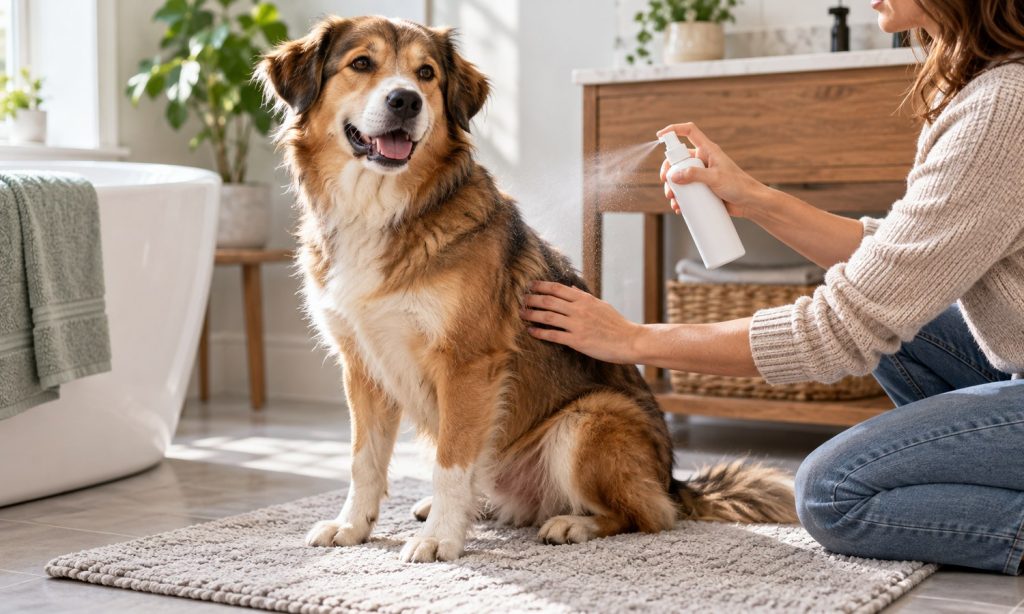
The best anti-itch spray depends on what is causing your dog’s discomfort. Some options contain active medicines such as hydrocortisone or pramoxine; others are non-medicated skin-care sprays with oatmeal, aloe, or other ingredients. Sprays can provide temporary topical care, but they do not diagnose fleas, infection, allergy, or other skin disease. We compare seven products and explain label precautions. Arrange veterinary care for severe, open, spreading, or recurring skin problems. First check whether the skin is intact and whether the cause is known. Compare active ingredients, age limits, and application directions, and contact a veterinarian for open, spreading, painful, or recurring irritation instead of repeatedly changing sprays.
Quick Picks
| Product | Best For | Key Advantage | Buy | |
|---|---|---|---|---|
| Pet MD 1% Hydrocortisone Spray | dogs with vet-approved localized irritation care | 1% hydrocortisone spray | View on Amazon | Jump to Review |
| Veterinary Formula Hot Spot & Itch Relief Medicated Spray | dogs over 12 weeks with label-matched hot spots | Lidocaine listed as an active ingredient | View on Amazon | Jump to Review |
| Davis Pramoxine Anti-Itch Spray with Oatmeal | dogs needing temporary topical itch relief | 1% pramoxine for temporary itch relief | View on Amazon | Jump to Review |
| VetWELL Hydrocortisone Spray with Pramoxine | dogs needing veterinarian-approved medicated care | Hydrocortisone and pramoxine formula | View on Amazon | Jump to Review |
| Pet Honesty Restore + Soothe Hot Spot Spray | owners comparing non-hydrocortisone skin-care sprays | Aloe vera and MicroSilver BG | View on Amazon | Jump to Review |
| Burt’s Bees for Pets Hot Spot Spray | dogs that tolerate aloe and apple cider vinegar | Apple cider vinegar formula | View on Amazon | Jump to Review |
| Bodhi Dog Itch Relief Spray with Oatmeal | owners comparing oatmeal coat-care sprays | Oatmeal and alcohol-free positioning | View on Amazon | Jump to Review |
For related guidance, see our over-the-counter hot spot treatments for dogs, compare dog shampoos for hot spots and itching, and explore allergy and itch chews for dogs.
1. Pet MD 1% Hydrocortisone Spray

- Spray format allows targeted topical application
- Pet MD’s spray is a topical product whose
- Sold for dogs
- Pet MD’s spray is a topical product whose listing identifies 1%
- Formula as non-stinging and free of fragrance and dyes
- Spray may not resolve the underlying cause of itching
Pet MD’s spray is a topical product whose listing identifies 1% hydrocortisone and positions it for irritated, dry, itchy skin and hot spots. It is sold for dogs, cats, and horses, but a multi-species label does not replace checking whether the product is appropriate for your dog’s age, condition, or treatment plan. Read the bottle directions and ingredient panel before use, and ask a veterinarian if the skin is broken, infected, widespread, or unusually painful.
The listing describes the formula as non-stinging and free of fragrance and dyes, and says hydrocortisone is intended to reduce irritation, swelling, itch, and redness. Hydrocortisone is an active medication, so this is not simply a grooming mist. Follow the exact label and veterinary instructions, avoid the eyes and mouth, and prevent licking if directed. Do not combine it with another medicated cream or spray unless a veterinarian confirms that the ingredients and schedule are compatible.
This can be a comparison for an owner whose veterinarian has recommended an over-the-counter hydrocortisone product for a small, appropriate area. It should not be used to mask persistent itching or repeated hot spots without finding the cause. Fleas, infection, allergies, and other conditions may need different treatment. Stop and contact a clinic if irritation worsens or the dog reacts. Confirm bottle size, label warnings, and current product details on the listing before ordering. Before applying, read the bottle that arrives and keep its packaging available; directions can change, and your veterinarian may need the exact ingredient list for follow-up care.
My Recommendation
Pet MD is a straightforward option to discuss when a veterinarian specifically recommends a 1% hydrocortisone spray for a limited area. Its active ingredient means label compliance matters. I would not use it to self-treat widespread, open, or infected skin, or combine it with other products without veterinary guidance.
2. Veterinary Formula Hot Spot & Itch Relief Medicated Spray

- Its product details name lidocaine
- Its application schedule on the listing describes twice-daily use
- Combining medications can create avoidable exposure or mask
- Eight-fluid-ounce bottle is described as citrus scented
- Listing positions it for hot spots associated with allergies
- Medicated ingredients require careful label use
This Veterinary Formula product is listed as a medicated hot spot and itch spray for dogs and cats over 12 weeks. Its product details name lidocaine, hydrocortisone acetate, allantoin, and wheat germ oil. Because the formula contains active ingredients, it should be treated as a medicated topical product and used only according to the bottle and veterinary advice. Check that your dog meets the minimum age and that the intended skin area is appropriate.
The product information says to avoid contact with eyes and to stop use if irritation develops. Its application schedule on the listing describes twice-daily use for one week followed by once daily for one week, but always follow the directions on the bottle you receive because labels can change. Do not spray near the face, let the dog lick the wet product, or apply to a large area without asking a veterinarian. Combining medications can create avoidable exposure or mask worsening signs. The eight-fluid-ounce bottle is described as citrus scented, paraben-free, and dye-free.
The listing positions it for hot spots associated with allergies, bites, or a dirty, wet, or matted coat, but a spray cannot diagnose the cause. A spreading lesion, pus, odor, pain, or repeated chewing warrants veterinary care rather than repeated topical use. Compare the full active ingredient panel with your dog’s current medications and ask the clinic if you are unsure. Before applying, read the bottle that arrives and keep its packaging available; directions can change, and your veterinarian may need the exact ingredient list for follow-up care.
My Recommendation
This may be useful when your veterinarian approves its named medicated ingredients and the label fits the dog’s age and affected area. It includes hydrocortisone acetate and lidocaine, so I’d be especially careful to prevent licking and avoid use near eyes or open lesions unless a veterinarian instructs you.
3. Davis Pramoxine Anti-Itch Spray with Oatmeal

- Davis Pramoxine Anti-Itch Spray is an eight-ounce topical
- 1% pramoxine hydrochloride
- Word temporary matters: symptom relief does not remove fleas
- Formula is described as containing colloidal oatmeal and
- Davis Pramoxine Anti-Itch Spray is an eight-ounce topical spray
- Pramoxine offers temporary symptom relief only
Davis Pramoxine Anti-Itch Spray is an eight-ounce topical spray for dogs and cats. The product listing identifies 1% pramoxine hydrochloride and describes its purpose as temporary relief from itch associated with minor skin irritation, insect bites, abrasions, or dermatitis. The word temporary matters: symptom relief does not remove fleas, treat infection, or identify an allergy. Check the bottle directions and ask a veterinarian before using it on a young, ill, or medicated dog.
The formula is described as containing colloidal oatmeal and moisturizing emollients to soothe dry or flaky skin. Those ingredients make it a different comparison from hydrocortisone sprays, but pramoxine is still an active topical ingredient. Follow label directions, keep the product away from the eyes and mouth, and prevent licking until it has dried if the label advises. If your dog has reacted to topical products before, test only as directed by the manufacturer or veterinarian.
This may suit an owner seeking a spot spray for mild, limited irritation between baths, provided a veterinarian agrees that the cause is appropriate for topical comfort care. The listing also mentions use between groomer visits. Do not continue repeated application when itch persists, spreads, or is accompanied by sores, odor, discharge, or pain. Review the ingredient panel and package size on the current listing before buying, since listings and packaging can vary. Before applying, read the bottle that arrives and keep its packaging available; directions can change, and your veterinarian may need the exact ingredient list for follow-up care.
My Recommendation
Davis stands out for its listed 1% pramoxine plus colloidal oatmeal and emollients. I’d consider it only for short-term, localized comfort after checking the label and cause of itch. A persistent or recurring problem needs veterinary diagnosis rather than repeated spot-spray use. Follow the package directions and do not layer it with another topical unless your veterinarian approves.
4. VetWELL Hydrocortisone Spray with Pramoxine

- VetWELL’s four-ounce spray is listed for dogs and
- Positions it for hot spots
- It combines medications
- Calls the formula no-sting
- VetWELL’s four-ounce spray is listed for dogs and cats and
- Combination ingredients need veterinary guidance when concerns arise
VetWELL’s four-ounce spray is listed for dogs and cats and identifies hydrocortisone and pramoxine as its active itch-relief ingredients. The product page positions it for hot spots, bites, scrapes, and irritated skin. Because it combines medications, review the label carefully and consult a veterinarian if your dog is taking other medicines, has a skin infection, or has a history of reactions. Use the product only on the species and areas named on its packaging.
The listing calls the formula no-sting and says it is intended to soothe irritation. These are manufacturer claims and do not guarantee relief for every dog or establish the cause of itching. Keep spray away from eyes, nose, mouth, and mucous membranes, and do not let the dog lick treated skin. Avoid applying it over large areas or under bandages unless a veterinarian directs you. Stop use and seek advice if redness, swelling, or discomfort worsens.
This compact bottle may be convenient for a household that has veterinary approval for a medicated spray and wants a small format. Compare the current active ingredient concentrations and usage directions on the bottle rather than relying only on the listing title. Do not layer it with the Veterinary Formula spray or Pet MD hydrocortisone without professional guidance; overlapping active ingredients may increase exposure. For recurring itch, arrange an exam to address allergies, parasites, infection, or another underlying cause. Before applying, read the bottle that arrives and keep its packaging available; directions can change, and your veterinarian may need the exact ingredient list for follow-up care.
My Recommendation
VetWELL combines hydrocortisone and pramoxine in a small bottle, which may be convenient if your veterinarian approves those ingredients. I would avoid using it alongside another medicated spray and would follow the product’s exact species, area, and frequency directions. Follow the package directions and do not layer it with another topical unless your veterinarian approves.
5. Pet Honesty Restore + Soothe Hot Spot Spray

- Pet Honesty Restore + Soothe is a four-ounce
- Aloe vera and MicroSilver BG and presents it as a skin-care option
- Not described in the listing as a hydrocortisone treatment
- Topical product should be chosen based on the dog’s skin condition
- Pet Honesty Restore + Soothe is a four-ounce hot spot spray
- Skin-care spray is not a substitute for diagnosis
Pet Honesty Restore + Soothe is a four-ounce hot spot spray listed for dogs and cats. The product page identifies aloe vera and MicroSilver BG and presents it as a skin-care option for irritated areas, licking, scratching, and odor. It is not described in the listing as a hydrocortisone treatment, but still check the complete ingredient panel, use instructions, and age guidance. A topical product should be chosen based on the dog’s skin condition and not only on a marketing claim.
The listing states that the formula is made without alcohol, parabens, or sulfates and has a light lavender scent. Fragrance can matter for a dog or household sensitive to scented products, so check tolerance and stop if irritation appears. The page includes broad claims about soothing hot spots and supporting skin; these should not be read as proof that it treats infection or a medical allergy. Prevent licking if the label directs and avoid eyes and mucous membranes.
This could suit an owner looking for a non-hydrocortisone skin-care spray for limited, uncomplicated irritation, provided the veterinarian agrees it fits the situation. It should not replace examination of a moist, painful, spreading, or recurrent hot spot. Clean and dry the area only as directed by a clinic, since some lesions need specific treatment. Confirm current label details and available bottle size on the listing before purchase. Before applying, read the bottle that arrives and keep its packaging available; directions can change, and your veterinarian may need the exact ingredient list for follow-up care.
My Recommendation
Pet Honesty offers a non-hydrocortisone comparison with aloe and MicroSilver BG listed, which may appeal when a veterinarian recommends gentle topical care. Its lavender scent may not suit every dog. I’d use it only on limited skin issues and seek care if a hot spot is moist, painful, spreading, or recurring.
6. Burt’s Bees for Pets Hot Spot Spray

- Page names apple cider vinegar
- Non-medicated comparison in this roundup
- Formula has no fragrances
- It presents aloe and honey as moisturizing and conditioning
- Apple cider vinegar may sting on damaged skin
- Non-medicated spray may not suit every irritation
This Burt’s Bees for Pets product is listed as a two-pack of ten-ounce hot spot sprays for dogs. The page names apple cider vinegar, aloe vera, and honey, and describes the spray as a coat and skin-care option. It is a non-medicated comparison in this roundup, but that does not mean it is risk-free or right for every dog. Read the label and avoid spraying on broken or severely inflamed skin unless your veterinarian advises it.
The listing says the formula has no fragrances, sulfates, or colorants and uses a pump bottle. It presents aloe and honey as moisturizing and conditioning components. These claims describe the manufacturer’s intended use; they do not show that the spray treats the cause of persistent itching. Apple cider vinegar may sting on damaged skin, so be cautious and stop if the dog shows discomfort. Prevent licking when directed, and keep it away from eyes and mouth.
A two-pack can be practical for a household that already knows the dog tolerates the formula, but it is a larger purchase before a first trial. Patch testing should follow the label or veterinary advice. If the dog has recurrent hot spots, ear infections, facial itching, or hair loss, have a veterinarian look for an underlying issue instead of repeatedly masking symptoms. Check the received package for current ingredients and use instructions. Before applying, read the bottle that arrives and keep its packaging available; directions can change, and your veterinarian may need the exact ingredient list for follow-up care.
My Recommendation
Burt’s Bees is a larger two-pack of a non-medicated spray with aloe, honey, and apple cider vinegar listed. It may suit mild coat-care use when the dog tolerates those ingredients. I’d avoid it on damaged skin and would choose a smaller or single bottle for a first trial if available.
7. Bodhi Dog Itch Relief Spray with Oatmeal

- Bodhi Dog Itch Relief Spray is an eight-ounce
- It also describes the spray as alcohol-free
- It also includes broad marketing language about allergies and
- Bodhi Dog Itch Relief Spray is an eight-ounce oatmeal product
- Page advises testing a small area
- Alcohol-free wording does not guarantee a response
Bodhi Dog Itch Relief Spray is an eight-ounce oatmeal product listed for dogs and cats. The product page names water, oat proteins, colloidal oatmeal, botanical extracts, baking soda, wheat germ, and vitamins A, D, and E. It also describes the spray as alcohol-free. Review the full ingredient panel carefully if your pet has known sensitivities, especially because a botanical formula may contain multiple components.
The listing describes the product as a soothing topical spray and deodorizer for dry or irritated skin. It also includes broad marketing language about allergies and immediate comfort; do not interpret that as evidence that it diagnoses or treats an allergic disease. The page advises testing a small area, but follow the actual label and ask a veterinarian if skin is broken or inflamed. Keep the product away from eyes and stop if your dog reacts.
This may appeal to owners who want an oatmeal-based, non-hydrocortisone spray for between-bath coat care. The listing also mentions a light apple scent and detangling use. Scent and residue preferences vary, so test carefully as directed before spraying broadly. If itching continues, spreads, or returns frequently, seek veterinary advice to check for fleas, infection, allergy, or another cause rather than relying on repeated topical applications. Before applying, read the bottle that arrives and keep its packaging available; directions can change, and your veterinarian may need the exact ingredient list for follow-up care.
My Recommendation
Bodhi Dog is the gentler grooming-style comparison in this group, with colloidal oatmeal and oat proteins listed. It is not a substitute for allergy or infection treatment. I’d try it only as directed on a small area, and stop if the dog seems uncomfortable or develops more redness.
How to choose best anti itch spray for dogs
Itching can have many causes, so a spray should be chosen by its label, intended use, and your veterinarian’s advice when symptoms persist. Compare active ingredients and application directions, avoid eyes and broken skin unless the label permits use, and stop if irritation worsens.
Separate medicated products from grooming sprays
Choose by active ingredients and label directions, not a broad promise of fast relief. Keep the bottle available so your veterinarian can review its exact contents if the skin problem persists.
Ask your veterinarian before combining them, especially if your dog is taking medication, has a chronic condition, or has broken skin. A product described as “natural” or “gentle” can still irritate a sensitive dog. Use only on the species, age, skin area, and schedule named on the label. Prevent licking if directed, and keep sprays away from eyes, nose, mouth, and genital areas.
Read the active ingredient panel first. Hydrocortisone and pramoxine are medications, while oatmeal, aloe, and other ingredients are usually presented as skin-care components. Products with multiple actives can overlap with creams, shampoos, or veterinary prescriptions.
Match the product to the skin problem
A small, uncomplicated area may be appropriate for label-directed topical care, but itch has many possible causes. Fleas, mites, bacterial or yeast infections, allergies, and other conditions require different plans. A spray may mask signs without treating the cause. Do not apply a spray to a large area, open wound, moist lesion, or infected-looking skin unless a veterinarian recommends it. Seek prompt care for swelling, pus, strong odor, pain, bleeding, spreading redness, or intense self-trauma. Recurrent itch, ear infections, or hair loss also deserves an exam. Follow the clinic’s advice rather than trying several products in sequence.
Check tolerance and use exactly as directed
Compare bottle size, scent, active ingredient concentration, label warnings, and intended age range. For a new product, follow label or veterinarian guidance for a small-area test, then watch for redness, swelling, increased scratching, or other reactions. Do not let the dog lick wet product; use a cone only if a veterinarian recommends it and it fits safely. Stop if irritation develops. Keep the package so you can share the exact ingredients with your clinic. If the dog’s itch continues despite brief label-directed use, arrange diagnosis instead of increasing frequency or applying another spray.
Keep a short record of the food or topical product used, when the signs began, and whether the affected area changed. That timeline can help your veterinary team decide what to investigate and which care steps are appropriate.
Frequently Asked Questions
Can I use human hydrocortisone spray on my dog?
Do not assume a human product is safe for pets. Use only a product labeled for your dog and ask a veterinarian about active ingredients and application.
Can anti-itch spray treat allergies?
A topical spray may provide temporary comfort, but it does not diagnose or treat the underlying allergy.
When should I call a veterinarian?
Call for open, painful, spreading, oozing, or recurring lesions, severe itch, or signs that worsen after use.
Final Verdict
For a veterinarian-approved medicated option, Pet MD clearly lists 1% hydrocortisone, while Davis is the oatmeal and pramoxine comparison. For non-hydrocortisone skin care, Pet Honesty lists aloe and MicroSilver BG. Use any spray only as labeled, and seek veterinary care when itch persists or skin looks damaged.
Affiliate disclosure: This article contains Amazon affiliate links. If you purchase through them, PetAdvisorPro may earn a commission. As an Amazon Associate I earn from qualifying purchases.