
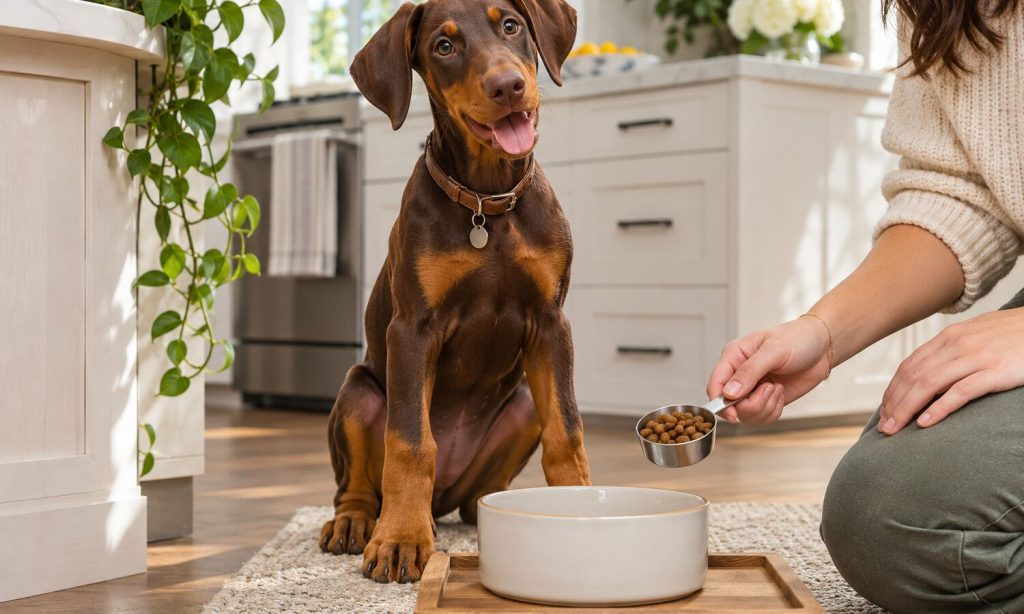
A Doberman puppy can grow fast, but faster is not automatically healthier. Common mistakes when choosing a dog food for doberman puppy often start with focusing on flashy ingredient claims while overlooking growth-stage nutrition, calorie intake, and mineral balance. These dogs are typically large when mature, so the feeding plan should support controlled growth. It should also suit the puppy’s digestive tolerance and real daily activity, not a guess based on a photo or breed stereotype.
The good news is that a careful label check and steady routine prevent many avoidable errors. When investigating dog food for doberman puppy, separate a product roundup from the nutritional decisions that matter for your individual animal. This article explains the common traps, what to check instead, and the warning signs that need veterinary advice. You will also learn how to judge progress through body condition, normal stools, and a measured growth pattern.
Mistake One: Ignoring the Large-Breed Growth Statement
A diet described as generally suitable for dogs may still be wrong for a growing Doberman. Read the AAFCO nutritional-adequacy statement, not simply the large words on the front. For a puppy expected to weigh at least 70 pounds as an adult, look for a formulation declared suitable for growth of large-size dogs. That statement is more informative than the words ‘premium’ or ‘natural.’ A food labeled for adult maintenance alone is not automatically adequate for puppy growth, even if your pup eagerly finishes it.
Puppies need enough protein, energy, and essential nutrients for developing tissue. Large-breed puppies also require carefully managed mineral levels, especially calcium and phosphorus. Adding extra calcium without veterinary guidance can unbalance a complete ration and may increase orthopedic risks. Do not assume ‘more minerals’ means stronger bones. If the label’s adequacy statement is unclear, ask the manufacturer for its nutritional documentation or discuss a different complete growth diet with your veterinarian.
Mistake Two: Feeding for Speed Instead of Body Condition
Dobermans often develop long legs and visible changes from week to week. Owners may interpret a lean puppy as underfed and keep increasing scoops. Yet excessive energy intake can encourage unnecessarily rapid growth. Follow the food’s feeding chart only as an opening estimate. Adjust with regular weigh-ins, a veterinarian’s growth assessment, and body-condition observations. You should usually be able to feel ribs beneath a light covering, with a waist beginning to appear. A puppy does not need to look round to be thriving.
Measure the actual ration instead of topping up the bowl whenever it becomes empty. Record the amount offered, treats, training food, and any leftovers. A kitchen scale helps when cup sizes vary between kibble shapes. Review your plan every couple of weeks during rapid growth because calorie needs change. The site’s guide to how much food to give your dog explains the basic principles behind portion estimates, but your puppy’s growing body requires individual adjustments.
Mistake Three: Choosing Foods by Trendy Ingredient Claims
Lists that rank ingredients without evaluating the finished diet are a weak way to judge nutrition. A named meat first does not prove the formula is nutritionally complete. Likewise, grain-free labeling is not a health benefit for every puppy. If you suspect a food allergy, obtain a diagnosis instead of removing entire categories on the basis of online speculation. Dietary restrictions can be especially troublesome in growing dogs because their total nutrient needs are demanding.
Ask meaningful questions about the expertise behind the formula. Does the producer employ qualified nutrition professionals? Are nutrient specifications available? Are there feeding trials or quality controls? These questions align with veterinary nutrition guidance and are more reliable than marketing language alone. Avoid unnecessary raw feeding, unbalanced homemade menus, and supplements added just because another owner recommended them. Growing puppies are not good candidates for casual diet experiments.
Mistake Four: Switching Abruptly or Changing Too Many Variables
A sudden change from the breeder’s food to a new kibble may trigger vomiting or loose stool. For an otherwise healthy puppy, introduce the new food gradually over several days, often a week or longer. If your veterinarian recommends a medically necessary immediate change, follow that specific plan. Keep the feeding time, treats, and bowl location stable while adjusting the mixture. This way you can identify whether the diet itself is tolerated.
Do not interpret one loose stool as proof of a permanent allergy. Stress, intestinal parasites, and illness can cause similar signs. Document when symptoms begin and whether the puppy eats, plays, and drinks normally. Repeated vomiting, bloody stool, pronounced lethargy, a painful abdomen, or poor hydration needs prompt veterinary assessment. Doberman puppies can become ill quickly, and a waiting game is not a substitute for pediatric veterinary care.
Mistake Five: Treating Every Puppy as the Same
A dog training several times daily may have different energy use from one in a quiet home. Yet neither exercise nor breed justifies feeding as much as the puppy will accept. Distinguish a measured growth ration from training treats, which can contribute a surprising number of calories. Use some of the day’s measured kibble for training when appropriate, and keep other treats moderate. Maintain access to clean water and watch that eating remains comfortable.
An individual puppy may also have chewing issues, dental pain, gastrointestinal sensitivity, or an underlying health condition. If food is consistently refused, do not conceal the issue beneath frequent flavor changes. Have a veterinarian assess appetite, teeth, stool, and growth. The right diet is the one that meets developmental needs and is actually tolerated. It is not a race to find the most elaborate ingredient list. IMO, careful measurement is one of the least glamorous but most useful puppy-care habits.
Mistake Six: Forgetting Ongoing Review and Life Stages
A formula that works at ten weeks may require different portion sizes several months later. Schedule routine veterinary checks and ask when to reassess calorie intake, feeding frequency, and the eventual transition to adult maintenance. Large dogs generally remain on growth-appropriate diets longer than small breeds, but the exact endpoint depends on maturity and veterinarian guidance. Do not switch automatically on a birthday without considering growth and condition.
Keep food in its original bag, secured inside a clean dry container if practical. Store unopened food somewhere cool and dry, and wash bowls after meals. Note the lot number in case of a recall. This basic hygiene protects both puppy and household. If you ever need to compare general feeding fundamentals beyond breed-specific needs, revisit the dog nutrition guide and use it alongside your veterinarian’s advice.
Frequently Asked Questions
Owners often ask whether one impressive label claim can settle a puppy-food decision. It cannot; the better answer comes from nutritional adequacy, measured intake, and how the growing dog responds.
These quick answers address common situations, but a puppy with symptoms or a prescribed diet needs an individual veterinary plan rather than general web advice.
Does a Doberman puppy need large-breed food?
Choose a complete growth diet whose adequacy statement specifically covers growth of large-size dogs when the adult size is expected to exceed 70 pounds.
Can I give calcium supplements to strengthen bones?
Not routinely. Excess calcium can disturb balanced growth nutrition. Give supplements only on veterinary advice for a diagnosed need.
How many meals should a young Doberman have?
Meal frequency changes with age and health. Ask your veterinarian for a puppy-specific schedule and divide the measured daily ration accordingly.
Is grain-free food automatically healthier?
No. Grain exclusion is not inherently better for a healthy puppy. Assess complete nutrition and discuss suspected food reactions with a veterinarian.
When should I switch to adult food?
Timing depends on growth and body condition. Large-breed dogs often stay on an appropriate growth diet until near maturity; confirm with your veterinarian.
Final Words
Avoiding common mistakes when choosing a dog food for doberman puppy begins with a simple priority: support healthy, controlled development. Verify large-breed growth suitability, measure calories, avoid unnecessary supplements, and change diets gradually. Track weight, stool, energy, and appetite instead of judging progress from the front of a food bag.
For background on the category, the site’s Doberman puppy food overview offers related context. Keep your own puppy’s veterinary growth checks at the center of the decision. A consistent, nutritionally appropriate feeding routine will serve your dog far better than endlessly switching between fashionable feeding theories.









