
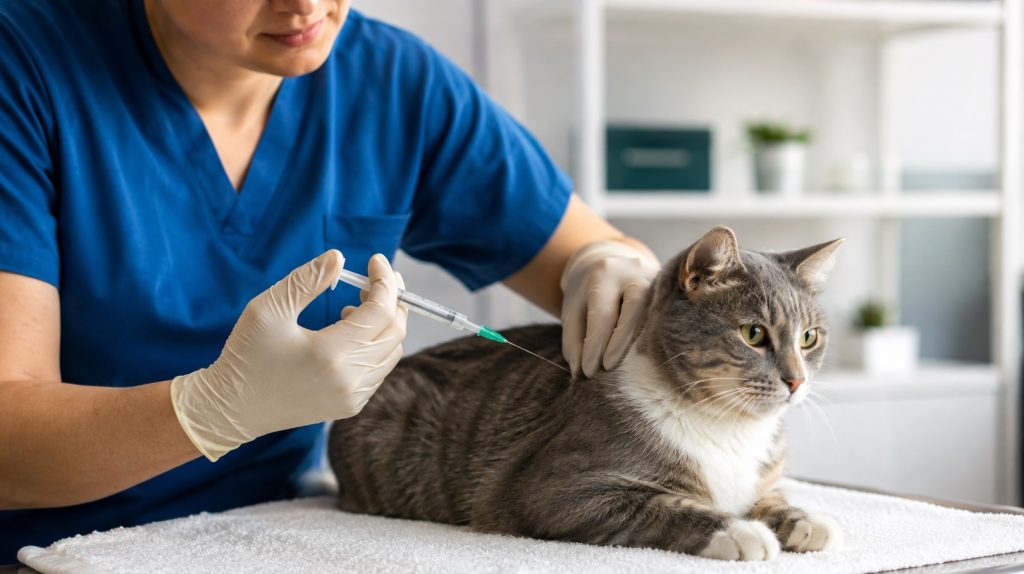
If your cat spends every minute indoors, you may wonder, “Do indoor cats need rabies vaccines?” It’s a reasonable question. After all, your cat isn’t roaming through fields, fighting raccoons, or chasing bats around the neighborhood—or at least that’s the plan.
The short answer is yes, indoor cats generally should receive a rabies vaccine, even if they never intentionally go outside. Rabies vaccination is considered a core vaccine for pet cats by the American Animal Hospital Association (AAHA) and American Association of Feline Practitioners (AAFP). Whether vaccination is legally required depends on your state and local regulations.
I’ve always believed that responsible pet care means planning for the unlikely situations, not just the everyday ones. An indoor cat may have a very low exposure risk, but “very low” isn’t the same thing as “impossible.”
Quick Answer: Do Indoor Cats Need Rabies Vaccines?
Yes, most indoor cats should be vaccinated against rabies.
The AAHA/AAFP feline vaccination guidelines classify rabies as a core vaccine for pet cats. Core vaccines are recommended because the diseases they prevent can cause serious illness and are sufficiently important to justify routine protection.
There are also legal considerations. Rabies vaccination requirements differ across the United States, so an indoor-only lifestyle does not automatically exempt your cat from local vaccination laws. The CDC recommends vaccinating cats against rabies according to applicable local laws.
So, if you’re asking “Do indoor cats need rabies vaccines?”, the practical answer is: usually yes—talk with your veterinarian and check your local requirements.
Why Would an Indoor Cat Need a Rabies Vaccine?
The biggest misconception about rabies vaccination is that exposure only happens when a cat spends time outdoors.
Unfortunately, cats don’t always cooperate with our carefully designed safety plans.
Indoor Cats Can Still Encounter Wildlife
Bats are one of the most important reasons an indoor cat can potentially encounter rabies.
Imagine a bat somehow gets inside your home. Your cat, naturally, may decide that the strange flying object is the most fascinating toy ever invented.
That playful interaction could potentially create a serious exposure.
In the United States, rabies is primarily found in wildlife, including bats, raccoons, skunks, and foxes.
An indoor cat may also accidentally escape through an open door, window, garage, or damaged screen. Even a cat that has never been outside can suddenly find itself exploring the neighborhood.
That is one reason I wouldn’t rely on the phrase “indoor-only” as the sole reason for skipping a rabies vaccine.
Indoor-Only Does Not Always Mean Zero Exposure
AAHA notes that vaccination decisions should consider an individual cat’s lifestyle and exposure risk rather than simply labeling a cat indoor or outdoor. Even cats that live exclusively indoors can encounter infectious threats through veterinary visits, contact with other cats, travel, boarding, or contaminated materials brought into the home.
Rabies is different from many everyday feline illnesses because of its severity.
Once clinical rabies develops, it is almost always fatal. That’s a pretty compelling reason not to gamble on “probably won’t happen.”
Is Rabies Vaccine for Cats Considered a Core Vaccine?
Yes.
The AAHA/AAFP feline vaccination guidelines identify rabies as a core vaccine for pet cats. Their recommendations are designed around protecting cats against important diseases while considering each animal’s individual circumstances.
That doesn’t mean every cat receives exactly the same vaccination schedule.
Veterinarians consider factors such as:
- Age
- Health status
- Previous vaccination history
- Lifestyle
- Geographic location
- Potential exposure
- Vaccine product
- State and local regulations
The guidelines emphasize individualized vaccination planning rather than a one-size-fits-all protocol.
How Often Do Indoor Cats Need Rabies Shots?
This is where the answer becomes a little less simple.
How often do indoor cats need rabies shots? It depends on the rabies vaccine being used, its labeled duration of immunity, and the laws in your state or local jurisdiction.
Some rabies vaccines for cats are labeled for one year, while others are labeled for three years. Where local law permits, AAHA/AAFP guidance recommends using a three-year vaccination interval when a three-year vaccine is available and appropriate.
However, you should never assume that your cat automatically needs a shot every three years—or every year—without checking.
Your veterinarian should consider the specific vaccine product and your area’s regulations.
The CDC also states that animal rabies vaccine schedules can vary according to the product and state or local requirements.
Why State Law Matters
Rabies is a public-health issue, not merely a pet-care issue.
Many U.S. jurisdictions require rabies vaccination for cats, although requirements vary. AAHA specifically notes that veterinarians should follow local statutes and requirements when determining rabies vaccination intervals.
So if someone tells you, “My indoor cat doesn’t need a rabies vaccine because it never goes outside,” don’t automatically assume that’s correct.
Your state’s law may say otherwise.
Kitten Rabies Vaccine Schedule
The kitten rabies vaccine schedule is generally different from the schedule used for an established adult cat.
The CDC says most cats should not be vaccinated for rabies before 12 weeks (3 months) of age, because the immune response in very young animals may not be as strong.
The exact timing should be determined by your veterinarian and the vaccine product being used.
For a kitten, the veterinarian will typically consider the complete vaccination history and coordinate the rabies vaccine with other recommended kitten vaccines.
If you’re adopting a kitten, don’t simply ask, “Did she get her shots?”
Ask for the actual vaccination records.
That little piece of paperwork can save you a lot of confusion later.
What Happens After the First Rabies Vaccine?
According to the CDC, an animal is considered immunized 28 days after its initial rabies vaccination. An animal receiving a booster is considered vaccinated immediately after the booster, even if the previous vaccination was overdue.
Because rabies exposure can have serious consequences, keeping vaccination records current is extremely important.
How Often Do Cats Need Rabies Shots?
The question “how often do cats need rabies shots?” doesn’t have one universal answer for every cat in America.
In general, the interval may be:
- Every year for a one-year-labeled vaccine
- Every three years for an appropriately labeled three-year vaccine
- Different from these intervals if local regulations require something else
The vaccine label and applicable law matter.
Your veterinarian may also recommend a particular vaccine based on your cat’s health and circumstances.
If your cat’s rabies vaccination is overdue, don’t simply wait until the next annual checkup. Call your veterinarian and ask what should be done.
What Happens If an Indoor Cat Is Not Vaccinated?
The consequences of skipping vaccination may not become obvious on an ordinary Tuesday afternoon.
Your cat can appear perfectly healthy for years.
The problem arises if an unexpected exposure occurs.
For example, suppose an indoor cat encounters a bat inside the house. If the cat is not appropriately vaccinated, public-health authorities may have to take additional precautions because rabies is nearly always fatal once clinical disease develops.
CDC guidance explains that management after a rabies exposure depends on the animal’s vaccination history and the circumstances of the exposure. Unvaccinated dogs, cats, and ferrets exposed to rabies can face strict quarantine or euthanasia recommendations depending on the situation and applicable public-health guidance.
That is not meant to frighten cat owners.
It’s actually one of the strongest arguments for prevention.
A relatively straightforward vaccination can help avoid a much more complicated situation later.
What Can Expose an Indoor Cat to Rabies?
An indoor cat’s risk may be low, but several scenarios are worth knowing.
1. Bats Entering the Home
A bat can enter through an opening that you didn’t even know existed.
Cats may chase, catch, bite, or play with bats.
If this happens, contact your veterinarian and local public-health authorities promptly rather than trying to decide on your own whether the bat was infected.
2. Raccoons, Skunks, or Foxes
An escaped indoor cat could encounter wildlife surprisingly quickly.
Depending on where you live, raccoons, skunks, and foxes can be important rabies reservoirs.
3. Accidental Escapes
Cats are excellent at exploiting opportunities.
One open front door can turn “indoor-only” into “indoor-plus-unplanned-adventure.”
4. Travel or Boarding
Some indoor cats occasionally travel, stay at boarding facilities, or visit other households.
These situations can change a cat’s exposure profile and are worth discussing with your veterinarian. AAHA/AAFP recommends reassessing vaccination plans when a cat’s lifestyle or circumstances change.
5. Other Unexpected Animal Contact
A new pet, a stray animal entering the home, or an accidental encounter can also change the risk picture.
FYI, cats don’t need to become professional outdoor explorers before vaccination becomes relevant. 🙂
What Should You Do If Your Indoor Cat Is Exposed to a Potentially Rabid Animal?
Treat a suspected rabies exposure seriously.
Step 1: Avoid Direct Contact
Don’t handle an animal that may have rabies with your bare hands.
Rabies virus can be transmitted through saliva or nervous tissue from an infected animal.
Step 2: Separate Your Cat Safely
If you can do so without putting yourself at risk, prevent further contact between your cat and other people or animals.
Step 3: Contact Your Veterinarian
Call your veterinarian as soon as possible.
Give them as much information as you can about:
- What animal was involved
- Whether your cat was bitten or scratched
- Whether saliva may have contacted an open wound
- Your cat’s vaccination history
- When the incident occurred
Step 4: Contact Public Health Authorities When Appropriate
Rabies exposure decisions can involve local or state public-health officials.
Don’t try to determine the quarantine requirements yourself.
The CDC recommends case-specific assessment following potential rabies exposure.
Step 5: Don’t Wait for Symptoms
This is especially important.
Don’t wait to see whether your cat develops strange behavior or other symptoms before seeking professional advice.
Rabies prevention is about acting before the disease becomes established.
When Should You Talk to a Vet About Your Cat’s Rabies Vaccine?
Contact your veterinarian if:
- Your kitten has never received a rabies vaccine.
- You don’t know your cat’s vaccination history.
- Your cat’s rabies vaccine is overdue.
- You’re moving to another state.
- Your cat is beginning to travel or board.
- Your cat escaped outdoors.
- Your cat encountered a bat or wild animal.
- Your cat was bitten or scratched by an unfamiliar animal.
- Your cat has bitten someone.
- You aren’t sure whether your cat’s vaccination meets local requirements.
If you’re unsure, calling your veterinarian is usually much easier than trying to interpret a complicated vaccination record at 11:30 p.m. :/
5 Frequently Asked Questions
1. Do indoor cats really need rabies vaccines?
Yes, rabies vaccination is generally recommended for indoor cats because rabies is a severe and almost universally fatal disease once clinical illness develops. AAHA/AAFP considers rabies a core vaccine for pet cats. Local laws may also require vaccination.
2. How often do indoor cats need rabies shots?
How often do indoor cats need rabies shots? It depends on the vaccine product, your cat’s circumstances, and state or local requirements. Some vaccines are labeled for one year and others for three years. Your veterinarian should determine the appropriate schedule.
3. At what age should a kitten get a rabies vaccine?
Most cats should not receive rabies vaccination before 12 weeks of age, according to CDC guidance. The exact timing should follow the vaccine label, veterinary recommendation, and applicable law.
4. Can an indoor cat get rabies from a bat?
Potentially, yes. A bat can enter a home and create an unexpected exposure opportunity. If your cat has contact with a bat or another potentially rabid animal, contact your veterinarian and local public-health authorities promptly.
5. Is rabies vaccination legally required for indoor cats?
It depends on where you live. Rabies vaccination laws vary among U.S. states and local jurisdictions. An indoor-only lifestyle does not automatically mean that your cat is legally exempt. Check your local requirements and ask your veterinarian.
Final Words
So, do indoor cats need rabies vaccines?
For most cats, yes.
Even though an indoor lifestyle dramatically reduces many environmental risks, it doesn’t create an invisible force field around your cat. Bats can enter homes, cats can escape, wildlife can get surprisingly close, and life occasionally ignores our carefully organized plans.
Rabies vaccination is considered a core component of feline preventive care by AAHA/AAFP, and vaccination requirements may also be established by state or local law.
The smartest approach is simple: keep your cat’s vaccination records current, ask your veterinarian which rabies vaccine and interval are appropriate, and know the rules where you live.
A few minutes discussing rabies vaccine for cats with your veterinarian can provide much more peace of mind than wondering whether your indoor cat is “safe enough.”
And when it comes to rabies, I’d rather be boringly prepared than regretfully optimistic.