
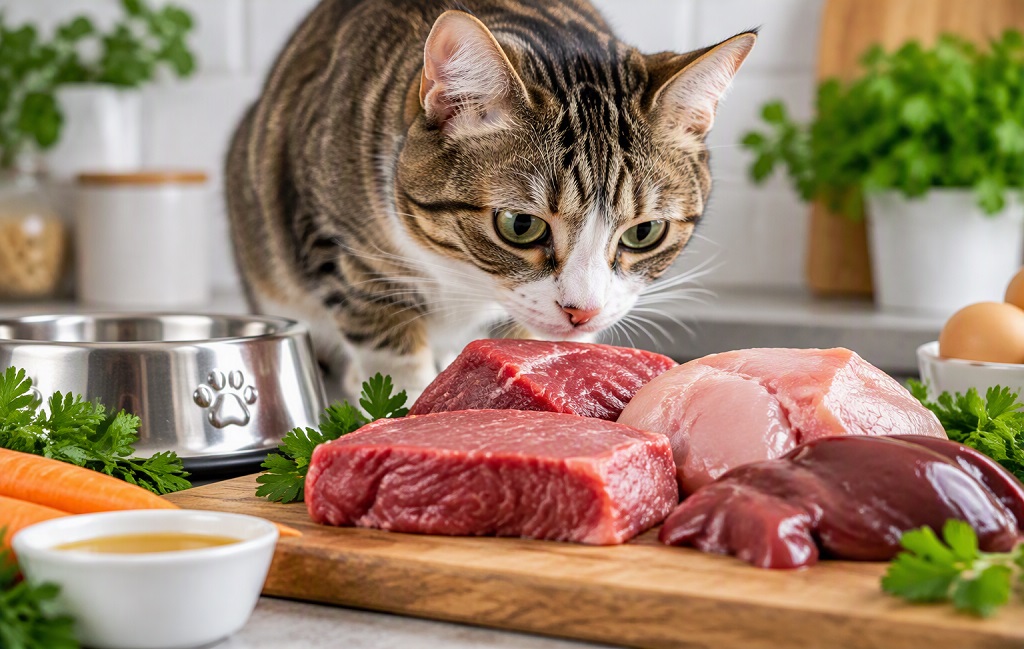
Cats are natural hunters, and watching one stalk a toy mouse can make it easy to imagine that raw meat must be the most natural food possible. But raw meat safety for cats is more complicated than simply asking whether a cat can digest meat.
Cats are obligate carnivores, and animal protein is an essential part of their nutrition. That does not mean every form of meat is safe to serve raw. Uncooked meat can carry harmful bacteria and parasites, may create nutritional problems when fed as a homemade diet, and can expose other members of the household to foodborne pathogens.
After 15 years of caring for different pets, I have learned not to confuse an animal’s enthusiasm with a nutritional recommendation. Cats are very convincing negotiators when food is involved. If something smells interesting, they may behave as though a veterinary nutritionist personally approved it. 🙂
So what does raw meat safety for cats actually mean? For most household cats, the safest approach is to feed a nutritionally complete and balanced cat food and avoid routinely feeding uncooked animal meat.
Is Raw Meat Safe for Cats?
The simple answer is raw meat is not considered a safe choice for routine feeding of cats by major veterinary and public-health organizations.
The CDC does not recommend feeding raw pet food or treats to cats and dogs. The AVMA also discourages feeding raw or undercooked animal-source proteins because of potential risks to animal and human health.
Raw meat may contain pathogens such as:
- Salmonella
- Listeria monocytogenes
- E. coli
- Campylobacter
It can also contain parasites, and homemade raw diets can be nutritionally incomplete.
This does not mean that every piece of raw meat will make a cat sick. It means that the risk is avoidable when safer, nutritionally appropriate alternatives are available.
That distinction is central to understanding raw meat safety for cats.
Raw Meat Safety for Cats: The Main Risks
There are several separate issues to consider. Raw meat is not simply “good” or “bad.” The type of meat, its source, handling, preparation, quantity, and the cat’s overall diet all matter.
Bacteria in Raw Meat for Cats
One of the biggest concerns with raw meat is bacterial contamination.
Raw animal protein can carry organisms such as Salmonella and Listeria. A cat consuming contaminated meat may become ill, but there is another issue that is sometimes overlooked: the bacteria can enter the household environment.
A cat may touch its food bowl, lick its paws, walk across the floor, or interact with family members after eating. Contamination can potentially spread through food bowls, utensils, countertops, hands, clothing, or feces.
This is particularly important in homes with:
- Children younger than 5
- Adults age 65 or older
- Pregnant people
- People with weakened immune systems
Some cats infected with foodborne bacteria may not appear seriously ill, yet they can still shed organisms.
For that reason, bacteria in raw meat for cats is not only a feline health issue. It is also a household food-safety issue.
Parasites and Raw Meat
Parasites are another part of the raw-meat equation.
Raw meat can contain parasites or parasite stages capable of infecting animals. The specific risk depends on the animal species, geographic area, source of the meat, and processing.
Toxoplasma is one well-known example associated with raw or undercooked meat. Cats can become infected after eating infected tissue.
This is one reason veterinary organizations generally do not treat “natural” raw feeding as automatically safer.
A piece of meat does not become harmless simply because it came from an animal rather than a factory.
Nutritional Imbalance
This is where many homemade raw diets become more complicated than they initially appear.
A piece of raw chicken, beef, turkey, or another meat can provide protein and other nutrients. But meat alone is not necessarily a complete diet for a cat.
Cats require an appropriate balance of nutrients, including:
- Taurine
- Essential amino acids
- Vitamins
- Minerals
- Calcium and phosphorus
- Essential fatty acids
- Adequate calories
Feeding mostly muscle meat without properly balancing the rest of the diet can eventually create nutritional deficiencies or excesses.
Merck Veterinary Manual notes that homemade diets can be nutritionally inadequate when they are not properly formulated.
This is why I would be very cautious about building a raw diet from online recipes. A recipe that sounds convincing on a website is not automatically equivalent to a diet formulated by a veterinary nutritionist.
Bones and Physical Hazards
Some raw diets include bones.
That introduces another category of risk.
Bones can cause:
- Choking
- Broken teeth
- Mouth or throat injuries
- Esophageal obstruction
- Intestinal obstruction
- Gastrointestinal injury
Grinding bones may change the physical risk, but it does not automatically solve the nutritional or bacterial issues associated with raw diets.
If your goal is simply to provide your cat with animal protein, there is little reason to introduce unnecessary bone-related hazards.
Thiamine Deficiency and Raw Fish
Fish deserves special attention.
Some raw fish contain thiaminase, an enzyme that breaks down thiamine, also known as vitamin B1. Repeated consumption of inappropriate raw fish diets can contribute to thiamine deficiency.
Severe thiamine deficiency in cats can cause neurological problems, including poor coordination, head tremors, abnormal head positioning, depression, and seizures.
This is not a reason to panic because your cat stole one bite of raw fish.
It is a reason to understand why a diet made largely from raw fish is not something to improvise at home.
Cooking destroys thiaminase, which is one advantage of properly cooked fish.
Raw vs Cooked Meat for Cats
When comparing raw vs cooked meat for cats, cooking has a major safety advantage: adequate heat can reduce or eliminate many harmful pathogens.
Plain, thoroughly cooked meat can be offered to many healthy cats as an occasional treat, provided it is prepared appropriately.
For example, a small amount of plain cooked chicken or turkey may be reasonable for some cats.
But avoid turning human dinner into feline dinner.
Do not give cats meat covered in:
- Onion
- Garlic
- Heavy salt
- Spicy seasoning
- Rich sauces
- Excessive fat
And always remove bones.
Cooked meat should generally remain a treat rather than replacing a nutritionally complete and balanced cat food.
That distinction is important because cooked meat is safer from a pathogen perspective, but plain cooked meat by itself still may not provide everything a cat needs nutritionally.
How to Prepare Raw Meat for Cats: What Owners Should Know
Searches for how to prepare raw meat for cats are common, particularly among owners interested in homemade raw diets.
The problem is that there is no simple kitchen technique that makes raw meat completely risk-free.
Washing raw meat does not sterilize it. Freezing may reduce some hazards but does not reliably eliminate all bacteria. Freeze-drying and dehydration also should not be treated as guaranteed methods of eliminating pathogens.
If an owner nevertheless chooses to feed a raw diet, the responsible approach is to discuss it with a veterinarian or veterinary nutritionist first.
Food-safety practices become especially important:
- Wash hands thoroughly after handling raw pet food.
- Clean and disinfect surfaces that contact the food.
- Keep raw pet food separate from human food.
- Store raw products according to the manufacturer’s instructions.
- Thaw frozen raw food safely in the refrigerator.
- Keep food in sealed containers.
- Clean food bowls regularly.
- Dispose of leftovers appropriately.
- Check for current product recalls.
The CDC recommends discussing raw feeding with a veterinarian and paying particular attention to whether the diet is complete and balanced.
Personally, I prefer eliminating an avoidable hazard rather than trying to manage a hazard perfectly. IMO, that is usually a sensible philosophy when the family kitchen is involved.
Can Stray Cats Eat Raw Meat?
Yes, can stray cats eat raw meat? They certainly can.
A stray or outdoor cat may eat raw prey, discarded meat, or other animal products simply because food is available.
But this does not prove that raw meat is safe.
Outdoor cats may encounter parasites, bacteria, spoiled food, contaminated prey, and other hazards that indoor cats are less likely to encounter.
There is also a major difference between survival behavior and optimal nutrition.
A cat eating something because it is hungry tells us that the cat can consume it. It does not tell us that the food provides a complete nutritional profile or that the food is free from infectious hazards.
This distinction is central to raw meat safety for cats.
A wild predator’s feeding behavior is not a veterinary nutrition plan for a house cat.
Current H5N1 Concerns for U.S. Cat Owners
There is another reason raw animal products deserve additional attention in the United States.
Highly pathogenic avian influenza A(H5N1) has caused serious illness in cats, and U.S. authorities have investigated infections associated with contaminated uncooked animal products, including raw meat and raw pet food.
Cats can be particularly susceptible to severe H5N1 disease.
As of 2026, the FDA continues to treat H5N1 as a food-safety hazard that manufacturers using certain uncooked or unpasteurized poultry or cattle ingredients must consider in their food-safety plans.
This does not mean that every piece of raw meat contains H5N1. It means the pathogen represents an additional reason for cat owners to take raw feeding seriously.
Watch for current FDA recalls and safety alerts involving raw pet foods, particularly poultry-based products.
If a cat that has consumed raw animal products develops signs such as fever, lethargy, loss of appetite, respiratory difficulty, tremors, seizures, or problems with coordination, contact a veterinarian promptly.
What If My Cat Accidentally Eats Raw Meat?
Don’t panic.
A cat stealing a small piece of raw meat from the kitchen counter does not automatically mean it will become seriously ill.
However, monitor the situation.
Consider:
- What type of meat did the cat eat?
- How much did it consume?
- Was the meat fresh or spoiled?
- Did it contain bones?
- Was it seasoned?
- Is the cat very young, elderly, or medically compromised?
- Does the cat develop symptoms afterward?
Contact your veterinarian if your cat consumed a large amount, swallowed bones, ate spoiled meat, or develops concerning symptoms.
Do not attempt to induce vomiting unless a veterinary professional specifically tells you to do so.
Signs of Foodborne Illness in Cats
Foodborne illness can produce gastrointestinal or systemic signs.
Potential symptoms include:
- Vomiting
- Diarrhea
- Bloody diarrhea
- Loss of appetite
- Fever
- Lethargy
- Abdominal discomfort
- Weakness
- Dehydration
Some infectious diseases can produce more serious signs.
Neurological symptoms, breathing difficulties, tremors, seizures, or severe weakness should not be treated as a simple upset stomach.
When in doubt, contact your veterinarian.
When to Call a Veterinarian
Veterinary advice is particularly important when your cat:
- Has persistent vomiting or diarrhea
- Stops eating
- Becomes unusually lethargic
- Has bloody stool
- Shows neurological abnormalities
- Develops tremors or seizures
- Has difficulty breathing
- Swallows a bone
- Shows significant abdominal pain
- Is very young, elderly, pregnant, or medically compromised
Don’t wait for a minor dietary mistake to become a major problem.
Cats are experts at hiding illness, so a significant change in behavior or appetite deserves attention.
Safer Alternatives to Raw Meat
If you want your cat to receive plenty of animal protein, you do not have to serve it raw.
A high-quality commercial cat food labeled complete and balanced can provide the nutritional foundation your cat needs.
Plain cooked meat can also be used as an occasional treat for many healthy cats.
The key is moderation and balance.
If you are interested in homemade feeding, speak with your veterinarian and, ideally, a board-certified veterinary nutritionist. A properly formulated diet is far more complicated than simply putting meat into a bowl.
There is nothing wrong with wanting a natural-feeling diet for your cat. The important question is whether the diet is safe, complete, and appropriate for that individual animal.
5 Frequently Asked Questions
1. Is raw meat safe for cats?
Raw meat is not considered a safe routine food for cats by major veterinary and public-health organizations because it can contain bacteria, parasites, and other hazards. Homemade raw diets can also be nutritionally unbalanced.
2. Can cats eat raw chicken?
Cats can physically eat raw chicken, but raw chicken can carry harmful bacteria and should not be considered a risk-free food. Properly cooked, plain, boneless chicken is a safer option.
3. Can cats eat raw beef?
Cats can consume raw beef, but raw beef can contain pathogens and parasites. Routine feeding is not recommended by major veterinary organizations. Properly cooked beef is generally a safer alternative.
4. Can stray cats eat raw meat?
Yes, stray cats may eat raw meat or prey. However, their ability to consume raw meat does not mean that it is free from bacteria, parasites, toxins, or nutritional problems.
5. Is cooked meat safer for cats than raw meat?
Generally, yes. Proper cooking reduces many foodborne pathogens associated with raw animal protein. However, cooked meat should still be plain and appropriately prepared, and it should not replace a nutritionally complete and balanced feline diet.
Final Words
Understanding raw meat safety for cats is not about arguing that cats should never eat meat. Quite the opposite—animal-derived nutrients are fundamental to feline nutrition.
The real issue is how that meat is sourced, prepared, balanced, stored, and served.
Raw meat can carry bacteria and parasites. Homemade raw diets can become nutritionally unbalanced. Bones can create physical hazards. Certain raw fish can contain thiaminase, and current U.S. experience with H5N1 has added another reason to be cautious about uncooked animal products.
After years of caring for pets, my view is straightforward: natural does not automatically mean safe, and raw does not automatically mean healthier.
For most household cats, a reputable complete-and-balanced cat food provides a much more predictable nutritional foundation. If you want to include meat as a treat, properly cooked, plain, boneless meat is a more sensible choice than routinely serving it raw.
Good cat nutrition is not about following the trendiest feeding philosophy. It is about giving your cat food that is safe, nutritionally appropriate, and sustainable for the long term.









