
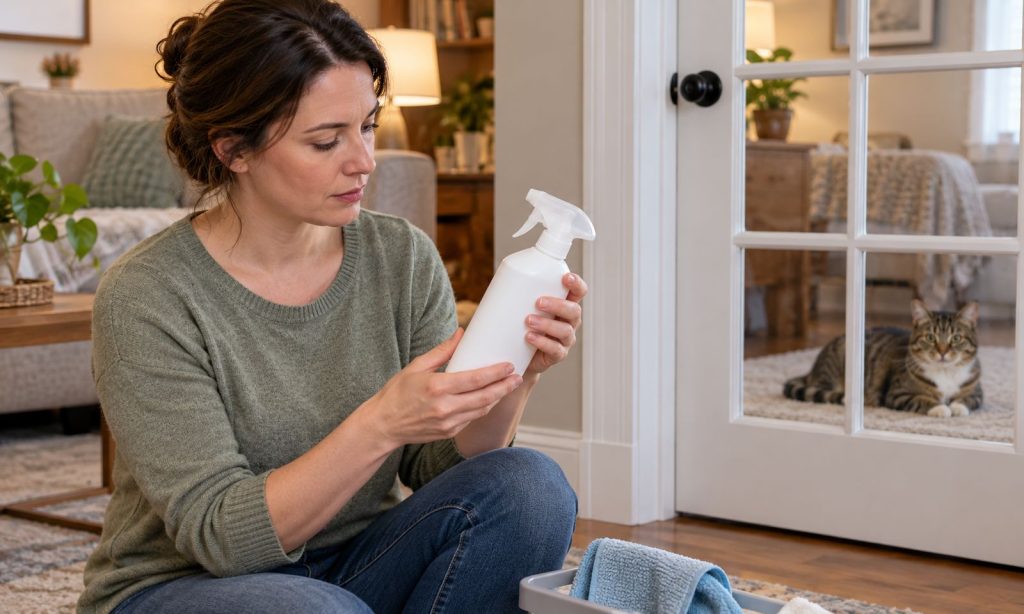
Finding fleas on a cat can make you want to spray the whole room immediately. Each cat and household needs its own safe plan. But the label and your cat’s access to that space matter just as much. A household spray is not automatically safe to use on an animal. A “natural” label does not guarantee it is harmless. This guide explains what to look for in flea spray for cats and home. Check its labeled use, target life stages, application limits, re-entry directions, storage, and warnings. It also covers when spraying may be only one part of flea control. If you are comparing a flea spray for cats and home, use the checks below and ask your veterinarian about treating the cat itself.
First, separate home sprays from products for cats
A flea spray intended for carpets, bedding, or room surfaces is not necessarily labeled for direct use on a cat. Never spray a household product onto your cat unless its label specifically says it is for that use and gives cat-specific directions. A product for dogs is not a substitute for a cat product. Cats can be harmed by some ingredients used in dog flea products and household pesticides.
The phrase “for cats and home” can refer to a home-treatment product or a pet product. Some packages include both, but each still has separate directions. Read the full label to confirm which meaning applies. Check the exact species, age, weight, location, and method of use. If the label is unclear, do not guess. Ask your veterinarian or contact the manufacturer using the number on the product.
A key part of what to look for in flea spray for cats and home is an explicit statement of where the product may be used. A room spray should explain whether it is for carpets, upholstery, cracks, pet bedding, or other surfaces. Do not assume a surface listed on one product is approved for another formula.
Read the whole label before buying or spraying
A basic check for what to look for in flea spray for cats and home is the label. It is the main use and safety guide. Check that the product is authorized for sale in the United States. Then look for the required registration or regulatory information. Pesticide products used around the home generally carry an EPA registration number. Some flea products for pets are regulated by the EPA, while others are regulated as animal drugs by the FDA. A number on a package does not mean every use is safe; the full directions still control.
Look for the exact target pest and location. A product that controls adult fleas may not address eggs or larvae. Another may be limited to certain surfaces or rooms. Read the application rate, repeat interval, ventilation instructions, protective equipment, first aid, and storage directions. A label that does not specifically cover your intended surface or situation is not a good fit.
Before choosing how to look for a flea spray for cats and home, check the cat’s living situation. Note whether the cat sleeps on the treated furniture, uses the carpet, shares a room with children, or can reach the area through a pet door. A product may be difficult to use safely if you cannot keep pets away for the full time required by its directions.
Check who must leave and when they can return
Labels may instruct you to remove cats, other pets, people, food bowls, toys, or bedding before application. They may specify how long to keep the area closed and when to ventilate it. Some require the surface to dry before anyone returns. Follow the exact directions for the product you have. Do not substitute a general rule such as “wait until the smell is gone.”
Include re-entry time in what to look for in flea spray for cats and home. Plan where your cat will stay while you treat the area. Use a separate, well-ventilated room that is not being treated, or arrange another safe location if the label requires it. Keep the cat, food, water, litter, toys, and bedding away from spray drift and treated surfaces. Do not let a cat walk across a treated floor and then groom its paws.
How to look for flea spray for cats and home includes checking whether you can follow the re-entry directions in real life. If the cat cannot be kept away for the specified period, choose another control plan with veterinary guidance instead of shortening the waiting time.
Understand active ingredients and warning terms
Another part of what to look for in flea spray for cats and home is the complete ingredient panel and warnings. Read them, but do not choose a product based on one ingredient name alone. Concentration, formulation, exposure route, and target species all matter. A chemical that appears in multiple kinds of products can have different uses and directions. Do not infer safety from a familiar ingredient, a botanical label, or a claim such as “gentle.”
Permethrin-containing dog products can be dangerous to cats. Household insecticides may also contain chemicals that require strict separation and handling. If you use a dog flea product elsewhere, follow its label to keep your cat away from the treated dog and any wet residue. Do not apply a dog-only product to a cat.
The best question is not whether an ingredient sounds natural or strong. Ask whether the product is labeled for your room and target pest. Check its cat precautions and make sure you can follow them. If anything is unclear, seek veterinary or regulatory guidance before use.
Match the product to the infestation and surface
Flea eggs and immature stages can be in places where pets rest, not only on the cat. A further check for what to look for in flea spray for cats and home is the labeled location. A label may distinguish between an indoor surface treatment and a product for outdoor use. Consider where your cat spends time: rugs, carpet edges, upholstered furniture, pet bedding, under furniture, or a porch. Choose only a product whose label explicitly covers the intended location.
A spray meant for hard surfaces may not be approved for a cat’s bed or a fabric sofa. A bedding product may have specific washing instructions. Check whether the product should be used on the whole room or only on listed areas. Do not spray food or water bowls, dishes, toys, scratching posts, or other items unless the label explicitly permits it.
When learning what to look for in flea spray for cats and home, check which flea life stages the label says it affects. No single spray should be assumed to eliminate every egg, larva, pupa, and adult. Flea pupae can remain protected in cocoons and emerge later. Seeing new fleas does not automatically mean the product was used incorrectly.
Do not expect one spray to solve every flea problem
As you review what to look for in flea spray for cats and home, consider what role the spray plays in a wider control plan. Fleas have multiple life stages. Eggs can fall from a pet into the environment, and immature fleas develop in hidden areas. The cycle can continue after adult fleas are killed. That is why household control may require repeated cleaning and a coordinated plan over time rather than one application.
Vacuum carpets, upholstery, floor edges, and places where your cat rests as recommended by reliable pest guidance. Empty the vacuum contents safely afterward. Wash pet bedding according to its care instructions. Use the spray only in the areas named on its label. If the infestation is extensive or continues, ask your veterinarian or a qualified pest professional to help plan next steps.
Every pet in the household may need appropriate flea control, but the right product depends on species, age, health, and other medicines. Ask your veterinarian about cat-specific prevention for each pet. Treating only the room or only one animal can leave other sources of fleas in place.
Be cautious with kittens and cats with health concerns
Kittens, senior cats, pregnant or nursing cats, and cats with illness may need extra caution. A home spray is not a substitute for a veterinary plan if the cat is young, frail, or receiving medication. Ask your veterinarian before using pesticide products if your cat has a health condition or has reacted to a flea treatment before.
Check for itching, hair loss, scabs, skin irritation, or unusual grooming. Fleas are one possible cause, but allergies and other skin conditions can look similar. Our guide to distinguishing cat fleas from allergies covers signs that may need veterinary evaluation.
Do not spray a cat because you see a flea. If the label does not specifically authorize direct application to cats, keep the product on the surfaces it names. For pet treatment, use a separate cat-labeled approach recommended by your veterinarian.
Store, apply, and dispose of spray safely
What to look for in flea spray for cats and home also includes safe storage and application directions. Keep flea spray in its original container with the label attached. Store it locked away and out of reach of pets and children. Keep it away from food, water, heat, and ignition sources if the label warns about them. Do not pour the contents into another bottle or reuse the container for anything else.
During application, follow any instructions about gloves, clothing, ventilation, and avoiding inhalation. Do not eat or drink while applying the spray. Afterward, wash your hands and any exposed skin as the label directs. Keep the cat away until the stated re-entry conditions are met, then ventilate the area as instructed.
Dispose of unused product and the empty container according to the label and local rules. Never pour pesticide into a drain or leave a container where a cat can lick residue. If the bottle leaks, follow its spill instructions and keep pets out of the area.
Know what to do after a possible exposure
If your cat touches, licks, or is sprayed by a product not labeled for cats, call a veterinarian or animal poison-control service now. Keep the product container and label available so the professional can identify the ingredients and instructions. Do not wait for symptoms to appear and do not try a home remedy unless a veterinarian directs it.
Possible pesticide reaction signs can include drooling, coughing, vomiting, unusual agitation, weakness, wobbliness, tremors, or seizures. A cat showing severe signs needs emergency veterinary care. The appropriate response depends on the product and type of exposure, so professional advice matters.
If a product gets on your skin or in your eyes, follow the label first-aid directions and contact the number listed on the label or a poison-information service. Keep the container away from the cat while you get help.
Frequently Asked Questions
Can I spray flea spray directly on my cat?
Only if the exact product label explicitly permits use on cats and provides cat-specific directions. A household room spray should not be applied to a cat.
How long should my cat stay out of a treated room?
Follow the product label’s exact re-entry and drying instructions. Do not rely only on odor or a general waiting time.
Can I use a dog flea spray in a home with cats?
Do not assume it is safe. Check the label for household use and cat precautions, keep the cat away as directed, and consult a veterinarian if you are unsure.
Does a home flea spray kill every stage of fleas?
Not necessarily. Check the label for the flea stages it targets. Cleaning and a coordinated plan may be needed because immature fleas can remain in the environment.
What if I still see fleas after spraying?
Follow the label’s repeat-use directions and continue recommended cleaning. Do not spray more often than directed. Ask a veterinarian or qualified pest professional if the problem continues.
Final Words
What to look for in flea spray for cats and home starts with the label. Verify the surface, target pest, cat separation rules, ventilation, re-entry time, and first-aid directions. Never use a room spray directly on a cat unless the label explicitly authorizes that use. Combine any approved home treatment with cleaning and veterinarian-guided pet care. For more detail on a flea spray intended for homes with cats, review the linked guide alongside the current product label. If a cat may have been exposed, contact a veterinarian promptly.
Reference
- U.S. Environmental Protection Agency: Controlling Fleas and Ticks Around Your Home
- U.S. Environmental Protection Agency: Read the Label First: Protect Your Pets
- U.S. Food and Drug Administration: Safe Use of Flea and Tick Products in Pets
- Cornell Feline Health Center: Fleas: A Source of Torment for Your Cat
- National Pesticide Information Center: Using Pesticides on Pets
- Centers for Disease Control and Prevention: Flea Life Cycles









