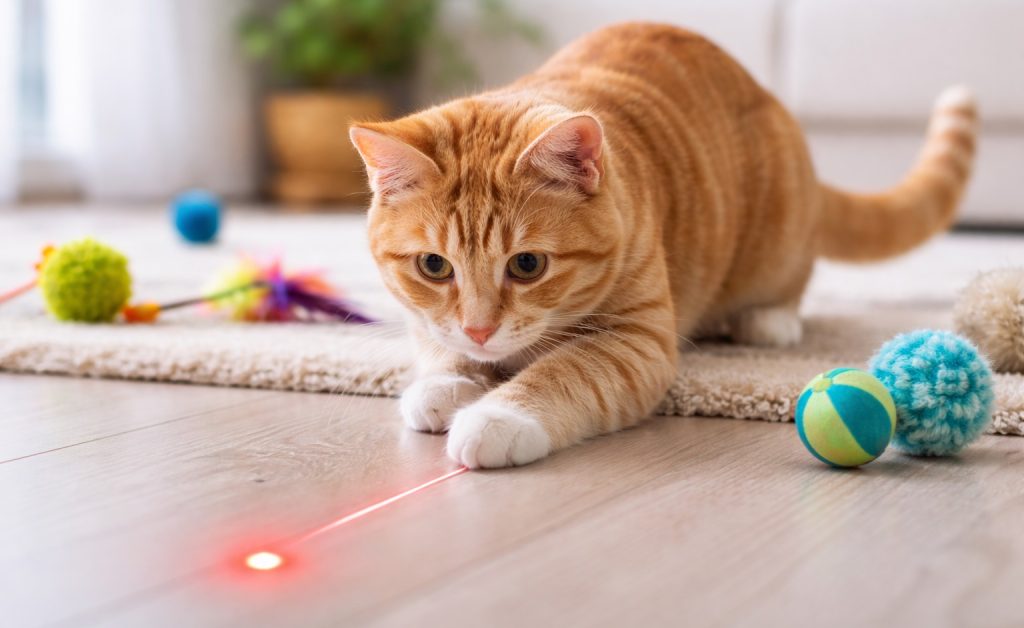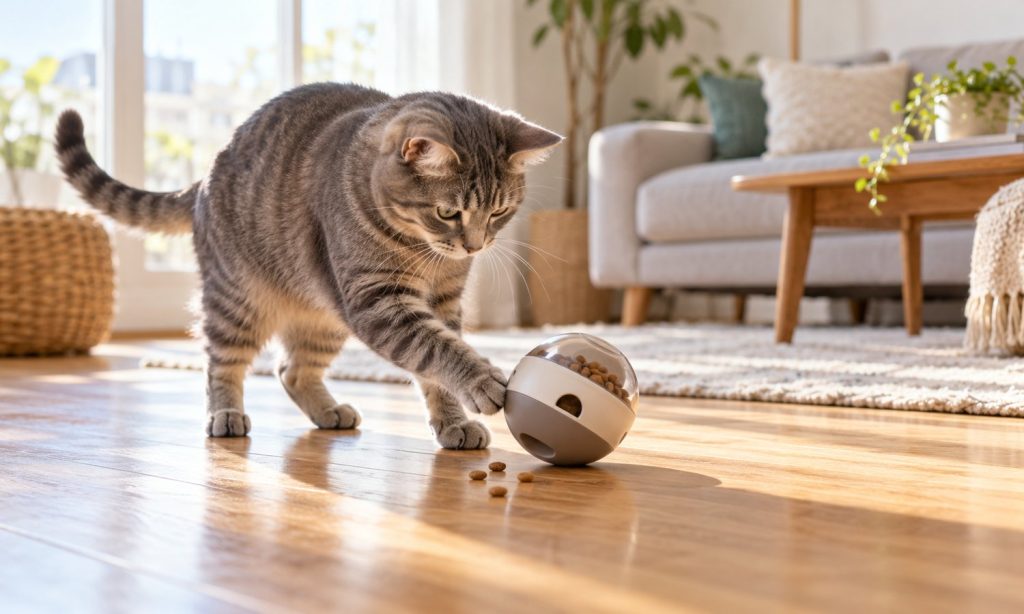
A treat-dispensing toy can turn a few pieces of kibble into a small activity for an indoor cat that enjoys batting, rolling, or figuring things out. The right design depends on your cat’s play style: some prefer a simple wobble toy, while others will work a maze or adjustable puzzle. We compared seven verified options, including compact self-righting toys, a spinning fish, a rolling ball, and multi-part feeders. Check the treat opening against the size of your cat’s usual food, start with an easy setting, and supervise until you know how your cat handles the toy. If food-seeking is part of a larger feeding concern, a cat interactive feeder guide can help you compare mealtime formats.
Quick Picks
| Product | Best For | Key Advantage | Buy | |
|---|---|---|---|---|
| FurtasticFinds Adjustable Puzzle Dispenser | Adjustable challenge | Twist-adjusted opening and self-righting wobble | View on Amazon | Jump to Review |
| Catstages 2-in-1 Spinning Fish Treat Dispenser | Food-motivated batters | 1/2-cup capacity and spinning fish design | View on Amazon | Jump to Review |
| Catit PIXI Treat Dispenser Mouse | Compact self-righting toy | Small mouse-shaped wobble dispenser | View on Amazon | Jump to Review |
| Rotatable Campfire Treat Puzzle | Adjustable rotating puzzle | Rotating outlets with adjustable openings | View on Amazon | Jump to Review |
| ALL FOR PAWS Interactive Puzzle Feeder | Multi-step enrichment | Maze-style layout with multiple challenge levels | View on Amazon | Jump to Review |
| TLKNG Wobble Treat Dispenser Enrichment Hub | Multi-action play | Combines wobble, track ball, teaser, and treat release | View on Amazon | Jump to Review |
| SunGrow Adjustable Treat Ball | Rolling treat ball | Adjustable dispenser opening in a 4.6-inch ball | View on Amazon | Jump to Review |
How to choose a treat dispensing toy for cats
A useful dispenser makes food rewarding to find without turning each snack into a frustrating chore. Match its movement, opening, and cleaning needs to the cat who will use it.
Choose the movement your cat already enjoys
Watch how your cat plays with ordinary objects. A cat that follows rolling balls may investigate a treat ball, while a cat that paws at stationary toys may prefer a spinner or maze feeder. Wobbling toys can offer visible movement in a small area; complex feeders ask the cat to nose, paw, or move pieces through a route. The broadest feature list is not automatically the best fit. A shy or easily frustrated cat may engage more readily with a simple dispenser that releases food after a light touch. For more hands-on play, rotate a food puzzle with other options rather than expecting one toy to meet every need. If your cat tends to mouth or tug toys, see our advice on choosing a durable cat toy and supervise play.
Check the food opening and difficulty
Treat size matters. Pieces that are too large may jam, while tiny crumbs may fall out before the cat interacts with the toy. Check the product’s stated food-size limits and test a few pieces before filling it. Adjustable openings let you begin with an easier release and increase the challenge only after your cat understands the game. For fixed openings, use food that moves freely and keep the first session short. A puzzle should reward curiosity; if your cat paws frantically, gives up, or chews at the body, simplify the setup or choose another style. A dispenser is also not a guaranteed slow-feeding treatment or a substitute for portion guidance from your veterinarian.
Plan for cleaning, supervision, and portions
Food dust and soft treats can collect in seams and moving parts. Removable pieces can help with cleaning, but follow the manufacturer’s care directions and dry components fully before refilling. Inspect plastic, seams, springs, and attachments before use; put a toy away if it cracks, loosens, or becomes difficult to clean. Start with a measured amount from the cat’s daily food allowance instead of adding extra snacks. A treat puzzle should be used where the cat can reach it without knocking it into hazards or getting it trapped beneath furniture. Cats vary, so observe whether the design encourages relaxed exploration and adapt the difficulty to the individual animal.
Cats respond differently to scent-based play, motion, and food rewards; our guide to catnip toys for adult cats covers another way to vary enrichment.
The Best Treat Dispensing Toys for Cats
1. FurtasticFinds Adjustable Puzzle Dispenser

What We Like
- Adjustable treat opening for different challenge levels
- Self-righting owl shape encourages repeat batting
- Food-grade ABS listed as BPA- and PVC-free
- Fits dry treats or kibble under 0.87 inch
- Designed to come apart for cleaning
What We Don’t Like
- Large kibble may not pass through the opening
- Plastic puzzle needs routine inspection for wear
This FurtasticFinds dispenser combines a wobbling puzzle with an adjustable treat opening. The opening can be changed by twisting the toy, letting you start with an easier release and make the task more demanding if your cat quickly empties it. The self-righting owl shape moves after a paw tap, so the cat has to keep nudging or batting to work for the next piece. The listing says it accepts dry treats or kibble smaller than 0.87 inch, a useful limit to check before filling it. It is a better match for food-motivated cats that enjoy pushing objects than for cats who prefer a stationary lick mat or simple bowl.
The body is described as food-grade ABS and the listing identifies it as BPA- and PVC-free, with smooth edges. Parts are designed to separate for cleaning, which matters because crumbs and oily treats can collect around the opening. Begin with only a few familiar pieces and watch how your cat handles the toy; a cat that paws forcefully may need a sturdier, heavier style. Keep the difficulty low at first so the puzzle rewards exploration instead of causing frustration. The dispenser can make a small portion of dry food more engaging, but it should not replace a balanced meal or an appropriate feeding routine. Remove it if parts loosen, crack, or become difficult to clean. Keep the first sessions brief. Take your time.
My Recommendation
Choose this adjustable dispenser if your cat likes to bat at moving toys and you want control over how easily treats fall out. Its self-righting movement and changeable opening offer more progression than a fixed-hole ball, while the compact puzzle format is easy to introduce in short sessions. The tradeoff is that you must match treat size to the opening and check the plastic body during use. For a cat that gets discouraged by puzzles, leave the opening generous and put only a few treats inside; if your cat prefers visual motion without food, a separate chase toy may be a better fit.
2. Catstages 2-in-1 Spinning Fish Treat Dispenser

What We Like
- Holds up to 1/2 cup of dry treats or kibble
- Swatting spins the fish to release food
- Measures 6.1 by 5.9 inches
- Removable base allows alternate setups
- Can attach to selected track systems
What We Don’t Like
- Requires batting and spinning rather than rolling
- Track attachment compatibility is limited to selected systems
The Catstages 2-in-1 fish is a stationary treat dispenser that turns a paw swipe into a small food puzzle. The listing says it holds up to one-half cup of dry treats or kibble and measures 6.1 by 5.9 inches. Cats bat and spin the fish to make pieces fall into the bowl, so it suits a cat that enjoys manipulating toys in one place. That setup can be easier to supervise than a ball that rolls under furniture, and the stable footprint gives the cat a clear target. The amount released will still depend on the food size and how the cat moves the spinner, so test it with a small portion before using it for a meal.
A removable base lets the toy be used on its own or attached to selected Catstages track products, according to the product information. That flexibility may appeal if your home already uses a compatible track, though you should confirm the connection before buying rather than assume every track will fit. The fish rewards repeated swats and may invite a hesitant cat to investigate when a few treats are placed around it. Its design is less suited to cats that prefer to chase a moving ball across a room. Use dry food only as directed, clean crumbs from the base, and supervise early sessions to see whether your cat bats gently or tries to chew the toy.
My Recommendation
This is a good option for a cat that likes to swat at objects and work for kibble without chasing a rolling dispenser across the floor. Its half-cup capacity and removable base give it a practical place in a play routine, especially if you own a compatible track. The limitation is that its puzzle relies on batting and spinning; a cat who ignores stationary toys may not engage. Start with a few treats, observe how food exits, and treat the listed capacity as a maximum rather than a serving recommendation.
3. Catit PIXI Treat Dispenser Mouse

What We Like
- Compact 3.1-inch-wide by 3.9-inch-tall size
- Self-righting weight returns it upright
- Dispenses treats unpredictably as it wobbles
- Mouse shape offers a clear paw target
- Available in two listed animal designs
What We Don’t Like
- Small compartment limits how many treats fit
- No adjustable difficulty is listed
The Catit PIXI mouse uses a small weighted base to rock back upright after a cat bats it. Product information lists a width of 3.1 inches and height of 3.9 inches, so it takes up little floor space and is easy to put away between sessions. Treats or dry food go inside the compartment and fall out unpredictably as the toy moves. That makes the puzzle straightforward to introduce: let your cat sniff it, then show how a light paw tap can produce a reward. The compact size may suit kittens and smaller adult cats particularly well, though a larger cat can use it if the opening and toy size fit its play style.
The product information describes the dispenser as available in mouse and rooster designs, with the same self-righting principle. Unlike an adjustable puzzle, this one does not list a way to change the opening or difficulty, so its challenge depends on the treat size and how your cat bats it. It can be a simple first step for a cat new to food enrichment, or a short activity before a meal. Use treats that fit freely, avoid overfilling, and check that pieces do not become trapped in the compartment. Supervise first sessions, especially if your cat mouths plastic toys. A small wobble dispenser is not a substitute for active play with you or for a secure food bowl.
My Recommendation
Pick the PIXI mouse when you want an uncomplicated, compact dispenser that rocks back upright after each nudge. Its simple action can help a curious cat discover the connection between batting and a food reward, and the small footprint stores easily. It offers less control over difficulty than adjustable puzzles, and its capacity is modest. If your cat needs a more involved challenge or tends to knock small objects forcefully, a wider puzzle with a stable base may be a better choice.
4. Rotatable Campfire Treat Puzzle

What We Like
- Multiple outlet sizes adjust treat access
- Rotating design turns batting into a puzzle
- Sized at 30 × 30 × 29 cm in listing
- ABS body with smooth edges listed
- Made for dry kibble and treats
What We Don’t Like
- Large footprint needs a clear play area
- Rotating parts add surfaces to clean
This campfire-shaped puzzle pairs a rotating top with adjustable treat outlets. The listing says you can turn a knob to alter opening sizes, helping you match the challenge to the food and your cat’s experience. A cat must bat or spin the structure to release dry kibble or treats, turning snack time into a foraging activity. Its listed dimensions are 30 by 30 by 29 centimeters, so measure a clear spot before choosing it; it will occupy more space than a small wobble ball. The larger shape can be useful for cats that push toys around, but the cat still needs to be interested in pawing at a stationary puzzle.
The product listing describes a smooth-edged ABS construction and calls the toy adjustable for dry food. It does not provide enough detail to assume dishwasher compatibility, so follow the supplied care directions and remove crumbs from the moving sections. Start with a wide opening and a few treats, then make access harder only after your cat understands the action. If the puzzle is too difficult from the beginning, a cat may walk away or chew at it rather than solve it. Supervise the first sessions and inspect the rotating pieces over time. As with any treat toy, count rewards toward the cat’s daily food allowance and do not leave a damaged or loose part within reach. Clear a little room around it.
My Recommendation
This rotatable puzzle makes sense if your cat already enjoys pawing at objects and you want to adjust treat access as it learns. Its larger format gives the activity a visible presence, while the adjustable outlets create a way to vary the task. It takes more floor space and has moving sections that need cleaning and inspection. If your cat is new to food puzzles, leave the openings generous and keep the first session brief; a compact, simpler dispenser may be the more welcoming starting point.
5. ALL FOR PAWS Interactive Puzzle Feeder

What We Like
- Maze-style sections make food access a task
- Multiple difficulty levels listed
- Detachable parts support cleaning
- Non-slip feet help limit shifting
- Can function as a slow-feeding activity
What We Don’t Like
- More pieces take longer to assemble and clean
- Puzzle complexity may not suit every cat
The ALL FOR PAWS feeder is a maze-style food puzzle rather than a small rolling dispenser. Its product information describes multiple difficulty levels and modules that can be adjusted as a cat learns, creating a longer activity for food-motivated pets. This format is useful when a cat quickly empties simple treat balls and needs a more involved way to explore a small portion of dry food. The listing also says the puzzle can act as a slow feeder, though it should not be treated as a medical solution or a substitute for an appropriate feeding plan. The non-slip feet are intended to keep the setup in place while a cat paws through the maze.
Detachable parts are listed to make cleaning easier, a meaningful point for any feeder that collects crumbs in narrow channels. The tradeoff is that more components mean more surfaces to check and reassemble. Start with the simplest arrangement and place a small number of familiar treats where your cat can see them; increase complexity gradually if it stays engaged. A cat who is uncomfortable with food frustration may do better with an easier dispenser or a lick mat. Review the included care directions, wash and dry components as recommended, and remove the feeder if any part cracks or becomes loose. As always, count treats as part of the daily ration. Start with a short session. Give learning time.
My Recommendation
Consider this maze feeder for a patient, food-motivated cat that already enjoys finding kibble in a puzzle. Adjustable difficulty, detachable parts, and a non-slip base give it a more involved role than a simple wobble toy. Its complexity requires setup and cleaning, and it may be frustrating for a cat that is just learning. Begin at the easiest level with a few visible rewards, then let your cat’s comfort guide any increase in challenge.
6. TLKNG Wobble Treat Dispenser Enrichment Hub

What We Like
- Several play modes in one compact hub
- Treat compartment rewards pawing
- Self-righting base rocks back after a hit
- Built-in track ball adds another activity
- BPA-, PVC-, and phthalate-free listing claim
What We Don’t Like
- Attached elements need frequent inspection
- Multiple modes may create distracting clutter for cautious cats
The TLKNG enrichment hub combines a wobbling treat dispenser with other play features, including a track ball and springy teaser attachment, according to the listing. Its self-righting base rocks back after a paw strike, while treats or dry kibble can be added to reward batting. This variety may work for a curious cat that likes switching between movement and food puzzles without several separate toys on the floor. It is compact enough for a play area in an apartment, but the attachments add more parts than a basic treat ball. Introduce one activity at a time and see whether your cat focuses on the dispenser, track, or teaser rather than presenting the whole setup as a test.
The product information describes rounded, food-grade ABS and claims the material is free from BPA, PVC, and phthalates. It also recommends supervision and inspecting attachments, which is sensible for a toy with a teaser and replaceable components. The listing does not establish how long each part will last, so check for loosened pieces or fraying before use and put the toy away if damaged. Use small dry treats that move freely through the dispenser and avoid leaving food inside for long periods. Cats vary widely in how they respond to complex toys: a shy cat may prefer a quieter single-action puzzle, while a playful cat may appreciate the changeable activity. Check each attachment before play.
My Recommendation
Choose this hub if your cat enjoys a mix of batting, tracking, and earning small food rewards, and you are willing to supervise and inspect the attachments. It offers more play modes in one footprint than a standalone dispenser. The extra components create more to clean and check, and a cautious cat may prefer a simpler toy. Begin by filling only the treat compartment and introducing the other features gradually so you can see what your cat actually uses.
7. SunGrow Adjustable Treat Ball

What We Like
- 4.6-inch ball rolls as the cat nudges it
- Adjustable food opening controls release
- Can dispense dry kibble or treats
- Offers movement for cats that chase objects
- Designed for cats and small pets
What We Don’t Like
- May roll under furniture or out of reach
- Shared pet sizing means fit should be checked
The SunGrow ball offers a classic rolling format: a cat nudges it across the floor and food comes out through an adjustable opening. The listing gives its diameter as 4.6 inches and describes it for cats as well as small dogs and other small pets. That movement can be a good fit for a cat that likes to chase or push objects, while the opening adjustment lets you change how readily pieces fall. Use kibble or small treats that match the slot and begin with an easy setting so the cat is rewarded for investigating. A rolling ball needs a clear, level area; on a crowded floor it can disappear beneath furniture or bump into objects.
The product is positioned as a slow-feeding and boredom activity, but results will depend on your cat’s interest and the food used. It is not a substitute for portion control: measure the food placed inside and account for it in the day’s total. The listing includes broad pet marketing, so check whether the ball’s size and opening work for your cat before relying on it. If the cat ignores rolling toys, a stationary spinner or maze may be easier to use. Supervise first sessions, especially if your cat chews rather than bats, and clean the interior according to the manufacturer directions. Take the toy away if its body cracks or the adjustment mechanism stops holding the selected opening.
My Recommendation
This adjustable ball suits cats that enjoy chasing or nudging objects and benefit from a food reward that moves around the room. Its 4.6-inch size and changeable outlet create a simple, active puzzle. The ball can travel out of reach, and the shared-pet design makes it sensible to confirm the dimensions and slot fit for your cat. Choose a stationary puzzle if your cat prefers to paw in one place or gets frustrated when a toy rolls away.
Frequently Asked Questions
Are treat-dispensing toys good for indoor cats?
They can provide a food-based activity for cats that enjoy batting, rolling, or solving simple puzzles. Interest varies; introduce the toy gradually and choose an easy starting level.
What treats should I put in a cat dispenser?
Use dry kibble or treats that fit the product’s opening and follow its care instructions. Begin with a few pieces to confirm that food releases easily and does not get stuck.
Can a treat toy replace a cat’s food bowl?
Some products can hold a portion of dry food, but follow the product directions and your cat’s feeding plan. Measure the amount and count treats within the daily ration.
How do I make a puzzle toy easier?
Choose the easiest setting if the toy adjusts, use visible rewards, and limit the first session to a few treats. If the cat seems frustrated, simplify or switch to a more accessible design.
Should I leave a treat dispenser out when I am away?
First observe your cat using it while you are present. Keep it available unattended only if the toy is intact, used calmly, and does not pose a chewing, choking, or entrapment concern.
Final Verdict
The best treat dispensing toy for cats is the one that fits your cat’s preferred movement and offers a manageable challenge. The FurtasticFinds and campfire puzzles provide adjustable openings; the Catit PIXI and SunGrow options suit cats drawn to simple wobbling or rolling motion; and the Catstages fish, ALL FOR PAWS maze, and TLKNG hub offer different stationary or multi-activity formats. Start with a few measured pieces, watch how your cat interacts, and choose a design you can keep clean and inspect. If a toy causes frustration or chewing, change the setup or select a simpler option.
Affiliate disclosure: This article contains Amazon affiliate links. If you purchase through them, PetAdvisorPro may earn a commission. As an Amazon Associate I earn from qualifying purchases.