How to choose the right cat scratch pad for apartments begins with matching the design to your cat’s preferences, routine, and environment. The right choice depends on where the cat already scratches, whether it prefers a flat or angled surface, how much floor space you can spare, and whether the pad stays put during use. A small footprint is helpful, but a pad that is too short or slides across the floor may not satisfy a cat’s normal scratching behavior. Start by measuring the available area and watching your cat’s posture and texture preference. Then check the pad’s usable surface, stability, material, and upkeep. This guide covers the tradeoffs that matter in apartment living, how to introduce a scratch pad, and ways to protect furniture while keeping the cat’s preferred surface accessible.
Match the pad to your cat’s scratching style
Scratching is a normal behavior that lets cats stretch, maintain their claws, and leave scent and visual marks. Some cats scratch vertically; others choose horizontal or angled surfaces. A cat that scratches a rug may be a good candidate for a floor pad, while one that reaches up a sofa arm may still need a tall post nearby.
Watch how your cat uses its current scratching spots. Does it crouch and pull across the carpet? Does it stretch forward from a standing position? Does it scratch one particular material? These details help you choose a shape and texture that make sense. No scratch pad fits every cat, and a preference may change as a cat ages or becomes less mobile.
If you are unsure, offer more than one orientation in separate locations. A horizontal pad can complement a vertical post and may be easier to place in a tight room. Keep the options available long enough to see which one the cat chooses rather than judging from a brief sniff.
Measure apartment space and cat space
Measure the floor area where the pad will sit, including room for the cat to approach, turn, and scratch. A pad can fit beneath a side table or beside a sofa, but it should not block a doorway or narrow path. Consider whether a person can walk through without stepping on the scratcher.
Look at the usable scratching area rather than the product’s total outside dimensions. A frame, raised lip, or curved edge may reduce the flat area. The cat should be able to place its paws and make several strokes without slipping off. Larger cats often need more surface than a small kitten. If the cat stretches forward, length may matter more than width; if it scratches with both paws side by side, a wider surface may be preferable.
Compactness should not compromise comfort. A pad that is tiny may be easy to tuck away but frustrating to use. Select the smallest size that still allows your cat’s normal scratching motion, then place it where the cat already spends time.
Choose the right shape and profile
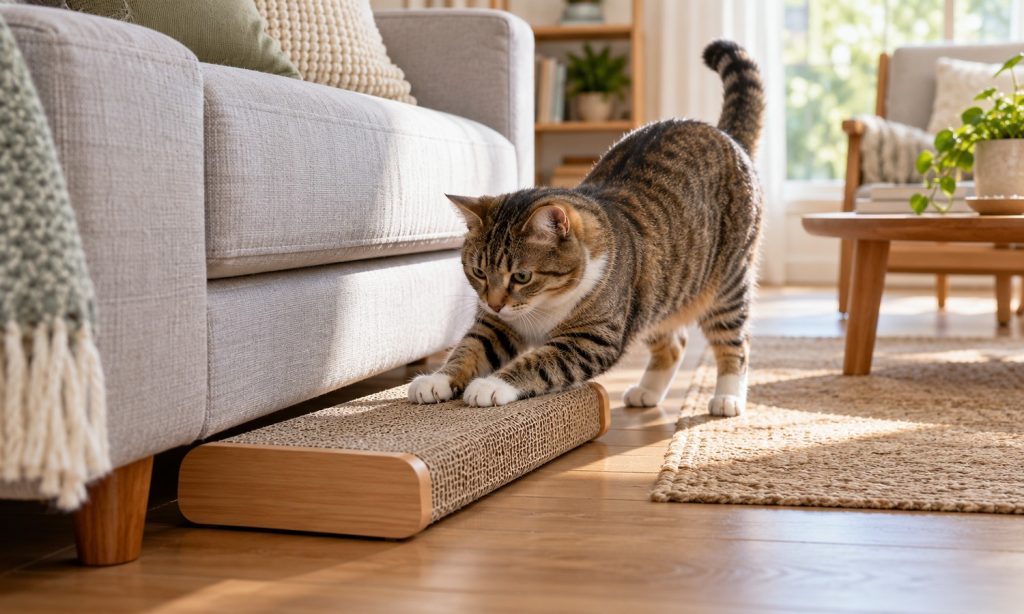
Flat pads suit cats that scratch flooring or rugs. Curved scratchers can serve as both a scratching surface and a low resting spot, but confirm that the curve does not rock under the cat’s weight. Angled boards can appeal to cats that reach forward and down. A low ramp may also be easier for a senior cat than a tall vertical post.
Measure the height as well as the footprint. Some floor pads have a raised edge or curved center, while others sit nearly flat. A cat that prefers a stable, low surface may dislike a steep incline. If the pad has a frame, look for rounded edges and a shape that does not pinch paws or create a trip hazard.
In a small apartment, a pad that doubles as a resting surface may use space efficiently. Still, check that lounging does not prevent scratching. If the cat sleeps on it and rarely scratches, add another nearby option rather than assuming the pad has failed.
Pick a surface your cat accepts
Scratch pads may be made from corrugated cardboard, sisal fabric, carpet, or other textured materials. Cats can prefer different feels. A cat that targets a woven rug may like a fabric surface; one that claws at cardboard may engage with corrugation. Observe current habits and choose a similar safe texture when possible.
Cardboard is light and easy to move, but it may shed and needs replacement once crushed or damaged. Woven sisal can feel firm and may last longer, while carpet can be appealing to cats that already scratch rugs. If using carpet texture, distinguish the pad from the apartment’s flooring with a contrasting material or location, so the cat gets a clear cue about which surface is appropriate.
Regardless of material, avoid loose fibers, exposed staples, sharp corners, and pieces the cat might chew or swallow. Keep cardboard dry and replace it if it becomes damp or musty. Inspect the pad regularly and discard it when it no longer stays intact.
Make sure it stays in place
A sliding scratch pad can interrupt a cat’s stroke and make the surface less inviting. Place it on a nonslip floor or use a safe nonslip backing. Press and tug the pad before introducing it. It should remain stable when pushed from different directions.
Curved boards and loungers need extra attention because a cat may shift weight to one edge. Check that the pad does not rock, slide under furniture, or tip when the cat climbs on. Avoid placing it near stairs, a balcony door, or a spot where it could move into a hazard. Keep the approach area clear and do not wedge the pad so tightly that the cat cannot exit easily.
Maintenance matters in a small home. Choose a surface that is easy to sweep or vacuum around. Check for loose cardboard bits or fibers and clean them up. If the pad has a replaceable core, confirm that it can be changed without making the remaining frame unstable.
Place it where the cat will use it
Start by placing the pad near a current scratching location. If your cat scratches the rug beside the couch, set the pad nearby. Cats often scratch after waking, so a spot near a favorite bed can help. A visible location in a room where the cat spends time is usually more useful than a storage closet.
Apartment placement requires balancing the cat’s routine with household traffic. Keep the pad accessible but not in the middle of a doorway. A space beside the sofa or at the end of a hallway may work if it leaves a clear walking path. If you later move it, do so gradually and watch whether the cat continues using it.
In multi-cat homes, a single pad can become a contested resource. Place additional scratchers in different areas so each cat has a choice. Separate locations can help cats avoid blocking one another’s access, even when the apartment is small.
Introduce it and protect furniture
Give your cat a chance to investigate without being handled or forced onto the surface. You can place a toy or a small treat nearby and reward voluntary approaches or scratching. Let the cat choose. Do not press its paws into the material, as that can make the pad feel unpleasant.
Protect the furniture or carpet the cat already targets with a safe cover while the pad is introduced nearby. Reward use of the acceptable surface and keep it consistently available. Avoid yelling, startling, or spraying the cat. These tactics do not show the cat where scratching is welcome and can increase stress.
If the pad is ignored, change one feature at a time: location, orientation, size, or texture. Give each change a fair trial. If the cat strongly prefers vertical scratching, add a wall panel or freestanding post rather than expecting a floor pad to replace every scratch site.
Frequently Asked Questions
How much space should a cat scratch pad take up?
Choose a pad that fits the room while allowing your cat to complete several comfortable strokes. Measure both the product and the approach area, and keep pathways clear.
Are horizontal scratch pads good for apartments?
They can be useful because many are low-profile and easy to place beside furniture. The right choice depends on your cat’s orientation and texture preferences.
Where should I put a scratch pad in a small apartment?
Start beside an existing scratch site or near a favorite sleeping place. Keep the pad visible and accessible without blocking doors or walkways.
What material is best for a cat scratch pad?
There is no universal best material. Match the surface to what your cat already scratches, such as cardboard, carpet, or woven texture, and keep it intact.
What if my cat scratches the sofa instead?
Place an appropriate scratcher close to the chosen spot, protect the furniture safely, and reward voluntary use. Try a different orientation or material if needed.
Final Words
A practical cat scratch pad for apartments fits the room and your cat’s scratching style. Measure the usable surface and walking space, choose a familiar texture, and check that the pad stays put. Place it near a current scratch site and introduce it patiently. If your cat prefers another angle or material, provide that option too. With a thoughtful setup, an apartment can offer satisfying scratching opportunities without sacrificing the space you need to live comfortably.