
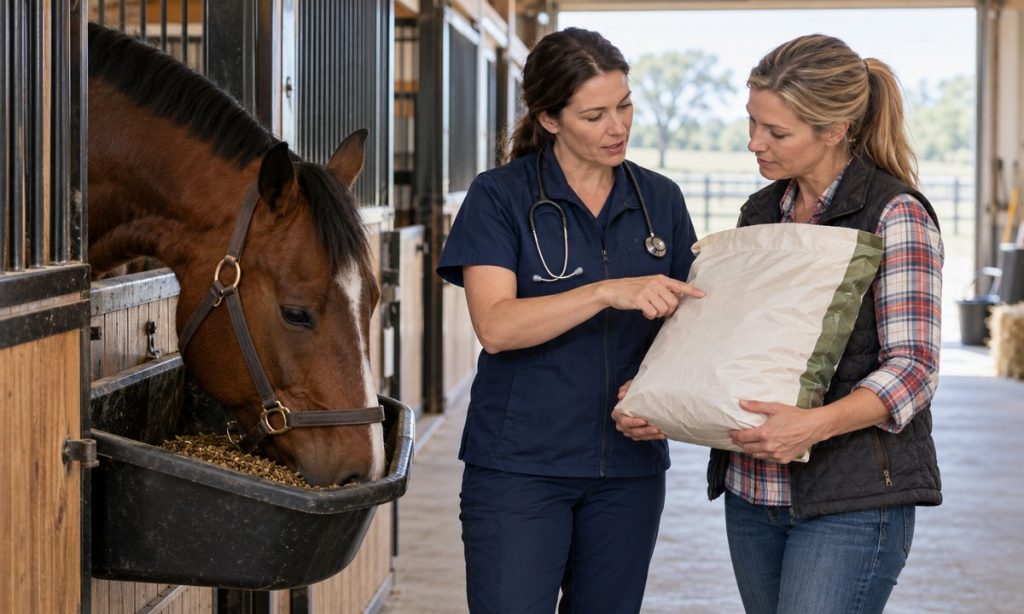
Feed-through fly control is meant to help interrupt development of certain flies in manure, but it does not work like a repellent that drives adult flies away from a horse. Products may contain different active ingredients, have different directions, and fit different farm situations. Before adding one, ask your veterinarian whether the target flies breed in your horse’s manure, whether the product suits the horse’s health and ration, and how it should fit with the rest of your fly plan. Bring the package label and a list of everything the horse eats or receives. If you are researching feed through fly control for horses, use that research to frame questions rather than to select a treatment on your own. A careful discussion helps set realistic expectations, avoid feeding errors, and protect horses that share the property.
How feed-through fly control works
Many feed-through fly-control products use an insect growth regulator or larvicide. After the horse consumes the labeled amount, the active ingredient passes into manure and affects the development of certain fly larvae. The exact mechanism and target species depend on the active ingredient and product label.
This approach does not instantly remove adult flies already in the barn. It may also miss flies breeding in spilled feed, wet bedding, decaying vegetation, or manure from untreated animals. The most appropriate plan depends on the fly species, the farm’s manure routine, nearby livestock, and local conditions. Ask your veterinarian what problem the product is intended to address before deciding whether it fits.
Questions to ask before starting
1. Which fly species are we trying to control?
Ask the veterinarian to help identify the main nuisance. Some flies develop in horse manure; others bite horses but breed elsewhere. A product that affects larvae in manure will not necessarily control biting flies that come from wetlands, cattle areas, or other sites. Share when and where flies are worst, whether they cluster around stalls or turnout, and whether the horse has skin reactions.
2. Does this active ingredient suit my horse?
Show the veterinarian the complete label, including the active ingredient, concentration, directions, warnings, and restrictions. Ask whether the horse’s age, pregnancy or nursing status, medical conditions, medications, or competition schedule change the decision. Do not assume two products with similar names or purposes have interchangeable directions.
Mention any history of feed sensitivity, metabolic disease, poor appetite, or difficulty maintaining weight. A veterinarian can consider the whole animal rather than evaluating a fly-control ingredient in isolation. If the horse is under veterinary treatment, ask the treating clinician before adding a new feed item.
3. How should it be measured and fed?
Ask how the label applies to your horse’s weight and whether the product must be given daily or mixed in a specific way. Confirm what to do if a serving is spilled, refused, or missed. Ask whether each horse must receive a separate measured portion. Shared feed tubs can make it difficult to know which animal consumed which amount.
If your horse receives a ration balancer, medication, or several supplements, ask how to keep the daily ration organized and avoid accidental double-dosing. Follow the label and veterinary instructions. Do not estimate a dose with an unmarked scoop or change it because fly pressure seems higher.
4. Which animals on the property need coverage?
Ask whether the program depends on treating all horses whose manure contributes to fly breeding. In a boarding stable, you may not control the feeding routine of every horse. Untreated manure can make a whole-property program less effective. Nearby cattle or other livestock may also contribute to fly problems, depending on the species and breeding sites.
Discuss who is responsible for feeding, recordkeeping, and checking that each horse gets its own portion. If multiple caretakers feed the barn, a written plan can prevent missed or duplicate servings.
5. How does it fit with manure and barn management?
Ask what changes would help remove breeding sites. Regular manure removal, managing wet bedding, cleaning spilled feed, and improving drainage can reduce fly habitat. A feed-through product is generally one part of an integrated plan, not a replacement for sanitation or other controls.
Discuss manure storage, composting, spreading, and nearby gardens or waterways. The label may include specific environmental or disposal precautions. Ask how long manure from treated horses should be managed according to the directions. Do not guess about using treated manure on crops or where runoff could reach water.
6. What should I expect, and when should we reassess?
Ask which fly stages and species the product targets, how long it may take to observe a change, and what signs would mean the plan is not working. The effect is not necessarily immediate because the product acts through manure and immature flies. Adult flies can continue to arrive from untreated or neighboring areas.
Agree on a practical review date. Keep notes on fly activity, manure handling, product servings, and any changes in the horse’s appetite or health. If there is little improvement, the answer may be better identification of breeding sites or a different control strategy, not a higher dose.
What to bring to the veterinary conversation
Bring the product label, the horse’s current ration and supplement list, medication details, approximate body weight, and a brief description of the fly problem. Photos or short videos may help show where flies gather or how the horse reacts. Include the number of horses and other livestock at the facility, turnout schedule, manure removal routine, and nearby wet or wooded areas.
Ask the veterinarian to review label directions with you and explain any precautions in plain language. If a product is not labeled for the horse or use you have in mind, do not use it unless the veterinarian gives a lawful, case-specific direction. Avoid combining multiple insect-control products without professional advice.
Why a layered plan matters
Fly control works best when the method matches where the pest breeds and how it reaches the horse. Manure management addresses breeding sites. Traps, screens, fans, physical barriers, or on-animal products may address other parts of the problem, but their use must follow their own labels and safety directions.
Owners sometimes report that feed-through products seemed more useful when every horse on a property received them and manure management continued. These are individual experiences, not proof that a product will work in every barn. Public owner discussions also vary widely in their descriptions of results. Use those reports as prompts for questions, while relying on the product label and veterinary guidance for decisions.
Frequently Asked Questions
Do feed-through products repel adult flies?
Usually not. Many act on immature flies in manure. Check the label for the target species and life stage, and ask what other controls may be needed.
Does every horse at a barn need to receive one?
It depends on the product and the property. Some programs are less effective when untreated horses leave manure in the same breeding areas. Ask the veterinarian and follow the label.
Can I add the product to a shared feeder?
Ask first. Individual measured feeding may be needed so each horse receives the labeled serving and no horse gets an unintended amount.
Will it control horseflies and deer flies?
Not necessarily. These flies may breed away from horse manure. Ask the veterinarian to identify the problem species and choose controls that match their biology.
Can I use treated manure in my garden?
Check the product label and ask your veterinarian or local extension office. Precautions vary, so do not assume treated manure is suitable for every use.
Final Words
Before adding feed-through fly control, ask your veterinarian about the target fly species, active ingredient, label directions, horse-specific precautions, feeding accuracy, property-wide coverage, manure handling, and realistic expectations. Bring the full label and the horse’s complete ration so the advice fits the individual animal. These products may affect immature flies in manure, while adult flies and other breeding sites can require additional management. If you are comparing feed through fly control for horses, confirm the details with your veterinarian and follow the current product label before making a change.









