
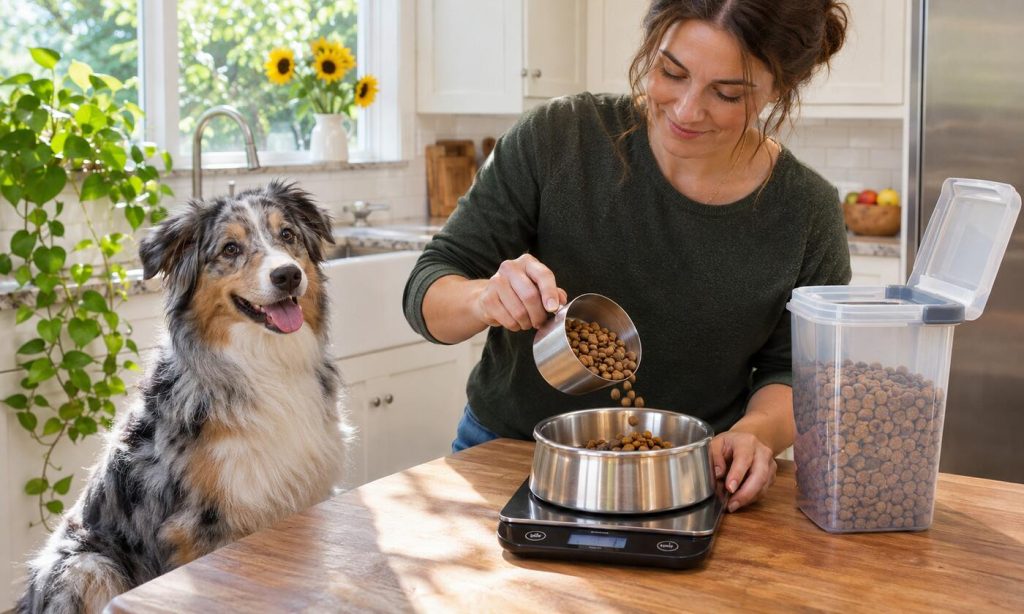
A food bag’s feeding chart is a starting point, not a personalized meal prescription. Two foods can recommend different scoop amounts because their calories per cup differ. If you are trying to size portions across dog food brands for Australian Shepherds, focus on your dog’s energy needs and the chosen recipe’s calorie information. Your dog’s weight, activity, life stage, and body condition matter more than the name printed on a package. Measuring accurately makes adjustments easier to evaluate.
The label on dog food brands for Australian Shepherds may show cups or grams per day. Neither figure should be copied blindly from another recipe. This guide explains how to translate calories into portions, compare feeding charts, account for treats, and monitor body condition. It does not select a brand or prescribe an individual diet. A veterinarian can help determine your own dog’s appropriate daily calorie target.
Understand why feeding amounts vary between formulas
Dog foods differ in calorie density. One cup of a food with more fat or less moisture can contain more energy than a cup of another food. Therefore, a brand’s suggested cups should not be treated as a universal measurement. Look for a calorie statement, commonly expressed as kilocalories per cup, kilogram, or can, along with feeding directions. The food also should be appropriate to the dog’s life stage. The US Food and Drug Administration explains the importance of a meaningful complete-and-balanced nutritional adequacy claim on pet food labels.
Consider what the chart assumes. Some feeding guides use broad weight bands and may not account for a working herding dog versus a quiet household companion. Neutering, age, pregnancy, and health conditions can change needs. An Australian Shepherd’s reputation for energy does not mean every individual needs an unusually large portion. Check body condition rather than guessing based on breed stereotypes. The related Australian Shepherd feeding and care guide discusses routines and transitions. This article focuses on the separate question of interpreting label numbers.
Convert a calorie target into a measured portion
Begin with a daily calorie target discussed with your veterinarian. Then find the food’s stated calories per cup or per gram. The arithmetic is simple: daily calories allocated to that food divided by its calorie density gives the number of cups or grams. For example, if a hypothetical dog were allocated 900 kilocalories from food and the recipe contained 360 kilocalories per cup, the calculation would be 900 ÷ 360 = 2.5 cups per day. These figures illustrate math only; they are not feeding recommendations for an Australian Shepherd.
If some daily calories come from treats, training rewards, or other food, the amount available for the main diet is lower. For a more consistent measurement, weigh a portion on a kitchen scale when the package gives grams or calories per kilogram. A level cup is better than a heaping cup, but cup volume can still vary with kibble shape and density. Write down the exact formula and serving amount. If you switch recipes, repeat the calculation with the new label rather than assuming the old scoop remains appropriate.
Read life-stage labels and make room for activity
Puppies, growing adolescents, adult dogs, and seniors can have different nutritional needs. A food intended for adult maintenance should not automatically replace a growth diet for a puppy. Pregnant or nursing dogs and dogs with medical conditions require tailored advice. The statement of nutritional adequacy helps identify the intended life stage. Ask your veterinarian to review food suitability when growth, weight, or medical status is changing. Do not attempt to correct a medical problem by simply doubling or halving a feeding chart amount.
Activity also changes energy expenditure, but daily exercise varies. A dog practicing agility intensively may need a different plan from an adult who mainly enjoys short walks. Seasonal workload changes can affect appetite and weight trends. Instead of adding food after one energetic afternoon, evaluate weight, muscle, and body condition over time with veterinary guidance. The Australian Shepherd food topic guide may help identify label terms to discuss, but portion sizing still depends on the individual dog and exact recipe. Avoid turning exercise into a justification for constant extra treats.
Use body condition to test whether a portion works
A calorie calculation gives an initial estimate, not the final answer. World Small Animal Veterinary Association nutrition guidance emphasizes body condition and ongoing reassessment. You should generally be able to feel ribs with a light covering and see an appropriate waist, though body shape and coat can complicate visual assessment. Ask your veterinarian to demonstrate a body condition score. Record weight under comparable conditions and watch for persistent gain or loss. Muscle condition matters too, especially in older or very active dogs.
Review changes gradually with a professional rather than making dramatic adjustments after one weigh-in. Keep notes on food portions, treats, exercise, stool consistency, appetite, and energy. Sudden weight loss, abnormal thirst, repeated vomiting, or persistent digestive trouble needs veterinary assessment. Even when the arithmetic is correct, a food may not suit an individual dog’s needs. IMO, a simple feeding log is more useful than relying on memory after several months of training treats and inconsistent scoops. The goal is healthy condition, not a perfect number from a package.
Compare new brands without carrying over the old scoop
When changing recipes, compare the calorie statements side by side. Suppose one recipe contains 400 calories per cup and another contains 320. The same physical cup does not provide the same energy. Recalculate the portion using the new label and your dog’s actual calorie target. Check whether a cup on the feeding chart means an eight-fluid-ounce measuring cup or whether the maker specifies weight. Read the full feeding directions and use the recipe’s measuring guidance. Never assume all brands use the same scoop sizes or energy density.
Introduce diet changes gradually if the veterinarian recommends a new food. Observe stool, appetite, and tolerance while maintaining a clear record of the total amount fed. Avoid mixing large quantities of two recipes without accounting for both calorie densities. If you need to adjust the transition because of a health condition, ask the veterinarian for a plan. FYI, a bigger bag may be more economical to carry home, but bag size tells you nothing about how many calories your dog should eat. Weight-based portions are a separate question from package size.
Frequently Asked Questions
Sizing portions across dog food brands involves reading energy density, calculating a starting amount, and checking how the dog responds. These answers address common measurement problems.
Your veterinarian remains the best source for an individual energy target. Feeding charts cannot diagnose nutritional needs, and the right portion can change with weight, age, and activity.
Should all Australian Shepherds eat the same number of cups?
No. Calorie needs vary by life stage, body condition, activity, health, and the food’s calorie density. A shared breed label cannot set a safe universal portion.
How do I compare grams with cups?
Use the formula’s own weight and calorie information. A kitchen scale provides grams; do not assume that one cup weighs the same across different kibble shapes.
Do treats count toward the daily portion?
Yes. Treats contribute energy. Discuss an appropriate allowance with your veterinarian and account for those calories when measuring main meals.
What if my dog gains weight on the recommended amount?
Review all food and treat intake, activity, and body condition with your veterinarian. The label is a starting guide, not a guarantee of suitable intake.
Does a larger bag mean a larger serving?
No. Package weight is a purchasing and storage quantity. The daily serving depends on energy density and the individual dog’s needs.
Final Words
To size dog food portions for Australian Shepherds, start with a veterinary-informed energy target and read each recipe’s calorie statement. Convert that target into measured cups or grams, subtract calories from extras, and reassess using body condition. Do not transfer an old scoop amount to a new formula without checking energy density. A realistic log makes gradual changes easier to track.
When reading dog food brands for Australian Shepherds, look past bag size and broad feeding charts. The feeding routine guide can help with everyday consistency. Your dog’s health, growth, and comfortable condition remain the final measures of a good portion plan.









