Dry, brittle-looking hooves can make you wonder whether an oil dressing belongs in your horse’s daily routine. The best hoof oil for dry hooves should match the product format you need, the way your horse lives, and the advice of your farrier. A brush-on oil can spread across the hoof wall, while a spray may be quicker and a thicker dressing may stay where you place it. Those formats are not interchangeable, and none can correct poor balance, an overdue trim, a deep crack, or lameness. This guide compares seven verified hoof-care products by their listed format, ingredients, applicator, and intended use. It also explains how to assess dry hooves safely, what to ask your farrier, and when topical dressing is not the right next step.
Quick Picks
These picks include brush-on oils, a spray, and thicker dressings. Compare the label and choose a format that fits your horse’s care plan.
| Product | Best For | Key Advantage | Buy | |
|---|---|---|---|---|
| Fiebing’s Hoof Oil for Horses with Mineral Oil (32 oz) – H | brush-on application | mineral-oil dressing in a 32-ounce container | View on Amazon | Jump to Review |
| The Soleful Equine Hoof Oil, Horse Hoof White Line, Thrush | ingredient preference | plant-oil dressing with a brush | View on Amazon | Jump to Review |
| Hoof Oil Spray for Horse – Deep Hydration & Frog Care | quick, portable application | compact botanical spray | View on Amazon | Jump to Review |
| Tack Shack of Ocala Effol Hoof Ointment for Horses, Hoof O | thicker product format | 16.7-ounce ointment and oil listing | View on Amazon | Jump to Review |
| Pure Sole Hoof Oil – All Natural Hoof Conditioner for Hors | one-container grooming kit | 16-ounce conditioning oil with a stored brush | View on Amazon | Jump to Review |
| Shur Hoof Moisturizer with Brush for Horse Hooves | durable application | thick dressing with brush and one-quart capacity | View on Amazon | Jump to Review |
| Manna Pro Hoof Heal Conditioning Dressing 32oz | owners who value clear directions | 32-ounce dressing with brush and labeled routine | View on Amazon | Jump to Review |
Seven Hoof Oils and Dressings for Dry Hooves
A topical dressing can support grooming, but it cannot diagnose why a hoof is dry or brittle. Ask your farrier about persistent changes.
Fiebing’s Hoof Oil for Horses with Mineral Oil (32 oz) – Hoof Dressing with Appl

What We Like
- 32-ounce brush-on mineral-oil dressing
- useful when you want a large-container liquid routine
- mineral-oil-based, with a built-in brush and semi-gloss finish
- The product page does not give a verified coverage estimate, so container size alone cannot show value.
What We Don’t Like
- the semi-gloss finish may not suit a matte preference
The listing identifies Fiebing’s Hoof Oil for Horses with Mineral Oil (32 oz) – Hoof Dressing with Applicator Brush to Condition Dry, Split Hooves & Corns – Prevents Cracks, Splits & Contracted Feet with Semi Gloss Finish as a 32-ounce brush-on mineral-oil dressing. Its product details describe it as mineral-oil-based, with a built-in brush and semi-gloss finish. That gives you a format to compare with your grooming routine, but it does not establish how a particular horse will respond. Check the current package for the complete ingredients and directions. Judge the item by its listed format, applicator, and intended use, not by shine or promises of repair. The product page does not give a verified coverage estimate, so container size alone cannot show value.
The main fit is useful when you want a large-container liquid routine. The tradeoff is that the semi-gloss finish may not suit a matte preference. Use it only on areas named by the label, and do not cover a painful or injured hoof while waiting to see what happens. Topical dressing cannot correct poor balance, an overdue trim, a deep crack, or lameness. Ask your farrier about recurring brittleness, and call a veterinarian for pain, heat, drainage, or sudden worsening. Clean the applicator as directed and avoid layering products without professional advice. Do not apply a heavy coat just to make the hoof look shiny. A simple routine makes changes easier to notice and describe to your farrier. Use the product label to confirm whether the brush should touch the frog or only the wall.
My Recommendation
Fiebing’s is a reasonable comparison if you want a brush-on mineral-oil dressing in a named large container. Use it as directed for routine care, not as a response to soreness or deep cracks. Choose another formula if you want a matte finish. Its listed semi-gloss finish is the main appearance tradeoff.
The Soleful Equine Hoof Oil, Horse Hoof White Line, Thrush, Abscesses, Overall H

What We Like
- plant-oil dressing with a brush
- useful if plant-based positioning matters to you
- described as a plant-oil hoof dressing with a brush applicator
- The current package should confirm its ingredient list, directions, and any absorption time.
What We Don’t Like
- organic positioning does not establish a medical benefit
The listing identifies The Soleful Equine Hoof Oil, Horse Hoof White Line, Thrush, Abscesses, Overall Hoof Strength, Growth, Hoof Conditioning Rehydration. Certified Organic – Professionally Designed and Developed as a plant-oil dressing with a brush. Its product details describe it as described as a plant-oil hoof dressing with a brush applicator. That gives you a format to compare with your grooming routine, but it does not establish how a particular horse will respond. Check the current package for the complete ingredients and directions. Judge the item by its listed format, applicator, and intended use, not by shine or promises of repair. The current package should confirm its ingredient list, directions, and any absorption time.
The main fit is useful if plant-based positioning matters to you. The tradeoff is that organic positioning does not establish a medical benefit. Use it only on areas named by the label, and do not cover a painful or injured hoof while waiting to see what happens. Topical dressing cannot correct poor balance, an overdue trim, a deep crack, or lameness. Ask your farrier about recurring brittleness, and call a veterinarian for pain, heat, drainage, or sudden worsening. Clean the applicator as directed and avoid layering products without professional advice. Stop use if you notice irritation, and ask your professional about persistent changes. A simple routine makes changes easier to notice and describe to your farrier. A farrier can help decide whether a topical belongs in your horse’s care plan.
My Recommendation
The Soleful option is worth comparing if plant-oil positioning and a brush-on format fit your routine. Read the current label, and do not rely on broad health claims as a substitute for professional care. It is best viewed as a routine topical, not a treatment plan. Ingredient preferences vary, so check the full label before choosing.
Hoof Oil Spray for Horse – Deep Hydration & Frog Care

What We Like
- compact botanical spray
- useful when portability and speed matter
- described as a spray for the hoof wall, sole, and frog
- Keep spray away from the horse’s face, and check that the label permits use on each area.
What We Don’t Like
- spray is harder to aim precisely than a brush
The listing identifies Hoof Oil Spray for Horse – Deep Hydration & Frog Care as a compact botanical spray. Its product details describe it as described as a spray for the hoof wall, sole, and frog. That gives you a format to compare with your grooming routine, but it does not establish how a particular horse will respond. Check the current package for the complete ingredients and directions. Judge the item by its listed format, applicator, and intended use, not by shine or promises of repair. Keep spray away from the horse’s face, and check that the label permits use on each area. Follow the stated schedule and any drying time before turnout or riding.
The main fit is useful when portability and speed matter. The tradeoff is that spray is harder to aim precisely than a brush. Use it only on areas named by the label, and do not cover a painful or injured hoof while waiting to see what happens. Topical dressing cannot correct poor balance, an overdue trim, a deep crack, or lameness. Ask your farrier about recurring brittleness, and call a veterinarian for pain, heat, drainage, or sudden worsening. Clean the applicator as directed and avoid layering products without professional advice. A brush or ointment may offer more control for a small target area. A simple routine makes changes easier to notice and describe to your farrier. Store the bottle where it will not leak onto tack or stall surfaces.
My Recommendation
Choose this spray when a compact container and quick application matter most. A brush gives you more precise placement. Keep it away from the face and do not use it to treat an infection. It may suit travel better than a thick dressing. Use a brush if you need tighter application control.
Tack Shack of Ocala Effol Hoof Ointment for Horses, Hoof Oil for Horses, Hoof Ca

What We Like
- 16.7-ounce ointment and oil listing
- useful if you prefer a thicker product format
- identified as a hoof ointment and hoof oil, with a named 16.7-ounce size
- The available item details do not confirm its complete formula or application instructions.
What We Don’t Like
- available formula and directions are limited
The listing identifies Tack Shack of Ocala Effol Hoof Ointment for Horses, Hoof Oil for Horses, Hoof Care for Horses, Hoof Ointment (Hoof Oil (16.7 fl oz)) as a 16.7-ounce ointment and oil listing. Its product details describe it as identified as a hoof ointment and hoof oil, with a named 16.7-ounce size. That gives you a format to compare with your grooming routine, but it does not establish how a particular horse will respond. Check the current package for the complete ingredients and directions. Judge the item by its listed format, applicator, and intended use, not by shine or promises of repair. The available item details do not confirm its complete formula or application instructions.
The main fit is useful if you prefer a thicker product format. The tradeoff is that available formula and directions are limited. Use it only on areas named by the label, and do not cover a painful or injured hoof while waiting to see what happens. Topical dressing cannot correct poor balance, an overdue trim, a deep crack, or lameness. Ask your farrier about recurring brittleness, and call a veterinarian for pain, heat, drainage, or sudden worsening. Clean the applicator as directed and avoid layering products without professional advice. Compare it with better-documented liquids if you need precise directions. A simple routine makes changes easier to notice and describe to your farrier. The listing is a starting point, so the package should answer product-specific questions.
My Recommendation
The Effol listing may suit a buyer who prefers an ointment-style product, but details are limited. Confirm formula, coverage, and directions on the package before you decide. A better-documented liquid is easier to compare for a specific routine. Limited item details make a label check especially important.
Pure Sole Hoof Oil – All Natural Hoof Conditioner for Horses with Hoof Oil Brush

What We Like
- 16-ounce conditioning oil with stored brush
- useful for a one-container grooming kit
- described as a conditioning oil with an applicator brush stored in the bottle
- The bottle brush can simplify storage, but keep it clean between applications.
What We Don’t Like
- broad treatment claims need careful interpretation
The listing identifies Pure Sole Hoof Oil – All Natural Hoof Conditioner for Horses with Hoof Oil Brush Applicator – Strengthens, Moisturizes and Treats Hoof Problems – 16 fl oz. as a 16-ounce conditioning oil with stored brush. Its product details describe it as described as a conditioning oil with an applicator brush stored in the bottle. That gives you a format to compare with your grooming routine, but it does not establish how a particular horse will respond. Check the current package for the complete ingredients and directions. Judge the item by its listed format, applicator, and intended use, not by shine or promises of repair. The bottle brush can simplify storage, but keep it clean between applications.
The main fit is useful for a one-container grooming kit. The tradeoff is that broad treatment claims need careful interpretation. Use it only on areas named by the label, and do not cover a painful or injured hoof while waiting to see what happens. Topical dressing cannot correct poor balance, an overdue trim, a deep crack, or lameness. Ask your farrier about recurring brittleness, and call a veterinarian for pain, heat, drainage, or sudden worsening. Clean the applicator as directed and avoid layering products without professional advice. Do not treat product claims as proof of disease prevention or repair. A simple routine makes changes easier to notice and describe to your farrier. Keep the bottle clean and avoid sharing an unwashed applicator between horses.
My Recommendation
Pure Sole’s stored brush is practical for a grooming kit, and the product is presented as a conditioning oil. Use it only as directed and seek help for hoof-wall separation or pain. The built-in applicator is its clearest practical advantage. Keep it in a clean grooming kit and follow the listed instructions.
Shur Hoof Moisturizer with Brush for Horse Hooves

What We Like
- thick dressing with brush and one-quart capacity
- useful if you prefer a heavier coating
- lists pine tar, fish oil, turpentine, and iodine among its ingredients
- Review the complete label and consider whether the named ingredients fit your preferences.
What We Don’t Like
- listed ingredients include turpentine and iodine
The listing identifies Shur Hoof Moisturizer with Brush for Horse Hooves as a thick dressing with brush and one-quart capacity. Its product details describe it as lists pine tar, fish oil, turpentine, and iodine among its ingredients. That gives you a format to compare with your grooming routine, but it does not establish how a particular horse will respond. Check the current package for the complete ingredients and directions. Judge the item by its listed format, applicator, and intended use, not by shine or promises of repair. Review the complete label and consider whether the named ingredients fit your preferences. Follow the stated schedule and any drying time before turnout or riding.
The main fit is useful if you prefer a heavier coating. The tradeoff is that listed ingredients include turpentine and iodine. Use it only on areas named by the label, and do not cover a painful or injured hoof while waiting to see what happens. Topical dressing cannot correct poor balance, an overdue trim, a deep crack, or lameness. Ask your farrier about recurring brittleness, and call a veterinarian for pain, heat, drainage, or sudden worsening. Clean the applicator as directed and avoid layering products without professional advice. Ask your farrier before combining it with another topical dressing. A simple routine makes changes easier to notice and describe to your farrier. Close the container securely and keep it away from children and feed.
My Recommendation
Shur Hoof may suit owners who prefer a thicker dressing and accept its ingredient profile. The heavy application is a tradeoff. Check sensitivities and follow the label. Its quart-size container may be more than a single horse needs. The heavier formula may be less convenient to remove after use.
Manna Pro Hoof Heal Conditioning Dressing 32oz

What We Like
- 32-ounce dressing with brush and labeled routine
- useful if you value a stated application schedule
- lists linseed oil, fish oil, turpentine, fir balsam, and beeswax
- The stated clean-and-dry preparation can help you follow a consistent routine.
What We Don’t Like
- named ingredients may not suit every horse
The listing identifies Manna Pro Hoof Heal Conditioning Dressing 32oz as a 32-ounce dressing with brush and labeled routine. Its product details describe it as lists linseed oil, fish oil, turpentine, fir balsam, and beeswax. That gives you a format to compare with your grooming routine, but it does not establish how a particular horse will respond. Check the current package for the complete ingredients and directions. Judge the item by its listed format, applicator, and intended use, not by shine or promises of repair. The stated clean-and-dry preparation can help you follow a consistent routine. Follow the stated schedule and any drying time before turnout or riding. Follow the stated schedule and any drying time before turnout or riding.
The main fit is useful if you value a stated application schedule. The tradeoff is that named ingredients may not suit every horse. Use it only on areas named by the label, and do not cover a painful or injured hoof while waiting to see what happens. Topical dressing cannot correct poor balance, an overdue trim, a deep crack, or lameness. Ask your farrier about recurring brittleness, and call a veterinarian for pain, heat, drainage, or sudden worsening. Clean the applicator as directed and avoid layering products without professional advice. Persistent cracks deserve a farrier check for balance and trimming interval. A simple routine makes changes easier to notice and describe to your farrier. Ask a professional before use if the horse has a current hoof injury.
My Recommendation
Manna Pro is worth comparing if you value an ingredient panel and stated application routine. Confirm the ingredients suit your horse, and coordinate use with your farrier. The listed cleaning and drying steps help clarify how to begin. Keep the farrier informed about any topical products in the routine.
How to choose best hoof oil for dry hooves
Hoof oils vary in texture, applicator, and listed ingredients. Choose based on clear directions and your horse’s routine, not appearance claims. Ask your farrier if the cause of dryness is unclear.
Match the format to your routine
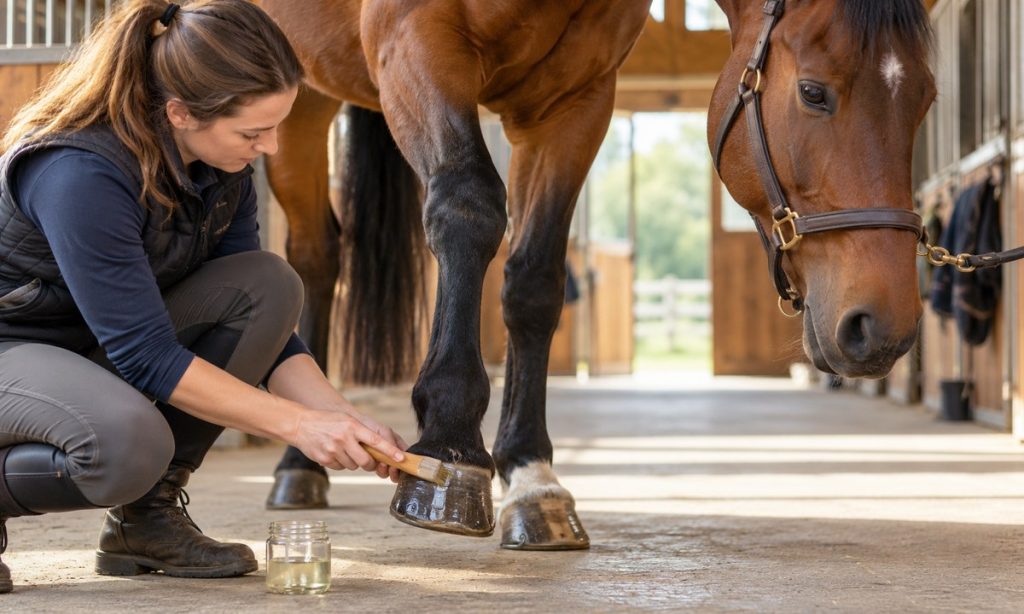
Brush-on oils give you control over where the product goes. Sprays can be quicker, but they require careful aim. Thick ointments may stay in place, yet can be messier and harder to remove from an applicator. Consider the number of horses, the areas you plan to dress, and whether you need a portable container. Compare the label’s size and directions, not an assumed coverage rate. Do not use a product on the frog, sole, or coronary band unless its directions allow it.
Read the ingredients and directions
Hoof oils may use mineral oils, plant oils, waxes, pine tar, or other ingredients. “Natural” does not mean universally suitable, and a dressing’s shine does not prove that the hoof is healthier. Review the full label if your horse has sensitive skin or a history of reactions. Apply only at the stated frequency. Avoid mixing several products because overlapping formulas can make it harder to monitor the hoof. The University of Minnesota Extension notes that dry weather and wet-to-dry changes can be associated with hoof cracks; regular trimming and overall hoof care remain central. See its horse-hoof care guidance.
Know when a dressing is not enough
A topical oil cannot correct an imbalanced trim, a deep crack, an injury, or a loose shoe. If the hoof is painful, warm, draining, foul-smelling, or repeatedly cracking, contact your farrier or veterinarian. UC Davis explains that a horse’s hoof moisture is influenced by its internal tissues, so soaking or wet ground is not a simple fix for dry hooves. Read its overview of common hoof-care claims. Follow product directions, keep the hoof clean, and reassess with a professional if the problem persists. Hoof oils vary in texture, applicator, and listed ingredients. Choose based on clear directions and your horse’s routine, not appearance claims. Choose a topical with clear directions, then track routine changes rather than expecting overnight repair.
Frequently Asked Questions
Does hoof oil fix cracked hooves?
No. A dressing may be part of routine care, but cracks can have several causes. Ask a farrier to assess persistent or deep cracks.
How often should I apply hoof oil?
Follow the product label and your farrier’s advice. Different formulas have different directions.
Can I apply oil to the frog and sole?
Only if the product label allows it. Do not cover an injury or suspected infection without professional guidance.
Should I soak a dry hoof before using oil?
Do not assume soaking is needed. UC Davis notes that external wetting is not a reliable way to moisturize hooves. Ask your farrier about your horse’s specific condition.
When should I call a farrier or veterinarian?
Call for lameness, heat, drainage, a deep crack, a loose shoe, or a hoof that keeps worsening despite routine care.
Final Verdict
The best hoof oil for dry hooves is the one whose format and ingredients suit your horse and your farrier’s plan. Fiebing’s offers a brush-on mineral-oil dressing; plant-oil formulas offer a different ingredient profile; sprays prioritize quick application; and thicker dressings trade ease for staying power. None replaces proper trimming or an assessment of persistent changes. Check the current label, apply only as directed, and ask your farrier to investigate recurring brittleness or cracks.
For related reading
For the broader comparison, see our guide to horse hoof-care products. For routine cleaning, read our guides to horse hoof picks and hoof brushes for horses. For broader hoof maintenance, see how wild horses trim their hooves and why horses need horseshoes.
Affiliate disclosure
This article contains Amazon affiliate links. If you purchase through these links, PetAdvisorPro may earn a commission. As an Amazon Associate I earn from qualifying purchases.