
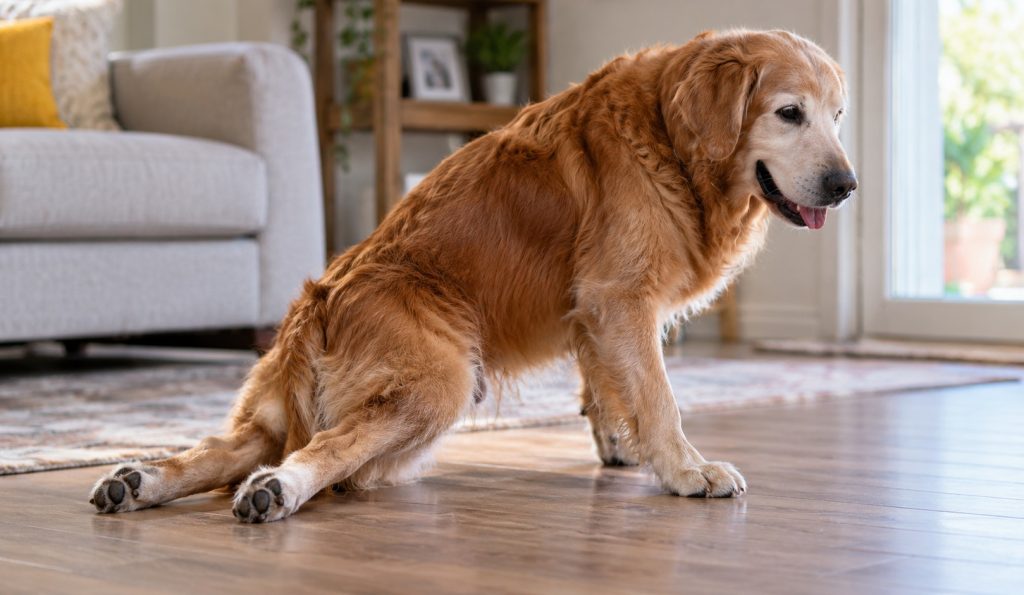
Seeing your dog suddenly drag one or both back legs can be frightening. One minute your dog may be walking normally, and the next, the rear paws are scraping the floor, the legs seem weak, or your dog struggles to stand. When that happens, it is natural to wonder what went wrong.
Dog Dragging Back Legs: Possible Causes range from painful orthopedic problems to nerve damage and disorders affecting the spinal cord. Some conditions develop gradually, while others can appear suddenly and require urgent veterinary attention.
The important thing is not to assume that your dog is simply “getting old” or having a bad day. Dragging the hind legs is a symptom, not a diagnosis. A veterinarian needs to determine what is interfering with normal movement before appropriate treatment can begin.
What Does It Mean When a Dog Drags Its Back Legs?
A dog dragging its back legs may have weakness, poor coordination, pain, loss of sensation, or paralysis. A neurologically affected dog may also knuckle over, meaning the paw turns under and the top of the foot contacts the ground. Some dogs stumble, cross their rear legs, sway when walking, or have difficulty knowing exactly where their feet are.
This is different from ordinary limping. A painful knee or hip, for example, may cause a dog to briefly avoid putting weight on one leg. A neurological problem can instead cause the leg to move abnormally or drag behind the dog. The distinction matters because the possible causes and treatments are very different.

Signs That May Accompany Hind-Leg Dragging
Pay attention to what else is happening. Useful observations for your veterinarian include:
- Scraping or dragging the rear paws
- Walking with an unusual or wobbly gait
- Difficulty getting up
- Falling or stumbling
- Crossing the back legs
- Knuckling of the paws
- Muscle loss in the hind limbs
- Back or neck pain
- Reluctance to climb stairs
- Difficulty jumping onto furniture
- Sudden inability to stand
- Changes in urination or bowel control
- Progressive weakness
The speed of onset is particularly important. A dog that has slowly become weaker over several months presents a different diagnostic picture from one that suddenly cannot use its back legs.
Dog Hind Leg Weakness Causes
There are many possible dog hind leg weakness causes, and more than one condition can produce similar-looking symptoms.
1. Intervertebral Disc Disease
Intervertebral disc disease, often called IVDD, is an important cause of neurological problems in dogs.
The discs between the vertebrae can degenerate, bulge, or rupture. If disc material presses against the spinal cord or nearby nerves, the dog may develop back pain, weakness, poor coordination, or paralysis. Some dogs develop symptoms suddenly, while others become progressively weaker.
Certain breeds, including Dachshunds, Beagles, Shih Tzus, and Pekingese, have a higher predisposition to particular forms of disc degeneration. Large dogs can also develop disc disease, so breed alone never rules it in or out. If your dog is dragging its rear legs and also appears painful, reluctant to move, or suddenly unable to walk, veterinary evaluation should not be delayed.
2. Degenerative Myelopathy
Degenerative myelopathy is another possible explanation for gradually worsening rear-leg weakness. This inherited neurological disease affects the spinal cord and is most commonly recognized in older dogs. Early signs can include subtle hind-limb weakness, difficulty coordinating the back feet, and a tendency to scrape the nails while walking.
Unlike many painful orthopedic conditions, degenerative myelopathy is generally not associated with significant pain. The disease progressively damages nerve pathways involved in movement and coordination. Unfortunately, there is currently no specific cure for degenerative myelopathy. Veterinary rehabilitation and supportive care may nevertheless help maintain mobility and quality of life for some dogs.
3. Spinal Injury or Trauma
A fall, automobile accident, bite injury, or other trauma can damage the vertebrae, spinal cord, or associated nerves. Spinal injuries may cause sudden and severe neurological problems. Depending on the location and severity of the injury, a dog may develop weakness, loss of sensation, or paralysis below the injured area.
If your dog has started dragging its back legs following trauma, don’t try to “walk it off.” That strategy belongs in the same rubbish bin as giving a dog random human pain medication because someone online said it worked for their cousin’s dog. :/ Keep movement to a minimum and seek veterinary care.
4. Lumbosacral Disease
Problems affecting the lower spine can compress the nerves responsible for the hind legs, tail, and parts of the bladder and bowel.
Degenerative lumbosacral stenosis is particularly recognized in larger dogs, including German Shepherd Dogs. Possible signs include difficulty using the hind legs, tail weakness, pain around the lower back, muscle loss, and neurological deficits. Dogs with these symptoms may require advanced imaging such as CT or MRI to identify the underlying problem.
5. Peripheral Nerve Damage
Not every case originates directly from the spinal cord. The nerves traveling from the lower spine into the hind legs can also be injured. Trauma, fractures, surgical complications, and other problems can damage individual nerves and interfere with normal movement or sensation.
Depending on which nerve is affected, a dog might have weakness in one leg, abnormal paw placement, reduced reflexes, or difficulty moving a particular joint.

6. Arthritis and Other Joint Problems
Arthritis can make a dog slow to rise, reluctant to walk, stiff after resting, or hesitant to climb stairs. Hip and knee disorders can also produce significant hind-limb problems. For example, cranial cruciate ligament disease is a major cause of hind-limb lameness in dogs.
However, arthritis does not automatically explain true paw dragging. If the back feet are repeatedly scraping the floor or your dog’s paws are turning under, a neurological examination may be necessary to distinguish nerve-related weakness from painful joint disease.
7. Hip or Knee Problems
Hip dysplasia, ligament injuries, joint degeneration, fractures, and other orthopedic conditions can change the way a dog walks. Dogs with painful joints may shift their weight forward and avoid using the affected rear limb. They may also have trouble getting up or climbing stairs.
The challenge is that orthopedic and neurological problems can sometimes look surprisingly similar to an owner. FYI, your veterinarian isn’t being overly cautious when checking reflexes and paw placement. Those seemingly simple tests can provide important clues about where the problem may be located.
8. Tumors and Other Spinal Conditions
Masses involving the spinal cord, vertebrae, or nerves can cause progressive weakness. The symptoms may develop slowly and become increasingly noticeable over time. Depending on the location, dogs can develop pain, incoordination, weakness, or paralysis. Veterinarians may use X-rays, CT scans, MRI, and sometimes biopsy or other testing to investigate suspected tumors.
9. Inflammatory or Infectious Disorders
Inflammation and infection can also affect the spinal column, spinal cord, or surrounding tissues. For example, disk spondylitis is an infection involving the disc and adjacent vertebral structures. Spinal pain is a common feature, and neurological problems can develop when inflammation or associated tissue affects the spinal cord.
Some other infectious and inflammatory neurological conditions can produce weakness or paralysis.
10. Vascular, Nutritional, or Toxic Problems
Less common causes should not be forgotten. Certain vascular disorders can produce sudden painful hind-limb weakness or paralysis. Some nutritional deficiencies can cause neurological problems, while certain toxins can also result in progressive weakness or paralysis.
These conditions are another reason not to guess at the cause based solely on symptoms.
Dog Hind Leg Paralysis: How Serious Is It?
Dog hind leg paralysis is more serious than ordinary stiffness or a mild limp. Paralysis means the dog has lost voluntary movement in the affected limb or limbs. It can result from severe spinal cord injury, nerve damage, certain diseases, vascular problems, or other neurological conditions. Sudden paralysis deserves prompt veterinary assessment.
If your dog goes from walking normally to being unable to stand or use its rear legs, treat that as an urgent problem rather than waiting several days to see whether it improves. The prognosis depends heavily on the underlying cause and the severity of neurological damage. Some dogs recover substantially with appropriate treatment, while others have permanent deficits.
When Should You Take Your Dog to the Vet?
A new unexplained change in your dog’s ability to walk deserves veterinary attention.
Seek emergency veterinary care when your dog:
- Suddenly cannot stand or walk
- Becomes rapidly weaker
- Develops severe back or neck pain
- Has suffered a significant fall or accident
- Develops sudden paralysis
- Has severe neurological changes
- Collapses
- Develops breathing difficulties
- Has major changes in bladder or bowel function together with neurological signs
Spinal cord injuries can worsen, and certain neurological conditions are time-sensitive. Prompt assessment can therefore matter. Don’t attempt to test deep pain sensation by pinching your dog’s toes or tail yourself. Neurological examinations are best performed by a veterinary professional.
How Veterinarians Diagnose the Problem
When investigating Dog Dragging Back Legs: Possible Causes, your veterinarian will usually begin with a physical and neurological examination. The veterinarian may observe how your dog stands and walks, assess paw placement, check reflexes, evaluate muscle condition, and look for pain or abnormalities affecting the spine and limbs.
Additional testing may include:
- Blood tests
- Urinalysis
- X-rays
- CT scans
- MRI
- Specialized neurological testing
- Cerebrospinal fluid analysis in selected cases
The exact combination depends on the dog’s age, breed, symptoms, history, and physical examination.
An MRI, for example, may be particularly valuable when spinal cord compression is suspected.
Treatment and Recovery
There is no single treatment for Dog Dragging Back Legs: Possible Causes because dragging is a symptom rather than a disease. Treatment might involve restricted activity and veterinary-prescribed pain control for some conditions. Other dogs may require surgery, rehabilitation, supportive nursing care, or treatment directed at an underlying infection or systemic disorder.
Severe intervertebral disc disease with significant spinal cord compression may require prompt surgery in appropriate cases. Recovery can range from relatively quick improvement to long-term management or permanent disability.
Factors affecting prognosis include the underlying diagnosis, severity of nerve or spinal cord damage, presence or absence of sensation and voluntary movement, and how quickly appropriate treatment is provided. That uncertainty can be difficult for an owner, but it is precisely why getting an accurate diagnosis is so important.
What Can You Do at Home While Waiting for Veterinary Care?
Until your dog is examined, focus on preventing further injury.
Keep your dog:
- Away from stairs
- Off slippery floors when possible
- Away from furniture it may try to jump onto
- Quiet and comfortable
- From excessive walking or running
If the paws are dragging, protect them from repeated scraping and injury, but don’t tightly bandage the legs unless your veterinarian has instructed you how to do it. Merck Veterinary Manual notes that protective measures may sometimes be appropriate for paralyzed limbs, depending on the individual case.
Avoid aggressive stretching, massage, chiropractic manipulation, or exercises unless recommended by your veterinarian. And don’t give human pain medication unless a veterinarian specifically tells you to. Several common human medications can be dangerous for dogs.

Can Hind-Leg Problems Be Prevented?
Not every neurological or orthopedic condition can be prevented. Still, sensible daily care can support your dog’s long-term mobility. Maintaining a healthy body weight reduces unnecessary stress on joints. Regular, age-appropriate exercise can help maintain muscle strength and coordination. Older dogs should also be monitored for subtle changes in gait, balance, and ability to rise.
For dogs with known mobility problems, your veterinarian may recommend rehabilitation exercises, environmental modifications, ramps, supportive harnesses, or other mobility aids.
The earlier a developing problem is recognized, the more options you may have for managing it.
Frequently Asked Questions
Why is my dog dragging its back legs?
Possible Dog Dragging Back Legs: Possible Causes include spinal disc disease, degenerative myelopathy, spinal injury, nerve damage, lumbosacral disease, orthopedic problems, tumors, infections, and certain vascular or metabolic disorders. A veterinary examination is needed to determine the actual cause.
Can a dog recover from hind-leg paralysis?
Sometimes. Recovery depends on the cause, severity, location of the neurological damage, and the dog’s remaining neurological function. Some conditions respond well to treatment, while others cause permanent deficits.
Is dragging the back legs always caused by a spinal problem?
No. Spinal disorders are important possibilities, but joint disease, nerve injuries, vascular disorders, and other conditions can also affect hind-limb function.
When is hind-leg weakness an emergency?
Sudden or rapidly worsening weakness, complete inability to stand, paralysis, severe pain, significant trauma, collapse, or neurological symptoms accompanied by major bladder or bowel changes warrant urgent veterinary attention.
Can degenerative myelopathy be cured?
Unfortunately, there is currently no specific cure for degenerative myelopathy. Management focuses on maintaining mobility, comfort, safety, and quality of life.
Final Words
Dog Dragging Back Legs: Possible Causes can range from relatively manageable orthopedic problems to serious diseases involving the spinal cord or nerves. The most important point is that dragging the rear legs is a symptom, not a diagnosis. The pattern of weakness, speed of onset, presence of pain, changes in coordination, and other symptoms all help a veterinarian determine what may be happening.
If your dog’s back legs have suddenly become weak, don’t wait for the problem to become dramatic before seeking help. Dogs are remarkably good at hiding discomfort, and a subtle change in walking can sometimes be the first visible sign of a significant problem.
As pet owners, we naturally want to help immediately. Sometimes the most helpful thing we can do is surprisingly simple: keep the dog safe, limit unnecessary movement, and get the right professional assessment. IMO, that beats trying twelve internet remedies and hoping one magically fixes a spinal cord. 🙂
The sooner the underlying cause is identified, the sooner you can make an informed plan for treatment, rehabilitation, and your dog’s long-term comfort.