
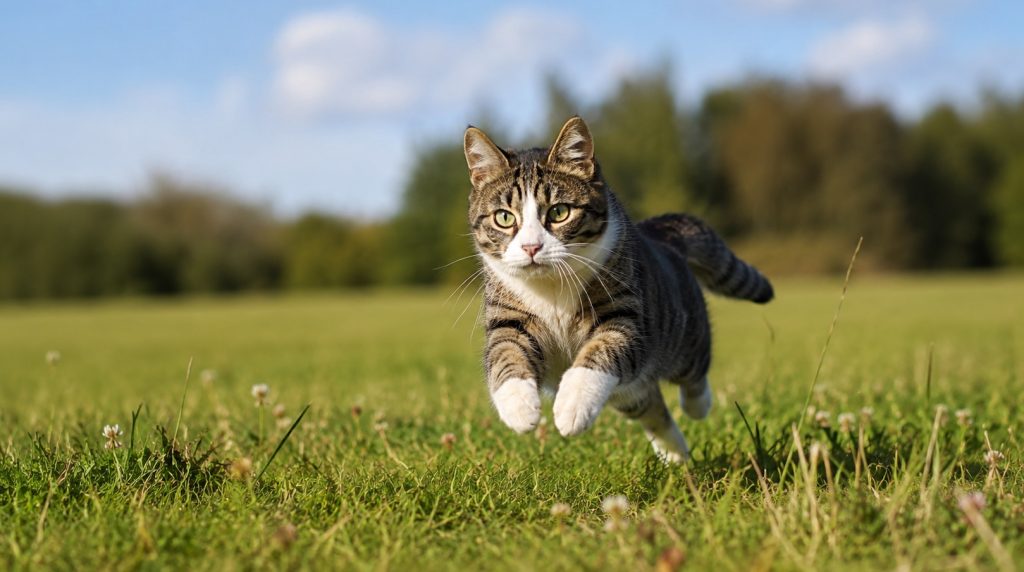
If you’ve ever watched your cat suddenly blast down the hallway, leap over a piece of furniture, and disappear around the corner, you’ve probably wondered: How Far Can Cats Run? The short answer is more complicated than a single number.
Cats are built for speed, acceleration, balance, and short bursts of intense activity—not for running a marathon beside you. A healthy domestic cat can reach roughly 30 mph for short bursts, according to Purina, but that impressive top speed doesn’t mean your cat can maintain it for a mile or even several minutes.
The distance a cat can run depends on its age, breed, fitness, health, body condition, environment, and motivation. A playful young cat chasing a toy behaves very differently from an older indoor cat taking a leisurely trip across the living room.
So, how far can cats run in practical terms? Let’s separate sprinting ability from endurance and look at what your cat’s dramatic hallway races actually mean.
How Far Can Cats Run?
There isn’t a scientifically established universal distance that applies to every domestic cat.
That’s because cats aren’t endurance runners in the same way that some dogs, horses, or humans can be. They’re primarily designed for short, explosive bursts of movement. A cat may sprint after prey, stop, stalk, walk, climb, jump, and sprint again.
This distinction matters.
A healthy cat might be capable of covering a considerable amount of ground during an active day, especially if it spends time outdoors. But that doesn’t mean it can continuously run that entire distance.
Think of a cat more like a sprinter than a distance runner.
When a cat takes off at full speed, the goal is usually very specific: catch something, escape something, chase something, or get somewhere immediately. There isn’t much reason for a cat to maintain maximum speed once that immediate purpose disappears.
For indoor cats, the actual running distance may be surprisingly small. A cat can get plenty of movement from climbing, jumping, chasing toys, wrestling with another cat, and performing the occasional 10-second hallway Grand Prix.
And yes, somehow they always seem to choose the middle of the night for that last one. 🙂
Source: Cats.com
How Fast Can a Cat Run?
A healthy housecat can reach approximately 30 mph during a short sprint, according to Purina.
That is extremely fast for an animal that may spend much of the afternoon sleeping.
Breed can make a difference, too. The Egyptian Mau, for example, is commonly described by Purina as the fastest domestic housecat and has been recorded at speeds of up to 30 mph.
However, you shouldn’t expect every cat to hit 30 mph.
A cat’s cat sprint speed can vary according to:
- Age
- Breed
- Muscle condition
- Body weight
- Motivation
- Surface
- Health
- Individual temperament
A healthy young cat chasing a favorite toy may look dramatically faster than a sedentary adult cat that isn’t interested in participating in your carefully planned exercise session.
In other words, your cat doesn’t owe you a personal best.
Why Do Cats Run So Fast?
So, why do cats run so fast when they spend so much time sleeping?
The answer comes down to anatomy and survival.
Domestic cats inherited many physical characteristics from wild feline ancestors. Their bodies are designed for quick acceleration, precise movement, jumping, climbing, and chasing.
Powerful Hind Legs
A cat’s rear legs provide much of the explosive power needed for acceleration.
When your cat crouches before launching toward a toy, those powerful hind limbs help push its body forward. This same muscular system also contributes to jumping and rapid changes of direction.
Flexible Spine
Cats have remarkably flexible bodies. Their spine contributes to their ability to stretch their bodies during a stride and make quick adjustments while running.
This flexibility is one reason a sprinting cat can look almost like its entire body is working as one coordinated spring.
Lightweight Athletic Build
Most healthy cats have a relatively compact, muscular body.
That combination of strength and relatively low body mass is useful when an animal needs to accelerate quickly. Carrying unnecessary weight would make explosive movement more difficult.
Hunting Instincts
Speed isn’t simply a party trick.
Cats are predators, and their natural behavior includes stalking, chasing, pouncing, and capturing prey. Even an indoor cat that has never hunted a mouse can still demonstrate these inherited behaviors through play.
That feather wand may look like a toy to you.
To your cat, apparently, it is a highly suspicious bird that has personally insulted the family.
How Long Can a Cat Run at Top Speed?
This is where many people misunderstand feline athletic ability.
A cat’s maximum speed is a short-burst performance, not a sustainable cruising speed.
Imagine a human sprinter. Running at maximum effort for a short distance is very different from jogging for several miles.
Cats operate in a similar way.
A cat can accelerate rapidly, reach a high speed, and then slow down. Once the immediate need for maximum speed disappears, continuing at that intensity isn’t particularly useful.
That’s why asking how far can cats run should always be followed by another question: At what speed?
A cat might be able to move around for a long period through a mixture of walking, climbing, exploring, stalking, and short runs. But that is very different from running continuously at top speed.
What Affects a Cat’s Running Distance?
Several factors can change how far and how effectively an individual cat can run.
Age
Kittens can be surprisingly energetic, but their bodies are still developing. They shouldn’t be pushed into strenuous exercise simply because they appear determined to destroy the living room at 2 a.m.
Adult cats generally have the greatest combination of physical maturity and athletic ability.
Older cats may naturally slow down, especially if they have age-related joint or mobility problems.
Breed
Some breeds are particularly athletic and energetic.
The Egyptian Mau is a well-known example. Purina notes that the breed can reach speeds of up to 30 mph.
However, breed isn’t everything. Two cats from the same breed can have very different fitness levels and personalities.
Fitness and Body Condition
A healthy, appropriately conditioned cat is more likely to move comfortably than an overweight or sedentary cat.
That doesn’t mean you need to turn your living room into a feline training facility. Regular play, climbing opportunities, and interactive activities can provide useful movement for many indoor cats.
Indoor vs. Outdoor Lifestyle
An outdoor cat may naturally travel farther because it has more space to explore.
It might walk across a yard, climb, stalk insects, chase another animal, and sprint between locations. Much of that movement isn’t sustained running.
An indoor cat has less territory but can still get excellent exercise through play and environmental enrichment.
Surface and Environment
Cats don’t run equally well on every surface.
Carpet, grass, flooring, gravel, and slippery surfaces provide different levels of traction. A cat attempting a high-speed turn on a smooth floor may discover that physics has opinions.
Safe footing matters, particularly during vigorous play.
Source: iStock Photo
Cat Sprint Speed vs. Endurance
The most impressive thing about feline running isn’t necessarily how long a cat can run. It’s how quickly it can accelerate and how precisely it can control its body.
A cat can go from sitting quietly to moving at full speed in a remarkably short period.
That explosive ability is useful for hunting and escaping danger.
Endurance is another matter.
A cat isn’t built to maintain maximum sprint speed for a long distance. Instead, feline movement tends to involve a mixture of:
- Walking
- Stalking
- Climbing
- Jumping
- Pouncing
- Short sprints
- Resting
This is why the answer to how far can cats run can’t simply be expressed as “X miles.”
The more useful answer is that cats are capable of impressive short-distance speed but generally aren’t designed for prolonged, high-speed running.
Cat vs. Dog Running Speed: Which Is Faster?
The cat vs dog running speed comparison isn’t completely straightforward.
A healthy domestic cat can reach around 30 mph in short bursts.
Some dogs can run substantially faster. The American Kennel Club, for example, reports exceptionally high speeds among breeds such as Whippets, with one cited average of more than 35 mph in Fast CAT competition.
But raw speed doesn’t tell the whole story.
Cats have extraordinary acceleration, agility, balance, and directional control. Dogs vary enormously by breed, too. A Whippet and a small companion breed aren’t built for the same kind of running.
The better comparison is this:
Dogs can include exceptional long-distance and high-speed runners, while cats are highly specialized for short bursts, acceleration, agility, and explosive changes of direction.
So if your cat challenges a Greyhound to a 5-mile race, my money isn’t going on the cat.
If the competition involves suddenly jumping onto a couch, turning around in midair, and disappearing behind a chair, however, the cat has a much more interesting résumé.
Why Do Cats Suddenly Sprint Around the House?
If your cat occasionally races around the house for no obvious reason, you’re probably seeing what many pet owners call the zoomies.
Veterinary-reviewed PetMD describes these episodes as frenetic random activity periods, or FRAPs. They are commonly associated with releasing pent-up energy and expressing instinctive behaviors, and they are generally normal in healthy cats.
Zoomies may occur after:
- Using the litter box
- Waking from a nap
- Playing
- Eating
- Seeing an exciting object
- Experiencing a burst of energy
- Spending a long period relatively inactive
Cats are also naturally more active around dawn and dusk, which helps explain why some owners experience the mysterious midnight sprinting championship.
If your cat otherwise behaves normally, occasional zoomies are usually nothing to worry about.
Do Indoor Cats Need Running Exercise?
Indoor cats don’t necessarily need to run long distances.
What they do need is appropriate physical and mental stimulation.
Interactive play can encourage natural behaviors such as chasing, stalking, pouncing, and jumping. Toys that make your cat move can be particularly useful when used appropriately.
You can also create opportunities for movement with:
- Cat trees
- Climbing shelves
- Interactive toys
- Wand toys
- Puzzle feeders
- Short play sessions
- Safe chasing games
The goal isn’t to force your cat to become a marathon runner.
The goal is to give your cat opportunities to behave like a cat.
FYI, several short play sessions can be more practical than expecting one long workout from an animal whose preferred exercise schedule may be “three minutes of chaos followed by a four-hour nap.”
When Running Behavior May Be a Reason to Call the Vet
Running itself is normally not a problem for a healthy cat.
The concern is a sudden change in behavior or running accompanied by other symptoms.
Contact your veterinarian if unusual activity is accompanied by signs such as:
- Limping
- Obvious pain
- Weakness
- Difficulty breathing
- Repeated falls
- Loss of balance
- Collapse
- Disorientation
- Reluctance to move
- A major and persistent change in normal behavior
Similarly, if your cat suddenly stops running, jumping, or playing when those activities were previously normal, don’t automatically assume your cat is simply “getting lazy.”
Cats can be very good at hiding discomfort.
If you’re concerned about a change in your cat’s mobility or behavior, a veterinarian can determine whether further evaluation is appropriate.
And if your cat is recovering from surgery or another medical problem, follow the activity restrictions provided by your veterinarian. For example, VCA’s postoperative guidance for cats specifically emphasizes restricting running and jumping during recovery.
Frequently Asked Questions
How far can cats run in a day?
There isn’t one reliable distance that applies to all cats. Outdoor cats may cover considerable territory through walking, exploring, climbing, stalking, and occasional sprinting, while indoor cats generally have much smaller activity areas. Total movement shouldn’t be confused with continuous running.
How fast can a house cat run?
A healthy domestic cat can reach approximately 30 mph during a short burst, although individual cats vary. Breed, age, health, body condition, motivation, and environment can all influence performance.
Why do cats run so fast?
Cats have physical adaptations suited to explosive movement, including powerful hind legs, a flexible spine, a lightweight athletic body, and excellent coordination. Their hunting instincts also favor rapid acceleration and short bursts of pursuit.
Are cats faster than dogs?
It depends on the dog and the type of running being compared. Some specialized dog breeds can exceed domestic cats’ commonly cited top speeds. However, cats are exceptionally agile and can accelerate and change direction very quickly.
Is it normal for my cat to suddenly sprint around the house?
Yes. Sudden bursts of running, commonly called zoomies, are usually normal in healthy cats. They can help release energy and express natural behaviors. If the running is accompanied by pain, weakness, breathing problems, disorientation, or another unusual symptom, contact your veterinarian.
Final Words
So, how far can cats run? There isn’t a single mileage figure that accurately describes every cat.
The more useful way to understand feline running is to recognize what cats are actually built to do. They are excellent short-distance sprinters with impressive acceleration, powerful hind legs, flexible bodies, and remarkable agility. A healthy domestic cat can reach around 30 mph in a brief burst, but that doesn’t mean it can maintain that pace over a long distance.
Your cat’s individual running ability will depend on age, breed, fitness, body condition, health, environment, and motivation.
For most pet parents, the goal shouldn’t be to measure how many miles their cat can run. Instead, focus on whether your cat has regular opportunities to move, play, climb, chase, and explore safely.
And if your perfectly calm cat suddenly turns into a furry missile at 1 a.m., don’t panic. In many cases, that’s simply your cat reminding you that having a predator in the house comes with a little nighttime entertainment.









