
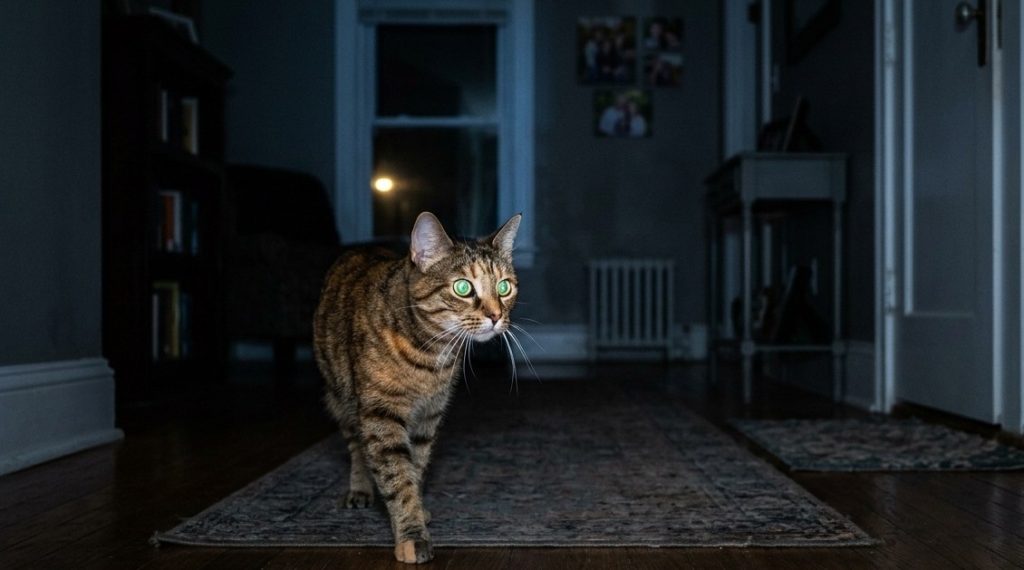
It is 3:00 AM on a Tuesday. The house is pitch-black, dead silent, and you are peacefully asleep. Suddenly, a eight-pound furry missile launches itself off your chest, lands squarely on the floorboards, and begins chasing an invisible target across the hallway at breakneck speed.
If you are a pet parent, you have lived this scenario. Over the past 15 years of living alongside cats, dogs, and a revolving door of foster pets, I have lost count of how many times I have stumbled over a rug in the middle of the night, only to watch my tabby effortlessly weave around furniture like a stealth fighter jet equipped with thermal imaging.
It leaves every cat owner asking the exact same question: How good is a cat’s night vision? Can they actually see in absolute darkness, or are they just really good at bumping into things quietly?
Let’s unpack the fascinating anatomy, science, and behavioral quirks behind feline eyesight, clear up common myths, and look at how cat vision vs human vision stacks up when the lights go down.
The Biological Engine: How Well Can Cats See in Low Light?
To understand how well cats can see when the sun goes down, we have to look inside the feline eye. Nature did not build a cat’s eyes for admiring vibrant watercolor paintings or reading fine print on a screen; it engineered them to spot small, fast-moving prey in the dim light of dusk and dawn.
Cats do not possess magical superpowers, but their visual architecture is wildly efficient. While a human eye needs a significant amount of light to form a clear image, a cat’s eye can construct a usable picture using roughly one-sixth (about 16%) of the light that we require.
So, how good is a cat’s night vision in practice? If you are sitting in a living room lit only by the faint glow of a streetlight filtering through the blinds, you see shadowy shapes and dark corners. Your cat, on the other hand, sees a bright, highly detailed environment with crisp movement detection.
Here are the primary biological features that make this possible:
-
A High-Density Rod Array: The retina contains two main types of photoreceptors—rods and cones. Cones process color and fine detail in bright light, while rods process motion and operate in dim conditions. Cats have roughly 6 to 8 times more rod cells than humans do, giving them extraordinary sensitivity to low light and subtle movements.
-
Massive Corneas and Slit Pupils: A cat’s eyes are proportionally huge compared to their head size. Their vertical slit pupils can open incredibly wide in low light, dilating until they cover almost the entire eye to pull in every available photon.
-
The Tapetum Lucidum: This is the feline secret weapon. Sitting directly behind the retina, this mirror-like layer of tissue bounces unabsorbed light back through the retinal cells a second time, giving the eye a second chance to catch it. (IMO, this is also the creepiest biological feature when you catch those glowing green eyes reflecting your phone screen at midnight.
Cat Vision vs Human Vision: A Head-to-Head Comparison
To truly appreciate feline eyesight, it helps to put cat vision vs human vision side by side. We often assume our pets experience the world the same way we do, but our visual priorities could not be more different.
Humans are daytime (diurnal) creatures. We evolved to rely on sharp color perception, high resolution, and depth perception in full sunlight. Cats are crepuscular—meaning they are naturally most active at twilight (dusk and dawn). Their eyes reflect that lifestyle.
+------------------------+------------------------------------+------------------------------------+
| Feature                | Human Vision                       | Cat Vision                         |
+------------------------+------------------------------------+------------------------------------+
| Low-Light Efficiency   | Poor; needs high ambient light     | Superior; needs 1/6th human light  |
| Visual Field (Scope)   | ~180 degrees                       | ~200 degrees (wider peripheral)    |
| Visual Acuity (Clarity)| 20/20 (Sharp, crisp detail)        | 20/100 to 20/200 (Blurry at distance) |
| Color Spectrum         | Trichromatic (Red, Green, Blue)    | Dichromatic (Blues, Yellows/Greens)|
| Motion Detection       | Slower in dim light                | Exceptional, especially in low light|
+------------------------+------------------------------------+------------------------------------+
Visual Acuity: Who Sees Details Better?
When it comes to fine detail, humans take the crown easily. A person with 20/20 vision can see an object clearly from 100 feet away, whereas a cat would need to be 20 feet away to see that same object with the same level of sharpness (giving them roughly 20/100 to 20/200 visual acuity).
If your cat stares intently at a blank wall for ten minutes, they are not seeing ghosts (well, usually). They are likely tracking a tiny speck of dust or a microscopic gnat moving in a way your human eyes cannot pick up.
Color Perception: Do Cats See in Black and White?
A common myth is that cats see purely in shades of gray. That is factually incorrect. Cats do see color, but their palette is much more muted than ours. Because their retinas are dominated by rods rather than cones, they have dichromatic vision. They perceive blues, greenish-yellows, and grays quite well, but reds, oranges, and pinks appear washed out or greenish to them.
FYI: Buying your cat a bright red toy mouse will not make it easier for them to find—to them, it just looks like a drab brownish-gray lump.
Can Cats See in Pitch-Black Darkness?
Now for the million-dollar question: How good is a cat’s night vision when there is zero light?
The short answer is no, cats cannot see in complete, 100% darkness.
No biological eye on Earth can construct a visual image without light. If you lock a cat in an interior bathroom with no windows, no nightlights, and the door sealed tight, they are just as blind as you or I.
So how do they navigate pitch-black rooms so gracefully? They use an integrated sensory suite that compensates when their vision hits a hard biological limit:
-
Whiskers (Vibrissae): A cat’s whiskers are not decorative face accessories; they are deeply rooted touch sensors that can detect tiny air currents. As a cat moves through a dark room, air pressure changes as they approach walls, chair legs, or closed doors. Their whiskers map those obstacles before their body physically touches them.
-
Superhuman Hearing: Cats can hear higher-pitched frequencies than dogs and humans, allowing them to pinpoint the exact location of a squeaky mouse or a rustling plastic bag across the house.
-
Spatial Memory: Anyone who has lived with a cat knows they are creatures of habit. They build intricate mental maps of your home’s layout. They know the exact distance from the sofa armrest to the coffee table, allowing them to make leaps in the dark purely from muscle memory.
Causes of Night Vision Loss in Cats
While young, healthy felines navigate dim hallways effortlessly, night vision can degrade over time. If you notice your cat suddenly hesitating at night or bumping into furniture, it usually signals an underlying medical issue rather than normal aging.
1. Progressive Retinal Atrophy (PRA)
PRA is a genetic condition that causes the photoreceptor cells in the retina to deteriorate slowly over time. Because rod cells—the ones responsible for low-light sight—are usually affected first, “night blindness” is often the very first symptom pet owners notice.
2. Cataracts
Just like humans, cats can develop cataracts as they age or as a complication of diabetes. The lens becomes cloudy or opaque, preventing light from reaching the retina efficiently. This causes blurred vision during the day and severe difficulty seeing at night.
3. Feline Hypertension (High Blood Pressure)
High blood pressure is extremely common in senior cats, often secondary to chronic kidney disease or hyperthyroidism. Systemic hypertension can cause small blood vessels in the back of the eye to burst, leading to retinal detachment and sudden, total blindness.
4. Glaucoma
Glaucoma occurs when fluid pressure builds up inside the eyeball, damaging the optic nerve. It is extremely painful and leads to rapid vision loss if left untreated.
Signs Your Cat Is Struggling to See at Night
Cats are absolute masters at hiding physical discomfort or sensory impairment. In the wild, showing weakness makes an animal a target, so domestic cats often adapt to gradual vision loss without making a sound.
As a pet parent, you need to watch for subtle behavioral shifts, especially in dimly lit environments:
-
Hesitation before jumping: Pausing at the edge of the bed or couch, testing the distance with a paw, or refusing to jump down at night.
-
Vocalizing in the dark: Meowing loudly or crying out in hallways after the lights are turned off (often caused by confusion or disorientation).
-
Navigating by walls: Walking slowly with their body brushing against walls or baseboards to guide themselves through dark rooms.
-
Clumsiness: Knocking over water bowls, running into chair legs, or misjudging landing spots during nighttime movement.
-
Physical Eye Changes: Cloudy lenses, unequal pupil sizes, bloodshot eyes, or a sudden loss of the normal “glow” in pictures.
When to Visit a Vet
If you notice any of the warning signs listed above, do not wait to see if things improve on their own. Eye issues in cats are medical emergencies.
I learned this lesson years ago with a senior foster cat. He started acting reluctant to come downstairs for dinner in the evening. Within a week, a quick veterinary exam revealed elevated blood pressure that was actively straining his retinas. Because we caught it early and started medication immediately, we were able to save his remaining eyesight.
You should seek immediate veterinary care if you observe:
-
A sudden onset of blindness or severe disorientation.
-
Pupils that remain wide open (dilated) even in bright light.
-
Visible cloudiness, redness, or milky film over the eyes.
-
Signs of eye pain, such as squinting, excessive tearing, or pawing at the face.
Your veterinarian can perform an ophthalmic exam, measure intraocular pressure, and check blood pressure to diagnose the underlying cause and protect your pet’s quality of life.
Solutions & Environmental Adaptations for Night-Blind Cats
If your vet confirms that your feline companion is losing their low-light vision, don’t panic. Cats are remarkably resilient creatures. While they may lose some visual acuity, their senses of smell, touch, and hearing will quickly step up to compensate.
Here are practical, low-cost steps you can take to make your home safe and accessible:
-
Install Motion-Sensor Nightlights: Plug inexpensive LED nightlights into hallways, near the litter box, and around feeding stations. A little ambient light goes a long way for a cat with declining sight.
-
Keep Furniture Layouts Consistent: Avoid rearranging sofas, coffee tables, or cat trees. A blind or night-blind cat relies heavily on environmental muscle memory.
-
Block Off Staircases: Place baby gates at the top of steep stairwells to prevent accidental falls during the night.
-
Scent-Mark Key Areas: Apply a drop of feline-safe essential oil (like diluted chamomile) or use familiar scents near the litter box or food area to help them navigate by smell.
-
Avoid Clutter on Floors: Keep shoes, backpacks, and toys picked up. Unexpected obstacles in hallways are major tripping hazards for visually impaired pets.
Prevention: Protecting Your Cat’s Eye Health
While genetic conditions cannot always be prevented, proactive care can preserve your cat’s eyesight well into their golden years.
+--------------------------+------------------------------------------------------------------+
| Care Category            | Action Item for Pet Parents                                      |
+--------------------------+------------------------------------------------------------------+
| Nutritional Support      | Feed high-quality food rich in Taurine, Vitamin A, & Omega-3s.   |
| Annual Wellness Checks   | Schedule yearly (bi-annual for seniors 10+) blood/eye screenings. |
| Blood Pressure Monitoring| Request routine BP checks during senior vet visits.              |
| In-Home Safety           | Keep cats indoors to prevent trauma, fights, and infections.     |
+--------------------------+------------------------------------------------------------------+
-
Prioritize Taurine in Their Diet: Taurine is an essential amino acid that cats cannot synthesize on their own. A deficiency in taurine causes severe retinal degeneration and eventual blindness. Always feed a commercially balanced, AAFCO-approved cat food.
-
Schedule Regular Vet Checks: Annual wellness visits (and bi-annual checks for cats over 10 years old) are critical for catching hypertension, kidney issues, and early stage cataracts before irreversible damage occurs.
-
Keep Them Indoors: Outdoor cats face higher risks of ocular trauma from cat fights, branches, infections, and toxins. Indoor cats enjoy significantly longer, healthier lives with intact vision.
Frequently Asked Questions
1. Do cats see better in the dark than dogs?
Yes, cats generally have better night vision than dogs. While both species far surpass human low-light vision, cats have a higher density of rod cells and a larger tapetum lucidum relative to their eye size, giving them the edge in dim environments.
2. Why do cats’ eyes glow in the dark when light hits them?
That eerie green, yellow, or blue glow is caused by the tapetum lucidum. This reflective membrane behind the retina acts like a mirror, reflecting unabsorbed light back out through the pupil so you see it shining back at you.
3. Should I leave a light on for my cat at night?
In most cases, healthy cats do not need a light left on; ambient light from windows, electronics, or streetlights is more than enough for them to see clearly. However, if you have a senior cat or one with known vision loss, leaving a soft nightlight on near their litter box and water bowl is a great idea.
4. Can cats see TV screens or phone displays in the dark?
Yes! Modern high-definition TVs and phone screens refresh fast enough for cats to perceive fluid motion rather than flickering images. Because cats are highly sensitive to movement, bright screens in a dark room easily catch their attention.
5. Why do my cat’s pupils turn into tiny slits during the day?
Feline pupils contract into narrow vertical slits in bright sunlight to protect their extremely sensitive retinas from overexposure. The vertical shape allows for precise control over how much light enters the eye while maintaining sharp depth perception for hunting.
Final Words
So, how good is a cat’s night vision when all is said and done? It is an evolutionary masterpiece. While your feline companion might not be able to read a book in a dimly lit room or distinguish between a red mouse and a green one, their ability to navigate low-light environments, spot subtle movement in the shadows, and pounce with lethal precision is unmatched.
The next time your cat gets the 3:00 AM “zoomies” and executes a flawless leap across your dark bedroom, don’t be too annoyed. Just appreciate the amazing biological engineering working behind those glowing green eyes—and maybe invest in a nightlight so you stop tripping over their toys.