
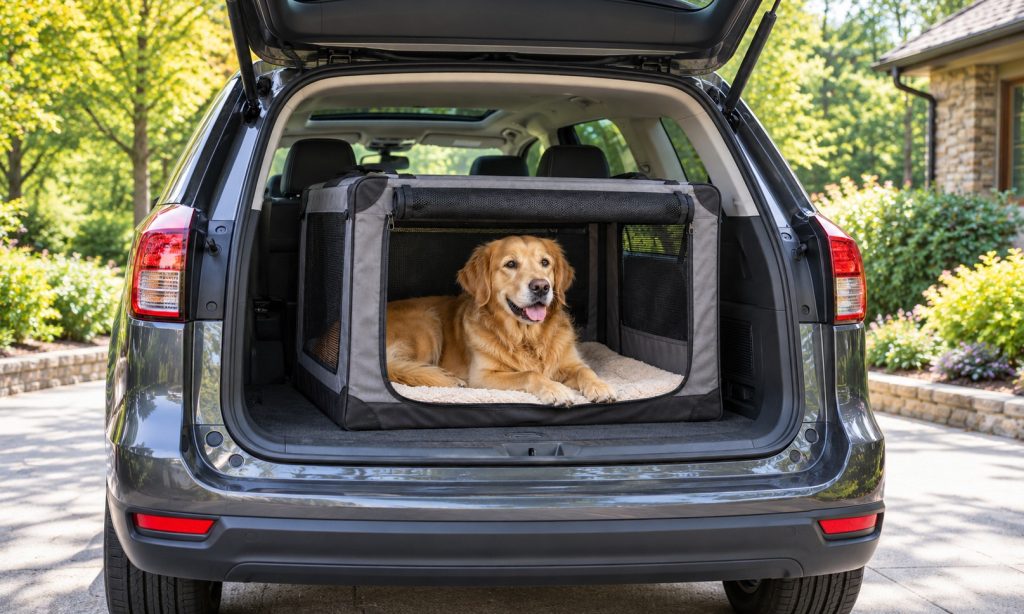
A travel crate has to do more than fold up or fit in your car. It needs to suit your dog’s size and behavior, the kind of trip you’re taking, and the space where it will be used. A crate that works well at a pet-friendly cabin may be unsuitable for an airplane or unsafe if it slides around in a vehicle.
When people search for the best portable dog crate for travel, they may be picturing a soft-sided carrier, a hard plastic kennel, or a folding metal crate. The right choice depends on the trip. Start with your dog and your travel plans, then compare construction, fit, ventilation, and ease of use.
What to look for in a portable dog crate for travel
A crate should fit the trip, not just the trunk. Before comparing materials or features, decide where your dog will travel and where the crate will be used. A short drive to a friend’s home has different constraints from a long road trip, a hotel stay, or a flight.
Think through these questions:
- Will the crate be used in a moving vehicle, at your destination, or both?
- Does it need to fold flat for storage?
- Will you carry it by hand, or can it stay in one place?
- Does your dog chew, scratch, push at doors, or panic in enclosed spaces?
- Will it need to meet an airline’s requirements?
The phrase best portable dog crate for travel can suggest one crate works for every dog and trip. In practice, the best fit is the crate that suits your particular use and can be used safely. A light fabric crate may be convenient for a calm dog staying in a hotel. It may not be the right choice for a persistent chewer or for use as a crash-protection device.
Choose the crate style for your type of trip
Soft-sided travel crates
Soft crates usually have fabric panels, mesh windows, and a collapsible frame. They are often easier to carry and store than rigid kennels. They can be useful for dogs already comfortable with confinement and for stationary use at a destination.
Their limitations matter. A dog who chews, claws, or pushes against mesh may damage the fabric or escape. Soft crates also may be harder to clean thoroughly after an accident. A soft crate should not be assumed to provide crash protection in a vehicle.
Hard-sided plastic kennels
Rigid plastic kennels have solid panels, ventilation openings, and a door that latches closed. Depending on their design, they may be useful for travel and at a destination. They are generally easier to wipe down than fabric crates, but can be bulky to carry and may not fold for storage.
Inspect the door, hinges, fasteners, and ventilation openings. A kennel that looks sturdy but has loose or damaged components is not ready for a trip.
Folding metal crates
Folding wire crates can provide airflow and visibility and may fold for storage. They are often better suited to a destination or a stationary setup than to carrying around. Their weight, shape, and exposed bars may make them awkward in some vehicles or accommodations.
A folding crate’s portability does not make it a vehicle safety system. If you use one in a car, consider how the crate itself is secured and whether its construction is appropriate for that use.
Airline cabin carriers
A small carrier used in an airplane cabin has to fit the airline’s current size and placement rules. The FAA says airlines set their own policies for pets in the cabin; if a pet is allowed, its carrier must fit beneath the seat without blocking the aisle and must remain stowed when required. Check the airline’s rules for your specific flight before buying or packing a carrier. Federal Aviation Administration
A carrier that meets one airline’s requirements may not meet another’s. Even aircraft on the same route can have different under-seat dimensions.
Measure your dog before choosing a crate
A crate should give your dog room to stand, turn around, and lie down in a natural position. For air travel, check the relevant carrier and airline instructions because they may specify additional fit requirements. AKC’s general crate guidance recommends measuring the dog while standing and allowing additional room when selecting a crate.
Measure your dog while standing:
- Measure from the floor to the top of the head or ears, whichever is higher.
- Measure from the nose to the base of the tail.
- Measure the widest part of the body.
- Compare those measurements with the interior dimensions of the crate.
Do not rely on a crate’s exterior measurements or a weight range alone. Two dogs who weigh the same can have very different body lengths and heights. If your dog is between sizes, check the manufacturer’s measuring instructions and the rules for your travel mode.
Also account for what will be inside. A thick bed takes up space, and some dogs are safer traveling without loose bedding they might chew. Try the setup before your departure so you can see whether your dog can settle comfortably.
Check ventilation, doors, and materials
A travel crate needs enough airflow for its intended setting. Look for ventilation on multiple sides, and make sure luggage, blankets, or the placement of the crate will not block openings. Mesh panels provide visibility and airflow but may be vulnerable to chewing or clawing. Solid panels can feel more enclosed, so watch how your dog responds.
Open and close every door several times. Check that:
- Latches engage fully and do not spring open when lightly pressed.
- Hinges and connecting points are intact.
- Zippers, if present, cannot be nudged open by your dog.
- The floor does not flex excessively under your dog’s weight.
- The crate does not wobble, tip, or collapse when assembled.
- Handles feel secure when the crate is empty and when loaded as directed.
Use the crate only within the manufacturer’s stated limits. Don’t modify doors, latches, or ventilation in ways that could create sharp edges or prevent secure closure.
Consider cleaning and setup at your destination
Travel can bring muddy paws, drool, spilled water, and the occasional accident. Removable floor trays, wipeable materials, and washable covers can make cleanup easier. If you use a fabric crate, check whether the cover or mat can be removed and cleaned according to its care instructions.
Practice assembling the crate before the trip. A new folding frame is not something you want to decipher in a dim hotel room while your dog supervises. Confirm that you can open, close, and secure every panel without forcing parts into place.
Think about where it will sit at your destination. A crate needs a stable, well-ventilated location away from heaters, direct sun, and busy walkways. Don’t leave a dog unattended in a crate outdoors or in a parked car. The AVMA advises never leaving a pet in a vehicle, even in shade or with the windows cracked. American Veterinary Medical Association
Road trips: the crate and the vehicle both matter
A crate in a moving car should not slide, tip, or become a projectile during sudden braking. The vehicle, crate, and dog all matter; a crate’s portability by itself does not establish that it is crash-tested or crash-safe. Check what the crate’s maker says about vehicle use, and secure it as directed.
Place the crate where it will not interfere with the driver or block access to controls, airbags, or exits. Don’t place a crate where it can shift into a person during a stop. If you are unsure how to secure a crate in your vehicle, ask a qualified vehicle-safety professional or your veterinarian for guidance appropriate to your dog and setup.
Plan stops for water, bathroom breaks, and movement. Never open the crate in an unsecured area where your dog could bolt into traffic. Use a leash before letting your dog out, and check that doors are closed before you open the crate.
Air travel requires airline-specific planning
Do not choose an air-travel crate based only on a label that says “airline approved.” Airlines have their own policies, which can depend on whether a pet travels in the cabin or another compartment, the aircraft, route, destination, and the dog’s size. The FAA directs travelers to check their airline’s specific pet policies. Federal Aviation Administration
Before booking, ask the airline:
- Whether your dog can travel in the cabin on that flight.
- The carrier’s maximum dimensions and whether soft sides are allowed.
- Whether your dog must remain in the carrier for the entire flight.
- What rules apply to dogs traveling outside the cabin.
- Whether breed, age, weather, or route restrictions apply.
For international travel, check destination requirements early. The USDA’s Animal and Plant Health Inspection Service explains that pet travel requirements depend on the destination and that airlines may have separate boarding requirements. Animal and Plant Health Inspection Service
Dogs with short noses or existing health concerns may need extra planning. Ask your veterinarian whether air travel is appropriate for your dog. The AVMA notes that a dog becoming familiar with the travel crate can help reduce travel stress, while emphasizing that crates must be secure. American Veterinary Medical Association
Introduce the crate before you travel
A crate is not a magic calming box. If your dog has never used one, bringing it out at the airport or the night before a long drive may create more stress. Introduce it gradually at home, with the door open at first. Let your dog investigate voluntarily, and reward calm approaches or short periods inside.
Build duration slowly. Close the door briefly only if your dog remains relaxed, then open it before distress escalates. Practice in small steps, and avoid forcing your dog inside. AKC’s crate-training guidance recommends starting with short periods and increasing time gradually; it also cautions against crating a dog all day, every day. akc.org
If your dog drools heavily, pants, scratches frantically, tries to break out, or cannot settle, stop and reassess. Those behaviors may signal fear, discomfort, or another issue that deserves help from a veterinarian or qualified behavior professional.
How often should you use or replace a portable dog crate for travel?
Use a travel crate when it suits the situation and your dog can remain comfortable and safe in it. Practice short, positive sessions before travel so the crate is familiar. A travel crate should not become a place where a dog spends excessive time simply because it is portable.
Inspect it before each trip and after any rough use. Replace or stop using it if you find:
- A cracked panel or bent frame.
- A door that no longer latches reliably.
- Torn mesh, broken zippers, or sharp exposed edges.
- Missing fasteners or loose joints.
- A floor that has become unstable.
- Damage from chewing that weakens the structure.
There is no universal replacement schedule. The crate’s condition, how often it is used, and the dog’s behavior matter more than its age. Follow the manufacturer’s care and replacement guidance when available.
When a portable crate may not be the right choice
A crate may not suit a dog who panics in confinement, repeatedly tries to escape, or has a medical condition that makes travel difficult. A dog who chews or claws at fabric may need a different type of enclosure, but a stronger crate alone may not solve the underlying distress.
If your dog has not traveled before, has severe travel anxiety, or has a health concern, talk with your veterinarian before a long trip or flight. Some dogs need gradual behavior support, a different travel plan, or a decision not to travel. Comfort and safety should guide the choice.
Five frequently asked questions
What type of portable dog crate is best for car travel?
It depends on your dog, vehicle, and how the crate can be secured. Choose a crate intended for the planned use, check its construction and latches, and make sure it cannot slide or tip. Don’t assume a folding or portable crate provides crash protection.
Can I use a soft-sided crate for air travel?
Possibly, if the airline allows that carrier style and its dimensions fit the requirements for your flight. Check directly with the airline before booking; rules vary.
How do I know if a travel crate is the right size?
Measure your dog’s height and length while standing, then compare those measurements with the crate’s interior space. Your dog should be able to stand, turn around, and lie down comfortably. Follow additional airline requirements if flying.
How long can a dog stay in a travel crate?
There is no single time limit that suits every dog. Age, health, prior crate training, bathroom needs, and the trip all matter. Plan breaks and do not treat a crate as an all-day substitute for exercise, supervision, or care.
How often should I replace a travel crate?
Replace it when damage affects stability, ventilation, or secure closure. Check it before trips and after rough use, and follow the maker’s care guidance.
Final words
To choose a travel crate, start with the journey, then check fit, construction, ventilation, and whether your dog can use it calmly. For flights, verify current airline rules before choosing a carrier. For car trips, plan how the crate will stay stable and never leave your dog in a parked vehicle.
The best portable dog crate for travel is not the one with the most features; it is the one that fits your dog and the trip, and that you can use safely. If your dog is distressed or has a health concern, get professional guidance before you travel.









