
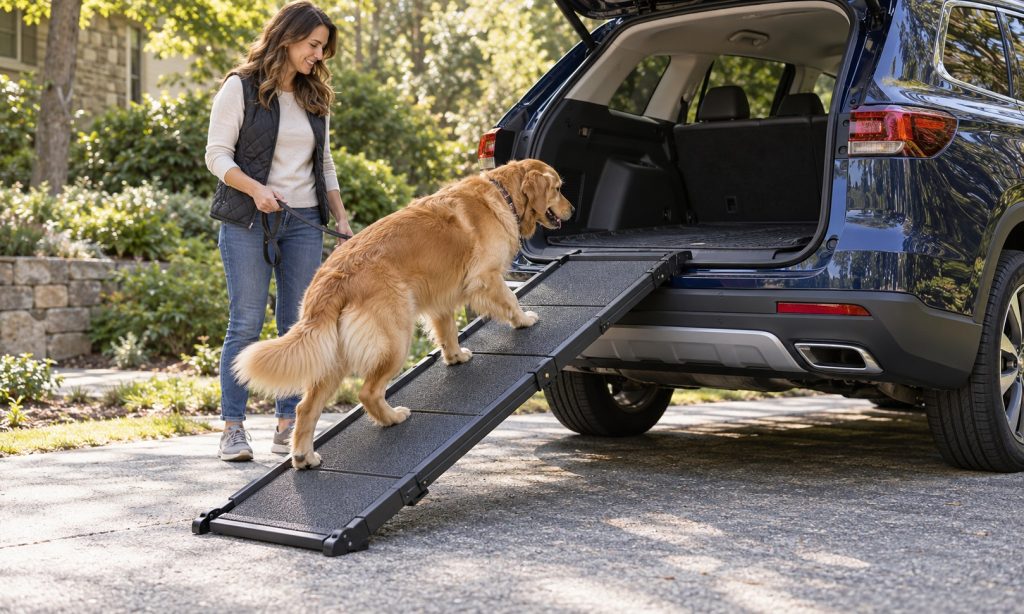
When your dog can no longer hop into the SUV—or never could comfortably—you may find yourself lifting, coaxing, or trying to catch a moving dog at the tailgate. A ramp can make getting in and out easier, but the right one needs to match your dog, your vehicle, and the way you travel.
Choosing the best dog ramp for SUV travel starts with a few practical checks: measure the height your dog must climb, make sure the ramp can rest securely against the vehicle, and consider whether your dog can walk on its surface with confidence. A ramp that is too steep, narrow, slippery, or awkward to set up can become another obstacle.
This guide explains what to look for in a dog ramp for SUV travel, how to introduce one, and how to keep loading and unloading calm and controlled.
Why use a dog ramp for an SUV?
SUV cargo floors and rear openings can be high enough to make jumping difficult for some dogs. A ramp gives a dog a walking surface between the ground and the cargo area. It may be useful for a senior dog, a large dog that is hard to lift, or a dog that hesitates to jump.
A ramp can also help reduce the need for repeated jumping. Veterinary guidance on mobility support includes ramps for vehicle access, and recommends non-slip surfaces and supervision for dogs with mobility concerns. VCA Animal Hospitals
A ramp is not a treatment for pain or an injury. If your dog has suddenly started avoiding jumps, limping, stumbling, or struggling to walk, contact your veterinarian to discuss the change. A ramp may help with access, but it won’t explain why your dog’s movement changed.
What to measure before choosing a dog ramp for SUV travel
Measurements help you narrow your choices before you bring a ramp home. Measure your own vehicle and dog rather than relying on a general description of “SUV compatible.”
Measure the height from the ground to the entry point
Park on level ground and measure from the ground to the place where the top of the ramp will rest. For a rear-entry ramp, this is usually the cargo floor or threshold. For a side-door setup, measure the height at the door opening.
Check the height in the places where you usually load your dog. A sloped driveway, curb, or uneven campsite can change how the ramp sits. If the ramp will be used on different vehicles, measure each one.
Compare the height with the ramp’s usable length
A longer ramp generally creates a more gradual climb to the same vehicle height. The usable length is the part the dog can walk on once the ramp is positioned—not necessarily its full length while folded or extended.
For example, a ramp that reaches a high cargo floor over a short distance may feel steep to a dog that is unsure on inclines. Before buying, check how the manufacturer defines the ramp length and whether the stated length includes any part that won’t rest on the ground or vehicle.
There isn’t one ideal angle for every dog. Your dog’s confidence, balance, stride, and mobility all matter. If the ramp looks steep when set up, or your dog must scramble to climb it, consider a longer ramp or another loading method.
Measure your dog’s width and the space around the SUV
The walking surface should give your dog room to place all four paws without feeling crowded. Measure your dog across the widest part of the body and compare that with the ramp’s usable width. Also consider whether you’ll have space to position the ramp beside the vehicle and leave room for yourself to guide your dog.
A ramp that fits the vehicle but blocks the only safe place for you to stand may be difficult to use. Check the setup in your driveway before relying on it for travel.
How to choose the right features
A walking surface with dependable traction
Look for a surface that helps paws grip as the dog walks up and down. Texture, ridges, or a covering may provide traction, but the important test is whether your dog can use the surface without sliding or hesitating.
Wet paws, rain, mud, and loose debris can change how secure the ramp feels. Keep the walking surface clean and dry when possible, and inspect it for wear. A surface that has become slick or loose may need repair or replacement.
Stable contact at the ground and vehicle
The ramp should rest securely at both ends. Check whether the lower end shifts when pressure is applied and whether the upper end stays in place at the vehicle opening. Some designs use a lip, hook, or other support at the top; follow the manufacturer’s instructions for positioning it.
Set the ramp on a firm, level area whenever possible. Avoid placing it on loose gravel, ice, mud, or a steep side slope. If the vehicle or ramp moves when your dog steps on it, stop and reset the setup before continuing.
Veterinary guidance for mobility aids emphasizes that a ramp should be sturdy and should not slip. VCA Animal Hospitals
Appropriate width and side guidance
A wider surface may feel less confining, especially for a large dog or one that has trouble balancing. Some ramps also have raised edges or rails that may help keep paws on the walking surface. These features don’t guarantee that a dog cannot fall, so remain nearby and supervise every trip.
Consider how your dog turns and steps. A ramp that is wide enough for a straight walk may still feel difficult if your dog must pivot at the top or approach from an angle.
Weight rating and construction
Check the listed weight limit and compare it with your dog’s current weight. If two dogs might use the ramp together, don’t assume it is designed for that; follow the manufacturer’s guidance. Look for clear instructions about use, care, and any conditions that affect the stated capacity.
Inspect hinges, locks, joints, feet, and the walking surface. A foldable ramp can be convenient to store, but it should lock securely into its intended position before use. Don’t use a ramp with cracked parts, loose hardware, damaged grip material, or a mechanism that no longer holds steady.
Folding, carrying, and storage
Think about where the ramp will ride when it isn’t in use. Measure the storage space in your cargo area and consider whether you can lift and fold the ramp comfortably. A heavier ramp may be difficult to handle at the roadside, while a very light ramp still needs to stay stable when your dog walks on it.
Check how the ramp folds, whether it has a carrying handle, and whether it can be stored without blocking visibility or other cargo. If you’ll use it frequently, practice setting it up and folding it before a trip.
Check the ramp with your SUV before travel
A ramp may be described as suitable for vehicles yet still be awkward with your SUV’s shape or cargo opening. Test the setup at home:
- Park on a firm, level surface and put the vehicle in park.
- Open the entry point you’ll use and clear the area.
- Position the ramp according to its instructions.
- Check that the top and bottom stay in place.
- Walk beside the ramp and check that you have room to guide your dog.
- Fold and store it to make sure it fits your cargo area.
If the ramp rests on a bumper or trim surface, check that the contact point is stable and won’t damage the vehicle. Never improvise a setup that leaves the ramp balanced on a narrow or slippery edge.
How to teach your dog to use a ramp
Some dogs walk up a ramp readily; others need time to get used to the feel and slope. Don’t wait until you’re late for an appointment to introduce it.
Start on flat ground
Place the ramp flat on the ground and let your dog investigate it. Reward calm interest, standing on it, and walking across it. Keep the first sessions short and easy.
Raise the ramp gradually
Once your dog is comfortable crossing the flat ramp, set it up at a low incline. Let your dog choose to approach, and reward small steps. Increase the height gradually as your dog becomes confident.
Avoid pulling or pushing your dog up the ramp. If your dog freezes, backs away, or slips, lower the difficulty and try again later. A ramp is only useful if your dog can use it without feeling frightened or unstable.
Practice going down, too
Dogs may find descending more difficult than climbing. Practice both directions at a low height, stay close, and give your dog time to place each paw. Keep a leash attached if that helps you guide your dog, but don’t use it to drag or force them.
If your dog continues to struggle, ask your veterinarian whether a ramp is appropriate and whether a veterinary rehabilitation professional can suggest a safe training approach.
Safe loading and unloading habits
Set up the ramp before opening the vehicle for your dog. Keep the surrounding area clear, and supervise the entire walk up and down. Don’t allow your dog to jump off the side or rush down while you’re still folding the ramp.
After loading, secure your dog appropriately for the drive using a travel restraint or carrier suitable for your dog and vehicle. A ramp helps with access; it does not restrain a dog during travel. The American Veterinary Medical Association advises pet owners to plan for safe travel with their animals.
At stops, choose a safe place away from moving traffic before unloading. Hold your dog’s leash before opening the door or cargo area, and make sure the ramp is stable before inviting your dog out.
How often should you use or replace a dog ramp for SUV travel?
Use the ramp whenever your dog needs it to enter or exit the SUV. There is no universal replacement schedule for every ramp. How long one lasts depends on its construction, frequency of use, storage, and exposure to weather.
Inspect it before each use for loose hardware, cracks, damaged hinges, worn traction material, and movement at the contact points. Clean off mud and grit, let it dry before storing, and follow the care instructions. Replace or repair it if it no longer locks, grips, or rests securely.
When a ramp may not be the right solution
A ramp may not suit every dog or every vehicle. Your dog may be too anxious to use it, the incline may be too steep in the available space, or the ramp may not sit securely at the entry point.
A different approach—such as a vehicle with a lower entry, a properly fitted support harness, or help from another person—may be more workable. For a dog with new mobility difficulties, weakness, pain, or balance problems, ask a veterinarian for advice before changing activity or relying on a new aid. Veterinary sources describe ramps as one part of broader mobility support, with the right approach depending on the individual dog. vet.cornell.edu
Frequently asked questions
Are dog ramps safe for SUVs?
They can be useful when they fit the vehicle, rest securely, provide traction, and are supervised during use. Check the setup before your dog steps onto it, and stop if the ramp shifts or your dog slips.
Is a longer dog ramp always better?
A longer ramp can make the climb more gradual, but it may be harder to store and position. Choose a length that works with your SUV and gives your dog a manageable incline.
Should my dog use a ramp going both up and down?
Yes, if your dog needs help in both directions. Practice descending separately because some dogs find it less comfortable than walking up.
Can I use a dog ramp on a sloped driveway?
A slope can change the ramp’s angle and stability. Use a firm, level location when possible. If the ramp shifts or becomes noticeably steeper, find a safer spot before loading your dog.
What is the best dog ramp for SUV travel?
The best dog ramp for SUV travel is one that fits your vehicle, supports your dog’s weight according to its instructions, gives your dog a stable and grippy path, and is practical for you to set up and store. Measure first and let your dog practice before using it on a trip.
Final thoughts
The best dog ramp for SUV travel is the one your dog can walk on steadily and you can set up securely. Measure the vehicle entry, compare the ramp’s usable length and width, check traction and stability, and practice at home. A calm, familiar routine can make loading less stressful for both of you.









