
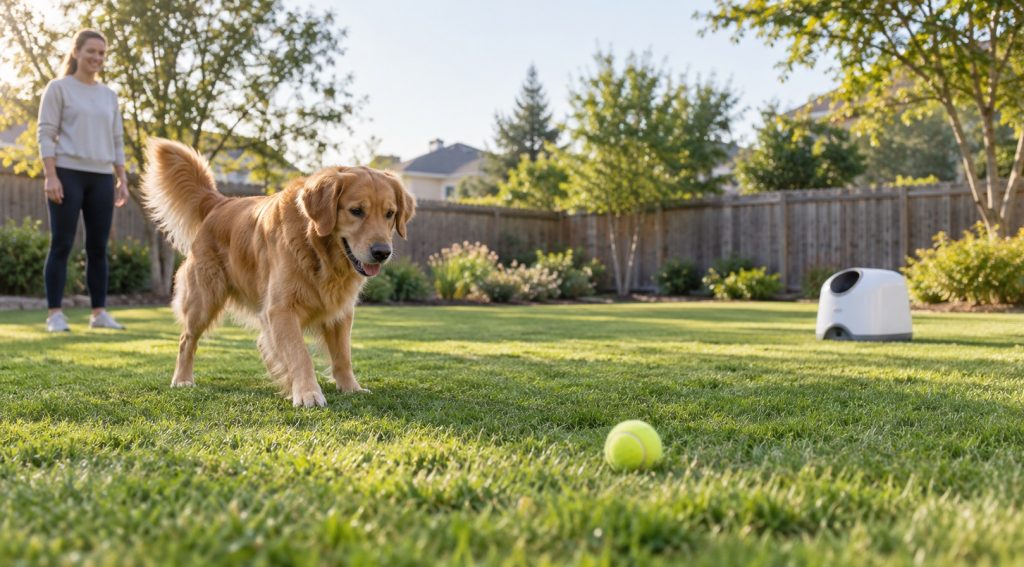
A dog who loves fetch can make a simple ball launcher look like an easy answer: load a ball, press a button, and let the game run. But an automatic launcher changes the rhythm of play. It can send ball after ball while you supervise from nearby, and some dogs will happily keep running long after they are tired.
Choosing the best automatic ball launcher for dogs starts with your dog, not the machine. Consider your dog’s size, health, behavior, and ability to play safely. Then look at the launch distance, ball size, safety features, and the space where you plan to use it. A good fit should make play easier to manage—not turn fetch into an unsupervised sprinting contest.
What is an automatic ball launcher?
An automatic ball launcher is a device that sends a compatible ball across a room or outdoor area. Some models let a person load and launch each ball. Others are designed for a dog to return a ball to the opening for another round.
That difference matters. A dog-operated launcher needs a dog who can learn where to stand, how to place the ball, and when to wait. It still needs an adult nearby. “Automatic” describes the launch mechanism; it does not mean the activity is safe to leave running while you leave the room.
Start with your dog’s needs
Size and ball fit
Check the ball dimensions and whether the launcher accepts only a specific size or type. A ball should be large enough that your dog cannot swallow it, but small enough to fit the device without forcing or jamming. Small balls can pose a choking risk, particularly for larger dogs. The American Kennel Club advises choosing balls wider than a dog’s jaw to reduce this risk.
Do not assume a ball is safe just because it came with the launcher. Look at your dog’s mouth and chewing habits, and inspect the ball regularly. If your dog tends to chew through toys, swallows pieces, or guards balls, you may need to choose a different activity or supervise especially closely.
Age, health, and fitness
A launcher can encourage repeated running, sharp turns, and sudden stops. Those movements may not suit every dog. Puppies, older dogs, dogs returning from an injury, and dogs with health or mobility concerns may need gentler exercise or a plan from their veterinarian. VCA notes that appropriate exercise depends on factors such as age, development, behavior, health, and physical structure.
Ask your veterinarian before introducing strenuous or repetitive fetch if your dog has a medical condition, has been told to restrict activity, or seems uncomfortable during exercise. For some dogs, a rolling ball, a short walk, a sniffing game, or a training session may be a better fit.
Temperament and fetch skills
Some dogs love chasing a ball but have trouble waiting, dropping it, or approaching a machine calmly. Others may be startled by the sound or movement. A dog who rushes toward the launcher while it is loading may need more practice before playing near it.
Before using an automatic device, make sure your dog can respond to simple cues such as “wait,” “come,” and “drop it.” If your dog is uneasy around new objects, introduce the launcher while it is switched off. Let your dog investigate at their own pace, and reward calm behavior.
What to look for in an automatic ball launcher for dogs
Adjustable launch distance
A shorter launch setting can help you start with controlled play in a smaller area. A longer distance may suit a large, open yard, but it is not automatically better. Consider whether your dog can stop safely, turn without sliding, and return the ball without sprinting into furniture, fences, or other dogs.
If the launcher does not offer adjustable distance, check whether its fixed range works for your available space. Do not rely on the device’s advertised range alone; your surface and layout affect where the ball may travel.
Safety features and ball loading
Review how the device signals that it is about to launch and whether it has features intended to reduce accidental launches when a person or dog is close. Treat those features as a backup, not a substitute for supervision. Keep children and other pets away from the launch path, and follow the manual’s setup and operating directions.
Look at the loading opening, moving parts, and controls. Can you load the ball without reaching into a hazardous area? Can you stop the machine quickly? If the instructions are unclear, or the device seems to behave unpredictably, do not let your dog use it.
Indoor or outdoor use
Think about the actual play space. Indoors, a ball can bounce into a window, lamp, stairway, or slippery floor. A launcher intended for outdoor use may send the ball farther than a small room can safely accommodate. If you want indoor play, choose a setup and ball that are appropriate for the room, and clear the route first.
Outside, look for a flat, nonslip surface with enough room to run and turn. Check for holes, garden tools, low obstacles, and areas where a ball could roll into a street or water. A fenced yard can help contain play, but it does not replace active supervision.
Noise, size, power, and cleaning
If your dog is noise-sensitive, pay attention to the sound the launcher makes while loading and launching. A loud or abrupt device may frighten some dogs. A large launcher can also be awkward to store or move, so consider where it will live between play sessions.
Check whether the unit uses an outlet, batteries, or another power source, and whether that works for your planned location. Look at how the ball chamber and exterior are cleaned. Dirt, saliva, and damaged ball pieces can build up with use. Use only the cleaning method allowed by the manual; do not pour water into an electrical device.
How to introduce the launcher
Start with the launcher switched off. Put it in the play area and let your dog approach it without pressure. If your dog is comfortable, reward calm investigation. Avoid luring a worried dog too close just to get the game started.
Next, practice with the launcher turned on but not launching, if the instructions allow it. Let your dog hear the sound from a comfortable distance. Then demonstrate one launch while your dog is safely positioned away from the device. Keep early sessions short and stop if your dog becomes frightened, overly excited, or fixated on the machine.
Teach your dog to wait until the ball has landed before chasing it. Cornell’s veterinary center recommends waiting for a thrown ball to land, because fast running, turns, and abrupt stops can increase injury risk. It also advises stopping before a dog becomes too tired.
If your dog will load the ball independently, teach that skill separately. Reward the dog for approaching the opening calmly and placing the ball where it belongs. Do not let your dog paw at, bite, or put their face into the launcher.
How to use it safely
Stay close enough to intervene. Watch your dog’s body language and the ball’s path. Take breaks, and end the game while your dog is still moving comfortably. Some dogs do not know when to stop, so the person supervising should decide when play is over.
Avoid launching balls toward steps, slick floors, sharp turns, hard obstacles, or other animals. Do not let multiple dogs crowd the machine or compete for the same ball. A chase game can quickly become rough when dogs have different sizes, speeds, or play styles.
Heat is another concern, especially during outdoor play. Cornell notes that strenuous exercise in hot or humid conditions can contribute to heatstroke, and recommends limiting activity during the hottest conditions, offering shade and water, and watching for signs such as heavy panting, drooling, reluctance to play, weakness, or confusion. Stop play and contact a veterinarian promptly if you are concerned about your dog’s condition.
How often should you use or replace an automatic ball launcher for dogs?
There is no single schedule that fits every dog. Your dog’s age, fitness, health, weather, and response to fetch all matter. Begin with brief, supervised sessions and adjust based on how your dog moves and recovers. If your dog is breathing hard, slowing down, repeatedly lying down, or reluctant to continue, end the game and offer a calm break. Ask your veterinarian what level of activity is appropriate if you are unsure.
Inspect the ball and launcher before each session. Replace a ball if it is split, deeply chewed, misshapen, or small enough to become a swallowing risk. Stop using the launcher if its housing is cracked, its opening is damaged, a moving part is exposed, or it launches unpredictably. There is no universal replacement interval; use the manufacturer’s instructions and the condition of the equipment.
When a launcher may not be the right choice
An automatic launcher may be a poor fit if your dog is afraid of mechanical sounds, cannot disengage from fetch, chews or swallows balls, or has been advised to limit running. It may also be impractical if you lack a clear, secure play area.
You can still give a ball-loving dog something to do. Try a short hand-thrown game with breaks, a rolling ball on a safe surface, “find the toy” in grass, or a few minutes of simple training. Fetch does not need a machine to be worthwhile.
Frequently asked questions
Can I leave my dog alone with an automatic ball launcher?
No. Stay nearby and supervise the entire session. The device may launch unexpectedly, your dog may become tired, or a ball may get stuck or damaged.
Are automatic ball launchers safe for puppies?
Not automatically. Puppies are still developing and may be uncoordinated. Ask your veterinarian what kinds of play are suitable for your puppy’s age and size, and avoid encouraging repeated high-speed stops, jumps, or sharp turns.
Can I use an automatic ball launcher indoors?
Only if the device and its launch distance are appropriate for the room. Clear breakable objects and slippery surfaces, keep the ball away from stairs, and supervise closely.
How do I know if my dog is tired?
Watch for changes such as slowing down, repeatedly sitting or lying down, becoming less responsive, or showing signs of heat stress. Dogs vary, so do not wait for your dog to collapse or refuse to move before ending play. Cornell recommends stopping before a dog becomes too tired.
How often should I replace the ball?
Replace it when it is damaged, worn, misshapen, or no longer the right size for your dog. Check it before every session, and follow the launcher’s instructions about compatible balls.
Final thoughts
The best automatic ball launcher for dogs is one that fits your dog’s size, health, confidence, and play habits—and fits safely into your space. Start slowly, supervise every session, use an appropriately sized ball, and stop before your dog is worn out. When you make those checks part of the routine, a launcher can be a useful way to add variety to supervised play.









