
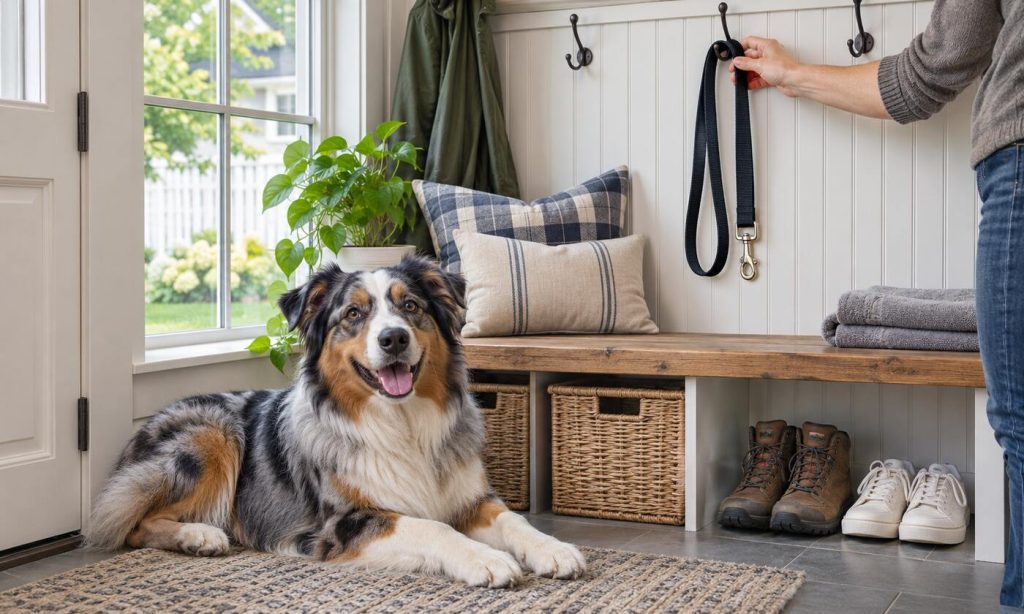
A dog that pulls puts repeated force on its leash, clip, and attachment points. Those parts need attention even after the walk is finished. Learning how to store a leash for a pulling dog safely means more than hanging it on the nearest hook. The leash should be inspected, cleaned, dried, and placed where it cannot become a chewing hazard or a tangled mess. Good storage also makes the next walk easier to prepare for.
A leash for a pulling dog can face harder daily use than one carried with slack. Yet storage cannot repair worn webbing or solve pulling behavior by itself. This guide covers materials, clips, moisture, coiling, hooks, and replacement signs. It also explains how to create a consistent check before every walk so that hidden wear does not catch you by surprise.
Inspect the leash before putting it away
Run your fingers along the full length after each walk. Look for frayed nylon, loose stitching, cuts, thinning leather, distorted rope fibers, or places where a dog has chewed. Pay extra attention near the handle and clip attachment, where force is concentrated. Check any reinforced seams for unraveling. A leash that survived one hard lunge may still have weakened fibers. Avoid relying on a quick glance from across the room. Inspect in good light and gently flex suspicious sections to see whether damage opens further.
Test the clip’s spring action with the leash detached from the dog. It should open and close smoothly without sticking. Check for cracks, bent gates, loose swivels, rust, or unusual wobbling. A defective clasp can release unexpectedly. Retire a leash with serious structural damage rather than hiding it in the walking basket for later use. If you use a harness, the article on adjusting a harness to prevent rubbing helps you check another important part of the setup. The leash and attachment should be evaluated as a complete system.
Clean dirt and moisture according to material
Brush off dry mud and grit before storing. For washable nylon or similar fabric, use the maker’s care instructions, mild soap, and enough water to remove dirt without soaking components that should stay dry. Rinse thoroughly where washing is permitted. Leather may require different care and should not be treated as ordinary washable webbing. Rope and retractable designs can also have specific cleaning limitations. Never immerse a retractable housing unless the manufacturer explicitly approves it. Water trapped inside can affect mechanisms and dry poorly.
Allow the leash to dry completely in a ventilated area away from intense direct heat. Storing wet fabric in a closed bag can encourage odor and deterioration. Do not put damp leather on a radiator or use a high-temperature dryer without suitable guidance. Clean the handle as well as the dog end; sweat, oils, and mud collect in both places. FYI, a leash that looks dry on the outside may still hold moisture under a folded strap. Open the loops and let air reach the entire length before hanging it neatly.
Store without sharp bends or dangerous loops
Hang a dry leash on a broad sturdy hook or lay it loosely in an accessible drawer. Avoid forcing it into tight knots or leaving weight hanging from the metal clip. Tight folds can concentrate wear at the same point over many months. Large loose coils work well for longer lines; do not wrap the leash tightly around your hand to store it or control a dog. Keep buckles and clasps from striking delicate surfaces or catching nearby fabric. For a long line, coil in a consistent direction and check for twists before your next outing.
Choose a location out of reach of children and dogs that chew straps. Loose loops and dangling clips can become hazards when a pet plays unsupervised. Never leave a stored leash attached to a dog where it could snag on furniture or become a tether. Keep walking equipment separate from food preparation and clean linens. If you carry a leash in a car, secure it so it does not interfere with pedals or seat hardware. A simple organized station helps you find the right lead without grabbing a damaged backup in a hurry.
Match storage to the leash’s construction
Flat webbing usually hangs well when fully dry and free of twists. Braided rope may benefit from loose coiling so it does not kink. Leather should retain its natural shape and avoid unnecessary dampness. A retractable lead needs particular attention to its cord, housing, and return mechanism; storage alone cannot correct a frayed thin line or sticking lock. Do not attempt internal repairs unless authorized by the manufacturer and performed competently. The key question is whether all parts will function under a sudden load, not whether the leash looks tidy on the wall.
Different walking activities place different demands on the lead. Long lines used for recall training often collect moisture and grit outdoors, while short everyday leads may wear near clips and handles. See what to look for in a long-line leash for handling differences. Avoid mixing similar-looking straps when one is designated only for light training tasks. Keep repaired or questionable equipment clearly separate until it is evaluated. A color label on a storage hook can help organize uses without depending on memory.
Build a repeatable routine and address pulling
Set a simple habit: inspect, clean if needed, dry, coil, and hang. Then repeat a quick clip and webbing check before leaving. If the leash shows recurring damage, assess whether chewing, dragging, or strong lunging is responsible. Replacement may be necessary, but training and suitable equipment fit deserve attention too. The SPCA of Texas emphasizes consistent training and positive reinforcement for better leash manners. Consider support from a qualified reward-based trainer when a dog pulls hard enough to put handlers or the dog at risk.
Check the collar or harness for fit, rubbing, and damage during the same routine. A strong leash attached to a poorly fitting harness does not guarantee safe control. The article on collar fit for strong pullers addresses one related concern. Never attach a leash to fixed furniture as a substitute for supervised handling. IMO, the best storage station is the one that reminds you to check equipment before every walk. Organization supports safety, but it cannot replace training and observation.
Frequently Asked Questions
Leash storage should preserve materials, reduce tangles, and keep damaged equipment out of circulation. These quick answers address common practical questions for owners of enthusiastic walkers.
The right routine depends on material and construction. Always follow relevant care instructions, and replace a leash when its load-bearing parts are no longer trustworthy. Do not wait for a visible break.
Should I wash the leash after every walk?
Not necessarily. Remove dirt as needed, especially after mud or salt exposure, and follow the material’s care instructions. Dry fully before enclosed storage.
Can I tie a wet leash into a tight knot?
Avoid that. Knots trap moisture and may create repeated stress points. Dry the leash open, then use a broad hook or loose coil.
Is it safe to store a leash on the dog’s collar?
No. Remove walking leads when they are not needed. A dangling leash may catch on objects, creating a risk of entanglement.
When should a leash be replaced?
Replace it for serious fraying, torn stitching, broken hardware, a damaged clip, or other loss of structural integrity. Do not depend on cosmetic appearance alone.
Does a stronger leash stop pulling?
No. Pulling is a behavior and handling issue. A sound leash supports control, but reward-based training and appropriate equipment fit remain important.
Final Words
Knowing how to store a leash for a pulling dog safely helps protect the strap, hardware, and the people handling it. Inspect after every outing, clean material appropriately, allow full drying, and store in loose loops away from chewing and entanglement risks. Remove damaged leads from use as soon as you notice them. A neat hook is only useful when the leash hanging from it is sound.
For any leash for a pulling dog, pair careful storage with regular checks of the harness fit and a humane walking plan. A predictable five-minute routine can make the next adventure less stressful for everyone.









