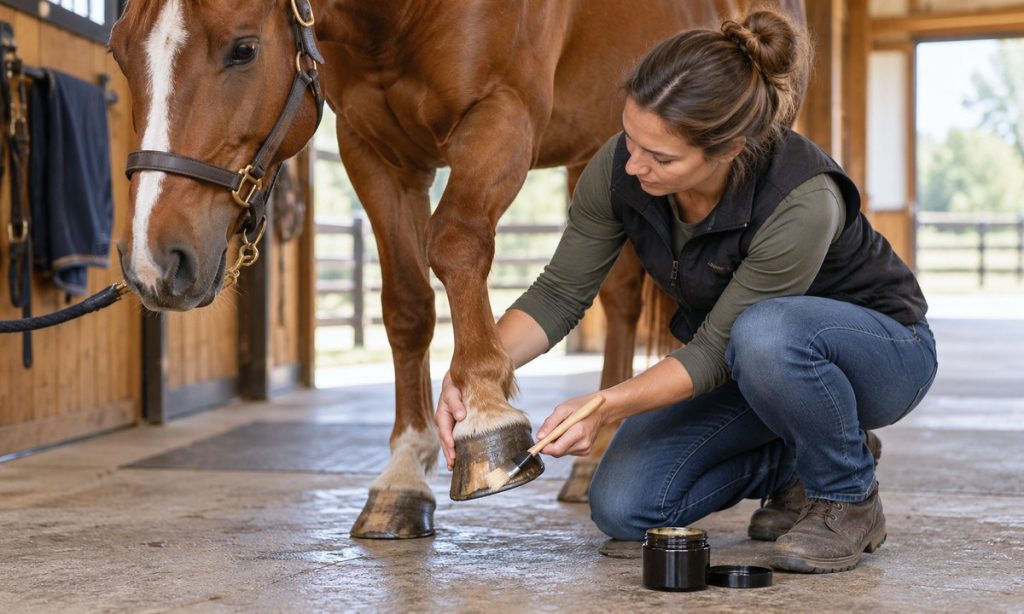
Brittle hooves can leave you weighing oils, balms, ointments, and hardeners that all use the word conditioner. The best hoof conditioner for brittle hooves should fit the horse’s hoof condition and the advice of its farrier, not just promise a quick shine. Some formulas focus on moisture balance, while others create a heavier coating or are intended for wet footing. Those differences matter when you compare ingredients, application areas, and cleanup. This guide reviews seven verified products by their listed format and care claims, while separating routine conditioning from treatment of cracks or infection. You will also find a practical checklist for choosing a product and signs that call for professional hoof care.
Quick Picks
These products range from dressings and ointments to a moisture-focused hardener. Confirm the label fits your horse and your farrier’s plan.
| Product | Best For | Key Advantage | Buy | |
|---|---|---|---|---|
| SOUND Hoof Conditioner | a simple wet/dry conditioner | No wax or petroleum listed | View on Amazon | Jump to Review |
| Absorbine Hooflex Therapeutic Conditioner Ointment for Horse | a heavier moisture barrier | Covers wall, sole, and frog per listing | View on Amazon | Jump to Review |
| Fiebing’s Hoof Dressing 1 Gallon – Helps Maintain Healthy Ho | a high-volume barn | One-gallon container | View on Amazon | Jump to Review |
| Kera Prep Hoof Hardener for Horses, Hoof Conditioner for Hor | wet-season prep | Moisture-repelling hardener | View on Amazon | Jump to Review |
| Hydrohoof Horse Hoof Moisturizer (17 fl. Oz / 500ml) | moisture balance | Honey-based balm with barrier cream format | View on Amazon | Jump to Review |
| SU-PER Hoof Dressing for Horses Hooves | a traditional dressing | Pine tar and oil blend | View on Amazon | Jump to Review |
| The Blissful Horses Hoof Butter All Natural Support for Your | small-batch butter | 4-ounce hoof butter format | View on Amazon | Jump to Review |
Seven Hoof Conditioners for Brittle Hooves
A conditioner may be part of a routine, but it cannot diagnose why a hoof is brittle. Keep your farrier involved if the problem continues.
SOUND Hoof Conditioner

What We Like
- No wax or petroleum listed
- Wet- and dry-condition protection described
- Moisture and suppleness are named goals
- Essential vitamins and nutrients are listed
What We Don’t Like
- A named result is not a guarantee of hoof repair
SOUND Hoof Conditioner is listed as a horse hoof conditioner or dressing. The product details say Made in America! Contains NO wax or petroleum. The listing says it contains no wax or petroleum and is intended to support moisture and suppleness. This offers a way to compare formula and intended use rather than assuming all products called conditioners work alike. Check the package for full ingredients, the areas where it may be applied, and the recommended schedule. The maker’s wording describes product intent; it is not proof that a topical will repair a brittle hoof. That makes the formula easier to compare with petroleum-based dressings, although it does not show how quickly one hoof will respond.
This option may fit owners who want a moisture-focused conditioner for changing weather. Its main tradeoff is that ingredient details and directions should be checked on the package. Apply it only as directed and coordinate use with your farrier, especially when the hoof is cracking, chipping, or unusually soft. A topical cannot correct balance, an overdue trim, nutrition concerns, or lameness. Clean the hoof and applicator as the label instructs. Do not cover a painful or injured area while waiting for improvement. Contact a veterinarian or farrier for heat, drainage, tenderness, deep cracks, or sudden changes. Keep the hoof routine consistent so your farrier can judge whether the pattern is changing. It gives you a stated basis for comparing products.
My Recommendation
SOUND may suit owners who want a conditioner described for wet and dry climates without wax or petroleum. Check the complete label and use directions before application. It is a topical support product, not a substitute for trimming or professional assessment. Its listed feature is a straightforward point of comparison.
Absorbine Hooflex Therapeutic Conditioner Ointment for Horse Hoof, 25 oz

What We Like
- Ointment format is clearly named
- Breathable moisture balance is listed
- Multiple hoof areas are identified
- 25-ounce size is stated
What We Don’t Like
- Heavier format may be messier than liquid
Absorbine Hooflex Therapeutic Conditioner Ointment for Horse Hoof, 25 oz is listed as a horse hoof conditioner or dressing. The product details say Regular use can restore and protect the frog, sole, heel, and coronary band. The item details describe a breathable moisture barrier and name the hoof wall, sole, frog, heel, and coronary band. This offers a way to compare formula and intended use rather than assuming all products called conditioners work alike. Check the package for full ingredients, the areas where it may be applied, and the recommended schedule. The maker’s wording describes product intent; it is not proof that a topical will repair a brittle hoof. The ointment texture can offer more control than a runny liquid on the wall, but plan for a slower cleanup.
This option may fit owners comparing an ointment rather than a liquid dressing. Its main tradeoff is that ointment can be less convenient to spread and remove. Apply it only as directed and coordinate use with your farrier, especially when the hoof is cracking, chipping, or unusually soft. A topical cannot correct balance, an overdue trim, nutrition concerns, or lameness. Clean the hoof and applicator as the label instructs. Do not cover a painful or injured area while waiting for improvement. Contact a veterinarian or farrier for heat, drainage, tenderness, deep cracks, or sudden changes. Do not apply over a suspected injury or infection without professional direction. Persistent changes deserve a professional assessment rather than additional layers of product.
My Recommendation
Hooflex Therapeutic Ointment is worth comparing when you prefer a thicker conditioner and want the listing to identify several hoof areas. The tradeoff is messier application. Use it only as directed and involve your farrier when cracks or soreness persist. The thicker texture may be less convenient to spread.
Fiebing’s Hoof Dressing 1 Gallon – Helps Maintain Healthy Horse Hooves and Feet

What We Like
- One-gallon size is stated
- Brittleness is named in the listing
- Semi-gloss appearance is described
- Long-standing product line is identified
What We Don’t Like
- Large container may be excessive for one horse
Fiebing’s Hoof Dressing 1 Gallon – Helps Maintain Healthy Horse Hooves and Feet is listed as a horse hoof conditioner or dressing. The product details say Fiebing’s Hoof Dressing is the the professional horseman’s standard for use on corns, quarter cracks, split hoofs and brittleness.. The listing describes a one-gallon hoof dressing for brittleness and notes a semi-gloss finish. This offers a way to compare formula and intended use rather than assuming all products called conditioners work alike. Check the package for full ingredients, the areas where it may be applied, and the recommended schedule. The maker’s wording describes product intent; it is not proof that a topical will repair a brittle hoof. Container size affects storage and value, but it does not reveal how much dressing each hoof needs.
This option may fit owners who use a dressing regularly across more than one horse. Its main tradeoff is that large size is a commitment and the finish may not suit everyone. Apply it only as directed and coordinate use with your farrier, especially when the hoof is cracking, chipping, or unusually soft. A topical cannot correct balance, an overdue trim, nutrition concerns, or lameness. Clean the hoof and applicator as the label instructs. Do not cover a painful or injured area while waiting for improvement. Contact a veterinarian or farrier for heat, drainage, tenderness, deep cracks, or sudden changes. Ask whether this product type suits your horse before using it on a tender or separated area.
My Recommendation
Fiebing’s is a practical comparison if a large dressing container fits your barn routine. Its semi-gloss finish and gallon size are clear tradeoffs. Check the label and buy a smaller format if you are unsure how often you will use it. A smaller size may be easier to trial first.
Kera Prep Hoof Hardener for Horses, Hoof Conditioner for Horses, 8 fl oz

What We Like
- Moisture defense is described
- Use areas are specified
- 8-ounce container is stated
- Preparation for sealants is noted
What We Don’t Like
- Placement restrictions need careful attention
Kera Prep Hoof Hardener for Horses, Hoof Conditioner for Horses, 8 fl oz is listed as a horse hoof conditioner or dressing. The product details say MOLECULAR-LEVEL STRENGTHENING – LivingstonTech Kera Prep Hoof Hardener uses cross-linking technology to reinforce hooves from the inside out. It helps support the structure of the hoof wall and sole for better . The listing describes a hoof hardener that repels moisture and says to avoid the frog and coronary band. This offers a way to compare formula and intended use rather than assuming all products called conditioners work alike. Check the package for full ingredients, the areas where it may be applied, and the recommended schedule. The maker’s wording describes product intent; it is not proof that a topical will repair a brittle hoof. Use the restricted placement areas exactly as the product label describes; more is not necessarily better.
This option may fit owners dealing with repeatedly wet footing and soft soles. Its main tradeoff is that hardener is not a general conditioner and placement matters. Apply it only as directed and coordinate use with your farrier, especially when the hoof is cracking, chipping, or unusually soft. A topical cannot correct balance, an overdue trim, nutrition concerns, or lameness. Clean the hoof and applicator as the label instructs. Do not cover a painful or injured area while waiting for improvement. Contact a veterinarian or farrier for heat, drainage, tenderness, deep cracks, or sudden changes. Stop and seek advice if the hoof becomes painful, warm, or suddenly worse. Persistent changes deserve a professional assessment rather than additional layers of product.
My Recommendation
Kera Prep fits a narrower need than a general conditioner. Consider it when wet footing and soft sole support are central concerns, but follow its placement restrictions closely. Ask your farrier before use if the horse has an existing hoof problem. Stay within the labeled placement area.
Hydrohoof Horse Hoof Moisturizer (17 fl. Oz / 500ml)

What We Like
- Balm and barrier-cream format is named
- Beeswax is listed
- Moisture balance is the stated goal
- 500-milliliter size is identified
What We Don’t Like
- Some listing claims extend beyond conditioning
Hydrohoof Horse Hoof Moisturizer (17 fl. Oz / 500ml) is listed as a horse hoof conditioner or dressing. The product details say ✅ BALANCES MOISTURE IN THE HOOF – Beeswax has been added to help prevent moisture loss from the hoof and bergamot oil conditions the hoof and helps protect it against damage from external factors.. The listing describes a honey-based moisturizer with beeswax and bergamot oil for moisture balance. This offers a way to compare formula and intended use rather than assuming all products called conditioners work alike. Check the package for full ingredients, the areas where it may be applied, and the recommended schedule. The maker’s wording describes product intent; it is not proof that a topical will repair a brittle hoof. The balm format can be easier to handle than a liquid for owners who prefer to apply product by hand.
This option may fit owners preferring a balm-like conditioner. Its main tradeoff is that disease-related language should not be treated as a veterinary claim. Apply it only as directed and coordinate use with your farrier, especially when the hoof is cracking, chipping, or unusually soft. A topical cannot correct balance, an overdue trim, nutrition concerns, or lameness. Clean the hoof and applicator as the label instructs. Do not cover a painful or injured area while waiting for improvement. Contact a veterinarian or farrier for heat, drainage, tenderness, deep cracks, or sudden changes. Follow the maker’s schedule and do not layer it with another dressing by default. Persistent changes deserve a professional assessment rather than additional layers of product.
My Recommendation
Hydrohoof is a useful comparison for owners who prefer a balm and moisture-balance positioning. Read the ingredient panel and instructions. Do not treat broad disease claims as treatment advice, and ask a professional about ongoing brittleness. The product’s application style is its main differentiator.
SU-PER Hoof Dressing for Horses Hooves

What We Like
- Wet and dry use is described
- Pine tar and oils are identified
- Flexible hoof wall is the intended benefit
- Show appearance is also mentioned
What We Don’t Like
- Traditional formula may be heavier than lotion
SU-PER Hoof Dressing for Horses Hooves is listed as a horse hoof conditioner or dressing. The product details say SU-PER Hoof Dressing is a great way to maintain the hooves in adverse conditions, as well as keep the hoof wall moisturized and pliable, to reduce the risk of hoof damage.. The item information describes pine tar and deep-penetrating oils for flexible, moisturized hooves in wet and dry conditions. This offers a way to compare formula and intended use rather than assuming all products called conditioners work alike. Check the package for full ingredients, the areas where it may be applied, and the recommended schedule. The maker’s wording describes product intent; it is not proof that a topical will repair a brittle hoof. Formula style is a preference as well as a practical choice; compare texture, cleanup, and labeled use.
This option may fit owners who want a traditional dressing with wet-weather positioning. Its main tradeoff is that pine-tar formulas may not fit every preference or farrier plan. Apply it only as directed and coordinate use with your farrier, especially when the hoof is cracking, chipping, or unusually soft. A topical cannot correct balance, an overdue trim, nutrition concerns, or lameness. Clean the hoof and applicator as the label instructs. Do not cover a painful or injured area while waiting for improvement. Contact a veterinarian or farrier for heat, drainage, tenderness, deep cracks, or sudden changes. Keep the brush or lid clean and avoid sharing an unwashed applicator between horses.
My Recommendation
SU-PER is worth comparing if you want a traditional dressing marketed for wet and dry conditions. Its pine-tar positioning is a preference tradeoff. Check the label and confirm with your farrier before adding it to an existing topical routine. Avoid stacking it with another dressing without guidance.
The Blissful Horses Hoof Butter All Natural Support for Your Horse’s Hooves, 4-O

What We Like
- Butter format differs from liquid oils
- Dry and brittle hooves are named
- Tea tree and neem oils are listed
- Handcrafted product is described
What We Don’t Like
- Small container may run out quickly in a busy barn
The Blissful Horses Hoof Butter All Natural Support for Your Horse’s Hooves, 4-Ounce is listed as a horse hoof conditioner or dressing. The product details say Offered in 0.50oz and 2oz Tubes and 4oz, 8oz and 16oz Tins. The listing describes a small hoof butter for dry, brittle hooves and names tea tree and neem oils. This offers a way to compare formula and intended use rather than assuming all products called conditioners work alike. Check the package for full ingredients, the areas where it may be applied, and the recommended schedule. The maker’s wording describes product intent; it is not proof that a topical will repair a brittle hoof. A small tin may be easy to pack, but check how the maker says to store it between applications.
This option may fit owners who want a compact butter-style product. Its main tradeoff is that small container may not fit frequent multi-horse use. Apply it only as directed and coordinate use with your farrier, especially when the hoof is cracking, chipping, or unusually soft. A topical cannot correct balance, an overdue trim, nutrition concerns, or lameness. Clean the hoof and applicator as the label instructs. Do not cover a painful or injured area while waiting for improvement. Contact a veterinarian or farrier for heat, drainage, tenderness, deep cracks, or sudden changes. A topical dressing cannot replace balanced trimming or resolve a structural crack. Persistent changes deserve a professional assessment rather than additional layers of product.
My Recommendation
The Blissful Horses Hoof Butter may appeal if you prefer a compact balm-style product for grooming. The four-ounce size is small, so compare it with larger options for frequent barn use. Check the full label and avoid treating it as a cure for cracks. The compact size is best for occasional use.
How to choose best hoof conditioner for brittle hooves
First identify what “brittle” means for your horse. Your farrier can help connect hoof appearance with trimming, footing, and care choices. Avoid choosing a conditioner from appearance claims alone. Review what has changed recently, including weather, turnout, and trimming interval. Keep a short written record of changes and questions for your farrier.
Compare the format and moisture approach
Liquids, ointments, butters, and hardeners differ in how they spread and where the label permits use. A brush-on dressing may be practical for the wall, while a thicker balm can be easier to keep in place. A hardener is a more specific option and may have placement restrictions. Consider cleanup, storage, and how often you can apply a product. Do not assume that a shiny finish means a stronger hoof or that a moisture barrier is right for every horse. Consider whether a lighter liquid or heavier ointment fits your daily schedule. If several horses share a barn, also think about storage, cleanup, and keeping applicators separate.
Read ingredients and application details
Check the complete ingredient panel and product directions. “Natural” is not a guarantee of suitability, and formulas can include oils, waxes, tar, or other substances. Ask your farrier before combining products. The University of Minnesota Extension notes that weather and wet-to-dry changes can be associated with hoof cracks, and that routine trimming remains important. Review its horse-hoof care guidance.
Separate routine care from treatment
A topical conditioner cannot correct an imbalanced trim or diagnose a painful crack. A short written care routine can help identify patterns over time. It may also be the wrong choice when a hoof needs targeted care rather than general conditioning. Ask a professional before changing products or applying a dressing to a sensitive area. Call a farrier or veterinarian for lameness, heat, drainage, a loose shoe, or a hoof that keeps worsening. UC Davis explains that hoof moisture is influenced by internal tissues, so wet ground alone is not a reliable cure for dryness. Read its overview of hoof-care claims. Choose one clear routine and monitor changes with professional input.
Frequently Asked Questions
Can a hoof conditioner repair brittle hooves?
It may support routine topical care, but it cannot fix every cause. Ask your farrier to assess repeated cracking or chipping.
Should I use oil or ointment?
Compare the labeled application areas, ingredients, and cleanup. Your farrier can advise which format suits the hoof.
Can I use a hardener on the whole hoof?
Only if its label permits it. Some products specify areas to avoid, so follow those directions carefully.
How often should I condition my horse’s hooves?
Follow the current product label and your farrier’s guidance. Do not increase frequency to chase a quick cosmetic effect.
When should I seek professional help?
Contact a farrier or veterinarian for pain, heat, drainage, a deep crack, or sudden deterioration.
Final Verdict
The best hoof conditioner for brittle hooves is the product whose format and directions fit the horse’s routine. SOUND and Hydrohoof focus on moisture balance, Hooflex offers a thicker ointment, and other choices emphasize a traditional dressing or targeted hardening. No topical replaces regular farrier care. Check ingredients, follow the label, and ask a professional to assess recurring cracks or soreness.
For related reading
For the broader comparison, see our guide to horse hoof-care products. For everyday cleaning, see our horse hoof pick guide and hoof brush guide. You can also read how wild horses trim their hooves and why horses need horseshoes.
Affiliate disclosure
This article contains Amazon affiliate links. If you purchase through these links, PetAdvisorPro may earn a commission. As an Amazon Associate I earn from qualifying purchases.